
Neck and shoulder muscle strain: how it differs from everyday stiffness, what to do in the first 48 hours and when massage makes sense in Ho Chi Minh City
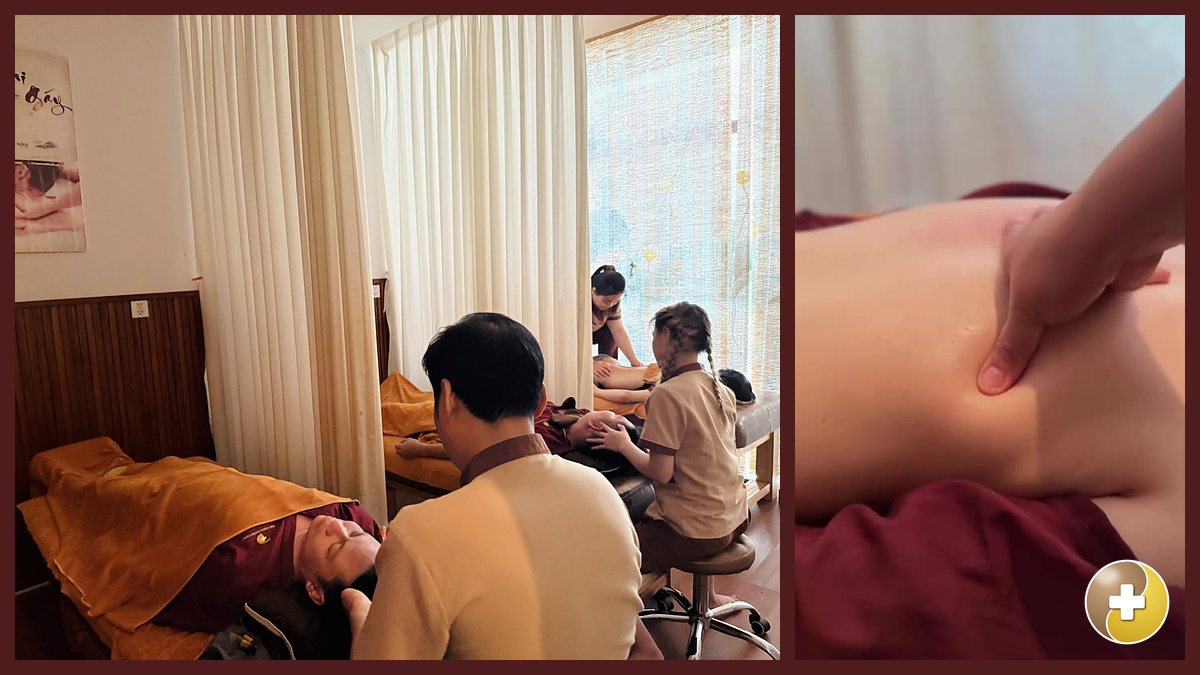
Quick answer: A neck and shoulder muscle strain is an overload of the trapezius, levator scapulae or sternocleidomastoid after a quick head turn, a heavy lift or a gym set. For 48 hours, stop the painful movement and move gently; muscle release comes later. Tong Gia in Districts 12 and 9, Ho Chi Minh City, never cracks the neck.
Want Lương Y Tống Văn Huynh’s team to read your spine and posture in person?
What is a neck and shoulder muscle strain?
A strain happens when a muscle in the neck or shoulder is pulled harder or faster than it can handle. In Western terms, some small fibres are overstretched and slightly damaged, the area becomes a little inflamed and warm, and the whole muscle tightens to "lock" the area and stop it being pulled again. That protective reflex is what you feel: a stiff neck, a sharp catch when you turn one way, sometimes the need to turn your whole body instead of your head.
Three muscles are usually involved:
- Trapezius: the large sheet from the base of the skull, the C7 spinous process and the upper back out to the collarbone and shoulder blade. It strains when you shrug, carry heavy bags on one side or hold your shoulders tense at a screen.
- Levator scapulae: from the side of the C1–C4 vertebrae down to the top corner of the shoulder blade. When it strains you feel a catch on one side when turning or looking down.
- Sternocleidomastoid: from the breastbone and collarbone up to the bone behind the ear. It strains when you turn your head fast; the ache may spread behind the ear and to the temple.
A strain is not the same as the slow stiffness many desk workers live with. This table helps you tell them apart:
| Sign | Acute strain | Long-term stiffness |
|---|---|---|
| Start | A clear moment, right after one movement | Gradual, over weeks or months |
| Feeling | Sharp in one spot, hurts in one direction, may feel warm | Heavy, dull, worse in the evening |
| Location | Usually one side, you can point to it | Both shoulders, hard to pinpoint |
| Warmth and massage | Not firm massage in the first 48 hours | Usually feels good straight away |
| Typical person | Just back from the gym, a heavy lift, a tall pillow | Office workers, drivers, anyone who looks down for hours |
In Ho Chi Minh City we see it in expats who sit at a laptop all week and then hit the gym on Saturday, in people riding a motorbike across town and turning to check traffic, in parents carrying small children, and in visitors who slept on a tall hotel pillow under strong air-conditioning.
Common causes: habits, work, posture and environment
A strain rarely has one cause. Usually the muscle has been tired and tense for days, and then one small movement is the last straw.
- Habits: quick head turns on a motorbike, holding a phone between ear and shoulder, scrolling in bed with the chin on the chest, late nights, skipping the warm-up.
- Work: laptop work for 8–10 hours, ride-hailing, hairdressing and nail work, teaching at a whiteboard, lifting 19-litre water bottles or boxes, carrying a child on one hip.
- Posture: when the head drifts forward toward the screen, the muscles at the back of the neck must hold it up all day. A one-shoulder backpack, a desk nap or a pillow that is too high keeps one side stretched for hours.
- Environment: air-conditioning blowing on the back of the neck, getting caught in the afternoon rain, moving from hot streets into a cold office. Cold muscles tighten and lose flexibility; Vietnamese people often call this "catching the wind".
- Stress: in Tong Gia's teaching material, long-term mental pressure tightens the muscles at the back of the head and the levator scapulae, giving neck and shoulder aches that spread into the head.
If the trouble started after training, read our neck and shoulder massage Q&A.
Other signs to watch
- A tender point at the side or base of the neck or on top of the shoulder.
- Turning, bending or looking up is limited in one direction only.
- A stiff neck in the morning; you support your head with a hand when sitting up.
- Mild warmth over the sore spot for the first day or two.
- Ache spreading behind the ear or to the temple, a heavy head, tired eyes.
- Tightness between the shoulder blades; a deep breath feels blocked.
- Ache down the upper arm while grip strength stays normal.
- Poor sleep because no position feels right, and a shorter temper.
Muscle pain usually changes with position and eases with gentle movement and rest. Lasting numbness, a weak arm or pain that stays the same while lying still is no longer only about a muscle.
When to see a doctor
Please see a doctor at a hospital or medical facility first, and skip massage for now, if you have any of these:
- Neck or left shoulder pain with chest tightness, shortness of breath or cold sweats: call 115 immediately.
- A sudden, severe headache, with vomiting, double vision, slurred speech or a drooping face: call 115.
- Neck pain after a traffic accident, fall or blow.
- Numbness or weakness in the arm, dropping things, tingling into the fingers.
- Fever with a stiff neck, especially in a child or an older person.
- Pain that keeps getting worse, pain at night while lying still, or unexplained weight loss and fatigue: get checked by a doctor alongside any wellness care.
- No improvement after 1–2 weeks of rest, cold or warm packs and gentle movement.
If a doctor is already following a neck condition, keep to their advice and tell our practitioner before the session. This is a wellness service, not medical care.
The Y Tướng Học view: the Liver and the sinews
Y Tướng Học (face reading for wellness) rests on one line: "the signs show outside, the organs lie inside". For a strained neck, the organ system most often linked is the Liver (Can). In Tong Gia's teaching material:
- The Liver governs the sinews (Can chủ cân): it nourishes tendons and ligaments and supports movement. When it is in balance the tendons are supple; when it is weak, muscles stiffen, cramp and lose flexibility more easily.
- The Liver stores blood: at rest, blood returns to the Liver to be replenished; during activity, the Liver sends it to muscles and tendons. Late nights leave the sinews under-nourished.
- The Liver and emotion: long-held anger makes Liver qi stagnate; people who are often irritable find their shoulders tense too.
- Liver and Gallbladder channels: an unbalanced Liver channel shows muscle tightness, cramps, irritability and poor sleep; the paired Gallbladder channel shows headache and shoulder pain.
What does it look like outside? The Liver shows in the eyes, nails and sinews: bright eyes, pink nails and supple tendons when balanced; dry, tired eyes, a short fuse, a tight neck, cramps and thin ridged nails when not. The teaching notes describe muscles that become hard as wood and sore to touch as qi stagnation and blood stasis, with deep spasm especially in the trapezius. Broken, criss-crossing forehead lines often go with tension in the face and neck, and a face that is wide at the forehead and narrow at the chin leads the practitioner to check C1–C2 first.
This is a wellness lens to choose where to work, not a verdict on your liver. Learn more in our Eastern face reading Q&A.
Spine segments and nerve-reflex areas involved
The spine has 33 vertebrae. In the spinal nerve-reflex balancing method, C1–C7 relates to the head, face, neck and arms, and D1–D12 (T1–T12) to circulation, breathing and digestion. Nerve roots leave the spinal cord through the gaps between vertebrae; that is where the practitioner's fingertips read. The table shows links used to choose areas, not a conclusion about illness:
| Segment | Nerves / function | What you feel | Related organ |
|---|---|---|---|
| C1–C3 (skull base) | Head, face; deep sub-occipital muscles | Stiffness rising into the head, behind the ear | Liver |
| C3–C5 (mid-neck) | Neck; levator scapulae and SCM attachments | A catch on one side when turning | Liver, Gallbladder |
| C5–C7 (base of neck) | Shoulders, arms; nerve roots to the arm | Heavy shoulder, ache down the arm | Liver |
| D1–D3 (between the blades) | Circulation, breathing; middle trapezius | Tight between the blades, shallow breath | Lung (Phế Du at D3), Liver |
| Mid-back (Can Du, Đởm Du area) | Bladder channel, where the organ "back-shu" points sit | Tight along the spine, tired, tense | Liver, Gallbladder |
The teaching material groups neck and shoulder aches under muscles, bones and joints, working C5–C7 together with L1–L5 and S1–S5. Why the lower back too? The spine is one chain: when the lower back is uneven, the neck compensates.
How Tong Gia works: spinal nerve-reflex balancing massage
Tong Gia Acupoint Wellness (Huyệt Đạo Tống Gia) was founded by Lương Y Tống Văn Huynh, a master of traditional Vietnamese wellness with more than 13 years in Eastern wellness, Y Tướng Học and spinal nerve-reflex balancing. It is a Vietnamese Eastern method he built from the heritage of head-and-spine work, with three "no"s: no chemicals, no needles, no rough force. Tong Gia never cracks or twists the neck. Everything is done by fingertips and hands on the muscles, and the practitioner stops if pain rises.
- Observation: head posture, shoulder height, complexion, eyes and nails; which movement hurts, since when, any tingling.
- Reading the spine by hand: each vertebra from C1 to D3, left against right. The hand reads skin temperature, the muscle layer, the shape of each vertebra and tender points. Warm, tight "excited" areas are worked; cool, "inhibited" areas are not pressed directly.
- Muscle release of the trapezius, levator scapulae and SCM, using push-and-turn and plucking across tight fibres, on a scale of 5 pressure levels; a fresh strain stays at the light end.
- Acupressure along the neck, shoulders and between the blades, on Can Du and Đởm Du in the back, and Liệt khuyết at the wrist ("for the head and neck, look to Liệt khuyết").
- Dosing and temperature: stop when the skin over the point turns from dry to slightly moist; a warm area gets lighter work.
- Home care: two or three gentle movements and pillow and screen tips for your job.
What a real session looks like. You sit first while the practitioner looks from behind at which shoulder is higher and which way your head tilts, then asks you to turn slowly to find the blocked side. Lying face down, the back of the hand checks skin warmth along the neck and shoulders, and the fingertips run down the groove beside the spine from the hairline to between the blades. A muscle that feels like a cord, where you say "that's the spot", is usually the point. Work starts away from the pain, softening the upper back, then moves in, with regular checks on pressure. It feels like a "good hurt" that melts. At the end you sit up, turn your head again and learn what to do at home.
Suitable services (full price list):
- Neck and shoulder care, 60 minutes: 550,000 VND (about 21 USD); first visit 399,000 VND (about 15 USD); 90 minutes 750,000 VND (about 29 USD). Most suitable after the first 48 hours. See neck and shoulder massage.
- Cupping to clear cold, 30 minutes: 85,000 VND (about 3 USD), when air-con or rain is part of the story; never on a warm, swollen area.
How it feels. During the session you feel tenderness at the tight point, then warmth, your shoulders seem to drop and your head feels lighter. Afterwards many people turn their head further and sleep more easily that night; some feel mild soreness for about a day, like after a workout. Results vary with each body; Tong Gia helps the muscles rebalance and does not promise the pain will vanish. Real guest stories are in a neck and shoulder session in Saigon and acupressure massage Q&A.
Want Lương Y Tống Văn Huynh’s team to read your spine and posture in person?
Home care and prevention
First 48 hours: stop the movement that hurts but do not lie still all day; nod, tilt and turn slowly a few times an hour; if the spot is warm or swollen, use ice wrapped in a towel for 10–15 minutes; do not crack your neck or let anyone pound it. After about 48 hours, once the warmth is gone, switch to a warm compress for 15–20 minutes.
- Turn your whole body to look behind, and use mirrors on the motorbike.
- Carry with both hands, hold loads close, switch sides with bags and children.
- Raise your screen to eye level and roll your shoulders every 45–60 minutes.
- Warm up neck and shoulders for 5–10 minutes before lifting, swimming or badminton.
- Keep the neck warm, keep air-con off your neck, use a pillow that keeps the neck in line with the back, and sleep enough.
Book a session
- District 12: 225 Dương Thị Mười, Phường Tân Chánh Hiệp (Tan Chanh Hiep Ward, District 12). Open 8:00–19:00 daily (4.9★, 235 Google Maps reviews).
- Vinhomes Grand Park, District 9: Căn T16-21 khu Manhattan, Phường Long Bình, TP. Thủ Đức (Unit T16-21, Manhattan zone, Long Binh Ward, Thu Duc City). Open 9:00–20:00 daily (5.0★, 208 reviews).
Book online or call, Zalo or WhatsApp +84 888 264 559. Tell us which movement caused the strain and when, so the practitioner can prepare. Visiting Ho Chi Minh City? Come and try a Vietnamese Eastern wellness method built by Lương Y Tống Văn Huynh.
Visit us
- Đông Y Huyệt Đạo Tống Gia Quận 12 (District 12)
225 Dương Thị Mười, Phường Tân Chánh Hiệp, Quận 12, HCMC · 8:00–19:00 daily · 0888 264 559 · Directions on Google Maps - Đông Y Huyệt Đạo Tống Gia Quận 9 (Vinhomes Grand Park, District 9)
Căn T16-21 khu Manhattan, Vinhomes Grand Park, Phường Long Bình, TP. Thủ Đức, HCMC · 9:00–20:00 daily · 0888 264 559 · Directions on Google Maps
Want Lương Y Tống Văn Huynh’s team to read your spine and posture in person?
FAQ
Should I get a massage right after a neck and shoulder muscle strain? Not a firm one in the first 48 hours, while the spot is warm and sharp. Once it settles, a gentle muscle release with gradually building pressure helps the muscle let go. Arm numbness or weakness, fever with a stiff neck, or pain after a knock means a medical check first.
How long does a shoulder strain take to ease? A mild strain usually settles over a few days if you avoid the painful movement and keep moving gently. If it is no better after 1–2 weeks, keeps getting worse or comes with arm numbness, get it checked at a medical facility.
My shoulder hurts after the gym. Is it a strain and what should I do? A sharp pain right after shrugs or overhead presses is often a strained trapezius or levator scapulae. Stop that exercise, move gently, use cold for 1–2 days if it is warm, then have muscle release and return with lighter weights and a proper warm-up.
Is arm numbness from neck pain dangerous? Brief tingling after lying on your arm is usually nothing. Lasting numbness, tingling into the fingers, a weak grip or dropping things can involve a nerve root in the neck and should be checked at a medical facility before any massage.
Is it normal to feel sore after a neck massage? Mild soreness for about a day where the muscles were released is common, like after a workout. Sharp pain that grows, arm numbness or dizziness is not normal; get checked and let the place that worked on you know.
Do you crack the neck, and how much is a session? No. Tong Gia never cracks or twists the neck; we work by hand on muscles and acupoints. Neck and shoulder care is 550,000 VND (about 21 USD) for 60 minutes, 399,000 VND on your first visit, and 30 minutes of cupping can be added for 85,000 VND.
Author: Lương Y Tống Văn Huynh – founder of Huyệt Đạo Tống Gia, a master of traditional Vietnamese wellness with over 13 years in Eastern wellness care, Y Tướng Học (face reading) and spinal nerve-reflex balancing massage.
Updated: 2026-11-15
Related guides
This is a wellness service, not medical care.