
Herbal steam for a cold in Ho Chi Minh City: how to steam safely, who should skip it, and what Tong Gia does
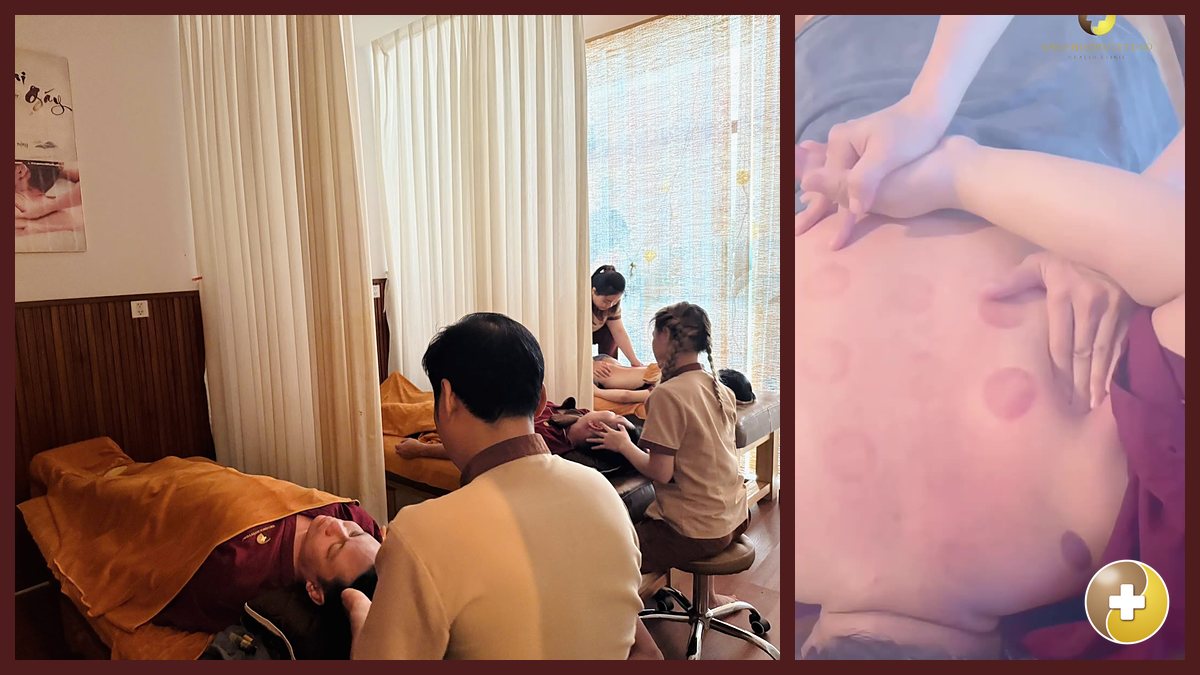
Quick answer: Herbal steam for a cold can warm you up, bring on a light sweat and ease a stuffy nose after rain, office air-con or wind on the motorbike. Skip it with a high fever. Tong Gia Acupoint Wellness in District 12 and Vinhomes Grand Park, Ho Chi Minh City, pairs herbal steam with cupping and acupressure around the upper back.
Want Lương Y Tống Văn Huynh’s team to read your spine and posture in person?
What is herbal steam for a cold, and what does it actually do?
Ask a Vietnamese friend what to do when you feel a chill coming on and you will probably hear "xông hơi": sit under a light blanket over a pot of steaming water, often boiled with lemongrass, pomelo leaves and ginger, until you break a light sweat. In Ho Chi Minh City the trigger is familiar to every expat. You ride home through a late-afternoon downpour and stay in a wet shirt for an hour, or you spend all day under the office air-con vent and by evening your spine feels prickly, your nose is blocked and your head feels heavy.
From a Western point of view, the common cold is mostly a virus in the upper airways. When the body gets chilled, the small blood vessels under the skin narrow to hold heat, so you feel shivery and the muscles of the neck and upper back tighten. The lining of the nose reacts, so it blocks up or runs clear. The Tong Gia curriculum notes that the nose warms, moistens and filters air before it reaches the lungs, and that the lungs release water vapour and heat with every breath. Warm, moist air makes the nose and throat feel more comfortable, the skin warms, surface vessels open again, a light sweat appears and tight muscles let go a little.
Be clear about the limits: steam does not kill a virus and cannot promise to shorten a cold. It helps you feel better while your body recovers on its own. If you want the general benefits of steam rather than the cold-specific angle, read what a gua sha and herbal steam session feels like in Ho Chi Minh City.
Common causes of catching a chill in Saigon
One soaking rarely does it alone. Usually several habits stack up in the same week:
- Getting caught in the rain and staying in damp clothes.
- Air-con blowing on the back of the neck, or sleeping with it on all night, then waking up sneezing and stiff.
- Going straight from sweating to a cold room: walking in the sun then into a mall, or sitting under a fan right after exercise.
- Wind on the motorbike getting into your collar, so the base of the neck and the area between the shoulder blades chill first.
- Late showers and going to bed with wet hair.
- Short sleep and long work weeks, which leave you slower to bounce back.
- Smoke and fine dust, which the curriculum describes as irritating the airways.
In traditional Vietnamese wellness, the Lung system (Phế) is called a "delicate organ", easily affected by cold, heat and dryness. It governs the skin and body hair and keeps up the protective energy that resists outside influences. When Lung energy is weak, people sweat easily, dislike wind, catch colds often and take a long time to recover. If the pores are open when cold wind hits, "wind-cold" gets in. The Lung is also linked to the digestive system: "the Spleen produces phlegm, the Lung stores it", so irregular eating can mean a phlegmy cough when you catch a cold.
Signs that often come with a cold
- Chills, dislike of wind, goosebumps, no sweat yet.
- Blocked or runny nose with clear mucus, repeated sneezing.
- Headache, heavy head, stiff neck.
- Whole-body tiredness, aching shoulders and upper back.
- Dry cough or clear, white phlegm.
- A hoarse voice: in this tradition the Lung governs the voice, so weak Lung energy shows as a soft, husky voice.
- Shallow breathing, frequent sighing, light sleep.
Phlegm colour matters. According to the curriculum, white, clear phlegm is usually from irritation, a cold or a virus; yellow or green phlegm may mean a bacterial infection, so watch it and get checked if there is fever; rust-brown phlegm should be checked; blood in the phlegm needs a check straight away. Normal breathing at rest is 12–20 breaths a minute, smooth, and you can finish a sentence without stopping for air.
The tradition also separates two patterns. "Lung energy deficiency" means weak push: a weak cough, breathlessness on effort, sweating easily, dislike of wind, a pale face. "Lung yin deficiency" means not enough moisture: a dry cough, dry throat, hoarse voice, mild afternoon warmth, red cheeks, night sweats. These are traditional concepts, not Western disease names. People in the second pattern usually should not sit in hot steam for long.
When to see a doctor
Steam is only for a mild chill. Please see a doctor at a medical facility first if you have any of these:
- High fever with cough and cloudy phlegm, or fever that does not ease over several days.
- Breathlessness at rest, needing to sit up to breathe, or wheezing for the first time.
- Chest pain, especially when breathing in deeply.
- Coughing up blood.
- A cough lasting more than two weeks.
- Blue lips or fingertips.
- An older person who becomes drowsy or confused.
- Unexplained weight loss, night sweats or a long-running low afternoon fever: get checked at a medical facility alongside any home care.
Chest tightness, breathlessness and a cold sweat: call 115 immediately.
If you have asthma, COPD, heart or lung conditions, are pregnant, or are steaming a young child, ask medical staff first and keep following their advice. This is a wellness service, not medical care.
Face reading (Y Tướng Học): where the Lung shows on the outside
Y Tướng Học (face reading for wellness) rests on one line: the signs show outside, the organs lie inside. In the Tong Gia curriculum, the Lung shows in the nose, the skin and the breath. A well-balanced Lung means smooth skin, deep breathing and a clear voice. Signs that it is tired are dry skin, a nose that blocks often, shallow breathing and frequent sighing; the emotion linked to the Lung is sadness.
- Complexion: people with weak Lung energy often look pale, sweat easily and have dry skin.
- The "Đồng" (同) face: long but square, firm bone and flesh, linked to the Metal element and the Lung. Basic resilience is good, but illness tends to come from wind-cold and dryness, and the upper back around D3 (the Lung point, Phế du) is prone to tightness.
- The area between the eyebrows: when it is sunken, narrow or creased vertically, the source reads this as stagnant Lung energy, with allergic noses and shallow breathing.
- Ears that stick forward: the source links these to weaker Lung and Kidney energy, a nose sensitive to weather and ringing ears in the wind.
- Lips that do not close, mouth-breathing at night: cold air goes straight into the airways, so the throat is dry in the morning.
These signs only guide where the practitioner checks first. They are not conclusions about your health, and they are never used to judge anyone; the hands on the spine always confirm.
Spine and nerve-reflex zones involved
The curriculum maps the 33 vertebrae by zone: the neck, C1–C7, relates to the head, face, neck and arms; the thoracic spine, D1–D12, relates to circulation, breathing and digestion. Nerve roots leave the spinal cord through the gaps between vertebrae, and that is where the fingers read the spine.
| Vertebrae / zone | Nerve link / function | What you feel with a cold | Organ system |
|---|---|---|---|
| C1–C7 (neck) | Head, face, neck, arms | Headache, heavy head, stiff neck | Lung (wrist point Liệt khuyết, "for head and neck") |
| C7 (base of neck) | Định suyễn point, 0.5 cun beside C7; Đại chùy on the midline | Cold neck base, goosebumps in a draught, cough | Lung; Đại chùy is traditionally used for colds |
| D1–D3 (between shoulder blades) | Breathing; Phế du, 1.5 cun beside T3 | Cold, tight upper back, shallow breathing | Lung governs energy and breath |
| D1–D12 (thoracic) | Circulation, breathing, digestion | Tiredness, poor appetite, phlegmy cough | Lung and Spleen |
| Skin | Holding heat, sweating | Chills, dislike of wind, no sweat | Lung governs skin and pores |
The table shows related zones to guide care, not a judgement about illness. The curriculum is explicit that acupoints do not act directly on lung tissue; in traditional theory, pressing them helps balance energy and blood flow and eases discomfort.
The Tong Gia method: spinal nerve-reflex balancing massage
Every session follows the method of Lương Y Tống Văn Huynh, a master of traditional Vietnamese wellness who founded Tong Gia and has more than 13 years in Eastern wellness care, face reading and spinal nerve-reflex balancing. It is a Vietnamese tradition built by hand, and if you are living in or visiting Ho Chi Minh City it is worth experiencing once. For a mild chill, a session runs like this:
- Questions and screening: when the chill started, any fever, pregnancy, asthma, heart or lung conditions, a long cough. Any warning sign means no session and advice to get checked first. No steam with a high fever.
- Observation: breathing rate, shallow or deep breathing, voice, complexion, posture.
- Reading the spine by hand: pressing and gliding along C7 and D1–D3, reading skin temperature, muscle layer, vertebra shape and sensation, comparing left and right.
- Muscle release: softening the neck base, shoulders, upper back and chest so the ribcage and diaphragm move more freely.
- Acupressure on the right zones: Phế du and Định suyễn on the back; Trung phủ and Đản trung on the chest; Xích trạch, Liệt khuyết, Thái uyên and Ngư tế on the arm. Hợp cốc on the hand is used only when pregnancy is ruled out.
- Warming: cupping on the upper back and herbal steam in a draught-free room, stopping once the skin over the key point turns from dry to slightly moist.
- Self-care coaching: a few minutes of belly breathing or pursed-lip breathing before you leave.
Services that suit a mild chill
- Herbal steam: 120,000 VND (about $4.60).
- Cold-releasing cupping, 30 minutes: 85,000 VND (about $3.30). Cups on the neck base and upper back. See also what cupping in Saigon feels like.
- Nose and sinus care, 60 minutes: 350,000 VND (about $13.50). Good when a blocked nose and heavy head come together.
Full prices are on the price list; common questions are answered in gua sha and herbal steam Q&A.
A typical session
On a rainy afternoon at the District 12 branch, an office worker arrives straight off the motorbike, shirt still damp, with chills, a blocked nose and a stiff neck since lunchtime. No fever, not pregnant, no asthma. The face looks a little pale and the breathing is short. On the spine, the skin between the shoulder blades is cooler than either side, the muscles around D2–D3 form a tight band and C7 feels tender. The practitioner releases the shoulders and upper back, presses Định suyễn and Phế du, then the wrist points, cups the upper back and finishes with steam in a closed room. The guest dries off, puts on a warm layer, drinks warm water and practises belly breathing before heading home.
What you feel during and after
Many guests feel the upper back slowly warming, a dull ache at the tight spots that turns into relief, and slower, deeper breaths. In the steam a light sweat appears, the nose opens a little and the body feels lighter and sleepy. Afterwards most people just want to rest and sleep more deeply that night. Everyone responds differently; Tong Gia does not promise to end a cold in one visit, only to help your body rebalance and feel more comfortable.
Want Lương Y Tống Văn Huynh’s team to read your spine and posture in person?
Self-care at home and prevention
- Steam sensibly: boil the pot for 5–10 minutes, let it settle, set it firmly on the floor away from children, sit 40–50 cm away under a thin blanket for 10–15 minutes until you sweat lightly. Stop at once if you feel dizzy, your heart races or breathing is hard. Dry off, change clothes and rest out of the draught for 20–30 minutes.
- Belly breathing: in through the nose for about 4 seconds, out slowly for about 6, for 5–10 minutes a day.
- Rub the sides of the nose (Nghênh hương point) with both index fingers for 1–2 minutes until warm.
- Keep the neck and chest warm: a scarf on evening rides, air-con vents pointed away from your neck, plenty of warm water.
- Protect your airways: a mask in smoke and dust, an airy home, hand washing, covering coughs, and a flu vaccine as recommended.
Do not steam with a high fever. People with low blood pressure, heart conditions, pregnancy, frail older adults and young children should not steam on their own.
How to book
- District 12: 225 Dương Thị Mười, Phường Tân Chánh Hiệp (Tan Chanh Hiep Ward, District 12). Open 8:00–19:00 daily (4.9★, 235 Google Maps reviews).
- District 9 – Vinhomes Grand Park: Căn T16-21 khu Manhattan, Phường Long Bình, TP. Thủ Đức (unit T16-21, Manhattan zone, Long Binh Ward, Thu Duc City). Open 9:00–20:00 daily (5.0★, 208 reviews).
Call, Zalo or WhatsApp +84 888 264 559, or book online. Mention that you have a chill and whether you have a fever, so the team can prepare a draught-free room.
Visit us
- Đông Y Huyệt Đạo Tống Gia Quận 12 (District 12)
225 Dương Thị Mười, Phường Tân Chánh Hiệp, Quận 12, HCMC · 8:00–19:00 daily · 0888 264 559 · Directions on Google Maps - Đông Y Huyệt Đạo Tống Gia Quận 9 (Vinhomes Grand Park, District 9)
Căn T16-21 khu Manhattan, Vinhomes Grand Park, Phường Long Bình, TP. Thủ Đức, HCMC · 9:00–20:00 daily · 0888 264 559 · Directions on Google Maps
Want Lương Y Tống Văn Huynh’s team to read your spine and posture in person?
FAQ
Is herbal steam for a cold safe? For a mild chill without fever, 10–15 minutes at 40–50 cm from the pot, followed by drying off and resting out of the draught, is usually fine. Skip it with a high fever; ask medical staff first if you have low blood pressure, a heart condition or are pregnant.
Should I steam if my nose is blocked from a cold? Yes, for a mild cold the warm, moist air often makes the nose feel easier. Rub the sides of the nose for 1–2 minutes too. A blocked nose with high fever, strong facial pain or that drags on should be checked at a medical facility.
What can I do about a runny nose after getting cold? Keep your neck and chest warm, drink warm water, keep air-con off your body and sleep enough. Clear mucus is common with a cold; if it turns yellow or green with fever, get it checked.
Will steam help a dry cough after the flu? Warm air may soothe the throat a little, but with a dry throat and night sweats long hot steam is not a good idea. A cough over two weeks, coughing blood or breathlessness needs a medical check.
My nose blocks when I sleep with the air-con on. What helps? Set it around 26–27°C, point the vent away from your head, keep your neck covered and put a small bowl of water in the room. In the morning rub the sides of your nose and do a few minutes of belly breathing.
Which acupressure points help a blocked nose? The Tong Gia curriculum lists Nghênh hương beside the nostrils, Hợp cốc on the back of the hand (not during pregnancy) and Liệt khuyết at the wrist. At Tong Gia practitioners also work Phế du and Định suyễn on the upper back.
Author: Lương Y Tống Văn Huynh – founder of Huyệt Đạo Tống Gia, a master of traditional Vietnamese wellness with over 13 years in Eastern wellness care, Y Tướng Học (face reading) and spinal nerve-reflex balancing massage.
Updated: 2026-11-15
Related guides
- Herbal steam for a cold in Ho Chi Minh City: how to steam safely, who should skip it, and what Tong Gia does
- Acupressure for sinusitis in Ho Chi Minh City: support for a clearer-feeling nose, safe self-care and the signs that need a check-up
This is a wellness service, not medical care.