
Back pain exercises at home: six gentle lower-back moves, how to breathe, when to stop, and when Tong Gia can help in Ho Chi Minh City
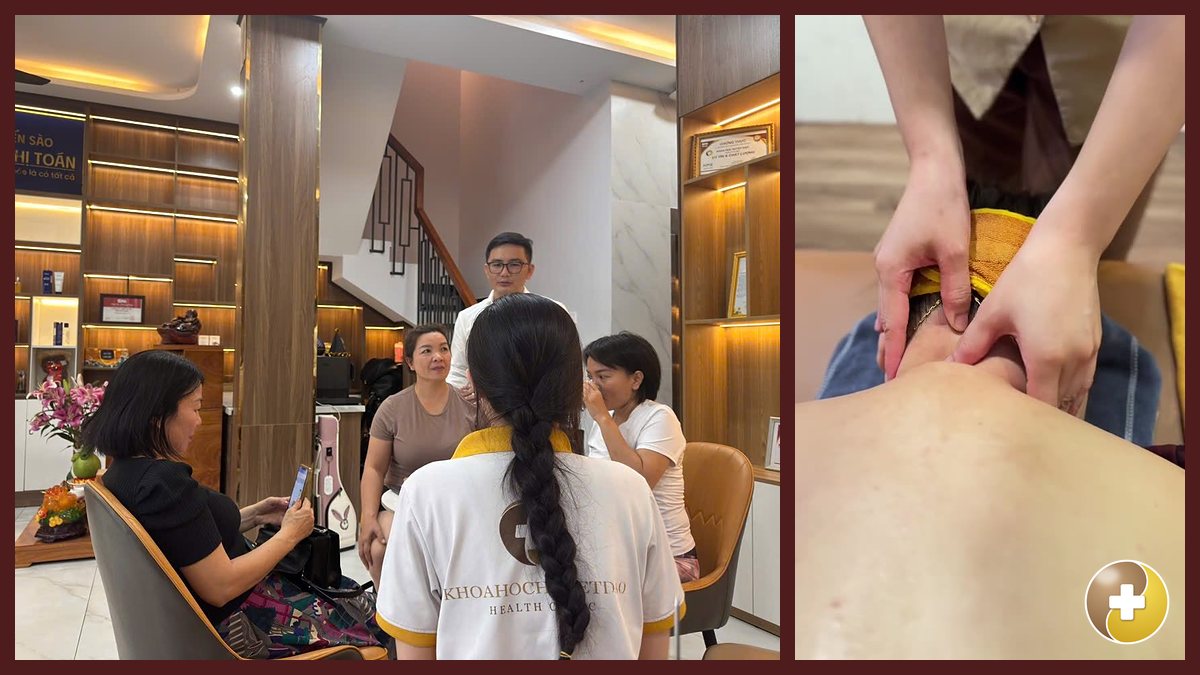
Quick answer: Back pain exercises at home suit the stiff, achy lower back that comes from long hours at a desk or on a motorbike: knee hugs, knee rocks, cat–cow, glute bridge, glute stretch and easy walking, 10–15 minutes a day. If it is not enough, Tong Gia Acupoint Wellness in District 12 and District 9, Ho Chi Minh City, reads the spine by hand and releases the lower-back muscles.
Want Lương Y Tống Văn Huynh’s team to read your spine and posture in person?
Which kind of back pain is fine to exercise at home?
Most people searching for back pain exercises at home describe the same thing: a stiff band across the lower back after a day in an air-conditioned office, a 30–40 minute motorbike commute, or a weekend of carrying kids and boxes. Bending over the sink in the morning feels tight; a few minutes of walking loosens it; by late afternoon in the chair it aches again. In Ho Chi Minh City this is everyday life for office staff in Quang Trung Software Park and the Hi-Tech Park, ride-hailing drivers and people who stand at a counter all day.
In Western medical terms, most lower-back pain is mechanical and non-specific. It comes from muscles, ligaments and the small joints around the spine rather than from an internal organ or a clear nerve injury. The muscles beside the spine hold your trunk in one position for hours, blood flow to them drops, they tire and tighten, and the small joints barely move, so mornings feel rusty. For this type of pain, current guidance agrees: keep moving gently and regularly rather than lying still, because movement brings blood to the muscles and keeps joints supple.
This guide follows a clear line: why the back gets stiff, which organ system Vietnamese traditional wellness links it to, what shows on the outside, which part of the spine carries the load, and how Tong Gia helps rebalance it when home exercise is not quite enough.
Common causes of a stiff, aching lower back
- Long, slumped sitting: 8–10 hours with a rounded back and no lumbar support loads the L4–L5 discs and muscles all day.
- Long motorbike rides: road vibration travels up the spine and the back muscles brace to keep balance, especially at long red lights.
- Lifting the wrong way: bending at the waist instead of the knees, or twisting while carrying.
- Weak core and glutes: without that natural "belt", the back muscles do extra work.
- Cold air and rain: air-con blowing on your back or a soaked shirt makes muscles contract and feel cold and hard.
- Stress and poor sleep: you brace without noticing and the muscles never fully rest.
- Training too hard: heavy sit-ups, poor deadlift form, or back-to-back badminton and pickleball without a proper warm-up.
In Vietnamese traditional wellness, the Kidney system "governs the bones": when Kidney energy is low, the lower back and knees tire easily. The Liver system "governs the tendons": when it is balanced, tendons stay supple; when it is weak, muscles cramp and stiffen. The Spleen system nourishes the muscles and limbs. These are functional ideas, not a statement that your kidneys or liver are unwell.
Signs that often come with it
- Stiffness across the lower back that eases with walking and worsens with sitting: typical muscle fatigue, good for home exercise.
- Morning stiffness under 30 minutes that fades: common in people who sit a lot and move little.
- A cold, dull ache on rainy days or under air-con.
- Aching into the buttock after a long ride, without numbness: often tight glute and piriformis muscles.
- Sharp, electric pain shooting down the leg, or a numb foot: this is no longer simple muscle fatigue; get checked first.
- Back ache with tired knees, night-time urination and feeling cold: traditional wellness reads this as low Kidney energy; still get it checked if it lasts.
When to see a doctor
Stop exercising, skip massage and please see a doctor at a medical facility if you have any of these:
- Pain spreading down the leg with numbness or weakness, or a foot that is hard to lift.
- Trouble passing urine, loss of bladder control, or numbness in the groin and inner thighs: go to the emergency department now.
- Pain at night that rest does not ease, or pain that grows week by week.
- Fever or chills with back pain; back pain with burning urination or blood in the urine.
- Unexplained weight loss or lasting fatigue: get checked alongside any home care.
- Pain after a fall, accident or hard knock, or sudden back pain in an older person with fragile bones.
- Chest tightness, shortness of breath or cold sweats, with pain spreading to the back: call 115 immediately.
This is a wellness service, not medical care.
Face reading (Y Tướng Học): how a tired back shows on the outside
Vietnamese face reading has a saying: "the signs show outside, the organs lie inside". In the Tong Gia approach, practitioners look at face shape and posture to decide which part of the back to check first, then confirm by hand on the spine. For people with a tired lower back, these features are often noted:
- Round "Viên" (圓) face: soft and full, linked to the Water element and the Kidney system; the lower back tends to feel cold and the muscles soft, with a dull, lingering ache.
- "Do" (由) face, narrow forehead and wide jaw: very thick lower-back and hip muscles that easily stagnate.
- "Giáp" (甲) face, broad forehead and pointed chin: "full above, empty below": headaches and poor sleep up top, a cold, hollow lower back and tired knees below.
- Thin, soft ear rims: associated with low Kidney energy, back and knee fatigue, and sensitivity to weather changes.
- Muscles that feel hard as wood: described as stagnation from long-term mental pressure, with deep tightness along both sides of the spine.
These are only hints for where to start, never a verdict on your health or character.
Spine and nerve-reflex zones involved
In the Tong Gia framework, the lumbar vertebrae L1–L5 relate to digestion, kidneys, urinary and reproductive function and the legs; the sacrum S1–S5 relates to elimination. Nerve roots leave the spinal canal between the vertebrae, which is exactly where the practitioner's fingers search.
| Vertebrae / area | Nerves and function | Typical feeling | Related organ system | Matching move |
|---|---|---|---|---|
| L1–L3 | Upper lumbar roots; digestion, kidneys | Ache across the waist after sitting | Kidney (Thận du, Mệnh môn points at L2) | Knee hugs, knee rocks |
| L4–L5 | Lower lumbar roots; legs | Morning stiffness, tight when bending | Kidney – Liver | Cat–cow, glute bridge |
| L5–S1 | Roots forming the sciatic nerve; legs, elimination | Ache into the buttock on long rides | Liver (tendons of glutes and hamstrings) | Glute stretch, walking |
| Back of the knee | Bladder meridian pathway | Tight hamstrings, hard to bend | "For back pain, look to Ủy trung" | Gentle hamstring stretch |
The table shows what is "related" to guide care; it is not a judgement about any disease.
The Tong Gia method: spinal nerve-reflex balancing massage
Every session follows the method built by Tống Văn Huynh, founder of Tong Gia and a master of traditional Vietnamese wellness with over 13 years in Eastern wellness, face reading and spinal nerve-reflex balancing. A lower-back session goes like this:
- Screening: how long it has hurt, any leg numbness, fever, falls or pregnancy. Warning signs mean no session and advice to get checked.
- Observation: how you stand and walk, whether shoulders and hips are level, your complexion.
- Reading the spine by hand from D10 to S1: skin temperature, the muscle layer, the shape of each vertebra and tender points, comparing left and right.
- Muscle release of the thick bands beside the lumbar spine, the glutes and hamstrings, with pressure building through five levels as you respond.
- Acupressure on Thận du, Chí thất and Mệnh môn in the lower back and Ủy trung behind the knee, stopping when the skin over the key point turns from dry to slightly moist.
- Home coaching: two or three moves chosen for your stiff zone, practised on the spot.
Suitable services: Lower-back care 60 minutes: 550,000 VND (about 21 USD), first visit 399,000 VND (about 15 USD); 90 minutes: 750,000 VND (about 29 USD); add cupping 30 minutes: 85,000 VND (about 3 USD) when the back feels cold. Full prices are on the price list; see also what a back massage in Saigon feels like and back massage questions.
A typical session
One evening at the Vinhomes Grand Park branch, an office worker said she had followed online videos for two weeks, yet still felt stiff in the morning and tight when tying her shoes. No leg numbness, no fever. Standing, her right hip sat higher than the left and her shoulders rolled forward. Along the spine, the skin around L4–L5 on the right was warmer, the muscle beside it formed a hard band, and the right glute was tender. The practitioner released the lower back and glute, pressed Thận du and Ủy trung, then corrected her glute bridge: she had been arching her back as she lifted, which made it ache more. Before leaving she practised two moves and found bending easier than when she arrived.
What you feel during and after
Pressed points feel achy, then pleasant, a "comfortable ache" in the Tong Gia training; it should never be sharp. Many people feel the lower back warm up and their breathing slow. Afterwards the back feels lighter and bending is easier; the next day it may feel mildly sore, like after a workout. Everyone responds differently, and Tong Gia does not promise the pain will vanish after one visit.
Want Lương Y Tống Văn Huynh’s team to read your spine and posture in person?
Self-care at home: six moves and prevention
Use a mat, 10–15 minutes once or twice a day. Breathe out as you move into each position, breathe in as you return; never hold your breath.
- Knee hugs: lying on your back, pull one knee gently to your chest for 20–30 seconds, switch, then both; three times each.
- Knee rocks: knees together, arms out, shoulders down; let both knees fall gently to one side, return, switch; 8–10 per side.
- Cat–cow: on hands and knees, round the back on the out-breath, let it sag slightly on the in-breath; 8–10 rounds.
- Glute bridge: squeeze the glutes and lift the hips until shoulders, hips and knees line up; hold 3–5 seconds; 8–10 times without arching.
- Glute stretch: ankle over the opposite knee in a "4", pull the thigh gently towards you; 20–30 seconds, 2–3 times per side.
- Easy walking: 10–20 minutes on flat ground; at work, stand and walk for a few minutes every 30–60 minutes.
Stop at once if you feel sharp or electric pain, numbness down the leg, dizziness, chest tightness, or if the pain is worse the next morning. In the first one or two days of an acute "locked" back, only belly breathing, single knee hugs and short walks; no heavy sit-ups, hard twists or cracking the back.
For prevention: sit with a cushion behind the lower back and the screen at eye level; lift with bent knees and the load close to you; rub your palms warm and rub both sides of the lower back 50–100 times; keep air-con off your back; and sleep before 11 pm. Runners can also read massage after running in Thu Duc.
How to book
Tong Gia Acupoint Wellness has two branches in Ho Chi Minh City, open every day, with real customer reviews on Google Maps:
- District 12: 225 Dương Thị Mười, Phường Tân Chánh Hiệp (Tan Chanh Hiep Ward, District 12). Open 8:00–19:00 daily.
- District 9 – Vinhomes Grand Park: Căn T16-21 khu Manhattan, Phường Long Bình, TP. Thủ Đức (unit T16-21, Manhattan zone, Long Binh Ward, Thu Duc City). Open 9:00–20:00 daily.
Call, Zalo or WhatsApp +84 888 264 559, or book online. When booking, mention where your back aches, how long you have been exercising and whether your legs feel numb, so the team can suggest 60 or 90 minutes.
Visit us
- Đông Y Huyệt Đạo Tống Gia Quận 12 (District 12)
225 Dương Thị Mười, Phường Tân Chánh Hiệp, Quận 12, HCMC · 8:00–19:00 daily · 0888 264 559 · Directions on Google Maps - Đông Y Huyệt Đạo Tống Gia Quận 9 (Vinhomes Grand Park, District 9)
Căn T16-21 khu Manhattan, Vinhomes Grand Park, Phường Long Bình, TP. Thủ Đức, HCMC · 9:00–20:00 daily · 0888 264 559 · Directions on Google Maps
Want Lương Y Tống Văn Huynh’s team to read your spine and posture in person?
FAQ
How often should I do back pain exercises at home? Once or twice a day for 10–15 minutes: knee hugs, knee rocks, cat–cow, glute bridge, glute stretch and easy walking. Move slowly and breathe out into each position; stop if you feel sharp pain or numbness down the leg.
What is a good 10-minute routine for lower back pain? Two minutes each of knee hugs, knee rocks, cat–cow, glute bridges and the glute stretch, then a few minutes of walking to keep the muscles warm.
I sit at a desk all day. What should I do for my back? Stand up and walk for a few minutes every 30–60 minutes, use a lumbar cushion, keep the screen at eye level, and do cat–cow and glute bridges morning and evening.
Should I exercise if my lower back pain is from a muscle strain? Yes, gently. For the first two days, only belly breathing, single knee hugs and short walks; add the other moves as the pain settles. With leg numbness, fever or bladder changes, get checked at a medical facility first.
Can yoga help back pain at home? Gentle poses such as cat–cow, child's pose and bridges are fine. Avoid deep forward folds, strong twists and backbends while the back is sore, and move with your breath.
How much is lower-back care at Tong Gia? 60 minutes costs 550,000 VND (about 21 USD), or 399,000 VND (about 15 USD) on your first visit; 90 minutes costs 750,000 VND (about 29 USD), at both District 12 and Vinhomes Grand Park.
Author: Lương Y Tống Văn Huynh – founder of Huyệt Đạo Tống Gia, a master of traditional Vietnamese wellness with over 13 years in Eastern wellness care, Y Tướng Học (face reading) and spinal nerve-reflex balancing massage.
Updated: 2026-11-15
Related guides
- Back pain exercises at home: six gentle lower-back moves, how to breathe, when to stop, and when Tong Gia can help in Ho Chi Minh City
- Herbal warm compress: how a mugwort, ginger and sea salt pouch differs from dry heat, and how to use one safely at home in Ho Chi Minh City
- Massage along the spine in Ho Chi Minh City: what it does, spine sections C – D – L – S, and what Tong Gia does
This is a wellness service, not medical care.