
Exam stress before tests: what your child's body is doing and how to help them walk in calmer
Quick answer: Exam stress is the nervous system's alarm response to pressure: racing heart, poor sleep, stomach aches, a blank mind. Enough sleep, slow breathing and smaller study blocks help it settle. Lasting sadness or any thought of self-harm needs professional support right away. Tong Gia in Ho Chi Minh City offers relaxation support only.
Want Lương Y Tống Văn Huynh’s team to read your spine and posture in person?
Exam stress before a test: what is happening in the body?
The night before an exam your teenager lies awake until late, cannot eat breakfast, and by the school gate has a cramping stomach, cold hands and a pounding heart. The paper arrives and the mind goes blank, even though they knew the material by heart last night. Parents watch, worry, ask questions, and the child gets more flustered. Families in Ho Chi Minh City see this every year around the Grade 10 entrance exams for public high schools, the national high-school graduation exam and university end-of-term exams. Expat families in international schools see the same thing before IGCSE, IB or AP sessions.
The Western medical view: exam stress is the body's response when the brain rates an exam as an important "threat". The Tong Gia curriculum explains that heart rate and blood pressure change with emotion through the autonomic nervous system, and that stress raises both. When the "alert" side of that system switches on, blood moves to the muscles, the heart speeds up, breathing becomes short and digestion slows down. That is why students feel stomach cramps, nausea, a dry mouth and sweaty palms. A moderate level of stress keeps you sharp; too much freezes memory, ruins sleep and kills appetite.
One thing needs saying straight away: exam stress is common, and it does not mean a child is weak or "overreacting". This article is not a tool for deciding that a child has an anxiety disorder or any mental health condition; only qualified health professionals can make that judgement. If sadness lasts for weeks, or a child says or shows thoughts of self-harm, seek professional support immediately: a mental health service or psychologist, a trusted adult, the school counsellor, and in an emergency call 115 or go to the nearest emergency department.
At Tong Gia Acupoint Wellness (Huyệt Đạo Tống Gia), exam season is when parents bring students in because "they sit studying all day, the neck is stiff as wood and they cannot sleep". Below we explain why the body reacts this way, which signs need a medical check, the Eastern and face-reading view, and simple ways to calm exam nerves at home.
Common reasons exam season winds students up
Stress rarely has a single cause. Usually several things pile up in the last few weeks, when revision gets heavier and sleep gets shorter.
| Cause | Typical example | Effect on the body |
|---|---|---|
| Pressure for results | Entrance exams, graduation, keeping a scholarship | Constant worry, poor sleep, racing heart |
| Short sleep | Studying until 1–2 a.m., up at 6 for school | Weaker memory, headaches, irritability |
| Long hours bent over a desk | Head down over books, phone and laptop | Stiff neck, shallow breathing, tired upper back |
| Irregular eating | Skipped breakfast, snacks, milk tea, coffee or energy drinks to stay awake | Upset stomach, fast heartbeat, alert then drained |
| Comparison and expectations | Compared with classmates or siblings, fear of letting parents down | Lasting tension, low mood, withdrawal |
| Little movement or daylight | School, tutoring, then more study at home | Poor sleep, sluggish body, foggy head |
The Tong Gia curriculum notes that shallow breathing and a hunched posture keep the diaphragm from moving, so the lungs do not fully expand and people tire easily, feel short of breath and get tense. Many parents miss this link: the child is not only worried "in the head"; the chest, neck and shoulders are braced too. If the neck and shoulders are the main complaint, see our neck and shoulder massage Q&A.
Signs that often come with it
- Body: racing heart, cold hands and feet, trembling, sweaty palms; stomach ache, nausea or several trips to the toilet before the exam; headache, stiff neck.
- Sleep: trouble falling asleep, light broken sleep, dreams of being late for the exam, tired on waking.
- Mood and thinking: restlessness, snapping at people, tears, "I can't take anything in", forgetfulness, reading the same page again and again.
- Behaviour: eating far less or far more, hiding in the phone, avoiding talk about exams, skipping classes.
In the Tong Gia curriculum, Eastern medicine links heavy worry with a cluster of signs that travel together: "poor appetite, poor sleep, palpitations, forgetfulness". If a student has all of these at once, the body is overloaded; it is not laziness. A single sign proves nothing on its own; look at the whole picture and how long it lasts.
When to see a doctor
Exam stress usually eases once the exams are over. Some situations should not wait:
- Chest pain or tightness, breathlessness, cold sweat, fainting: call 115 at once; no massage, no acupressure.
- Sadness or hopelessness lasting two weeks or more, loss of interest in everything, withdrawal, not eating, many sleepless nights: please see a doctor or mental health professional.
- Any thought or talk of self-harm or not wanting to live: seek professional support immediately, do not leave the young person alone, tell family and school; in an emergency call 115.
- Repeated panic attacks: pounding heart, fear of dying, shaking, breathlessness, even when no exam is near.
- Clear weight loss, ongoing stomach pain or vomiting, blood in the stool: get the digestive system checked rather than blaming stress.
- Palpitations with trembling, weight loss or bulging eyes: get checked, as the thyroid may be involved.
This is a wellness service, not medical care. Tong Gia does not replace a psychologist or medical staff; a massage session only helps the body relax and sleep better. Lasting sadness deserves to be heard by a qualified professional.
The Eastern and face-reading view
According to the Tong Gia curriculum, in Eastern medicine the Heart (Tâm) governs the blood vessels and houses the spirit: mind, awareness and sleep. Exam season stretches that spirit thin, so sleep is restless and the heart flutters. The Spleen (Tỳ) runs digestion, and the curriculum quotes "worry injures the Spleen": no appetite, bloating. It adds that heavy worry drains both Heart and Spleen, giving poor appetite, poor sleep, palpitations and forgetfulness. The Liver (Can) keeps qi and emotions flowing; when Liver qi is stuck, people become irritable and cannot relax, and because "Wood overacts on Earth", tension easily shows up as bloating, stomach pain and irregular bowels. The curriculum also records that Western medicine sees a clear effect of stress on digestion. Weak Kidney (Thận) function is linked with "forgetfulness, poor concentration, a tired mind", common after long stretches of late nights.
What do the outer signs look like? In Y Tướng Học (face reading for wellness), "the signs show outside, the organs lie inside". Following Part 3 of the curriculum, practitioners look for:
- A sunken, narrow area between the brows with vertical lines and tight muscles: a sense of pressure in the chest, frequent sighing, palpitations, worry; deep stress tightening the face, neck and shoulders.
- A forehead with many irregular lines: long mental pressure tightening the forehead, back of the head and shoulder-lifting muscles, with neck ache spreading to the head.
- Round, very open eyes: described as impatient, prone to worry, finding it hard to focus for long; "a scattered spirit".
- Crescent-moon brows: a balanced body, but under long pressure prone to nervous exhaustion, light insomnia and shortness of breath.
This is school-of-thought knowledge used to choose which areas to check, never to judge a child's character or ability, and never a substitute for a medical check. For more, see our face reading for wellness Q&A.
Spine segments and nerve-reflex zones involved
The Tong Gia curriculum teaches that the neck vertebrae C1–C7 relate to the head, face, neck and arms, and the thoracic vertebrae D1–D12 to circulation, breathing and digestion. For the "nerves and mind" group (long-standing headaches, long-term poor sleep, nervous exhaustion), it combines the neck C1–C7, the upper back D1–D3 and the sacral area, noting that this follows the school's materials, is supportive only and does not replace medical assessment.
| Segment / area | Nerve link / function | Common exam-season signs | Organ (Eastern view) |
|---|---|---|---|
| C1–C3 (base of skull) | Head, face, sleep | Heavy head, ache at the back of the head, trouble falling asleep | Heart, Liver, Kidney |
| C4–C7, trapezius | Neck, shoulders, arms | Stiff neck, raised shoulders, tired writing arm | Liver (sinews) |
| D1–D3 | Upper back, breathing | Shallow breath, tight chest, sighing | Lung, Heart |
| D4–D5 (Quyết âm du, Tâm du) | Circulation, heart rhythm | Fluttering heart when thinking of the exam | Pericardium, Heart |
| Mid-back (Liver and Spleen points) | Digestion | Stomach ache, bloating, no appetite before exams | Liver, Spleen |
| Sacral area | Part of the curriculum's nerves-and-mind group | Worn out, lower back tired from sitting | Kidney |
The table shows links used to guide where to work, not to identify any disease. Practitioners compare left and right, top and bottom, work only on "excited" zones (warmer skin, tight muscle, more tenderness) and avoid pressing directly on "inhibited" zones.
The Tong Gia method: spinal nerve-reflex balancing massage
This is a Vietnamese traditional wellness method built by Lương Y Tống Văn Huynh, a master of traditional Vietnamese wellness and founder of Tong Gia, with over 13 years in Eastern wellness, Y Tướng Học and spinal nerve-reflex balancing. For stressed students the aim is a looser body, a calmer spirit, a softer neck and upper back and deeper sleep. Tong Gia does not promise better grades or an end to worry; the session simply helps rebalance the body so the student can study from a calmer base.
- Questions and screening: sleep, food, coffee or energy drinks, stomach aches, headaches, any current medical follow-up. If a warning sign from the section above appears, the practitioner stops and recommends a medical check first.
- Face-reading observation: complexion, the area between the brows, forehead, eyes, shoulder line and breathing.
- Reading the spine by hand: pressing and gliding from C1 down to the sacral area to read skin temperature, muscle tone, vertebra shape and tender points, comparing both sides.
- Muscle release: softening the base of the skull, trapezius, between the shoulder blades and along the spine, with light to medium pressure and a steady rhythm.
- Acupressure on the right areas: Tâm du and Quyết âm du on the back; Nội quan and Thần môn at the wrist; Thái Xung, which the curriculum uses to ease Liver qi and help reduce tension; finishing at Bách hội on the crown to clear the head and calm the spirit.
- Self-care coaching: 4–6 breathing, pressing Nội quan when nervous in the exam room, pressing Thần môn before sleep.
A typical session
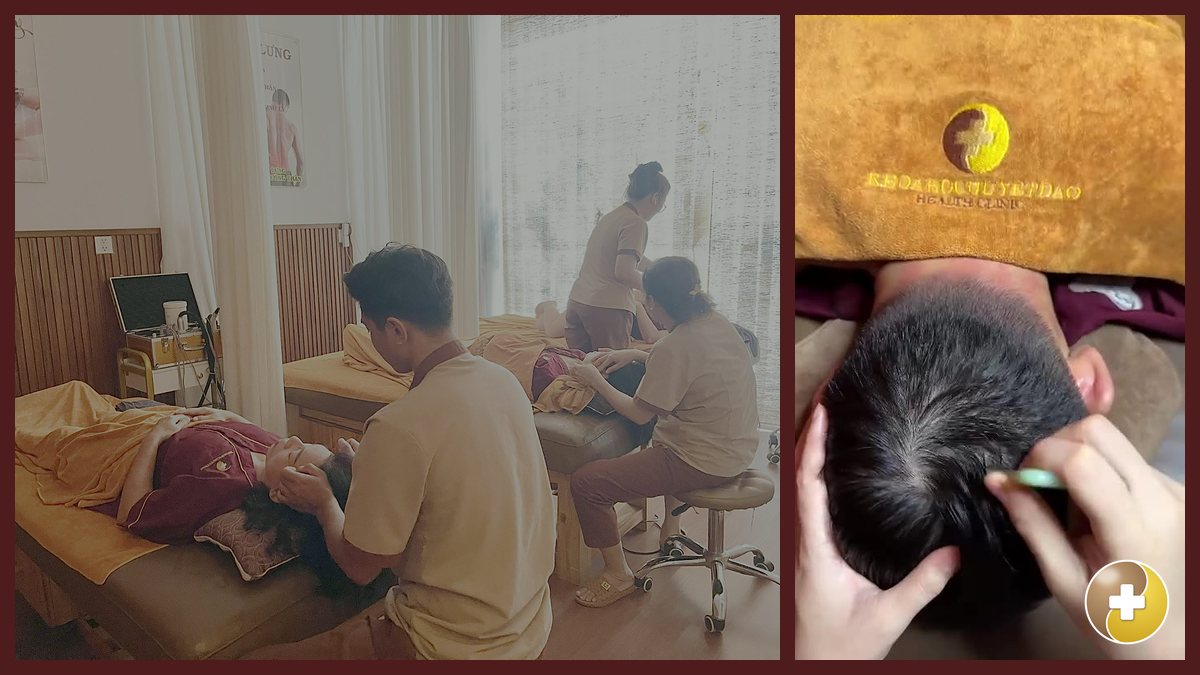
A typical session might look like this for a Grade 9 student preparing for the Grade 10 entrance exam, brought in by her mother after three weeks of sleeping past midnight and stomach aches every morning. The practitioner asks about her timetable, bedtime and breakfast, and notices raised shoulders, a slight frown and short, high breathing. Along the spine the base of the skull is warm, both trapezius muscles are tight and the muscles beside D4–D5 are thick. The neck is softened with light pressure, the upper back is gently vibrated, Tâm du and Quyết âm du are pressed, then the wrists. Midway the shoulders drop and breathing slows; she dozes off. At the end mother and daughter learn 4–6 breathing, and the mother agrees on lights-out before 11 p.m. for the final week.
Suitable services and prices
- Herbal hair wash with neck and shoulder massage, 60 minutes: 250,000₫ (about 10 USD), a gentle weekend break during revision.
- Neck and shoulder care, 60 minutes: 550,000₫ (about 21 USD), first visit 399,000₫ (about 15 USD), for a stiff neck and shoulders from long study hours.
- Heart wellness session, 75 minutes: 750,000₫ (about 29 USD), when palpitations, worry and poor sleep are the main issue.
Full prices are on our price list. Younger students should come with a parent. For sleep-focused care, read our acupressure for sleep Q&A and acupressure massage Q&A.
How it feels during and after
At first most students feel tenderness at the back of the neck and trapezius, then warmth, lighter shoulders and a less heavy head. Pressing the wrist can send a mild tingle along the inner forearm. Many say they fall asleep more easily that night and wake with a clearer head. Responses vary from person to person; Tong Gia supports relaxation only and does not replace a psychologist when one is needed.
Want Lương Y Tống Văn Huynh’s team to read your spine and posture in person?
Self-care at home: easing exam nerves
- Slow 4–6 breathing: breathe in through the nose for 4 seconds, out slowly for 6 seconds, 5–10 minutes a day. In the exam room, 5–6 such breaths before turning the paper over help settle the heart.
- Press Nội quan when nervous: 2 cun above the wrist crease, between the two tendons; press gently for 1–2 minutes on each side. Before sleep, press Thần môn (on the wrist crease, in the hollow beside the tendon on the little-finger side) with slow breathing.
- Protect sleep to protect memory: no all-nighters in the final week; a short 15–30 minute nap if possible (traditional medicine sees 11 a.m.–1 p.m. as the Heart meridian's strong hours). Cut coffee and energy drinks after mid-afternoon.
- Stand up every 45–60 minutes: roll the shoulders, open the chest, walk for a few minutes so the diaphragm works again.
- Parents: talk less, listen more: swap "you must pass" for "giving it a real try is enough", keep breakfast simple and easy to digest. Sitting quietly for 10–15 minutes focusing on the breath also calms the spirit.
Repeating the key point: lasting sadness or any thought of self-harm means seeking professional support immediately. For gentle relaxation, many families also enjoy our Vietnamese head spa.
Book a session
- District 12: 225 Dương Thị Mười, Phường Tân Chánh Hiệp (Tan Chanh Hiep Ward; keep the Vietnamese address for taxis). Open 8:00–19:00 daily.
- Vinhomes Grand Park, District 9: Căn T16-21 khu Manhattan, Phường Long Bình, TP. Thủ Đức (unit T16-21, Manhattan zone, Long Binh Ward, Thu Duc City). Open 9:00–20:00 daily.
Call, Zalo or WhatsApp +84 888 264 559, or book online. Message us the student's age, exam dates, sleep and any stomach aches or headaches so the practitioner can prepare. Younger students should come with an adult. Real ratings and reviews are on each branch's Google Maps profile.
Visit us
- Đông Y Huyệt Đạo Tống Gia Quận 12 (District 12)
225 Dương Thị Mười, Phường Tân Chánh Hiệp, Quận 12, HCMC · 8:00–19:00 daily · 0888 264 559 · Directions on Google Maps - Đông Y Huyệt Đạo Tống Gia Quận 9 (Vinhomes Grand Park, District 9)
Căn T16-21 khu Manhattan, Vinhomes Grand Park, Phường Long Bình, TP. Thủ Đức, HCMC · 9:00–20:00 daily · 0888 264 559 · Directions on Google Maps
Want Lương Y Tống Văn Huynh’s team to read your spine and posture in person?
FAQ
Is exam stress before a test normal? Mostly yes. It is the nervous system reacting to pressure: racing heart, poor sleep, stomach ache, easing after the exam. If sadness lasts for weeks, eating and sleep collapse, or there are thoughts of self-harm, seek professional support immediately.
How can my child calm down inside the exam room? Before turning the paper, sit tall, drop the shoulders and take 5–6 slow 4–6 breaths. Press the Nội quan point on the wrist gently for 1–2 minutes. Start with easy questions to get a rhythm, then return to the hard ones.
My child is stressed about the Grade 10 entrance exam. What should we do as parents? Protect bedtime before 11 p.m., keep breakfast easy to digest, talk less about scores and comparisons, and listen more. If the child withdraws, cries a lot, cannot sleep for weeks or mentions self-harm, see a mental health professional right away.
Why does my teenager get stomach aches before exams? Stress slows and sensitises digestion, so cramps, nausea and loose stools before an exam are common; Eastern medicine says worry injures the Spleen. Ongoing pain, weight loss, heavy vomiting or blood in the stool need a medical check.
Can students have massage or acupressure? Yes, with light pressure and a parent present for younger students. Massage helps the neck and upper back loosen and sleep come more easily. It is wellness care, not a replacement for medical or psychological support.
When does exam stress need professional help? When sadness lasts two weeks or more, interest in everything fades, panic attacks repeat, or there are thoughts of self-harm. Then seek professional support immediately and do not leave the young person alone; in an emergency call 115.
Author: Lương Y Tống Văn Huynh – founder of Huyệt Đạo Tống Gia, a master of traditional Vietnamese wellness with over 13 years in Eastern wellness care, Y Tướng Học (face reading) and spinal nerve-reflex balancing massage.
Updated: 2026-11-17
Related guides
- Driving stress in Saigon traffic: why jams lock up the body and shorten the temper, and how to unwind after the wheel
- Student stress: why your body goes into alarm mode in exam season and how to ease it
- Nervous tension explained: what stress does in the body, how Eastern medicine sees it, and how to return to rest
- Exam stress before tests: what your child's body is doing and how to help them walk in calmer
- Trouble sleeping after giving birth: why you are exhausted yet wide awake
- Insomnia and "weak kidneys": what Eastern and Western medicine say, why you wake at night, and how to care for it
This is a wellness service, not medical care.