
Insomnia and "weak kidneys": what Eastern and Western medicine say, why you wake at night, and how to care for it
Quick answer: "Insomnia from weak kidneys" is an Eastern idea: Kidney yin too weak to calm Heart fire (Heart–Kidney imbalance), or weak Kidney qi causing night urination that breaks sleep. In Western terms, night urination, stress and age are more common causes. Long-lasting insomnia needs a check-up. Tong Gia in Districts 12 and 9, HCMC, offers supportive care.
Want Lương Y Tống Văn Huynh’s team to read your spine and posture in person?
Insomnia and "weak kidneys": start with the Western picture
"My insomnia is from weak kidneys" is something Vietnamese people often say when poor sleep comes together with a tired lower back and knees, night urination, ringing ears, warm palms and soles in the evening, or a cold back. Let us be clear from the start: "weak kidneys" here is an Eastern medicine idea describing reduced Kidney qi, yin or yang, not Western kidney disease. Only urine and blood tests show how the kidney organs actually work.
In Western medicine, insomnia means trouble falling asleep, waking in the night, waking too early, or sleeping enough hours yet still feeling unrefreshed, over a period long enough to affect daytime life. People who report "insomnia with night urination and backache" are usually middle-aged or older: sleep naturally becomes lighter with age, the bladder holds less, women around menopause often have hot flushes and night sweats, and older men often wake to urinate.
In Ho Chi Minh City we meet this pattern in business owners and managers who work late, shift workers in industrial zones and the Hi-Tech Park whose sleep times keep changing, and older parents living with their children who say "I get up two or three times to pee, and then I can't fall asleep again".
Common causes in Western terms
| Cause group (Western view) | Typical pattern | Often seen in | Sensible next step |
|---|---|---|---|
| 1. Night urination breaking sleep | Up 2–3 times to urinate, hard to fall asleep again | Older adults; people drinking a lot of water, tea, coffee or beer in the evening | Less fluid after 7 pm; long-lasting night urination needs a check-up |
| 2. Stress and worry | Lying awake, racing thoughts, fast heartbeat | High-pressure jobs, business owners | Wind-down routine, less evening work; get checked if it persists |
| 3. Habits and environment | Irregular bedtime, late screens, hot or noisy room | Shift workers, younger adults | Fixed sleep times, screens off early, dark cool room |
| 4. Hormonal change | Hot flushes, night sweats, waking mid-night | Women around menopause | Gynaecology check if troublesome |
| 5. Aches and a tired back | Pain when turning over, back aches lying long | People with back pain or joint wear | Back care, suitable mattress and pillow |
| 6. Conditions needing a check-up | Loud snoring, pauses in breathing; thirst and frequent urination; swollen legs; burning urine | People with extra weight, high sugar or blood pressure, heart conditions | Medical check-up and tests as advised |
The Tong Gia curriculum notes typical urination of about 4–8 times by day and 0–1 at night; getting up twice or more every night for a long time deserves a look for the cause.
Signs worth noting
Eastern medicine looks at the whole "Kidney picture", not just sleep. In the curriculum's table of declining Kidney function (Eastern sense), the sleep row reads: trouble sleeping, dream-filled sleep, waking to urinate. Also notice:
- Hot or cold: warm palms and soles, evening flushes, night sweats, dry mouth and throat (Kidney yin direction); or feeling cold, cold hands and feet, a cold weary back, copious clear urine (Kidney yang direction).
- Back and knees: aching lower back, weak knees, tiring fast when standing.
- Ears, hair, memory: ringing ears, slowly reduced hearing, dry or thinning hair, early greying, forgetfulness.
- Heart: palpitations and restlessness when lying down; the curriculum lists Heart–Kidney imbalance as insomnia, palpitations and weary back and knees.
- Timing: tired in the afternoon but wide awake at night; a "hot" head on the pillow; or light sleep with waking at 3–4 am.
No single sign proves anything; Kidney yin and yang deficiency are Eastern concepts, not Western disease names, and should not be used to label yourself or a relative.
When to see a doctor
Please see a doctor first, with wellness care only alongside, if:
- Insomnia has lasted several weeks, with daytime sleepiness, poor focus or near-misses while driving.
- You snore loudly or someone has seen you stop breathing in sleep, with morning headaches.
- Low mood lasts, you lose interest in things, or have dark thoughts: seek professional help early.
- Night urination twice or more for a long time, or with burning, blood, weak stream, strong thirst or weight loss.
- Swollen legs or eyelids, persistently foamy urine, or blood pressure that is hard to control.
- Lasting fatigue, pallor or unexplained weight loss: get checked alongside any wellness care.
- You wake with chest pain, shortness of breath or cold sweats: call 115 immediately.
If you take sleeping tablets or other prescribed items, do not stop or change them on your own. This is a wellness service, not medical care.
The Y Tướng Học view: Kidney, Heart and the faces of poor sleepers
In the Tong Gia curriculum, the Heart–Kidney relationship is called "Water and Fire in balance": Heart fire descends to warm the Kidney, Kidney water rises to cool the Heart. When the two lose contact, it is called Heart–Kidney imbalance, listed as insomnia, palpitations, weary back and knees. An easy image: when the water below runs low, the fire above flares up, and the mind will not settle on the pillow.
| Eastern direction | Typical sleep | Other signs | Care direction in the curriculum |
|---|---|---|---|
| Kidney yin deficiency, Heart–Kidney imbalance | Hard to fall asleep, many dreams, easy waking | Warm palms and soles, evening flushes, night sweats, dry mouth, ringing ears, palpitations | Sleep early, avoid late nights and very spicy food |
| Kidney qi deficiency | Sleep broken by trips to the toilet | Frequent urination, night urination, incomplete emptying | Keep warm, do not hold urine, regular routine |
| Kidney yang deficiency | Light sleep, feeling cold, hard to drop off again | Cold hands, feet and back, clear urine, low energy | Keep back, belly and feet warm; warm foot soaks |
The curriculum states that when Kidney qi is sufficient, the bladder opens and closes properly and sleep is not interrupted; when it is weak, urination becomes frequent and nightly. That is the bridge between Eastern "weak kidneys" and broken sleep.
Y Tướng Học (Vietnamese face-and-body reading for wellness) says "the signs show outside, the organs lie inside"; Lương Y (master of traditional Vietnamese wellness) Tống Văn Huynh organised this 2,000-year-old knowledge for daily care. Signs the curriculum links to sleep and the Kidney: a dented or sunken occipital bone (Kidney essence deficiency, long-term insomnia or very light sleep, early memory decline, tight neck muscles at the skull base); a flat back of the head (Kidney qi or yang deficiency, feeling cold, light sleep); a "Giáp" face, wide above and narrow below ("full above, empty below": poor sleep and flushes above, weak knees and night urination below); thin, soft ear rims. These only guide where the practitioner reads first (neck, upper back, lower back) and are never used to name a disease. More in our Eastern face reading Q&A.
Spine segments and nerve-reflex zones involved
In the Tong Gia curriculum on spinal nerve-reflex balancing, the nervous-system group (including long-term insomnia) combines the neck C1–C7, upper back D1–D3 and the sacral zone; lumbar L1–L5 relates to the kidneys and urinary tract; sacral S1–S5 to elimination. For "weak-kidney insomnia" the practitioner reads all three levels.
| Segment / zone | Nerves and function | Common feeling | Related organ |
|---|---|---|---|
| C1–C3, skull-base muscles | Head and face; linked in the curriculum to Kidney essence when the occiput is weak | Stiff, warm neck, heavy head, light sleep | Kidney (marrow sea), Liver |
| D1–D5 | Circulation, breathing; Xinshu (BL15) beside T5 | Palpitations, restless chest when lying down | Heart |
| L1–L3 | Kidneys, urinary tract; Shenshu, Mingmen, Zhishi at L2 | Band of ache, cold back, night urination | Kidney |
| S1–S5 | Elimination, lower pelvis | Heavy sacrum, urge to urinate at night | Kidney–Bladder |
The Tong Gia method for insomnia with "weak kidneys"
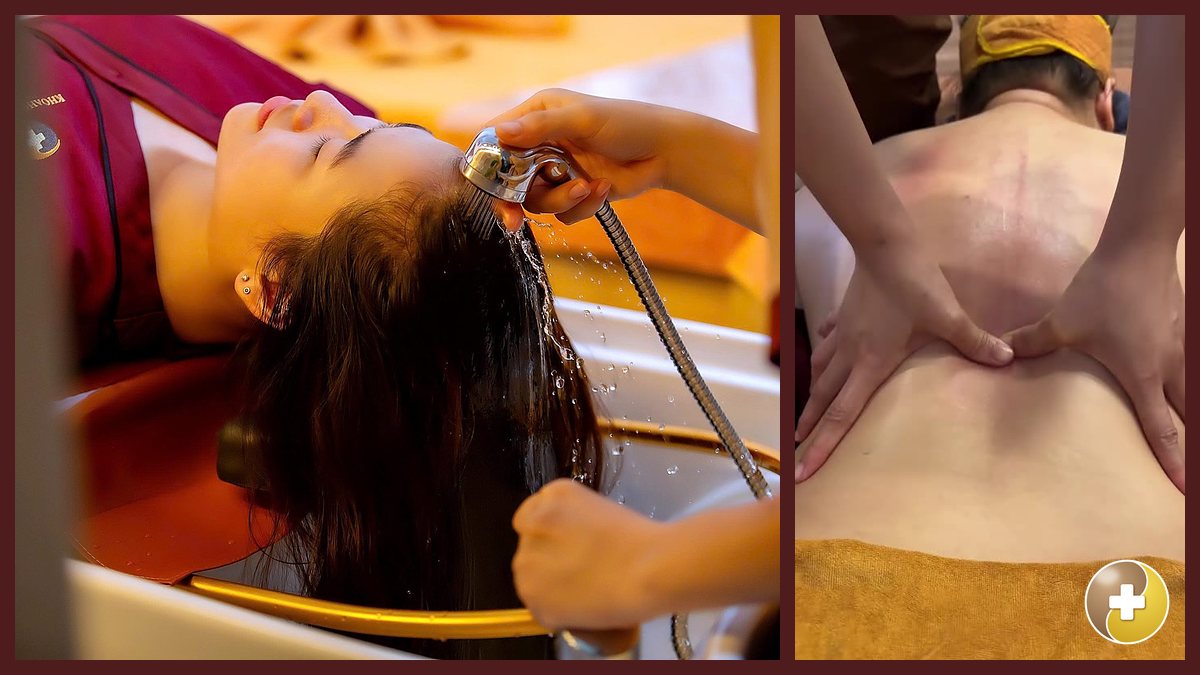
The method was built by Lương Y Tống Văn Huynh, founder of Tong Gia, over more than 13 years in Vietnamese traditional wellness, face reading and spinal nerve-reflex balancing. The aim is to help rebalance Heart and Kidney in the Eastern sense, calm the neck and warm the lower back so the body can drop into sleep, not to replace a check-up. A session includes:
- Questions and observation: trouble falling asleep or staying asleep, how many night trips, hot or cold, check-ups so far, anything prescribed; pregnancy, kidney conditions, blood pressure, blood sugar; head shape, ears and complexion.
- Reading the spine by hand from C1 to the sacrum: skin temperature, muscle layer, vertebral shape and your response. Heart-fire types often have a warm, stiff neck; Kidney-yang types a cool, hollow lower back.
- Muscle release: skull base, shoulders, then along the Bladder meridian down to the lower back; warm zones are cooled, cool zones warmed.
- Acupressure on the right points: Xinshu (BL15) beside T5, Shenshu and Mingmen at the lower back; Shenmen (HT7) at the wrist crease; Taixi (KI3) at the inner ankle; Yongquan (KI1) on the sole, used in the curriculum to draw fire downward and settle the mind; Sanyinjiao (SP6), never in pregnancy.
- Home-care guidance: rubbing the soles, foot soaks, bedtime, evening fluids.
A typical session: the guest is often a woman around 50 who has slept poorly for six months: her soles feel hot when she lies down, her mind keeps "running", dreams are vivid, and at 2–3 am she wakes to urinate and stays awake until morning; every afternoon her back aches and her ears ring a little. Basic tests were normal. The practitioner finds the C1–C2 area warm and stiff, D4–D5 slightly tight and L2 cool. Work starts with a gentle calming of the neck, shoulder release and Xinshu, then warming Shenshu and Mingmen, finishing by rubbing Yongquan and pressing Taixi on both feet. Halfway through she falls asleep and her breathing slows; that night, she reports, her head felt "quiet on the pillow" and she woke only once.
Suitable services (single-visit prices, see the price list):
- Kidney wellness session, 75 min: 750,000 VND (about 29 USD) for poor sleep with night urination, weary back and knees, a cold back or hot soles.
- Head care, 60 min: 750,000 VND (about 29 USD) for trouble falling asleep with a tense mind and a stiff, warm neck.
- Traditional Vietnamese massage, 90 min: 550,000 VND (about 21 USD) for whole-body relaxation after a hard week.
What guests feel: the neck softens, the back warms, and many fall asleep on the table. Afterwards most say they fall asleep more easily that night and wake with a lighter head; some feel drowsy at first, then alert. Long-standing insomnia usually needs several sessions 5–7 days apart together with routine changes. We support and rebalance; we do not promise the insomnia will end. See also our acupressure for sleep Q&A, the Vietnamese head spa Q&A and the jet lag massage Q&A.
Want Lương Y Tống Văn Huynh’s team to read your spine and posture in person?
Self-care at home and prevention
- Be in bed before 11 pm: the curriculum says early sleep nourishes yin, conserves essence and lets the Kidney rest. Keep the same sleep and wake times at weekends.
- Rub Yongquan, the soles, for 3–5 minutes each in the evening; soak the feet in warm water (about 38–42°C) for 15–20 minutes before bed; test the temperature carefully if you have diabetes.
- Press Taixi 1–2 minutes each side; rub the lower back 50–100 times until warm.
- Drink enough by day, less after 7 pm; limit tea, coffee and alcohol in the late afternoon and evening; empty the bladder before bed and do not hold urine during the day.
- Go easy on very spicy food if your palms and soles run hot; keep the back, belly and feet warm if you run cold; switch off screens 30–60 minutes before sleep.
Booking
Tong Gia has two branches in Ho Chi Minh City, open daily, with real reviews on Google Maps:
- District 12: 225 Dương Thị Mười, Phường Tân Chánh Hiệp (Tan Chanh Hiep Ward, District 12). Open 8:00–19:00 daily.
- District 9 – Vinhomes Grand Park: Căn T16-21 khu Manhattan, Phường Long Bình, TP. Thủ Đức (unit T16-21, Manhattan zone, Long Binh Ward, Thu Duc City). Open 9:00–20:00 daily.
Call, Zalo or WhatsApp +84 888 264 559, or book online. If you live in or are visiting Ho Chi Minh City, this is a chance to experience a Vietnamese traditional wellness method developed by Lương Y Tống Văn Huynh. When booking, tell us whether you struggle to fall asleep or stay asleep, how often you get up at night, whether you run hot or cold, and whether you have had a check-up.
Visit us
- Đông Y Huyệt Đạo Tống Gia Quận 12 (District 12)
225 Dương Thị Mười, Phường Tân Chánh Hiệp, Quận 12, HCMC · 8:00–19:00 daily · 0888 264 559 · Directions on Google Maps - Đông Y Huyệt Đạo Tống Gia Quận 9 (Vinhomes Grand Park, District 9)
Căn T16-21 khu Manhattan, Vinhomes Grand Park, Phường Long Bình, TP. Thủ Đức, HCMC · 9:00–20:00 daily · 0888 264 559 · Directions on Google Maps
Want Lương Y Tống Văn Huynh’s team to read your spine and posture in person?
FAQ
What does "insomnia from weak kidneys" mean? It is an Eastern idea: Kidney yin too weak to calm Heart fire (Heart–Kidney imbalance) makes sleep hard and dream-filled; weak Kidney qi causes night urination; weak Kidney yang gives light, cold sleep. It is not Western kidney disease, and long-lasting insomnia still needs a check-up.
What is Heart–Kidney imbalance? In the Tong Gia curriculum, Heart fire descends to warm the Kidney and Kidney water rises to cool the Heart. When this balance is lost, it shows as insomnia, palpitations and weary back and knees, often with hot palms and soles and night sweats.
What can I do if night urination keeps waking me? Drink enough during the day but less after 7 pm, cut evening tea, coffee and beer, empty your bladder before bed and soak your feet. If you get up twice or more every night for a long time, or have burning, blood in the urine or strong thirst, get checked.
Can weak kidneys really cause insomnia? In Eastern medicine they are linked: sufficient Kidney qi means uninterrupted sleep. In Western medicine insomnia more often comes from stress, habits, night urination, age or other conditions. The two views complement each other; do not assume you have kidney disease.
Does acupressure help me sleep better? Many people fall asleep more easily after a session because the neck relaxes and the back warms. Tong Gia uses Xinshu, Shenmen, Shenshu, Taixi and Yongquan as in the curriculum. It supports sleep but does not replace a check-up for long-lasting insomnia.
Is a foot soak before bed worth it? A 15–20 minute warm foot soak warms the feet, relaxes the body and makes it easier to sleep, especially if you run cold. It does not "flush" the kidneys. People with diabetes should test the water temperature carefully.
Author: Lương Y Tống Văn Huynh – founder of Huyệt Đạo Tống Gia, a master of traditional Vietnamese wellness with over 13 years in Eastern wellness care, Y Tướng Học (face reading) and spinal nerve-reflex balancing massage.
Updated: 2026-11-17
Related guides
- Driving stress in Saigon traffic: why jams lock up the body and shorten the temper, and how to unwind after the wheel
- Student stress: why your body goes into alarm mode in exam season and how to ease it
- Nervous tension explained: what stress does in the body, how Eastern medicine sees it, and how to return to rest
- Exam stress before tests: what your child's body is doing and how to help them walk in calmer
- Trouble sleeping after giving birth: why you are exhausted yet wide awake
- Insomnia and "weak kidneys": what Eastern and Western medicine say, why you wake at night, and how to care for it
This is a wellness service, not medical care.