
Is acupressure safe? Where the real risks come from, who should be careful and what Tong Gia asks before every session in Ho Chi Minh City
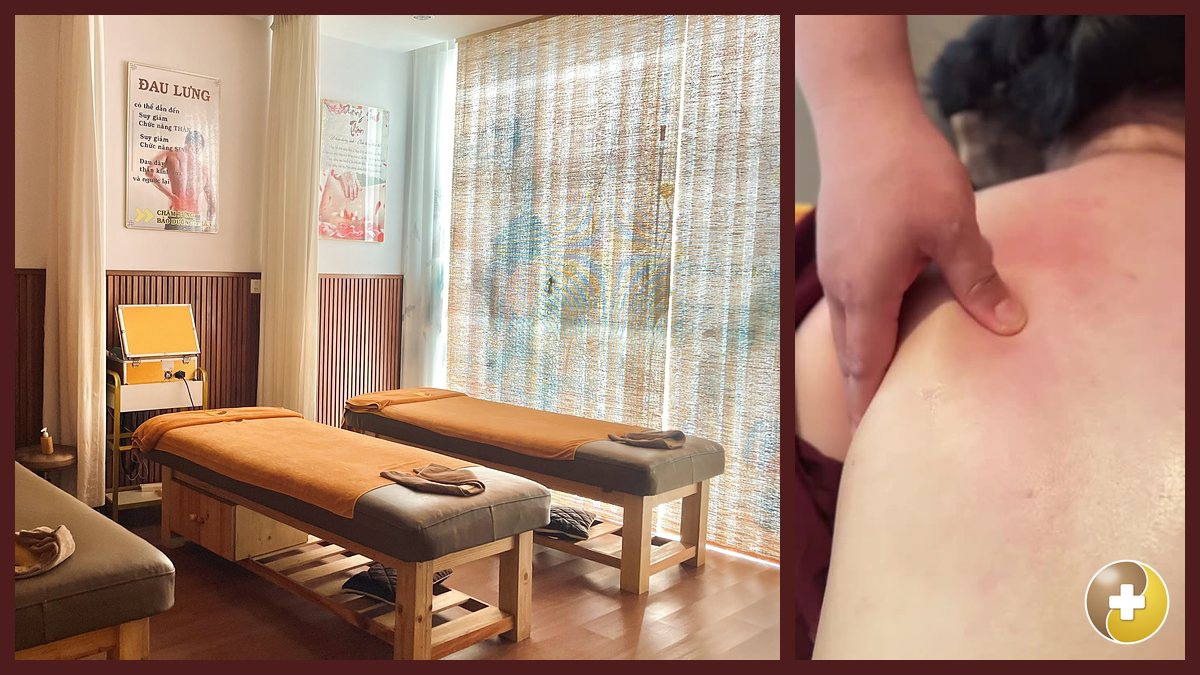
Quick answer: Acupressure by hand, with the right pressure on the right areas, is safe for most people. Problems usually come from pressing too hard, neck cracking, pregnancy or an unchecked health condition. Tong Gia Acupoint Wellness (Huyệt Đạo Tống Gia) in District 12 and Vinhomes Grand Park, Ho Chi Minh City, always asks about your health first.
Want Lương Y Tống Văn Huynh’s team to read your spine and posture in person?
What acupressure is, and how safe it really is
Acupressure means pressing, kneading and pushing on fixed points and areas of the body with a fingertip, the whole hand or the forearm. In Western terms, the pressure travels through skin, muscle and tendon and reaches the sensory nerve endings underneath. Those signals run back to the spinal cord, which sits inside the spinal canal; nerve roots leave it on both sides through the gaps between the vertebrae. With the right amount of pressure, the body answers with a contract-and-release response in the muscle, and the area feels warm and lighter. With too much pressure, the same nervous system reacts the other way: the muscle guards, the skin bruises, and some people feel faint or nauseous.
So the short answer to "is acupressure safe?" is: done by hand, with the right pressure, on the right areas and for the right person, it is safe for most people. Three things decide how safe a session is: pressure, the area being worked and your own health. Miss one of them and a relaxing hour can turn into a week of soreness.
In Ho Chi Minh City this question usually comes from expats who spend all day in air-conditioned offices in District 2, Thu Duc or the Saigon Hi-Tech Park and fear "hitting a nerve"; from visitors who heard about a roadside neck crack that left someone dizzy all afternoon; from women who are pregnant or trying to conceive; and from people bringing older parents with heart or blood pressure issues. This guide explains where the real risks lie, who should be careful, which signs mean stop, and how Tong Gia screens before every session. The method is a traditional Vietnamese approach to Eastern wellness built by Lương Y (master of traditional Vietnamese wellness) Tống Văn Huynh.
Common causes of discomfort or risk
Most stories of "I felt worse afterwards" have little to do with the points themselves. They come from technique, timing, and whether anyone asked questions first.
Technique
- Too much pressure from the start. "No pain, no gain" puts full body weight on one point. Muscle squeezed suddenly tightens to protect itself, small vessels under the skin break, and you get bruises and days of soreness.
- Neck cracking. The pop sounds satisfying, but a fast twist loads the upper neck, where many nerve roots and the vessels to the head pass. People whose deep muscles at the base of the skull are already tight can feel dizzy afterwards.
- Working areas that should be left alone. The Tong Gia course material calls skin that is cooler than normal an "inhibited" zone and says it is never worked directly; only "excited" zones that are warmer, tighter and more tender are addressed. Pressing everywhere does not help; it only tires the body.
- Staying too long on one spot. The rule is to stop as soon as the skin over the key point turns from dry to slightly moist.
Habits and timing
- Right after a big meal: no strong pressure on the belly; wait about 1–2 hours.
- Very hungry or short on sleep: lying face down for a long time and then sitting up fast can make you light-headed.
- Fever: postpone the session; fever with flank pain or burning urination needs a check-up.
- Stiff muscles from air-con and phone use: the stiffer the muscle, the more it hurts under hard pressure, so pressure must build slowly.
Who should be careful
- Pregnant, or could be: no Hegu (LI4, 合谷) on the back of the hand, no Sanyinjiao (SP6, 三阴交) on the inner shin, care with Guanyuan (CV4) below the navel, and no belly work.
- People taking anticoagulants (blood thinners): you bruise and bleed easily, so light pressure only, away from bruises.
- Heart condition, stent or pacemaker: get the opinion of the health worker following you; no strong work on the chest or over the device.
- High blood pressure, kidney disease, diabetes: careful questions, gentle work, following your health worker's advice.
- Severe osteoporosis or a chest injury: no tapping, no heavy pressure on the spine or ribs.
- Recent abdominal surgery, a tumour, acute belly pain or a clotting disorder: ask your health facility first.
Signs to watch during and after a session
- Normal: a tender "good ache" at the point, warmth spreading, lighter shoulders and sleepiness afterwards. The course calls this a wave of sensation: a pleasant ache that makes the muscle contract and release so the body can rebalance itself.
- Say so at once, so the practitioner stops: tingling or electric pain down the arm or hand, dizziness, nausea, a racing heart, shortness of breath, cold sweats, a sharp stabbing pain.
- Watch afterwards: bruises that spread or swell, pain that grows instead of easing, a severe headache, numbness or weakness in a limb.
- Mention when booking: easy bruising for no clear reason, bleeding gums, swollen ankles, dizziness when changing position, chest pain on effort.
Our acupressure massage Saigon Q&A covers how a session feels and how to ask for lighter pressure.
When to see a doctor
Call 115 immediately, with no massage and no acupressure, for chest tightness, shortness of breath or cold sweats, or a drooping mouth, weakness on one side or slurred speech.
Please see a doctor at a medical facility before acupressure if you have:
- Chest pain or pressure lasting more than 5–10 minutes that does not ease with rest, or pain spreading to the left arm, shoulder, neck or jaw.
- Fainting or near-fainting; a pounding heartbeat with dizziness.
- New numbness or weakness in the arms or legs; a newly crooked tongue or mouth in an older person.
- Easy bruising, bleeding gums, yellow skin or eyes.
- Anaemia, pale skin, heavy tiredness or unexplained weight loss: get checked at a medical facility alongside any wellness care.
- Fever with flank pain or burning urination; swelling of the face or legs.
After a session, see a doctor if pain gets worse and lasts more than 2–3 days, bruising spreads widely, a limb goes numb or weak, or you feel very dizzy, nauseous or unsteady. If you are already under a doctor's care, keep following their advice.
This is a wellness service, not medical care.
The face-reading view: who needs a lighter touch
Y Tướng Học (face reading for wellness) says "the signs show outside, the organs lie inside": what appears on the surface reflects the organ systems within. At Tong Gia this is never used to judge anyone; it tells the practitioner who needs lighter pressure, which areas to avoid and who should get checked first. The course material pays close attention to these signs:
- Thin, brittle, ridged nails: in Eastern wellness the Liver stores blood and "shows in the nails". Weak Liver blood often comes with dizziness and cramps, so pressure on the neck stays light and you sit up slowly.
- Pale lips, tired limbs, easy bruising: the Spleen shows in the lips and "keeps blood inside the vessels". When it is weak you bruise easily, so firm pressure leaves marks.
- A very pale or flushed face, bluish lips or fingertips: the Heart shows in the face and tongue. Bluish lips or fingertips are a warning sign: no session, and advice to get checked.
- A flat, sunken or uneven back of the skull with dull skin: this links to the Kidney and the Governor Vessel; the Kidney governs bone and marrow, and the brain is the "sea of marrow". It often comes with tight deep muscles at the base of the skull and dizziness on standing, so C1–C3 is never twisted or pressed hard.
- A tongue that veers to one side in an older person: the course lists this as a danger sign that needs an urgent check-up, not acupressure.
Spine, nerves and reflex areas involved
According to the Tong Gia course, the cervical vertebrae C1–C7 serve the head, face, neck and arms; the thoracic D1–D12 relate to circulation, breathing and digestion; the lumbar L1–L5 to digestion, kidneys, urinary and reproductive function and the legs; S1–S5 to elimination. The table shows links only, not a conclusion about any condition.
| Vertebrae / area | Related nerves / function | What to watch when pressing | Organ link (Eastern view) |
|---|---|---|---|
| C1–C3 (base of skull) | Head, face; deep neck muscles, vessels to the brain | Dizziness or headache if pressed hard or twisted | Kidney (bone, marrow), Liver |
| C4–C7 (lower neck) | Nerve roots to shoulder, arm, hand | Tingling down the arm: stop and move on | Liver (governs the tendons) |
| D4–D5 (upper back, chest) | Circulation, breathing; Jueyin Shu (BL14) below T4, Heart Shu (BL15) below T5 | Heart condition, stent, pacemaker: gentle kneading only | Heart, Lung |
| D11–D12 (mid back) | Digestion; Spleen Shu, Stomach Shu | After a full meal: no strong belly pressure; easy bruising: light touch | Spleen–Stomach |
| L1–L5, lower belly | Kidneys, urinary, reproductive, legs; Guanyuan (CV4) | Pregnancy: no belly work, care with Guanyuan | Kidney |
| Hands, legs | Hegu (LI4) between the 1st and 2nd hand bones; Sanyinjiao (SP6) above the inner ankle | Not used during pregnancy | Large Intestine; Spleen–Liver–Kidney |
The upper neck comes first because it is short and narrow, crowded with nerve roots and vessels, and it is exactly where people like to "crack it". That is why the hands read it before any work is done.
The Tong Gia method: how spinal nerve-reflex balancing stays safe
The method was built by Lương Y Tống Văn Huynh over more than 13 years of Eastern wellness, Y Tướng Học and spinal nerve-reflex balancing. A session follows six steps: observe the face and body → ask safety questions → read the spine by hand → work in order → care for the organ systems → coach you on self-care.
The "rules of the hand"
- Five pressure levels, light to strong: one finger → whole hand → bent arm → straight arm → whole-body strength. First-timers, older guests and people on anticoagulants stay at the light levels.
- Only excited zones are worked; inhibited zones are never pressed directly.
- Direction: the spinal canal is the axis for every push or rotation, with no sudden jerk.
- Dose: when the skin over the key point turns moist, that point is done.
- Temperature: skin warmth is tracked, bringing hot areas down and cool ones up.
- Stop sign: any unusual reaction means the work stops at once.
What a real session looks like
A first 60-minute neck and shoulder session in District 12 for a guest who said in advance that they take anticoagulants usually goes like this. The practitioner checks the history again: heart, blood pressure, pregnancy, last meal. Then comes observation of face colour, lips, nails and neck posture. With you lying face down, the hands glide and probe along the spine to read four things: skin temperature, the muscle layer, the shape of each vertebra and tender points. The lower neck and upper back are often warmer, with ropey bands of muscle; cool areas are left alone. Muscle release uses one finger and then the whole hand, never the arm or body weight, and avoids old bruises. Each point is worked until the skin turns moist, then the next. You leave with simple self-care tips and a note for next time.
Suitable services and prices
- Traditional Vietnamese massage, 60 min: 450,000 VND (about 17 USD), moderate pressure, good for a first try.
- Neck & shoulder session, 60 min: 550,000 VND (about 21 USD); first visit 399,000 VND (about 15 USD). See the first-visit page.
- Herbal hair wash with neck & shoulder massage, 60 min: 250,000 VND (about 10 USD), gentle, suits older parents.
All services are on the price list. For the neck in particular, read our neck and shoulder massage Saigon Q&A.
How guests usually feel
During the session most guests feel a pleasant ache at each point and warmth spreading through the shoulders and back; many fall asleep. Afterwards the neck turns more easily and the head feels lighter. Every body responds differently. Tong Gia does not promise that pain will be gone after one visit; the work helps rebalance each spinal segment and supports organ function according to your own constitution.
Want Lương Y Tống Văn Huynh’s team to read your spine and posture in person?
Safe self-care and prevention at home
- Use a fingertip, the lightest of the five levels, until you feel a pleasant ache; do not let someone lean their full weight on your back.
- Never crack your own neck. Tilt your head slowly to each side while breathing out.
- If you could be pregnant, do not press Hegu or Sanyinjiao, and do not rub the belly.
- Do not rub the belly right after a big meal; wait 1–2 hours.
- Cover your neck in air-con and stand up every 45–60 minutes.
Bringing your parents? Read booking a massage for parents in Vietnam. New to the style? Start with the traditional Vietnamese massage Q&A or the acupressure massage page.
Booking
When you book, please mention pregnancy, anticoagulants, heart issues, blood pressure or recent surgery so the practitioner can plan the pressure and areas. Next time you are in Ho Chi Minh City, come and try this Vietnamese Eastern-wellness method.
- District 12: 225 Dương Thị Mười, Phường Tân Chánh Hiệp (Tan Chanh Hiep Ward, District 12). Daily 8:00–19:00, 4.9★ from 235 Google reviews.
- Vinhomes Grand Park: Căn T16-21 khu Manhattan, Phường Long Bình, TP. Thủ Đức (Unit T16-21, The Manhattan, Long Binh Ward, Thu Duc City, formerly District 9). Daily 9:00–20:00, 5.0★ from 208 reviews.
Call, WhatsApp or Zalo +84 888 264 559, or book online.
Visit us
- Đông Y Huyệt Đạo Tống Gia Quận 12 (District 12)
225 Dương Thị Mười, Phường Tân Chánh Hiệp, Quận 12, HCMC · 8:00–19:00 daily · 0888 264 559 · Directions on Google Maps - Đông Y Huyệt Đạo Tống Gia Quận 9 (Vinhomes Grand Park, District 9)
Căn T16-21 khu Manhattan, Vinhomes Grand Park, Phường Long Bình, TP. Thủ Đức, HCMC · 9:00–20:00 daily · 0888 264 559 · Directions on Google Maps
Want Lương Y Tống Văn Huynh’s team to read your spine and posture in person?
FAQ
Is acupressure safe? Acupressure by hand, with the right pressure on the right areas, is safe for most people. Problems usually come from pressing too hard, neck cracking, pregnancy or an unchecked health condition, so a practitioner should ask about your health and build pressure slowly.
My neck and shoulders hurt after a massage. Is that normal? A mild, pleasant ache in the worked area is normal and fades after the session. If pain grows, lasts more than 2–3 days, bruising spreads or your arm goes numb, get checked at a health facility, and ask for lighter pressure and no neck cracking next time.
Why do I get a headache after a massage? It often happens when the base of the skull (C1–C3) is pressed too hard or the neck is twisted, or when you lie face down for long while hungry or tired. Rest and keep the neck warm. A severe headache with vomiting, a drooping mouth or one-sided weakness means calling 115.
I feel dizzy after eating. Should I still get acupressure? Wait about 1–2 hours after a meal, and avoid strong belly pressure. If dizziness keeps coming back, or comes with palpitations, breathlessness or near-fainting, get checked at a health facility before acupressure.
Can older people who get dizzy have acupressure? Yes, once warning signs have been checked. Pressure stays light, the neck is never twisted, and they sit up slowly. A newly crooked tongue or mouth, or weakness on one side, needs an urgent check-up instead.
Can I get acupressure while pregnant? During pregnancy Hegu (LI4) and Sanyinjiao (SP6) are not used, Guanyuan (CV4) is handled with care and the belly is not worked on. Ask the health facility following your pregnancy first and mention it when booking.
Can I have acupressure if I take anticoagulants? Usually yes, with light pressure only, away from bruises and never pressing hard. Mention it when booking. If you bruise for no clear reason or your gums bleed, get checked first.
Author: Lương Y Tống Văn Huynh – founder of Huyệt Đạo Tống Gia, a master of traditional Vietnamese wellness with over 13 years in Eastern wellness care, Y Tướng Học (face reading) and spinal nerve-reflex balancing massage.
Updated: 2026-11-15
Related guides
This is a wellness service, not medical care.