
Trigger points: why a knot in the shoulder or hip sends pain to the head or leg, and how Tong Gia finds and releases it in Ho Chi Minh City
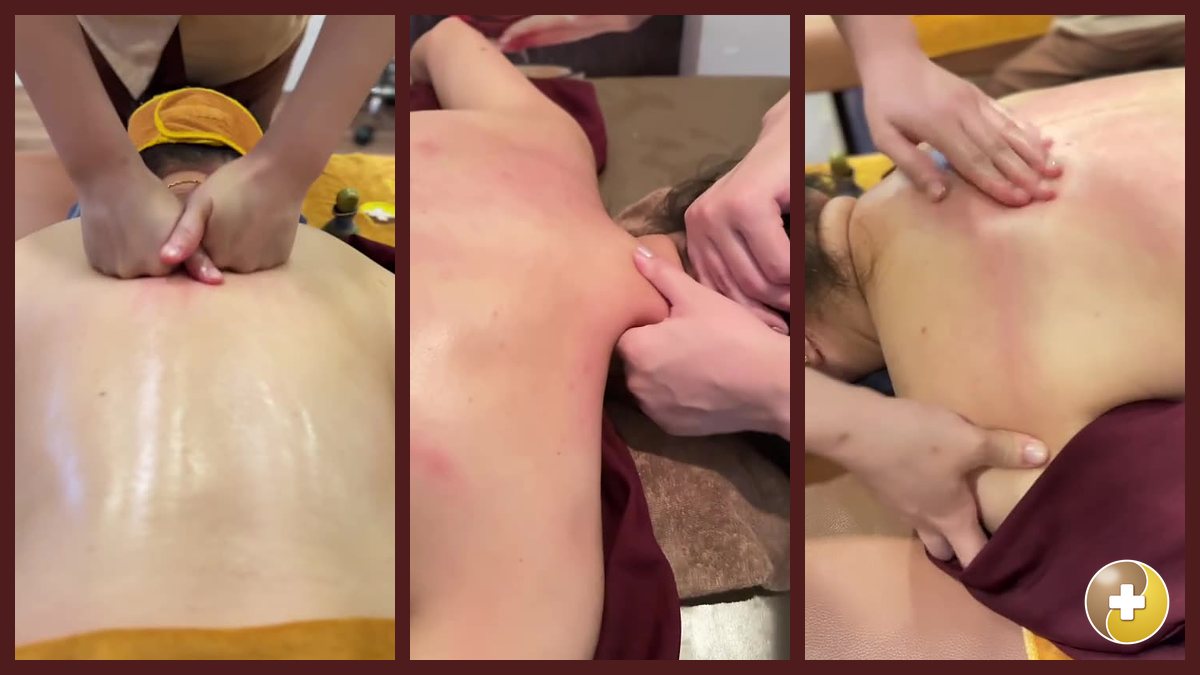
Quick answer: A trigger point is a small knot in a tight band of muscle that will not let go; pressing it hurts and sends pain elsewhere, for example from the top of the shoulder to the temple. Tong Gia Acupoint Wellness in District 12 and Vinhomes Grand Park, District 9, Ho Chi Minh City finds the knot by hand along the spine and releases it.
Want Lương Y Tống Văn Huynh’s team to read your spine and posture in person?
What is a trigger point?
"I press a small lump on my shoulder and the pain shoots up to my temple." Many expats and visitors describe it exactly like that when they come to Tong Gia Acupoint Wellness (Huyệt Đạo Tống Gia). That lump is a trigger point: a small, tender knot inside a taut band of muscle that feels like a pea or a tight guitar string under the fingers.
The Western explanation. Muscle fibres normally contract and relax in rhythm. When a small group of fibres is held tight for too long, or overloaded, it contracts and does not fully let go. That tight spot squeezes tiny blood vessels, local blood supply drops, waste products build up, and the nerve endings in the area become more sensitive. So light pressure hurts, and the brain reads the signal as coming from another area that shares the same nerve pathway. This is called referred pain: you press here and feel it there.
There are two common kinds. An active trigger point hurts even when nobody touches it. A latent one only hurts when pressed, but still makes the muscle stiff, weak and quick to tire. Many people carry latent points for years until late nights, stress or a long day under the air-con wake them up.
| Muscle | Where the knot sits | Where the pain often goes |
|---|---|---|
| Upper trapezius | Middle of the shoulder ridge | Behind the ear, temple, jaw angle |
| Levator scapulae | Top corner of the shoulder blade | One side of the neck, hard to turn the head |
| Suboccipital muscles | Hollow just under the skull | Top of the head, behind the eyes |
| Spinal muscles | Both sides of the mid-back | Shoulder blade, side of the ribs |
| Gluteus medius | Upper outer buttock | Outer thigh, sometimes the calf |
In Ho Chi Minh City we see trigger points most often in office workers on laptops 8–10 hours a day under air-con, engineers in the Saigon Hi-Tech Park, drivers who spend hours on the road, parents carrying small children, and people who lift, run or play badminton and pickleball without stretching.
Common causes: habits, work, posture and environment
- Holding one position too long: looking down at a phone, pushing the chin toward the screen, shrugging while typing. The trapezius and levator scapulae hold the weight of your head for hours.
- Repetitive work: sewing, nail work, warehouse lifting, long hours at the steering wheel or on a motorbike.
- Air-con blowing on the neck: cold makes muscle tighten; a whole day under a cold draft keeps it from relaxing.
- Training too hard without a warm-up: adding weight fast, or a long weekend run after a week at the desk.
- Stress and short sleep: the shoulders creep up and the jaw clenches without you noticing, and the muscle never gets time to recover.
- Carrying on one side: a heavy bag, a one-strap backpack, holding the phone between ear and shoulder.
- Too little water: in Saigon heat, a dehydrated muscle tires and cramps more easily.
Other signs to watch
- A stiff neck that catches when you turn one way.
- Headaches at the temple, the back of the head or behind the eyes, often worse in the afternoon.
- Heavy shoulders and a rope-like band when you squeeze them.
- Tired, dry eyes after screen time.
- A small twitch when the knot is pressed.
- Light sleep because lying on either side presses on the sore spot.
- A vague heavy or tingly arm that does not follow one nerve line and eases when you change position.
- Grip that tires quickly.
When to see a doctor
Trigger points are usually harmless, but some signs suggest the cause is not in the muscle. Please see a doctor at a medical facility first, and skip massage for now, if you notice:
- Chest pain or tightness, shortness of breath, cold sweat, or pain spreading to the left arm or jaw: call 115 immediately.
- A sudden severe headache with vomiting, double vision, slurred speech or a drooping face: call 115.
- Numbness or weakness in an arm or leg, or dropping things.
- A swollen, hot, red area, fever, or a stiff neck with fever.
- Pain after a crash, a fall or a blow.
- Pain at night at rest, or constant pain that does not change with position.
- Unexplained weight loss or lasting fatigue: get checked at a medical facility alongside any wellness care.
- No improvement after one to two weeks of rest and warmth.
If a doctor is already following your neck or spine, keep to their advice and tell the practitioner before the session. This is a wellness service, not medical care.
The Y Tướng Học view: the Liver governs the sinews
Y Tướng Học (face reading for wellness) rests on one line: "what is inside shows on the outside." According to the Tong Gia curriculum, the Liver system in Eastern medicine has three roles linked to muscle knots. It keeps qi flowing smoothly (when this fails: tight chest, irritability, poor sleep). It stores blood and sends it to muscles and tendons when you move (when blood is short: dry eyes, brittle nails, cramps). And it nourishes the sinews, keeping tendons supple and joints free.
The curriculum describes a muscle type practitioners often meet in people with many knots: muscle bound tight like wood, dry, or sore to the touch. In Eastern terms this leans toward qi stagnation and Liver qi constraint: mental pressure blocks the flow and causes long-lasting deep spasm, especially in the trapezius and the long muscles beside the spine, with aches and tension headaches.
What does it look like outside? For the neck and shoulder group, linked to the Liver and Kidneys, the practitioner looks at the cheekbones, eyebrows, forehead lines and how firm the flesh feels. High, bony cheekbones with little cover often go with deep tendon tension. A broad forehead with a wide jaw often comes with uneven tension left and right. A flat back of the skull is noted with deep spasm at the base of the skull. Common Liver signals: dry tired eyes, irritability, tight shoulders, cramps. This is traditional reference knowledge to choose where to look first, not a medical finding.
Spine segments and nerve-reflex areas involved
In the Tong Gia curriculum the neck vertebrae C1–C7 relate to the head, face, neck and arms; the thoracic D1–D12 to circulation, breathing and digestion; the lumbar L1–L5 to the lower limbs. Nerve roots leave between the vertebrae, so a tight band beside the spine can make a distant area ache.
| Vertebrae | Nerve area / function | Common signs | Related organ (Eastern view) |
|---|---|---|---|
| C1–C3 | Base of skull, head | Heavy head, pain to the crown | Kidney, Liver |
| C4–C7 | Neck, shoulders, arms | Stiff trapezius, knot on the shoulder ridge | Liver |
| D1–D3 | Upper back, chest, breathing | Knot between the shoulder blades, shallow breath | Lung, Heart |
| D7, D9 | Mid-back, digestion | Tight bands along the spine, rib-side ache | Liver, Spleen |
| L4–S1 | Low back, hips, legs | Knot in the buttock, pain down the outer thigh | Kidney |
How Tong Gia works: spinal nerve-reflex balancing massage
This is a Vietnamese Eastern wellness method built by Lương Y (master of traditional Vietnamese wellness) Tống Văn Huynh over more than 13 years of practice. The practitioner does not just squeeze where you point; they look for the source knot behind the referred pain.
- Observe: posture, which shoulder sits higher, complexion, cheekbones; questions about where the pain travels, desk hours, training, sleep.
- Read the spine by hand: skin temperature, the muscle layer, the shape of each vertebra and your feedback, comparing left and right.
- Narrow it down: from a wide area to a key zone to the key point, the small knot driving the whole pattern.
- Muscle release: pushing and rolling to soften thick bands, cross-fibre strokes on rope-like fibres, pressure building from one finger to the full hand.
- Acupressure on the right points, and stop on time: work ends when the skin over the point turns from dry to slightly moist.
- Home care: how to press the knot yourself and what to change at your desk.
A typical session. With an office worker who has a knot on the right shoulder, the practitioner sees the right shoulder sitting higher and the chin forward. Along C4–C7 and D1–D3 the right side is warmer, thicker, with a tight band; pressing it sends pain to the temple, matching the afternoon headache. The upper back is softened first, then the knot with gradually stronger pressure. When the band softens and the skin turns moist, work moves to the base of the skull and the mid-back. At the end you sit up, turn your neck and learn a 20–30 second self-press.
Suitable services (full list on the price page):
- Neck and shoulder care, 60 minutes: 550,000 VND (about 21 USD); first visit 399,000 VND (about 15 USD); 90 minutes 750,000 VND (about 29 USD).
- Back and waist care, 60 minutes: 550,000 VND (about 21 USD), first visit 399,000 VND, for knots in the low back and buttock.
- Extra 30 minutes on one area: 199,000 VND (about 8 USD).
How it feels. When the knot is found you feel a sharp tenderness that travels to your usual sore spot, which tells us it is the right point. Pressure builds slowly, so it is a "good hurt", then warmth and release. Afterwards many people find their shoulders drop, the neck turns further and sleep comes more easily. Some feel mild soreness for a day. Results vary; Tong Gia helps the muscles rebalance and does not promise the pain will vanish. More guest experiences: neck and shoulder massage Q&A, acupressure massage Q&A, back massage Q&A and massage after running.
Want Lương Y Tống Văn Huynh’s team to read your spine and posture in person?
Home care and prevention
- Stand up every 30–45 minutes: shrug and drop the shoulders five times, roll them back; raise the screen to eye level.
- Warm compress for 10–15 minutes on the knot in the evening; never on a swollen, hot area.
- Gentle self-press: lean a tennis ball against the wall on the knot for 20–30 seconds at a "good hurt" level, breathe slowly, release.
- Stretch after training: 30 seconds per muscle, twice; add weight gradually.
- Keep the neck warm and sleep enough: keep air-con off your neck, switch bag sides, drink water, go to bed before 11 pm.
Book a session
- District 12: 225 Dương Thị Mười, Phường Tân Chánh Hiệp (Tan Chanh Hiep Ward, District 12). Open 8:00–19:00 daily.
- Vinhomes Grand Park, District 9: Căn T16-21 khu Manhattan, Phường Long Bình, TP. Thủ Đức (Unit T16-21, Manhattan zone, Long Binh Ward, Thu Duc City). Open 9:00–20:00 daily.
Book online or call, Zalo or WhatsApp +84 888 264 559. Tell us where the knot is and where the pain travels. Real reviews are on each branch's Google Maps page. Visiting Ho Chi Minh City? Come and try a Vietnamese Eastern wellness method built by Lương Y Tống Văn Huynh.
Visit us
- Đông Y Huyệt Đạo Tống Gia Quận 12 (District 12)
225 Dương Thị Mười, Phường Tân Chánh Hiệp, Quận 12, HCMC · 8:00–19:00 daily · 0888 264 559 · Directions on Google Maps - Đông Y Huyệt Đạo Tống Gia Quận 9 (Vinhomes Grand Park, District 9)
Căn T16-21 khu Manhattan, Vinhomes Grand Park, Phường Long Bình, TP. Thủ Đức, HCMC · 9:00–20:00 daily · 0888 264 559 · Directions on Google Maps
Want Lương Y Tống Văn Huynh’s team to read your spine and posture in person?
FAQ
Is a trigger point dangerous? Usually not; it is a tight muscle knot that causes local and referred pain. But numbness or weakness, fever, a hot swollen area, night pain, weight loss, or chest pain with breathlessness need a medical check first; chest tightness with cold sweat means calling 115.
Is a hard lump at the back of my neck a trigger point? It may be, if it sits inside the muscle, sends pain elsewhere when pressed and softens with warmth and massage. A round lump under the skin that moves, grows, or comes with fever or weight loss may be a lymph node and should be checked at a medical facility.
Why do my shoulders tighten again even after many massages? Often only the sore spot was worked, not the source knot, or the habit behind it is still there: shrugging at the desk, air-con on the neck, short sleep. Tong Gia reads the spine by hand to find the key point and shows home care, but desk habits matter too.
Does acupressure on the neck and shoulders hurt? There is a sharp tenderness when the knot is found, but pressure builds slowly with your feedback, so it feels like a good hurt followed by warmth. Say so if it is too much and the practitioner eases off. Mild soreness for a day is common.
What should I do for shoulder pain from a muscle strain? If it started after one sudden movement, rest that movement for 48 hours, move gently and use cold if it is warm or swollen; then warmth, light stretching and muscle release. For an old knot, use warmth, gentle self-press and regular neck and shoulder care.
Can I book in English? Yes. Message +84 888 264 559 on Zalo or WhatsApp, or book online, and describe where the knot is and where the pain travels so the practitioner can prepare.
Author: Lương Y Tống Văn Huynh – founder of Huyệt Đạo Tống Gia, a master of traditional Vietnamese wellness with over 13 years in Eastern wellness care, Y Tướng Học (face reading) and spinal nerve-reflex balancing massage.
Updated: 2026-11-15
Related guides
- Neck and shoulder muscle strain: how it differs from everyday stiffness, what to do in the first 48 hours and when massage makes sense in Ho Chi Minh City
- Trigger points: why a knot in the shoulder or hip sends pain to the head or leg, and how Tong Gia finds and releases it in Ho Chi Minh City
This is a wellness service, not medical care.