
Acupressure for finger joint pain: which points, how it works and when to get checked first
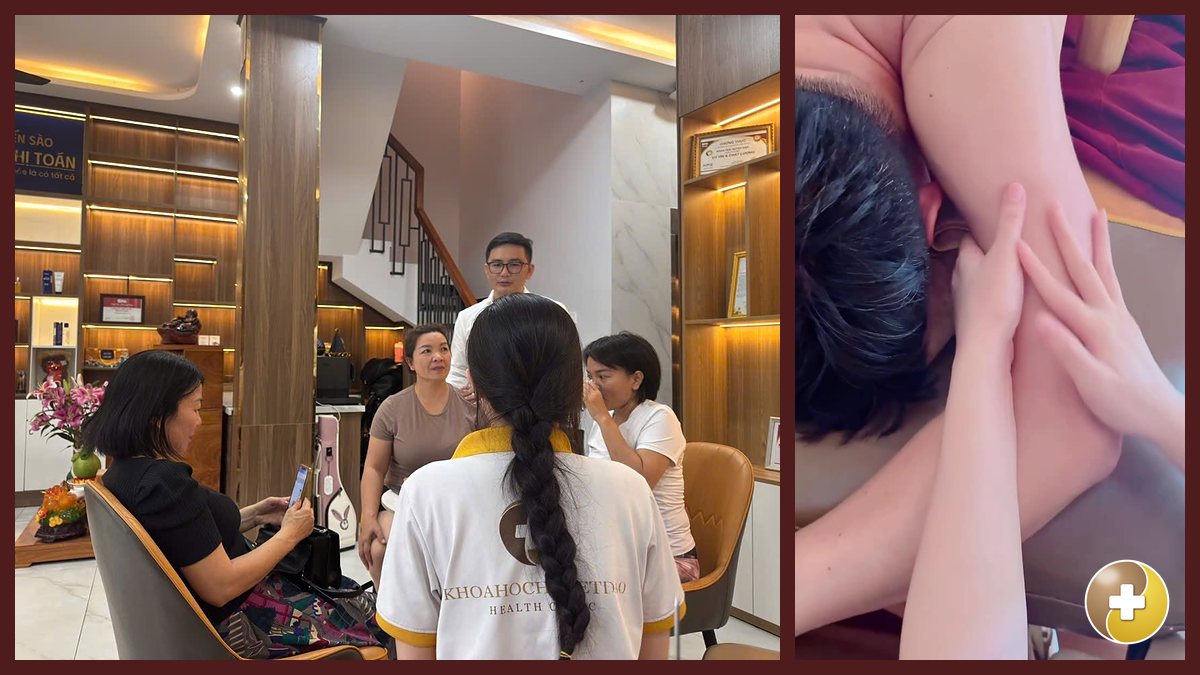
Quick answer: Acupressure for finger joint pain can help the tendons and muscles around the joint soften, but it cannot change a worn joint. Points often used around the hand are Hợp cốc, Ngư tế, Thái uyên and Liệt khuyết. A hot, red, swollen joint needs a medical check first. Tong Gia Acupoint Wellness in Ho Chi Minh City works the points after reading the neck.
Want Lương Y Tống Văn Huynh’s team to read your spine and posture in person?
What is acupressure for finger joint pain?
Finger joint pain means aching, soreness, stiffness or swelling in the knuckles: at the base of the finger, in the middle joint or near the tip. People notice a weaker grip, trouble opening jars or doing buttons, tighter rings, and fingers that need a few minutes to loosen in the morning. In Western medicine finger joint pain is a symptom that can come from the joint, the tendons around it or the nerves that run down to the hand.
Many people search for "acupressure for finger joint pain" hoping for a single point that makes the pain go away. In the Tong Gia curriculum, acupoints never stand alone. The approach of Tong Gia Acupoint Wellness (Huyệt Đạo Tống Gia) follows a chain: read outward signs to understand the organs, read the spine by hand to find the zone, then release muscles and press points in the right places. The hand sits at the end of the meridians that run along the arm and at the end of the nerve roots from the lower neck, so comfortable fingers start at the neck, shoulder and elbow. Acupressure cannot change a joint that has worn or deformed; what it can support is softer tendons and muscles around the joint, better circulation, relaxation and less stiffness.
In Ho Chi Minh City the people who ask are often tailors, nail and hair technicians, office workers, market traders lifting goods, home cooks and older residents whose knuckles swell each morning. If morning stiffness is your main issue, see stiff fingers in the morning.
Common causes of finger joint pain
- Osteoarthritis of the fingers: common from middle age, especially after menopause and in people who have used their hands for years. Pain and stiffness at the tip joints or the base of the thumb, sometimes small hard bumps, worse with use and better with rest.
- Inflammatory arthritis such as rheumatoid arthritis: swollen base and middle joints on both hands, morning stiffness over 30 minutes, tiredness. This needs medical follow-up.
- Gout: one joint suddenly hot, red and very painful, often at night or after drinking or a heavy meal.
- Trigger finger and flexor tendon irritation: the finger catches when bending and snaps when straightened, with pain at the base on the palm side; common with scissors, steering wheels and tools.
- Overuse and small injuries: a finger caught in a door, a ball hitting the fingertip, sprains, or endless small movements like filing nails or texting.
- Pain from the neck and arm: irritated C6–C8 nerve roots and tight forearm muscles make fingers ache, tingle or feel "stiff" without swelling.
Cold workplaces, air-conditioning, cold water, poor sleep and stress make it worse. People who work with their hands often have two layers at once: tiring finger joints and a tight neck, shoulder and forearm. Acupressure supports the second layer well.
Signs worth noting
- Which joint and which finger, on which hand.
- Swelling, warmth, redness; one joint or many; both hands symmetrically or not.
- How long morning stiffness lasts (a few minutes versus over 30 minutes).
- Catching or snapping when bending.
- Numbness: thumb to middle finger suggests the carpal tunnel or C6–C7; ring and little finger suggest the ulnar nerve or C8–D1.
- Rings becoming tight, bent fingers, and whole-body signs such as fever, weight loss, rash or other painful joints.
When to see a doctor
- A finger joint that is suddenly hot, red and very painful, especially at night: possible gout or infection. No massage on that joint.
- Many small joints in both hands swollen and stiff for over 30 minutes each morning, with tiredness or mild fever.
- Pain after an injury, with bruising, a bent finger or inability to straighten it.
- Lasting numbness or weakness, dropping things, wasting of hand muscles.
- Fingers turning white or purple in the cold, or sores on the fingertips.
- Pain getting worse over two to three weeks despite rest.
- Left arm pain with chest tightness, shortness of breath or sweating: call 115 immediately.
- Diabetes, kidney disease, pregnancy, pale skin or unexplained weight loss: get checked alongside any wellness care.
If a doctor has already found finger osteoarthritis or arthritis, keep following that plan; acupressure is extra care. This is a wellness service, not medical care.
The Y Tướng Học view: which organs link to the fingers?
The Tong Gia curriculum links finger joints and tendons with three organ systems. The Liver governs the sinews: when it is strong, tendons are supple and joints flexible; when weak, muscles tighten, cramp and lose flexibility, and nails become thin, ridged and brittle. The Kidney governs the bones; the curriculum describes weak Kidney qi with early ageing of bones and joints, dry creaky joints, sensitivity to weather and deep aches when the season changes. The Spleen governs the muscles and four limbs; when weak, the hands feel heavy and tired.
What is inside shows outside. The practitioner looks at the knuckles (the curriculum says well-balanced people do not show bony knuckles even when slim; prominent knuckles are "more bone than flesh", linked with dryness of the joints), the nails, the ears (thin, soft ears are linked with weak Kidney qi), the flesh at the base of the thumb and the forearm, and posture. These signs guide areas and pressure; they are not a medical conclusion.
Spine segments, meridians and points linked to the fingers
In the curriculum, C1–C7 govern the head, face, neck and arms, and the muscle, bone and joint group works on C5–C7, L1–L5 and S1–S5. The spine column below is general anatomy; the meridians and point locations are from the Tong Gia curriculum:
| Finger | Segment, nerve (Western anatomy) | Meridian (curriculum) | Points with locations in the curriculum | Related organ |
|---|---|---|---|---|
| Thumb | C6, median and radial nerves | Lung meridian, ending at Thiếu thương (corner of the thumbnail) | Ngư tế (LU10), Thái uyên (LU9), Liệt khuyết (LU7) | Lung; Liver (sinews) |
| Index | C6–C7 | Large Intestine meridian, from the index finger to shoulder and neck | Hợp cốc (LI4, between the 1st and 2nd metacarpals; not in pregnancy) | Large Intestine – Lung |
| Middle | C7 | Pericardium meridian, ending at the middle fingertip (Trung xung) | Nội quan (PC6) | Pericardium; Liver |
| Little | C8–D1, ulnar nerve | Heart meridian ending at the little finger (Thiếu xung); Small Intestine meridian along the outer arm | Thần môn (HT7) | Heart – Small Intestine; Spleen |
| Whole hand | D1–D3, circulation | Meridians crossing the elbow | Xích trạch (LU5, elbow crease) | Lung, Heart; Kidney |
The curriculum describes these points mainly by their organ effects and does not name a special "finger joint point". At Tong Gia they are pressed gently as part of opening the meridians through the hand, after reading the spine and releasing the muscles.
The Tong Gia method: spinal nerve-reflex balancing massage
This Vietnamese traditional wellness method was built by Lương Y Tống Văn Huynh, founder of Huyệt Đạo Tống Gia and a master of traditional Vietnamese wellness with over 13 years in the field. It follows three "no" rules: no chemicals or herbs by mouth or injection, no needles, no rough force or aggressive point pressing. A typical session:
- Screening: which joints, heat or swelling, injury, medical checks, gout, arthritis, diabetes, pregnancy. A hot red joint is not massaged.
- Observation: knuckles, nails, ears, hand muscles, shoulders.
- Reading the spine by hand from C4 to D3, comparing sides and working only "excited" zones.
- Releasing the neck, shoulder and arm down to the forearm.
- Hand work: light strokes along the finger tendons, softening the base of the thumb and the muscles between the metacarpals; around the knuckles only very light pressure, no pulling or cracking.
- Points: chosen from Ngư tế, Thái uyên, Liệt khuyết, Hợp cốc, Nội quan, Thần môn and Xích trạch according to the painful finger, starting with one-finger pressure.
- Stopping on time when the skin turns from dry to slightly moist, then home advice.
Suitable services: add-on area massage 30 min 199,000 VND (about US$7.70) for arms, hands and fingers; neck and shoulder care 60 min 550,000 VND (about US$21), first visit 399,000 VND (about US$15); Vietnamese traditional massage 60 min 450,000 VND (about US$17). See prices.
A typical session (a composite, not one real guest): a tailor in her fifties from Gò Vấp has had aching at the base of her right thumb and the middle joint of her index finger for months, worse after long cutting, ten minutes of stiffness each morning; a medical check found mild finger osteoarthritis without inflammation. Her knuckles are prominent, her nails ridged, her right shoulder high and the base of her thumb tight. The skin around C6–C7 on the right is warmer. The practitioner releases the neck and shoulder, works down the arm, strokes the finger tendons, softens the base of the thumb and presses Ngư tế, Thái uyên, Liệt khuyết and Hợp cốc. The thumb base feels sore at first, then warmth spreads through the hand; by the end her fingers open and close more easily. She is advised to use softer-handled scissors, rest hourly and soak her hands in warm water at night.
What guests feel: tight spots feel sore but pleasant, then ease; on the right point a mild ache may run along the finger and fade, and the hand warms. There should be no sharp joint pain. Afterwards fingers usually feel softer; wear-and-tear is long-term, so regular sessions 5–7 days apart plus less strain work together. Tong Gia supports and helps rebalance; it does not promise the pain will go after one visit. Related reading: numb fingers in cold weather.
Want Lương Y Tống Văn Huynh’s team to read your spine and posture in person?
Self-care at home and prevention
- Gentle self-acupressure: with the other thumb, make small circles on Hợp cốc (between the 1st and 2nd metacarpals) and Ngư tế (the fleshy base of the thumb) for 1–2 minutes each, just to a mild ache. No Hợp cốc in pregnancy; never press a hot swollen joint.
- Finger movement in warm water: soak the hands for 5–10 minutes, slowly make a fist and spread the fingers 10 times, touch the thumb to each fingertip.
- Less strain: thick soft handles, carry with the whole hand or forearm, rest every 45–60 minutes.
- Warmth: gloves for cold water and dishes; keep air-conditioning off your hands.
- Neck and shoulders: move them every hour, screen at eye level. Wrist pain too? Read wrist pain when putting weight on your hands.
Booking
- District 12: 225 Dương Thị Mười, Phường Tân Chánh Hiệp (Tan Chanh Hiep Ward, District 12). Open 8:00–19:00 daily.
- District 9 – Vinhomes Grand Park: Căn T16-21 khu Manhattan, Phường Long Bình, TP. Thủ Đức (unit T16-21, Manhattan zone, Long Binh Ward, Thu Duc City). Open 9:00–20:00 daily.
Call, Zalo or WhatsApp +84 888 264 559, or book online. Tell us which finger joints hurt, on which hand, whether they are swollen or warm and whether you have had a medical check. Visitors to Ho Chi Minh City are welcome to try this Vietnamese traditional wellness method built by Lương Y Tống Văn Huynh. Read also numb hands: common causes.
Visit us
- Đông Y Huyệt Đạo Tống Gia Quận 12 (District 12)
225 Dương Thị Mười, Phường Tân Chánh Hiệp, Quận 12, HCMC · 8:00–19:00 daily · 0888 264 559 · Directions on Google Maps - Đông Y Huyệt Đạo Tống Gia Quận 9 (Vinhomes Grand Park, District 9)
Căn T16-21 khu Manhattan, Vinhomes Grand Park, Phường Long Bình, TP. Thủ Đức, HCMC · 9:00–20:00 daily · 0888 264 559 · Directions on Google Maps
Want Lương Y Tống Văn Huynh’s team to read your spine and posture in person?
FAQ
Does acupressure help finger joint pain? It cannot change a worn joint, but it can support softer tendons and muscles around the joint, better circulation and less stiffness. At Tong Gia, point work comes after reading the neck and releasing the shoulder and arm.
Which acupoints are used for finger joint pain? The Tong Gia curriculum gives locations for Ngư tế, Thái uyên, Liệt khuyết, Hợp cốc, Nội quan and Thần môn around the hand and wrist, and Xích trạch at the elbow. The practitioner chooses by the painful finger. Hợp cốc is not used in pregnancy.
Why does the base of my right thumb hurt? Common reasons are wear at the thumb base joint in middle age, thumb-side tendon irritation from gripping and phone use, or pain from the neck at C6. Heat, swelling, pain after injury or stiffness in many joints should be checked.
My ring finger joint hurts and my ring is tight. Is it serious? Swelling can come from joint inflammation, gout or a knock. Remove the ring early before it gets tighter. A hot, red, very painful joint needs a medical check and no massage on that joint.
Can I press points on my fingers at home? Yes, gently for 1–2 minutes per point such as Hợp cốc and Ngư tế, stopping if pain increases. Do not press a hot swollen joint or pull and crack the fingers. No Hợp cốc in pregnancy.
Author: Lương Y Tống Văn Huynh – founder of Huyệt Đạo Tống Gia, a master of traditional Vietnamese wellness with over 13 years in Eastern wellness care, Y Tướng Học (face reading) and spinal nerve-reflex balancing massage.
Updated: 2026-11-17
Related guides
- Acupressure for finger joint pain: which points, how it works and when to get checked first
- Finger joint pain at night: causes by pain hour, warning signs and gentle care in Ho Chi Minh City
- Aching wrist: common causes, warning signs and gentle care in Ho Chi Minh City
- Numb hands and feet in older adults: six common causes, danger signs and safe care
- Numb heel: six common causes, the warning signs, and how Tong Gia can help
- Numb hands from neck and shoulder pain: the path from your neck to your fingers
This is a wellness service, not medical care.