
Neck, shoulder and lower back massage: why both ends of the spine ache together and how Tong Gia cares for them
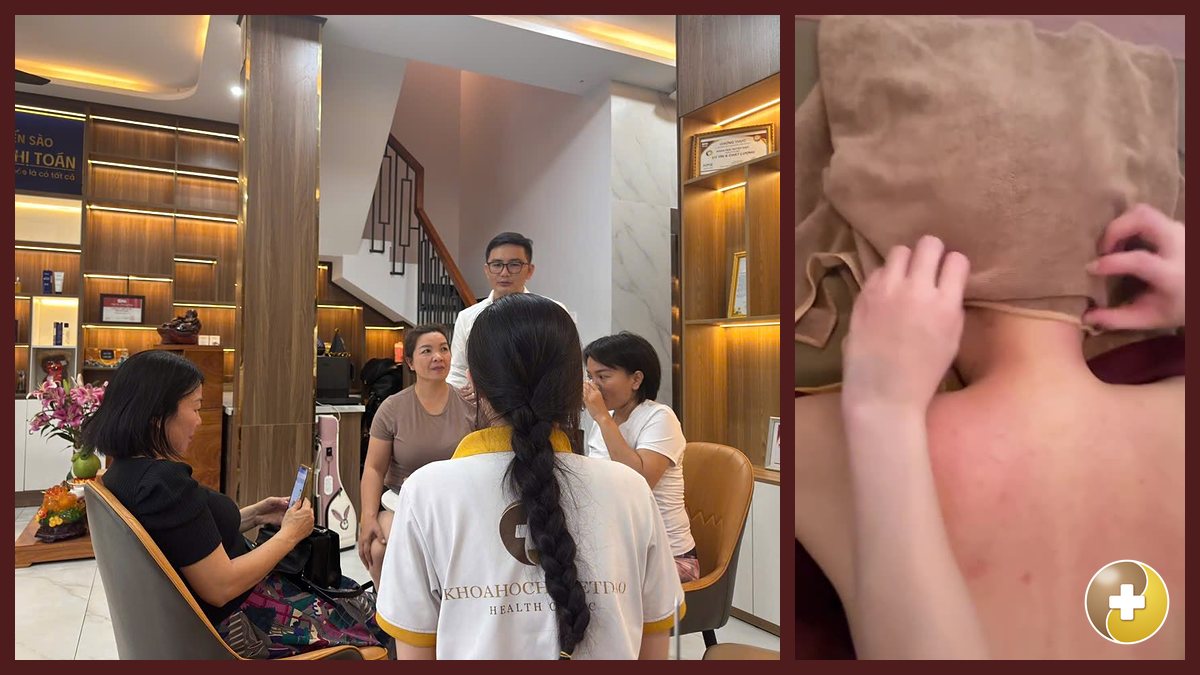
Quick answer: The neck, shoulders and lower back often ache together because the spine is one chain, so both ends need care. Tong Gia Acupoint Wellness in District 12 and District 9, Ho Chi Minh City, reads the spine from C1 to S1 before releasing the muscles. If you want care for both areas, mention it when booking; the time needed depends on your condition, and the practitioner will advise when you book. Neck-shoulder or back-waist care, 90 minutes, is 750,000 VND (about 29 USD).
Want Lương Y Tống Văn Huynh’s team to read your spine and posture in person?
Neck, shoulder and lower back massage: why both ends of the spine ache together
A neck, shoulder and lower back massage cares for both ends of the spine: at the top the back of the neck, the sides of the neck, the shoulder blades and the upper back; at the bottom the waist, the lower back, the sacrum and the glutes. Many people see these as two separate problems and book a shoulder massage one week and a back massage the next. At both branches of Tong Gia Acupoint Wellness (Huyệt Đạo Tống Gia), however, a very common complaint is both at once: "My neck is stiff, my shoulders are heavy, and when I stand up after sitting, my lower back hurts too."
In Western anatomy the spine is one continuous chain from the skull to the tailbone, with four natural curves: the neck curves forward, the upper back backward, the lower back forward and the sacrum backward. These curves balance each other. When the head drifts forward toward a phone or screen, the upper back slowly rounds; to keep the eyes level, the neck tips back and the small muscles under the skull stay contracted all day. A rounded upper back changes the pelvis and lower back too, so the lumbar muscles have to brace. It also works the other way: someone with low back pain shifts weight to one leg, the opposite shoulder rises, and the neck follows. Some muscles also connect the two areas directly: the trapezius runs from the base of the skull down to the twelfth thoracic vertebra, the latissimus dorsi runs from the mid and lower back and the thoracolumbar fascia up to the arm, and the spinal erectors run the whole length of the spine. When one end tightens, the other end is pulled.
That is why working on only one end often brings a few good days before the ache returns. Caring for both the neck and shoulders and the lower back lets both ends soften together, and posture rebalances more easily; if you want both areas cared for, mention it when booking and the practitioner will advise on the time needed. In Ho Chi Minh City this pattern is typical for office workers at Quang Trung Software Park and the Hi-Tech Park, long-distance motorbike riders, tailors and nail technicians who bend for hours, people standing at a counter or stove, and parents carrying small children.
Common causes of neck and lower back pain at the same time
- Poor desk set-up: a low screen, head forward, back not touching the chair. The neck carries the head, the upper back rounds, the lower back loses its curve; the longer you sit, the shorter the hip flexors and the lazier the glutes.
- Long motorbike rides: arms braced on the handlebars lift the shoulders, the head tilts up to watch the road, the back rounds, and vibration travels down to the lumbar spine. A heavy helmet for an hour tires the neck as well.
- Detailed work bent forward: sewing, nails, repairs, cooking on a low stool. The whole chain of muscles along the back is stretched for hours.
- Carrying on one side: a hip pushed out to hold a child, the other shoulder hitched up; over time both the neck and the lower back become uneven.
- Poor sleep support: a pillow that is too high bends the neck, a soft mattress lets the lower back sag; hammocks, dozing on the sofa.
- Cold air: air-conditioning on the neck and back, going to bed with wet hair, a sweaty shirt in a cold office.
- Lasting stress: shoulders creep up, the jaw clenches, breathing gets shallow, and the back muscles tighten too. The Tong Gia curriculum notes that long mental pressure tightens the muscles at the back of the head and the shoulder elevators, causing chronic neck and shoulder pain that spreads to the head.
The common thread is muscles that work all day with little rest. Massage helps them soften, but to keep the effect you need to change how you sit, sleep and lift, which is why every session ends with self-care advice.
Signs worth noting
- Numbness running down the arm (thumb, index or little finger), weaker grip: related to C5–C7.
- Numbness into the buttock or leg, pain worse when coughing: related to L4–S1.
- Headache at the back of the head, dizziness when turning or tipping the head back.
- Morning stiffness in both the neck and the lower back.
- One shoulder higher, one hip higher, clothes twisting to one side.
- Poor sleep because no lying position feels comfortable; lasting tiredness, a cold lower back, weak knees.
When to see a doctor
Please see a doctor at a medical facility first, and skip massage on the neck and back for now, if you have:
- Chest pain or tightness spreading to the neck, jaw, left shoulder or back, shortness of breath, cold sweat: call 115 immediately.
- A drooping face, slurred speech, sudden weakness or numbness on one side, severe dizziness: call 115 immediately.
- Numbness in the groin, difficulty controlling the bladder, weakness in both legs: go to emergency care.
- Arm or leg numbness or weakness getting worse, unsteady walking.
- Neck or back pain after a fall or accident; fever with a stiff neck.
- Night pain that rest does not ease, unexplained weight loss or lasting fatigue: get checked in parallel.
- Pain lasting more than 4–6 weeks despite rest and better posture.
This is a wellness service, not medical care. If you are being followed for a disc problem or spinal wear, keep following the advice you have been given; Tong Gia offers supportive care only.
The Y Tướng Học view: the Liver governs sinews, the Kidney governs bones
Eastern wellness explains why the neck and the lower back ache together through two organs. In the Tong Gia curriculum, the Liver governs the sinews: when strong, tendons are supple; when weak, muscles cramp and stiffen. The Liver also stores blood and sends it to the sinews when you move. The Kidney governs the bones and produces marrow; when it weakens, "the lower back and knees ache", and the lower back is called "the house of the Kidney". Sinews spread through the whole body, bones form the axis; when both weaken, the muscles along the spine tighten from the neck to the waist. The curriculum notes that in Liver–Kidney yin deficiency the sinews become tight and knotted, with chronic neck and shoulder aches and early dry discs. The Bladder channel, paired with the Kidney, runs along both sides of the spine; the Gallbladder channel, paired with the Liver, crosses the head and shoulders.
The core idea of Y Tướng Học (face reading for wellness) is that "the signs show outside, the organs lie inside". Its roots go back more than 2,000 years; Lương Y Tống Văn Huynh, a master of traditional Vietnamese wellness, organised it and combined it with spinal nerve-reflex balancing. For people with both neck and back aches, the curriculum notes:
- A wide forehead with a narrow chin: "full above, empty below". On the back, C1–C2 tends to be warm and over-active while the lower back is hollow and cold, the classic picture of a tense neck, headaches and poor sleep together with weak lower back and knees.
- The bridge of the nose as a small picture of the spine: a crooked bridge often goes with an uneven axis at L4–L5–S1 and the pelvis, and the neck and shoulders follow.
- High, bony cheekbones (Liver–Gallbladder): deep sinew tightness, with the trapezius and back muscles very knotted.
- Firm flesh that feels hard as wood: high mental pressure, stagnation, chronic deep tightness, especially in the trapezius and the muscles along the Bladder channel.
- A long, thin face: thin spinal muscles, both neck and back tire quickly; gentle pressure is needed.
This is a wellness way of choosing which end to start with and how firm to go, not a medical conclusion.
Spine segments and nerve-reflex zones involved
In the Tong Gia spinal nerve-reflex balancing curriculum, the spine has 33 vertebrae: C1–C7 relates to the head, face, neck and arms; D1–D12 to circulation, breathing and digestion; L1–L5 to the kidneys, urinary and reproductive organs and the legs; S1–S5 to elimination. For muscle-bone-joint complaints such as neck aches, disc problems, sciatica and numb hands and feet, the curriculum combines C5–C7, L1–L5 and S1–S5 together. In other words, the method itself sees the neck and lower back as a pair.
| Segment | Nerves / function | Typical feeling | Related organ | Outer sign |
|---|---|---|---|---|
| C1–C2 | Skull–neck joint, turning the head | Stiffness at the hairline, ache at the back of the head | Kidney, Liver | Wide forehead, narrow chin; warm skin at C1–C2 |
| C5–C7 | Brachial plexus: shoulder, arm, hand | Heavy shoulder blades, numbness into the arm | Liver – Kidney | High cheekbones, uneven shoulders |
| D1–D4 | Upper thoracic roots; circulation, breathing | Heaviness between the shoulder blades | Lung (Lung Shu BL13 at D3), Heart | Rounded upper back, head forward |
| L1–L3 | Upper lumbar roots; kidneys, hip flexion | Ache across the waist, cold back | Kidney (BL23, GV4) | Thin ears; hollow, cold lower back |
| L4–L5, S1 | Lower lumbar and sacral roots; legs, sciatic nerve | Low back pain when bending, ache into the buttock | Kidney – Liver | Crooked nose bridge, uneven hips |
The table only shows what is "related", to choose areas and pressure. More in English: neck and shoulder massage in Saigon, questions and answers and back massage in Saigon, questions and answers.
The Tong Gia method for the neck, shoulders and lower back
The method was built by Lương Y Tống Văn Huynh, founder of Tong Gia, over more than 13 years of practice in Eastern wellness, Y Tướng Học and spinal nerve-reflex balancing. It is a Vietnamese traditional approach: read the face to understand the organs, read the spine by hand to find the zone, then care for each segment. Instead of rubbing the whole back evenly, the practitioner reads the full axis from C1 to S1 to see which end is pulling the other, then divides the time accordingly. A session:
- Questions and observation: which area aches first and more, your job, how you sit and sleep, any scans; face, nose bridge, ears, posture, shoulder and hip level.
- Reading the spine by hand: skin temperature, muscle layer, vertebral shape and your feedback, segment by segment from C1 to S1, compared above, below and side to side. "Excited" zones (warmer, tighter, more tender) come first; "inhibited" zones are not worked directly.
- Releasing both ends: above, the trapezius, shoulder elevators, side-of-neck muscles and the area between the shoulder blades; below, the spinal erectors, quadratus lumborum and glutes. Of the 5 pressure levels, the neck only gets the gentle ones and is never cracked; the lower back can go firmer as you tolerate it.
- Acupressure: along the Gallbladder channel on the shoulders and the Bladder channel beside the spine; Lung Shu (BL13, 肺俞) for shallow breathing; Kidney Shu (BL23, 肾俞), Mingmen (GV4, 命门) and Zhishi (BL52) on the lower back; Weizhong (BL40, 委中) behind the knee; finishing with Baihui (GV20, 百会) on the crown to clear and calm the mind. Warm skin is cooled (often the neck), cold skin is warmed (often the lower back); work stops when the skin turns from dry to slightly moist.
- Self-care advice: screen, chair, pillow and mattress; stretches for both ends; rubbing the Kidney Shu area at home.
A typical session: an accountant in her forties working at Quang Trung Software Park came to the District 12 branch one evening; when booking she had mentioned that she wanted both areas cared for. Her neck had been stiff and her right shoulder heavy for years; lately, after month-end closing, her lower back hurt when she stood up and felt stiff when she bent over the sink in the morning. No numbness; she had been checked and told it was muscular. The practitioner noticed a wide forehead and narrow chin, a slightly crooked nose bridge, a forward head and a lower right shoulder. Reading the spine, C1–C2 and C5–C6 on the right were warm and thick, L2 was cool and slightly hollow, and L4–L5 on the left was tight. The neck and shoulders were released first with light pressure and the back of the neck cooled; then the Mingmen and Kidney Shu area was warmed and L4–L5 released with gradually firmer pressure, finishing with Weizhong and Baihui. She said her neck felt "lighter and cooler" and her waist "warmer", and she dozed off near the end. Sitting up, turning her head and bending forward both felt easier. She was advised to raise her screen to eye level, put a small cushion behind her lower back and stand up every 45 minutes.
Suitable services (see prices):
- Neck-shoulder / back-waist care, 90 min: 750,000 VND (about 29 USD). The 60-minute session is 550,000 VND (about 21 USD; first visit 399,000 VND, about 15 USD). If you want care for both areas, mention it when booking; the time needed depends on your condition, and the practitioner will advise when you book.
- Extra 30 minutes on one area: 199,000 VND (about 8 USD), as on the current price list; the practitioner will advise when you book whether it suits you.
- Full-body care, 120 min: 950,000 VND (about 37 USD), for aches in the neck, back and legs and a longer session; see full-body massage 120 minutes, questions and answers.
What guests feel: tight points at the shoulders, base of the neck and along the lower back feel sore but pleasant; the curriculum calls this "creating a wave of sensation" so the body can rebalance. Many say the neck feels lighter and cooler, the waist grows warm, and they get sleepy near the end. Afterwards guests usually find turning the head and bending easier and sleep more deeply that night; a few feel mild muscle tiredness the next day. Long-standing aches usually need a few sessions 5–7 days apart, plus better posture. Tong Gia supports and helps rebalance; it does not promise the pain will go. Read a guest's account in a neck and shoulder massage in Ho Chi Minh City.
Want Lương Y Tống Văn Huynh’s team to read your spine and posture in person?
Self-care at home and prevention
- Set up your desk once, properly: top of the screen at eye level, a chair with a backrest, a small cushion behind the lower back, feet flat. Stand, shrug and stretch every 45 minutes.
- Stretch both ends daily: five minutes for the neck and shoulders, five for the lower back; stop anything that causes numbness.
- Rub the Kidney Shu area: warm your palms, place them on both sides of the lower back and rub up and down 50–100 times until warm.
- Pillow and mattress: a pillow that supports the neck without being too high; a mattress firm enough that the lower back does not sag.
- Keep the neck and back warm: no air-conditioning blowing directly on you, dry your hair, change out of a sweaty shirt.
Booking
Tong Gia has two branches in Ho Chi Minh City, open daily, with real reviews on Google Maps:
- District 12: 225 Dương Thị Mười, Phường Tân Chánh Hiệp (Tan Chanh Hiep Ward, District 12). Open 8:00–19:00 daily.
- District 9 – Vinhomes Grand Park: Căn T16-21 khu Manhattan, Phường Long Bình, TP. Thủ Đức (unit T16-21, Manhattan zone, Long Binh Ward, Thu Duc City). Open 9:00–20:00 daily.
Call, Zalo or WhatsApp +84 888 264 559, or book online. Mention that both your neck and lower back ache, which is worse and whether you have numbness, so the practitioner can advise on the time needed; it depends on your condition. Book longer sessions earlier in the day. If you are visiting Ho Chi Minh City, this is a chance to try a Vietnamese traditional wellness method first-hand. See also the neck and shoulder massage page.
Visit us
- Đông Y Huyệt Đạo Tống Gia Quận 12 (District 12)
225 Dương Thị Mười, Phường Tân Chánh Hiệp, Quận 12, HCMC · 8:00–19:00 daily · 0888 264 559 · Directions on Google Maps - Đông Y Huyệt Đạo Tống Gia Quận 9 (Vinhomes Grand Park, District 9)
Căn T16-21 khu Manhattan, Vinhomes Grand Park, Phường Long Bình, TP. Thủ Đức, HCMC · 9:00–20:00 daily · 0888 264 559 · Directions on Google Maps
Want Lương Y Tống Văn Huynh’s team to read your spine and posture in person?
FAQ
How do I book care for both my neck and lower back? Mention when booking that you want both areas cared for, which one is worse and whether you have any numbness. The time needed depends on your condition, and the practitioner will advise when you book. The neck always gets gentle pressure with no cracking; the lower back can go firmer as you tolerate it.
Are neck pain and lower back pain connected? Often, yes. The spine is one chain: a forward head rounds the upper back and the lower back braces to compensate, and muscles such as the trapezius and latissimus dorsi link the two areas. The Tong Gia curriculum combines C5–C7, L1–L5 and S1–S5 for muscle and joint complaints.
Should I book 60, 90 or 120 minutes? On the price list, neck-shoulder or back-waist care is 550,000 VND for 60 minutes (about 21 USD; first visit 399,000 VND) and 750,000 VND for 90 minutes; full-body care is 950,000 VND for 120 minutes (about 37 USD). If you want care for both areas, mention it when booking; the time needed depends on your condition, and the practitioner will advise when you book.
I have a herniated disc or neck arthritis. Can I still have this massage? Many people can have gentle work on the surrounding muscles, provided they have been checked, share their results and have no worsening limb weakness or bladder changes. Practitioners never crack or twist the spine, and you keep following the advice from your medical team.
How often should I come? For long-standing aches, once a week for the first few weeks, 5–7 days apart, then every 2–4 weeks. To keep the effect, fix your screen, chair and pillow and stand up every 45 minutes of sitting.
Is it normal to feel sore after the session? Mild muscle soreness for about a day is common, like after light exercise. Drink warm water, rest and stay warm. If pain increases a lot, spreads into the arms or legs, or lasts more than 2–3 days, let Tong Gia know and get checked.
Author: Lương Y Tống Văn Huynh – founder of Huyệt Đạo Tống Gia, a master of traditional Vietnamese wellness with over 13 years in Eastern wellness care, Y Tướng Học (face reading) and spinal nerve-reflex balancing massage.
Updated: 2026-11-16
Related guides
- Self-massage for neck and shoulder pain at home: 6 safe steps, how firm to press and when to stop
- Right-side neck and shoulder pain: why only one side hurts, which signs need a doctor, and how Tong Gia works with it in Ho Chi Minh City
- Choosing a reliable neck and shoulder massage place in Ho Chi Minh City: 7 things to check before you book
- Neck and shoulder cupping: where the cups go, how it feels and when to skip it
- Cervicobrachial syndrome: why neck pain travels into the shoulder and arm, which signs need a doctor, and how Tong Gia's hands-on wellness care fits in Ho Chi Minh City
- Head, neck and shoulder acupressure massage: why the head and neck belong in one session
This is a wellness service, not medical care.