
Self-massage for neck and shoulder pain at home: 6 safe steps, how firm to press and when to stop
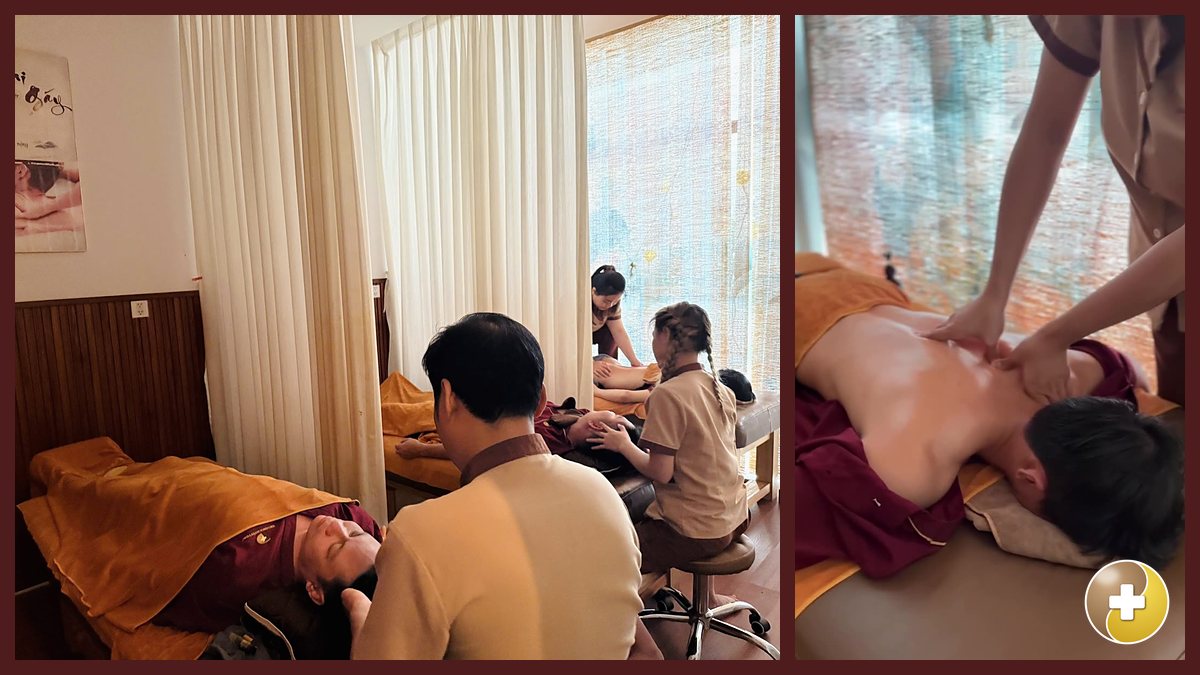
Quick answer: To self-massage neck and shoulder pain, warm the neck, stroke from the hairline to the shoulder, squeeze and knead tight trapezius spots, press the Liệt khuyết point on the wrist, at a pleasant-ache level, for about 10 minutes. Numbness or pain after a fall needs a doctor. Tong Gia in Districts 12 and 9, Ho Chi Minh City, can show you.
Want Lương Y Tống Văn Huynh’s team to read your spine and posture in person?
What is self-massage for neck and shoulder pain, and why does it help?
Self-massage means using your own hands, sometimes with a warm towel or a small ball, to stroke, squeeze, knead and press the muscles at the back of the neck, the sides of the neck and the tops of the shoulders, so that tight spots can soften. It is quick, free of equipment and easy to do at your desk, on the sofa after dinner or before bed.
In Western terms, when you look down at a laptop or phone for hours, your head drifts forward and the muscles behind the neck must work constantly to hold it up. Three groups do most of the work: the trapezius (the large sheet from the base of the skull and the C7 vertebra out to the collarbone and shoulder blade), the levator scapulae (from the C1–C4 vertebrae down to the top corner of the shoulder blade) and the small suboccipital muscles right under the hairline. A muscle that stays contracted squeezes its own small blood vessels, so less blood arrives, waste products from muscle work build up and sensory nerve endings are irritated. You feel it as heaviness, aching, sometimes a headache. Pain then makes the muscle tighten further, and a loop of tightness, pain and more tightness sets in.
Massage interrupts that loop mechanically: it warms the tissue, gently lengthens the fibres and increases local circulation, while receptors in the skin and muscle send signals to the spinal cord that allow the muscle to let go. Done well, many people feel their shoulders drop and the neck turn more easily within minutes.
Self-massage also has limits. You cannot reach the area between your shoulder blades, you cannot read your own spine, and people in pain tend to press far too hard. Pressing hard on a contracted muscle makes it guard even more, and the next morning feels worse. This guide shows a measured approach, adapted for home use from the principles in the Tong Gia teaching materials.
| Situation | Self-massage? | Note |
|---|---|---|
| Heavy, tired shoulders after a workday | Yes | About 10 minutes, warm up first |
| Stiff neck after sleeping on a tall pillow | Yes, gently | Move slowly first, no forceful turning |
| Fresh strain after a sudden movement, area feels hot | Not in the first 48 hours or so | Rest the painful movement, cold pack if hot |
| Pain with numbness into the fingers or a weak arm | No | See a doctor first |
| Neck pain after a fall or accident | No | See a doctor |
| Pregnancy | Light stroking only | Skip the Hợp cốc (LI4) point |
In Ho Chi Minh City we often meet expats who work remotely from a condo all day, engineers at the Saigon Hi-Tech Park, people commuting by motorbike across town, teachers, new parents carrying babies and visitors who slept under strong hotel air-conditioning. They want something to do between sessions that actually helps.
Common causes, and which area to focus on
Knowing why your neck aches tells you where to work, rather than squeezing everywhere.
- Habits: looking down at a phone for long stretches, cradling a phone between ear and shoulder, a pillow that is too high, napping slumped over a desk, late nights and too little sleep.
- Work and posture: the further the head moves forward, the more load the back-of-neck muscles carry. Riders tense their arms and look up at traffic; nail technicians and tailors look down; warehouse staff carry loads on one side.
- Environment: air-conditioning blowing on the neck, getting caught in an afternoon rainstorm, walking from the heat into a cold office. Cold muscles contract and lose flexibility; Vietnamese grandparents call this "catching wind".
- Stress: according to the Tong Gia teaching materials, long-term mental pressure tightens the whole occipitofrontal muscle and the levator scapulae, causing chronic neck and shoulder aching that spreads to the head.
| Cause | Where it tightens | Focus when self-massaging |
|---|---|---|
| Phone, low screen | Hairline at the back, sides of the neck | Stroke down the neck, knead the skull base |
| Tense shoulders at the keyboard or handlebars | Upper trapezius (top of shoulder) | Squeeze and knead the shoulder top |
| Carrying on one side | One side of neck and shoulder | Work the tighter side more |
| Air-conditioning, cold | Back of the neck | Warm first, stroke gently |
| Ongoing stress | Skull base, levator scapulae, head | Slow kneading, long breaths, wrist point |
Other signs to watch before you start
Muscle-type pain usually shows these features:
- A heavy, dull ache, worse in the evening, easing with rest.
- A knot like a cord or a bean that feels "right on the spot" when pressed.
- Limited turning in one direction that improves with slow movement.
- Ache spreading to the back of the head or the temples, tired eyes.
- Tightness between the shoulder blades, a catch on deep breaths.
- Trouble finding a comfortable sleeping position.
These usually respond well to gentle self-massage. Pain that stays the same when lying still, lasting numbness, a weak hand or dizziness when looking up is a different story. A spot that is swollen and hot right after a sudden movement also needs rest, not kneading, for about 48 hours.
When to see a doctor
Please see a doctor at a hospital or medical facility first, and skip self-massage for now, if you have any of these:
- Neck or left shoulder pain with chest tightness, shortness of breath or cold sweats: call 115 immediately.
- A sudden, severe headache with vomiting, double vision, slurred speech, a drooping face or weakness on one side: call 115.
- Neck pain after a traffic accident, fall or blow.
- Numbness or weakness in the arm, dropping things, tingling into the fingers.
- Fever with a stiff neck, especially in a child or an older person.
- A lump in the neck, pain that keeps getting worse or hurts at night while lying still, unexplained weight loss and fatigue: get checked by a doctor alongside any wellness care.
- No improvement after 1–2 weeks of gentle self-massage, warmth and movement, or pain that is worse after every attempt.
If a doctor is already following a neck condition, ask them before starting self-massage. This is a wellness service, not medical care.
The Y Tướng Học view: the Liver nourishes the sinews
Y Tướng Học (face reading for wellness) rests on the idea that "the outer appearance reflects the inner organs". For neck and shoulder tension, the organ most often discussed is the Liver (Can) in the Eastern sense. According to the Tong Gia teaching materials, the Liver governs the sinews and supports movement; it stores blood during rest and sends it to muscles during activity; it is tied to emotions, so long-held anger or frustration lets Liver qi stagnate. The Gallbladder channel, paired with the Liver, is described as easing pain in the head and shoulders, and when out of balance shows headaches and shoulder pain.
What does it look like on the outside? The Liver shows in the eyes, nails and sinews. In balance: bright eyes, pink nails, supple muscles. Out of balance: dry tired eyes, irritability, a tight neck, cramps. The teaching materials describe muscles that feel "hard as wood" and tender as a sign of qi stagnation, with deep spasm especially in the trapezius. High, bony cheekbones are linked with a very bound-up trapezius, and broken criss-cross lines on the forehead with spasm of the face and neck muscles under mental pressure.
One more useful note: the Liệt khuyết point (LU7) is the connecting point of the Lung channel, remembered by the saying "for head and neck, look to Liệt khuyết", and is used for coughs and a stiff neck. It sits on the wrist and is easy to press yourself. This is a wellness perspective for choosing where to work, not a statement about your liver's health. See our neck and shoulder massage Q&A.
Spine segments and nerve-reflex areas involved
The spine has 33 vertebrae. According to the Tong Gia teaching materials, the neck (C1–C7) relates to the head, face, neck and arms, while the upper and mid back (D1–D12) relate to circulation, breathing and digestion. Nerve roots leave the spinal canal through gaps on either side, so when you massage yourself, work the muscle bands on either side of the neck and never press directly on the bony bumps in the middle.
| Segment / area | Nerves, function | Typical feeling | Eastern organ | Self-massage? |
|---|---|---|---|---|
| C1–C3 (skull base, hairline) | Head, face; deep suboccipital muscles | Stiffness rising to the head, tired eyes | Liver | Yes, slow and light |
| C3–C5 (mid neck, sides) | Neck; levator scapulae attachment | A catch on one side when turning | Liver, Gallbladder | Yes, back and side only |
| C5–C7 (base of neck, shoulder top) | Shoulders, arms; nerve roots to the arm | Heavy shoulders, ache into the upper arm | Liver | Yes, squeeze the trapezius |
| D1–D3 (between the shoulder blades) | Circulation, breathing; middle trapezius | Tightness, catch on deep breaths | Lung, Liver | Hard to reach |
| Wrist (Liệt khuyết, LU7) | Lung channel connecting point | Stiff neck, heavy head | Lung | Yes, 1–2 minutes each side |
The teaching materials place neck aching in the muscle–bone–joint group, worked together with C5–C7, L1–L5 and S1–S5, because the spine is one chain and a tilted lower back makes the neck compensate. That is why self-massage eases the surface while the root often needs hands that can read the whole spine.
How Tong Gia works: spinal nerve-reflex balancing massage
Tong Gia Acupoint Wellness (Huyệt Đạo Tống Gia) was founded by Lương Y Tống Văn Huynh, a master of traditional Vietnamese wellness with over 13 years in Eastern wellness care, Y Tướng Học and spinal nerve-reflex balancing. It is a Vietnamese Eastern method built on three "no"s: no chemicals, no needles, no rough force. We never crack or twist the neck.
- Observation: head posture, shoulder height, complexion, eyes and nails, plus questions about your work, how long it has hurt and how you have been massaging yourself.
- Reading the spine by hand: comparing left and right, top and bottom along C1–C7 and D1–D3, feeling skin temperature, muscle texture, vertebral shape and tender points. Only the "excited" areas (warm, tight, more painful) are worked directly.
- Muscle release of the trapezius, levator scapulae and skull-base muscles, with push-and-roll and flicking techniques; pressure moves through five levels from one finger to the whole body, and the neck usually needs only light to medium.
- Acupressure in the right zones: along the neck, shoulder tops, between the shoulder blades and Liệt khuyết at the wrist.
- Dosing and temperature: work stops when the skin over the key point turns from dry to slightly moist.
- Home guidance: correcting how you self-massage, plus pillow and screen tips for your job.
A typical session: a remote worker who has squeezed her shoulders every night for weeks, sometimes until red, still wakes up heavy. After watching her turn her head, the practitioner reads the spine and usually finds the real knot deep between the shoulder blades, out of reach of her own hands, while the shoulder tops are already a bit sore from over-squeezing. The work starts away from the pain, softens the upper back, then moves in. At the end she learns where to massage at home and where to leave alone.
| Service | Price (VND) | Approx. USD |
|---|---|---|
| Neck and shoulder care, 60 min | 550,000 (first visit 399,000) | about $21 (first visit about $15) |
| Neck and shoulder care, 90 min | 750,000 | about $29 |
| Hair wash with neck and shoulder massage, 60 min | 250,000 | about $10 |
During the session you feel a pleasant ache at tight points, then warmth; the shoulders seem to drop. Afterwards the neck usually turns further and sleep comes more easily; some people feel mild soreness for about a day, like after exercise. Results vary from person to person; we help the body rebalance and relax, without promising the pain will be gone after one visit. Read about a full visit in neck and shoulder massage in Ho Chi Minh City: the experience.
Want Lương Y Tống Văn Huynh’s team to read your spine and posture in person?
Home care: self-massage in 6 steps, plus prevention
This routine takes about 10–12 minutes in a chair with a backrest. The spirit comes from the Tong Gia principles: compare both sides, go from light to firmer, work only warm and tight areas, and stop when the skin feels warm and slightly moist.
| Step | How | Time | Watch out |
|---|---|---|---|
| 1. Warm up | Warm towel on the neck, or rub your palms together and cup the neck | 3–5 min | No heat on a swollen, burning spot |
| 2. Compare sides | Back of the hand on both sides of the neck and shoulders; press lightly for knots | 1 min | Give the warmer, tighter side more time |
| 3. Stroke down | Three fingers from the hairline down to the base of the neck, then out to the shoulder tip | 10 strokes each side | Stay on muscle, not on the spine bones |
| 4. Squeeze and knead the trapezius | Right hand squeezes the top of the left shoulder like a sponge; circle slowly on knots | 1–2 min each side | A pleasant ache, never bruising |
| 5. Skull base | Interlace fingers behind the head, thumbs in the hollows at the hairline, lean the head back onto them and circle | 1 min | Stop at once if dizzy |
| 6. Wrist point and gentle movement | Press Liệt khuyết; then nod, tilt and turn the head very slowly | 1–2 min per wrist; 5 slow turns each way | Never crack your own neck |
Finding Liệt khuyết: about two of your own finger-widths above the wrist crease, on the thumb side, at the outer edge of the radius bone. Press gently for 1–2 minutes per side until you feel a mild ache. You can add Hợp cốc (LI4), between the first and second hand bones, but the teaching materials are clear that it is not used during pregnancy.
How firm? On a scale where 10 is unbearable, stay around 3–4. Harder does not work faster; it makes the muscle guard. Do this once or twice a day. If you feel more sore the next morning, you overdid it: lighten up and shorten the time. Avoid deep pressure on the front-side of the neck, where large blood vessels run, and avoid broken or inflamed skin.
Five prevention habits:
- Raise the screen to eye level and lift the phone instead of dropping the head; stand and roll the shoulders every 45–60 minutes.
- Keep the neck warm; do not let air-conditioning blow on it.
- Choose a pillow that keeps the neck in line with the back when lying on your side.
- Carry with both hands; switch sides with bags and babies.
- Sleep enough and manage stress, so that, in Eastern terms, the Liver can rest.
If you like pressure on specific points, see acupressure massage in Saigon: Q&A; for cold-related stiffness, cupping in Saigon: Q&A.
Book a session
- District 12: 225 Dương Thị Mười, Phường Tân Chánh Hiệp (Tan Chanh Hiep Ward, District 12). Open 8:00–19:00 daily.
- Vinhomes Grand Park, District 9: Căn T16-21 khu Manhattan, Phường Long Bình, TP. Thủ Đức (Unit T16-21, Manhattan zone, Long Binh Ward, Thu Duc City). Open 9:00–20:00 daily.
Book online or call, Zalo or WhatsApp +84 888 264 559. You can read real guest reviews on each branch's Google Maps profile. Tell us how you have been massaging yourself and which side hurts, so the practitioner can prepare and show you the right technique. Living in or visiting Ho Chi Minh City? Come and try a Vietnamese Eastern wellness method built by Lương Y Tống Văn Huynh.
Visit us
- Đông Y Huyệt Đạo Tống Gia Quận 12 (District 12)
225 Dương Thị Mười, Phường Tân Chánh Hiệp, Quận 12, HCMC · 8:00–19:00 daily · 0888 264 559 · Directions on Google Maps - Đông Y Huyệt Đạo Tống Gia Quận 9 (Vinhomes Grand Park, District 9)
Căn T16-21 khu Manhattan, Vinhomes Grand Park, Phường Long Bình, TP. Thủ Đức, HCMC · 9:00–20:00 daily · 0888 264 559 · Directions on Google Maps
Want Lương Y Tống Văn Huynh’s team to read your spine and posture in person?
FAQ
How do I self-massage neck and shoulder pain at home? Warm the neck for 3–5 minutes, compare both sides for knots, stroke from the hairline down to the shoulder tip, squeeze and knead the top of each shoulder, circle at the skull base, then press Liệt khuyết on the wrist and move the neck slowly. Keep it to a pleasant ache, about 10–15 minutes.
Which acupressure point can I press myself for a stiff neck? Liệt khuyết (LU7) on the wrist, about two finger-widths above the crease on the thumb side, is easy to reach; the Tong Gia materials link it to the head and neck. Press gently 1–2 minutes per side. Hợp cốc (LI4) can be added, but not during pregnancy.
Is it OK to self-massage my neck every day? Gentle self-massage once or twice a day, 10–15 minutes each time, is usually fine. More soreness the next day, bruising or tingling means too much pressure; lighten up. Lasting numbness in the arm needs a doctor.
Should I crack my own neck to relieve the stiffness? No. The pop is gas leaving the joint and does not release the muscle; forcing it can overstretch the neck. Tong Gia never cracks or twists the neck either; we release muscles and press points by hand.
Why does my neck ache come back even after massage? Usually because the cause is still there: a low screen, a tall pillow, air-conditioning on the neck, stress or late nights. The root knot also often sits between the shoulder blades or in the lower back, where you cannot reach. Habits need to change alongside care.
How much does neck and shoulder care cost at Tong Gia? Neck and shoulder care is 550,000 VND (about $21) for 60 minutes, 399,000 VND (about $15) on your first visit, and 750,000 VND (about $29) for 90 minutes. Hair wash with neck and shoulder massage is 250,000 VND (about $10).
Author: Lương Y Tống Văn Huynh – founder of Huyệt Đạo Tống Gia, a master of traditional Vietnamese wellness with over 13 years in Eastern wellness care, Y Tướng Học (face reading) and spinal nerve-reflex balancing massage.
Updated: 2026-11-16
Related guides
- Self-massage for neck and shoulder pain at home: 6 safe steps, how firm to press and when to stop
- Right-side neck and shoulder pain: why only one side hurts, which signs need a doctor, and how Tong Gia works with it in Ho Chi Minh City
- Choosing a reliable neck and shoulder massage place in Ho Chi Minh City: 7 things to check before you book
- Neck and shoulder cupping: where the cups go, how it feels and when to skip it
- Cervicobrachial syndrome: why neck pain travels into the shoulder and arm, which signs need a doctor, and how Tong Gia's hands-on wellness care fits in Ho Chi Minh City
- Head, neck and shoulder acupressure massage: why the head and neck belong in one session
This is a wellness service, not medical care.