
Neck and shoulder cupping: where the cups go, how it feels and when to skip it
Quick answer: Neck and shoulder cupping places cups at the base of the neck, on top of the shoulders and between the shoulder blades to warm and loosen a tight trapezius, never on the front or sides of the neck. At Tong Gia Acupoint Wellness (District 12 and Vinhomes Grand Park, Ho Chi Minh City) cupping is 85,000 VND (about 3 USD), usually after 60-minute neck-shoulder care.
Want Lương Y Tống Văn Huynh’s team to read your spine and posture in person?
What is neck and shoulder cupping, and why this area?
Neck and shoulder cupping means placing cups on the base of the neck, the top of the shoulders and the space between the shoulder blades, then drawing out some air so the suction lifts the skin and surface muscle. This is where city bodies get tired first: the trapezius spreads from the nape over the shoulders and down the upper back, the levator scapulae links the neck to the shoulder blade, and the long spinal muscles run either side of the spine. When you lean toward a screen, the head moves a few centimetres forward and these muscles hold its weight for hours.
In Western terms, suction pulls the skin, the tissue below and the fascia around the muscle upward; blood gathers, so the area turns pink and warm. Nerve endings under the skin receive a strong but not sharp new signal, so the dull ache in the shoulders can ease and breathing slows. The round marks are small amounts of blood from tiny vessels, not toxins. Research on cupping for neck and shoulder tiredness is still limited, so we only say it helps the area feel warmer, looser and more comfortable while the body rebalances.
In Ho Chi Minh City, the people asking for neck and shoulder cupping are office staff under air-con, long-distance drivers, tailors, hairdressers and nail technicians who bend for hours, cold-storage workers and anyone riding home through the rain. The area has its own rules: the skin on the nape and shoulders is thinner than on the back, marks show above an open collar, and the front and sides of the neck carry large blood vessels, so cups never go there. For cupping in general, see our cupping Q&A.
Where do the cups go?
- Base of the neck around C7: the Đại chùy point and Định suyễn on either side, the spot that feels cold in a draught.
- Top of the shoulders: the thickest part of the trapezius, where a hard "knot" forms after long desk hours.
- Between the shoulder blades (D1–D3): the Phế du area, where the upper back sets like a board.
- Inner edge of the shoulder blades: on the muscle beside the spine, never on the bony tips.
- Never: the front or sides of the neck, right on the collarbone, broken skin, large moles, freshly bruised areas.
Common reasons the neck and shoulders tighten
- Looking down at screens and phones: a forward head makes the nape and upper trapezius work non-stop.
- An air-con vent blowing on the nape: the muscle chills and clenches by afternoon.
- Rain and wet clothes: a cold nape and upper back, heavy shoulders by evening.
- A pillow too high, or sleeping face down: waking with a neck stiff on one side.
- Carrying on one shoulder: handbags, one-strap backpacks, carrying a child on one hip.
- Stress: unconscious shoulder bracing, jaw clenching, light sleep.
In the Tong Gia training, the Liver system governs the sinews; when it is constrained by stress, the trapezius and the long back muscles spasm deep down. The Gallbladder channel is described as easing the head and the neck-shoulder area, and when it is out of balance people get headaches and shoulder pain. The Lung system governs the skin; when it is low, wind and cold get in, and the Đại chùy point at the base of the neck is used for chills in traditional practice. These are functional ideas, not a statement that your liver or lungs are unwell.
Signs to watch
- Common and suited to wellness care: a cold nape, heavy shoulders, a crunchy neck when turning, a hard knot on top of the shoulder, tiredness that builds through the afternoon, tired eyes, light sleep.
- Morning stiffness after a bad sleeping position: usually settles in a few days.
- Headache at the back of the head or temples with shoulder fatigue: common with long-term neck tension.
- Normal marks: round, pink to purple, fading over several days to about a week; shoulder marks can be darker than back marks because the muscle there is tighter.
- Not right: tingling down the arm or fingers, weak grip, dropping things, sharp pain when coughing, dizziness when turning the head.
When to see a doctor
Neck and shoulder cupping is wellness care for tired, chilled, stiff muscles. Please see a doctor at a medical facility first if you have:
- Neck pain spreading down the arm with numbness or weakness, or dropping things.
- Strong dizziness, nausea, blurred vision, slurred speech, a drooping face or weakness on one side: call 115.
- Neck pain after a fall or a road accident.
- Neck pain with fever, or a stiff neck that cannot bend the chin to the chest.
- Pain that grows at night, weight loss or lasting fatigue: get checked alongside any wellness care.
- Blood thinners, easy bruising or a blood disorder: ask your medical team first.
Chest pain spreading to the left shoulder, neck or jaw with breathlessness or sweating: call 115 immediately, no massage, no cups. This is a wellness service, not medical care.
Face reading (Y Tướng Học): how a tight neck and shoulders show outside
Y Tướng Học (face reading for wellness) holds that "what is inside shows outside". In the Tong Gia training the practitioner looks at the face, the shoulder line and the feel of the muscle first:
- Shoulder muscle hard as wood: described as stagnant energy and blood with a constrained Liver; mental pressure drives deep spasm in the trapezius and tension headaches. This person needs thorough muscle release before cups.
- "Giáp" face (甲): wide forehead, pointed chin; the training notes the upper neck (C1–C2) tends to run hot, with headaches and poor sleep. A hot nape gets gentle work, not strong suction.
- "Đồng" face (同): long and square, linked to the Lung system; the upper back around D3 tightens and the nape catches cold when the weather turns.
- "Thân" face (申): broad cheekbones; stress brings one-sided headaches and tight bands in the mid back around D7–D9.
- "Dụng" face (用): an uneven face; the training links it to a tilted spinal axis, with one side tight and the other slack. A clearly higher shoulder is common.
Features are only a hint for where to start, never a health verdict and never used to judge anyone.
Spine and nerve-reflex zones involved
The Tong Gia training maps the neck vertebrae C1–C7 to the head, face, neck and arms, and the thoracic D1–D12 to circulation, breathing and digestion. Nerve roots leave between the vertebrae, which is why a pinched neck root can send tingling into the hand. The training groups neck and shoulder tiredness with muscles and joints, worked through C5–C7, L1–L5 and S1–S5.
| Vertebrae / area | Nerve / function | Neck-shoulder feeling | Related organ system | How we cup |
|---|---|---|---|---|
| C1–C2 (nape, hairline) | Head, face | Hot nape, occipital headache, poor sleep | Heart, Liver | No cups at the hairline; calming massage |
| C5–C7 (base of neck) | Neck, shoulders, arms | Cold nape, heavy shoulders | Lung, Liver | 2–4 static cups either side of C7 |
| Upper trapezius | Holds the head, lifts the shoulder | Hard knot, ache at the desk | Liver, Gallbladder channel | Static or short sliding cups |
| D1–D3 (Phế du) | Breathing | Board-like upper back, shallow breath | Lung | Static or sliding cups beside the spine |
| D4–D7 (inner shoulder blade) | Circulation, breathing | Ache along the shoulder blade | Heart (Tâm du at D5) | Light cups; never with chest pain |
The table shows related zones for choosing where to work, not a medical finding. Pressure points do not act directly on organs; in traditional theory they help regulate energy and blood and ease discomfort.
The Tong Gia method: spinal nerve-reflex balancing massage
At Tong Gia Acupoint Wellness (Huyệt Đạo Tống Gia), neck and shoulder cups always come after reading the spine and releasing the muscle, following the method of Lương Y Tống Văn Huynh, master of traditional Vietnamese wellness and founder, with over 13 years in Eastern wellness, face reading and spinal nerve-reflex balancing. Dry cups only, no skin pricking, no rough force.
- Screening: arm tingling, dizziness, blood pressure, blood thinners, bruising, pregnancy, neck injury.
- Observation: head position, shoulder height, complexion, eyes, how you turn your neck.
- Reading the spine by hand: from C1 to D7, reading skin temperature, muscle layer, vertebra shape and tender points, comparing left and right.
- Neck-shoulder muscle release: nape, trapezius, levator scapulae, inner shoulder blade, from one finger up to the whole palm.
- Acupressure: Đại chùy, Định suyễn, Phế du, and Liệt khuyết at the wrist ("for head and neck, look to Liệt khuyết").
- Cupping: 4–8 cups; warm, tight zones are cupped, cool, slack zones are only warmed. Cups come off when the skin responds.
- Settling and advice: keep the nape warm, adjust the pillow and the screen, a short stretch routine.
Services and prices
- Neck-shoulder care 60 min: 550,000 VND (about 21 USD), first visit 399,000 VND (about 15 USD); 90 min 750,000 VND (about 29 USD).
- Cold-relief cupping 30 min: 85,000 VND (about 3 USD), added after neck-shoulder care or on its own.
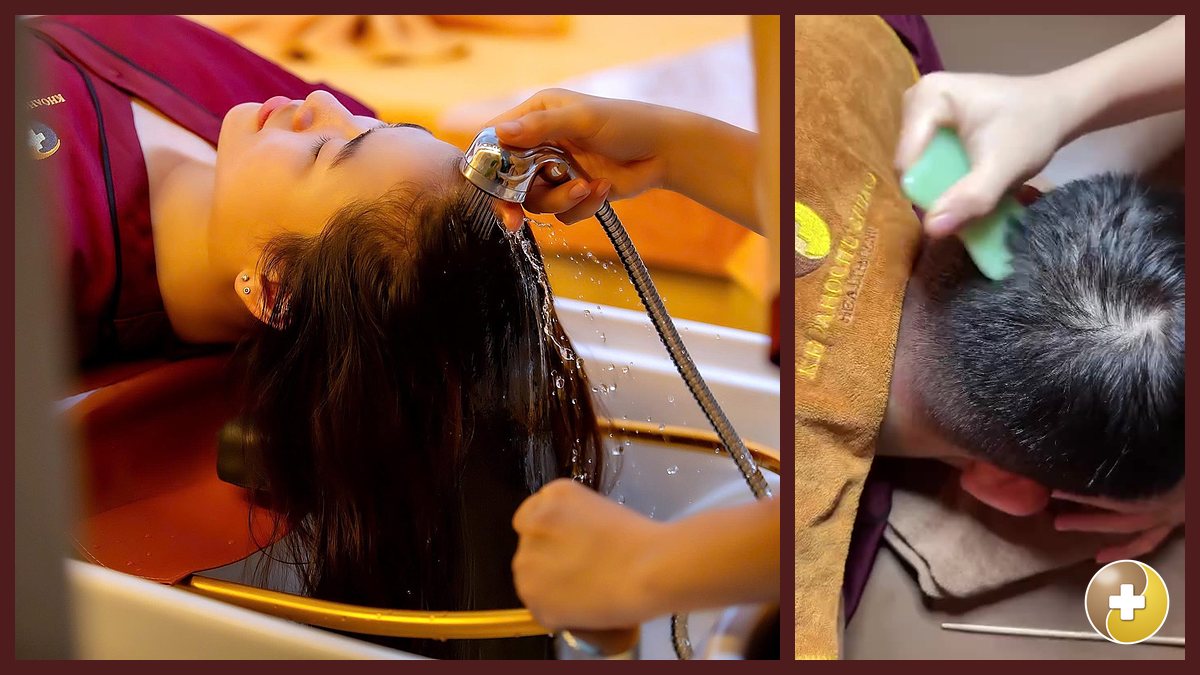
- Hair wash with neck-shoulder massage 60 min: 250,000 VND (about 10 USD) if you just want to unwind.
Full price list; the neck and shoulder massage page; stories in neck and shoulder massage in Saigon.
A typical session
One lunchtime at the District 12 branch, a tailor who sews ten hours a day says his right shoulder aches, turning his head left pulls, and afternoons bring a headache at the back of the head. No arm tingling, no dizziness, no falls. His right shoulder sits higher, his head forward. Reading the spine: the nape at C1–C2 slightly warm, C6–C7 a little off to the right, the right upper trapezius a wood-hard knot, the area between the shoulder blades cooler. About 35 minutes of release, acupressure at Đại chùy and Định suyễn, then two cups at the base of the neck, two on the right shoulder, two between the shoulder blades; the hairline only gets calming strokes. The right shoulder marks come up darker. He is advised to raise his chair so the machine sits at elbow height and to stand and roll his shoulders every hour.
What you feel during and after
The knot on the shoulder is tender at first, then softens. When the cups grip, the shoulder feels tight, then warmth spreads down the shoulder blade; many people say the shoulder feels "lifted". Afterwards the neck turns more easily, the head feels lighter, eyes less tired, sleep deeper. Shoulder marks can be tender under a backpack for a day or two. Everyone differs; we do not promise one session ends neck tiredness, and your sitting habits decide how long the ease lasts.
Want Lương Y Tống Văn Huynh’s team to read your spine and posture in person?
Self-care at home and prevention
- Do not self-cup the neck: the skin is thin; never cup the front or sides of the neck.
- Screen at eye level, a chair with back support: every 45–60 minutes stand, roll the shoulders, draw them back.
- Keep the nape warm: no vent on the nape, a light scarf on evening rides, dry off after rain.
- Pillow height: on your side, as high as your shoulder width; on your back, lower; avoid face down.
- Five minutes of stretching and belly breathing daily: in for about 4 seconds, out slowly for about 6. More tips in our neck and shoulder massage Q&A and cupping experience guide.
How to book
Tong Gia Acupoint Wellness has two branches in Ho Chi Minh City, open every day, with real customer reviews on Google Maps:
- District 12: 225 Dương Thị Mười, Phường Tân Chánh Hiệp (Tan Chanh Hiep Ward, District 12). Open 8:00–19:00 daily.
- District 9 – Vinhomes Grand Park: Căn T16-21 khu Manhattan, Phường Long Bình, TP. Thủ Đức (unit T16-21, Manhattan zone, Long Binh Ward, Thu Duc City). Open 9:00–20:00 daily.
Call, Zalo or WhatsApp +84 888 264 559, or book online. Mention arm tingling, dizziness, blood thinners, easy bruising or pregnancy, and whether you need to wear an off-shoulder outfit soon, so the cups can be planned around it.
Visit us
- Đông Y Huyệt Đạo Tống Gia Quận 12 (District 12)
225 Dương Thị Mười, Phường Tân Chánh Hiệp, Quận 12, HCMC · 8:00–19:00 daily · 0888 264 559 · Directions on Google Maps - Đông Y Huyệt Đạo Tống Gia Quận 9 (Vinhomes Grand Park, District 9)
Căn T16-21 khu Manhattan, Vinhomes Grand Park, Phường Long Bình, TP. Thủ Đức, HCMC · 9:00–20:00 daily · 0888 264 559 · Directions on Google Maps
Want Lương Y Tống Văn Huynh’s team to read your spine and posture in person?
FAQ
What does neck and shoulder cupping do? Suction lifts the skin and surface muscle at the base of the neck, the top of the shoulders and between the shoulder blades; blood gathers, the area warms and loosens and the neck turns more easily. It does not replace a medical check for arm tingling or dizziness.
Where exactly are the cups placed? Around C7 at the base of the neck, on the upper trapezius, between the shoulder blades and along their inner edge. Never on the front or sides of the neck, the collarbone or broken skin.
Is neck cupping safe? Done on the right zones with the right suction it is safe for healthy people. Risks come from too much suction, cups left too long, cupping the front of the neck, or cupping with fever, pregnancy, blood thinners or easy bruising.
How long do shoulder cupping marks last? Usually several days to about a week, often darker on the shoulders. If you need to wear an off-shoulder outfit soon, tell the practitioner; fewer cups or light sliding cups leave paler marks.
How often can I have neck and shoulder cupping? Let old marks fade fully before cupping the same spot again, usually one to two weeks apart. Desk workers can keep regular neck-shoulder massage and add cups when the nape feels cold and stiff.
How much is neck and shoulder cupping at Tong Gia? Cupping alone is 85,000 VND (about 3 USD) for 30 minutes. Most people pair it with 60-minute neck-shoulder care at 550,000 VND (about 21 USD), or 399,000 VND (about 15 USD) on a first visit.
Author: Lương Y Tống Văn Huynh – founder of Huyệt Đạo Tống Gia, a master of traditional Vietnamese wellness with over 13 years in Eastern wellness care, Y Tướng Học (face reading) and spinal nerve-reflex balancing massage.
Updated: 2026-11-16
Related guides
- Self-massage for neck and shoulder pain at home: 6 safe steps, how firm to press and when to stop
- Right-side neck and shoulder pain: why only one side hurts, which signs need a doctor, and how Tong Gia works with it in Ho Chi Minh City
- Choosing a reliable neck and shoulder massage place in Ho Chi Minh City: 7 things to check before you book
- Neck and shoulder cupping: where the cups go, how it feels and when to skip it
- Cervicobrachial syndrome: why neck pain travels into the shoulder and arm, which signs need a doctor, and how Tong Gia's hands-on wellness care fits in Ho Chi Minh City
- Head, neck and shoulder acupressure massage: why the head and neck belong in one session
This is a wellness service, not medical care.