
Frequent insomnia in Ho Chi Minh City: seven common causes, the warning signs, and how Tong Gia can help
Quick answer: Frequent insomnia usually comes from ongoing stress, late coffee or alcohol, phones in bed, night shifts, body aches or hormonal changes; sometimes from sleep apnoea, depression or thyroid problems. If it lasts over a month, get a medical check. Tong Gia Acupoint Wellness (Huyệt Đạo Tống Gia), in District 12 and Vinhomes Grand Park (District 9), Ho Chi Minh City, helps the body relax by hand.
Want Lương Y Tống Văn Huynh’s team to read your spine and posture in person?
What does frequent insomnia actually mean?
Frequent insomnia means that most weeks you have several nights of trouble falling asleep, light broken sleep, waking in the middle of the night and not getting back to sleep, or waking far too early, around 3 or 4 a.m. The real measure is not the hours spent in bed but the next morning: tired body, heavy head, poor focus, short temper, sleepy in the afternoon and then wide awake again at night.
In Western physiology, sleep is run by the brain through two systems working together. One is the body clock, strongly set by light and by when you eat and sleep. The other is sleep pressure, which builds during the day while you are awake and active. On top of these sits the autonomic nervous system: when the sympathetic side (the "fight or flight" side) stays switched on by stress, the heart beats faster, muscles stay tight and the mind keeps running, so the body struggles to shift into rest. Frequent insomnia is a sign that one of these systems is out of rhythm.
So there is no single answer to "what is wrong with me if I often can't sleep?" Insomnia is a symptom, not a disease name. It is usually called long-term when it happens three or more nights a week for around three months and affects daytime life. A few bad nights before an exam, after a long flight or during a family crisis usually settle once life settles.
In Ho Chi Minh City, Tong Gia Acupoint Wellness (Huyệt Đạo Tống Gia) sees frequent insomnia in many groups: expats and office staff answering messages from overseas teams late at night; shift workers in the industrial zones and the Saigon Hi-Tech Park; business owners still doing the accounts in their heads at midnight; women around menopause with night sweats; older parents who fall asleep early and wake at 3 a.m. Street noise, hot rooms and air-con switched on and off all night add to it. Jet lag on arrival is a separate, short-term story, covered in jet lag massage Q&A.
Common causes: habits, work, environment and health
These are the groups that come up most often. One person can sit in two or three at once. They help you picture what is going on, not reach a conclusion on your own; only a medical facility can confirm the cause.
- Ongoing stress and worry. Work pressure, money, family problems keep the stress response on all day. The body is tired but the mind replays the day. This type often takes one to two hours to fall asleep, and the fear of "will I sleep tonight?" becomes a loop of its own.
- Evening habits. Coffee, milk tea or strong tea after 2 p.m.; beer or wine in the evening (easier to drop off, but more waking after midnight); phones in bed; long afternoon naps; sleeping in at weekends. A late or heavy dinner also gets in the way: the Tong Gia curriculum notes that the stomach then has to work when the body needs rest, and advises a light dinner two to three hours before bed.
- Work hours. Rotating shifts, night duty, long-distance driving, calls with teams in other time zones. The body clock is pulled back and forth and daytime sleep stays short and shallow.
- Aches at night. A stiff neck and shoulders, back pain, numb hands, calf cramps or sore knees wake you every time you turn over. Many people blame "thinking too much" when part of the problem is muscles that cannot let go.
- Age and hormones. Hot flushes and night sweats around menopause; lighter, earlier sleep and night-time toilet trips with age; months of night feeds after a baby.
- Sleep environment. Heat, noise, street lights, a partner who snores loudly, a mattress or pillow that does not suit you.
- Health problems that need a medical check. Sleep apnoea (loud snoring with pauses in breathing, dry mouth and headache on waking), depression and anxiety disorders, an overactive thyroid, acid reflux, asthma or night-time breathlessness, heart disease, chronic pain, frequent night urination.
| Pattern | Often seen in | Likely cause group |
|---|---|---|
| Takes 1–2 hours to fall asleep | Stressed people, late phone use | Stress, evening habits |
| Falls asleep but wakes often | People with aches, evening drinkers, night urination | Body pain, alcohol, age |
| Wakes at 3–4 a.m. and stays awake | Older adults, people feeling low for weeks | Age; watch your mood |
| Enough hours but still exhausted, loud snoring | Heavier people, snorers | Needs a check for sleep apnoea |
| Hot, sweaty, restless at night | Women around menopause | Hormonal change |
Other signs to watch
- A racing heart or palpitations when you lie down, startling easily.
- Hot palms and soles at night, hot flushes, night sweats.
- Lots of dreams, poor memory, a pale face, dizziness on standing.
- Poor appetite, bloating, constant worrying.
- Irritability, tight shoulders, headaches at the temples, dry tired eyes.
- Getting up to urinate twice or more, aching lower back and knees, cold feet.
- Loud snoring with pauses noticed by family, dozing off during the day.
- Low mood that lasts, losing interest in things you used to enjoy.
Keep a simple sleep diary for one to two weeks: time to bed, time asleep, how many times you woke, time up, coffee, alcohol, mood. It helps a great deal at a medical check, and Tong Gia practitioners ask the same questions before a session.
When to see a doctor
Please see a doctor first, and consider wellness care alongside afterwards, if any of these apply:
- Chest pain or tightness, breathlessness, cold sweats, especially while lying down or on waking: call 115 (Vietnam's emergency number) right away.
- Waking up breathless and needing to sit up, needing extra pillows, swollen ankles.
- Loud snoring with breathing pauses, or daytime sleepiness strong enough to doze off while driving.
- Low mood for more than two weeks, loss of interest, or thoughts of self-harm: get help now and tell someone close to you.
- Insomnia with unexplained weight loss, shaky hands, a fast heartbeat or heavy sweating: get your thyroid and other tests checked at a medical facility.
- Insomnia with pale skin, tiredness and dizziness, which may point to anaemia.
- Three or more bad nights a week for over a month despite changing your habits.
- Insomnia after a head injury or serious illness, or with a severe headache and vomiting.
If a doctor is already following your sleep, mood, heart or thyroid, keep to that advice and tell the practitioner before your session. This is a wellness service, not medical care.
The Y Tướng Học view: the Heart houses the mind
Y Tướng Học, the Eastern face- and body-reading tradition taught at Tong Gia, rests on one idea: what is inside shows outside. According to the Tong Gia curriculum, sleep in Eastern medicine belongs first to the Heart system: the Heart "houses the spirit" and governs the mind, awareness, thinking and sleep. When the Heart is unsettled, sleep is broken, dreams are many and memory slips. The curriculum is clear that insomnia linked to the Heart in this sense does not mean heart disease.
Three other organ systems often join in:
- Liver: keeps qi flowing smoothly. Long stress or anger makes Liver qi stagnate, with irritability and poor sleep; Liver fire easily stirs Heart fire, giving restlessness and trouble falling asleep. The Liver also shows in the eyes and nails.
- Spleen: too much worry weakens the Spleen and drains Heart blood, with palpitations, insomnia, poor appetite and forgetfulness.
- Kidney: when Heart and Kidney fall out of balance there is insomnia, palpitations and aching lower back and knees; Kidney yin deficiency brings hot palms and soles, afternoon flushes, night sweats and dream-filled sleep; weak Kidney qi means waking to urinate.
What can you see in the mirror? A pale or flushed face and a red tongue with little coating (Heart); dry tired eyes and thin brittle nails (Liver); pale lips and soft muscles (Spleen); thin ear rims, dry hair, a cold lower back (Kidney); and shoulders that feel like rope (stress held for a long time). The curriculum describes the "Giáp" face shape (wide forehead, pointed chin) as prone to "excess above, weakness below": headaches, insomnia and flushes above, weak knees and night urination below, with a hot upper neck and a cold, hollow lower back. These are signals for caring for the right person, never labels or a judgement. Learn more on our face-reading wellness page and in the Eastern face reading Q&A.
Spine segments and nerve-reflex areas involved
The Tong Gia curriculum maps the 33 vertebrae: the neck (C1–C7) serves the head, face, neck and arms; the upper and middle back (D1–D12) serves circulation, breathing and digestion; the lower back (L1–L5) serves digestion, kidneys, urinary and reproductive organs and the legs; the sacrum (S1–S5) serves elimination. For the "nerves and mind" group, where long-term insomnia sits, the work focuses on the neck C1–C7, the upper back D1–D3 and the sacral area.
| Segment | Nerves / function | Often comes with | Eastern organ |
|---|---|---|---|
| C1–C3 (base of skull) | Head and face, suboccipital muscles | Heavy head, tight temples, slow to fall asleep | Liver qi stagnation |
| C4–C7 | Neck, shoulders, arms | Stiff shoulders, pain when turning, numb hands at night | Liver governs sinews |
| D1–D3 | Upper back, breathing rhythm | Shallow breathing, chest tightness, sighing | Lung, Heart |
| D4–D5 (Heart back points) | Heart and chest area | Palpitations, startling, many dreams | Heart |
| L2 and sacral area | Kidneys, urinary system, legs | Night urination, aching back and knees | Kidney |
How Tong Gia works: spinal nerve-reflex balancing massage
This is a Vietnamese Eastern wellness method built by Lương Y Tống Văn Huynh, a master of traditional Vietnamese wellness with over 13 years in Eastern wellness care, Y Tướng Học and spinal nerve-reflex balancing. A session for frequent insomnia follows clear steps:
- Observe and ask: trouble falling asleep or staying asleep, waking time, coffee, alcohol, work, any medical check so far; then face, tongue, eyes, nails and posture.
- Read the spine by hand: skin temperature, muscle padding, the shape of each vertebra and your own sensations, comparing left and right.
- Find the key zone and key point: usually around C1–C3, D1–D5 and the sacrum, working only on overactive areas (warm, tight, more tender).
- Muscle release: the base of the skull, trapezius and both sides of the upper spine, in a slow, even "wave" rhythm that builds from one finger according to your feedback.
- Acupressure: Bai Hui on the crown, Shen Men and Nei Guan at the wrist, the Heart back point, San Yin Jiao on the lower leg (not during pregnancy), Tai Chong for stress and Yong Quan on the sole.
- Stop at the right moment: when the skin at the key point turns from dry to slightly moist and its temperature moves the right way.
- Home routine: breathing, bedtime acupressure and timing that suit your pattern.
Suitable services (same price at both branches, full list on prices):
- Heart wellness care, 75 minutes: 750,000 VND (about 29 USD). For trouble falling asleep, palpitations, a busy mind, many dreams.
- Head care, 60 minutes: 750,000 VND (about 29 USD). When insomnia comes with a heavy head, tight temples and a stiff neck.
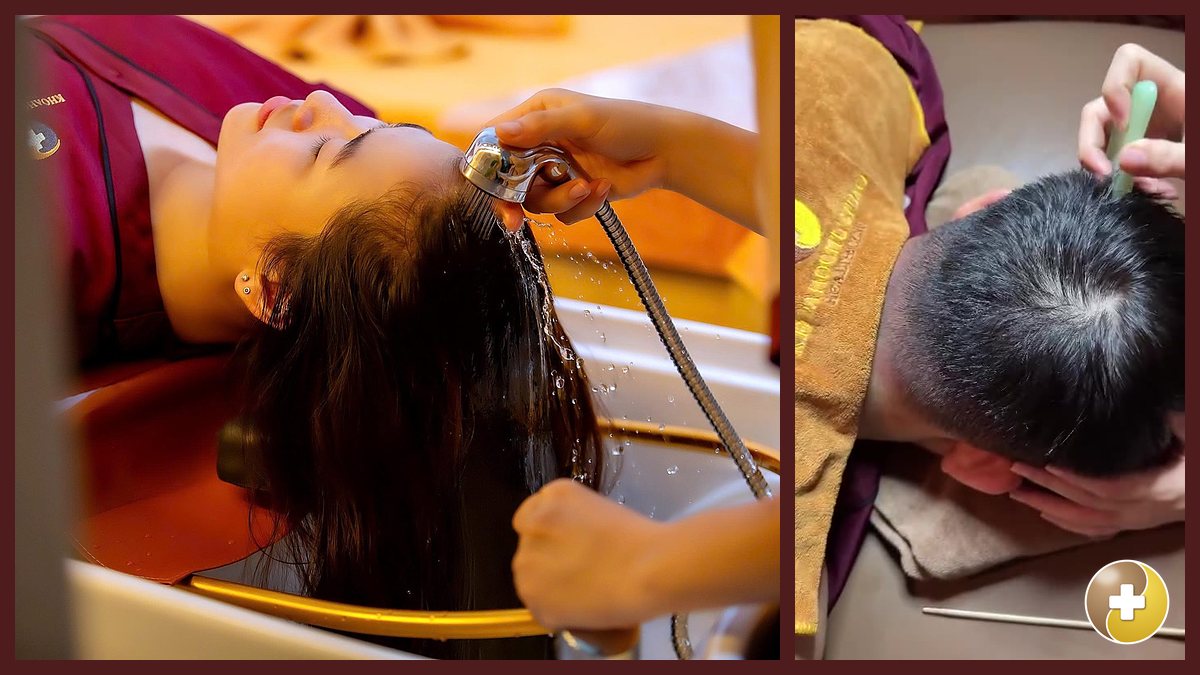
- Herbal hair wash with neck and shoulder massage, 60 minutes: 250,000 VND (about 10 USD). A gentle option to unwind after a hard week.
More on sleep sessions at acupressure for sleep, the acupressure for sleep Q&A and the Vietnamese head spa Q&A.
A typical session. This is a composite of many sessions, not one guest's story. A sales manager in his forties working in Thu Duc had spent half a year lying awake more than an hour on four or five nights a week, then waking at 3 a.m. He had been checked and told to fix his routine. The practitioner noticed slightly red eyes, a reddish tongue, raised shoulders and fast speech. On the spine, C1–C2 felt clearly warmer, the trapezius on both sides was tight as cord, and D4–D5 on the left was warm and tender. The session began with very slow release of the base of the skull and shoulders, moved down the upper back to the Heart back point, and finished on Bai Hui, Shen Men, Nei Guan and Tai Chong. He fell asleep on the table for about ten minutes.
How it feels. Tenderness at the neck and between the shoulder blades, then a lighter head and slower breathing; many guests doze off. Afterwards shoulders drop, the head feels clear and that night it is often easier to fall asleep; some feel mild soreness for a day. Results differ with each body, and Tong Gia helps the body rebalance and relax without promising perfect sleep after one session. More answers are in the acupressure massage Q&A.
Want Lương Y Tống Văn Huynh’s team to read your spine and posture in person?
Home care and prevention
- 4–6 breathing: breathe in through the nose for 4 seconds and out slowly for 6 seconds, 5–10 minutes before bed.
- Press Shen Men before sleep: the hollow on the wrist crease on the little-finger side, 1–2 minutes each side, with slow breathing.
- Warm foot soak: 15–20 minutes at about 38–42°C before bed; people with diabetes should test the water carefully.
- Keep regular hours: asleep before 11 p.m., the same wake-up time at weekends, naps of 15–30 minutes only; no coffee or strong tea after 2 p.m., less alcohol in the evening.
- Light dinner two to three hours before bed; a dark, cool room and the phone away from the bed.
Book a session
- District 12: 225 Dương Thị Mười, Phường Tân Chánh Hiệp (Tan Chanh Hiep Ward, District 12). Open 8:00–19:00 daily.
- Vinhomes Grand Park, District 9: Căn T16-21 khu Manhattan, Phường Long Bình, TP. Thủ Đức (Unit T16-21, Manhattan zone, Long Binh Ward, Thu Duc City). Open 9:00–20:00 daily.
Book online or call, Zalo or WhatsApp +84 888 264 559. Tell us your sleep pattern, how long it has lasted and whether you have had a check. An early-evening slot lets you go straight home to rest. Real guest reviews are on each branch's Google Maps page. Living in or visiting Ho Chi Minh City? Come and try a Vietnamese Eastern wellness method built by Lương Y Tống Văn Huynh.
Visit us
- Đông Y Huyệt Đạo Tống Gia Quận 12 (District 12)
225 Dương Thị Mười, Phường Tân Chánh Hiệp, Quận 12, HCMC · 8:00–19:00 daily · 0888 264 559 · Directions on Google Maps - Đông Y Huyệt Đạo Tống Gia Quận 9 (Vinhomes Grand Park, District 9)
Căn T16-21 khu Manhattan, Vinhomes Grand Park, Phường Long Bình, TP. Thủ Đức, HCMC · 9:00–20:00 daily · 0888 264 559 · Directions on Google Maps
Want Lương Y Tống Văn Huynh’s team to read your spine and posture in person?
FAQ
What causes frequent insomnia? Frequent insomnia is a symptom, not a disease. Common causes are ongoing stress, evening habits (coffee, alcohol, phones), shift work, body aches, hormonal changes with age and a poor sleep environment. Some cases come from sleep apnoea, depression, thyroid or heart problems, which need a medical check.
Is long-term insomnia dangerous? It leaves you tired, less focused and irritable, and raises the risk of accidents when driving. Get checked promptly if it comes with loud snoring and breathing pauses, lasting low mood, weight loss or waking breathless; chest pain, breathlessness and cold sweats mean calling 115.
Can a vitamin or mineral shortage cause insomnia? Anaemia and low iron can cause tiredness and poor sleep, but frequent insomnia is more often linked to stress and habits. Only a blood test at a medical facility can show a shortage, so avoid guessing and self-supplementing.
Which acupoints help with sleep? The Tong Gia curriculum uses Shen Men on the wrist crease (little-finger side), Nei Guan on the inner wrist, Bai Hui on the crown, San Yin Jiao on the inner lower leg (not during pregnancy) and Yong Quan on the sole. Press each gently for 1–2 minutes before bed with slow breathing.
Why do I keep waking at 3 a.m.? Early waking is common with age, evening alcohol, stress or a mood that has been low for a while. If low mood and loss of interest last more than two weeks, please get support from a medical facility.
Does massage help insomnia, and how soon? When insomnia comes from stress and tight neck and shoulders, muscle release and acupressure help the body let go, and many guests fall asleep more easily that same night. How much and how many sessions varies, and there is no promise of perfect sleep; long-term insomnia should be checked first.
Author: Lương Y Tống Văn Huynh – founder of Huyệt Đạo Tống Gia, a master of traditional Vietnamese wellness with over 13 years in Eastern wellness care, Y Tướng Học (face reading) and spinal nerve-reflex balancing massage.
Updated: 2026-11-15
Related guides
- Insomnia in women: why sleep breaks before periods, after birth and in perimenopause, and how gentle acupressure care works in Ho Chi Minh City
- Frequent insomnia in Ho Chi Minh City: seven common causes, the warning signs, and how Tong Gia can help
- Midlife insomnia (ages 40–55): why your mind races in bed, and how Tong Gia works with it in Ho Chi Minh City
This is a wellness service, not medical care.