
Head acupressure: the head points, what a session feels like and who it suits
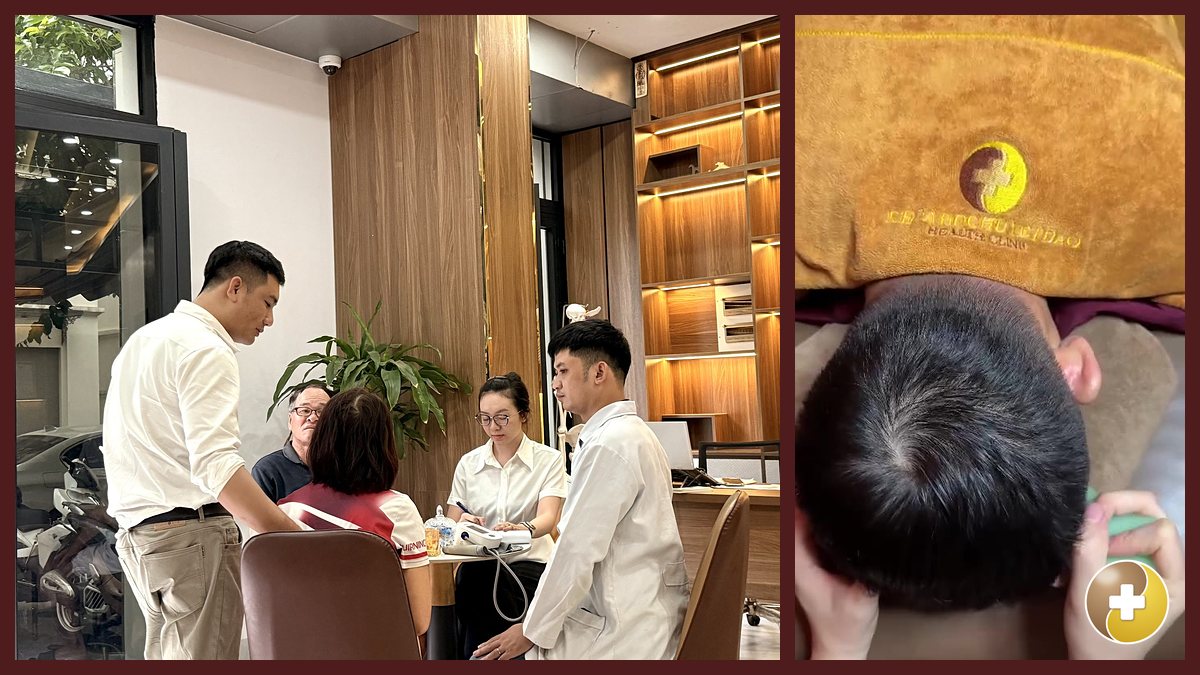
Quick answer: Head acupressure uses the soft pads of the fingers to press and circle points on the scalp, forehead and skull base, such as Bách Hội, Ấn Đường, Thái Dương and Phong Trì, so the head muscles let go and the head feels lighter. Tong Gia in District 12 and District 9, Ho Chi Minh City, reads the neck first.
Want Lương Y Tống Văn Huynh’s team to read your spine and posture in person?
What is head acupressure? The Western and the Eastern view
Head acupressure is a hands-only method: the soft pads of the fingertips press, hold and circle a set of points on the scalp, the forehead, around the eyes and at the back of the neck. People in Ho Chi Minh City look for it when the head feels heavy, tight like a hat one size too small, when the eyes are tired after a day of screens, or when they lie down and the mind keeps running. It is not a casual scalp rub. The skin on the head is thin, bone sits close underneath, and blood vessels and nerves run near the surface, so the pressure has to be lighter and more precise than on the back or legs.
In Western anatomy the scalp is covered by a muscle sheet called the epicranius: the frontal muscle at the front, the occipital muscle at the back, joined by a flat tendon over the crown. On each side sits the temporal muscle, which you use to chew. Just under the skull at the back lies a group of small suboccipital muscles that attach to the first two neck vertebrae. Stress, short sleep and a forward head over a laptop keep these muscles contracted for hours, which people feel as a band around the head, aching temples and a heavy back of the head. Correct pressure helps these fibres release, lets blood reach the scalp more easily and slows the breath.
In traditional Eastern thinking the head is where the yang meridians meet. According to the Tong Gia training manual, the point Bách Hội sits on the crown, where the midline of the head crosses the line joining the tops of the ears, and is used to clear the mind, calm the spirit and ease tension. The Gallbladder meridian runs along both sides of the head and is described in the manual as helping with discomfort of the head, neck and shoulders. The method of Tong Gia Acupoint Wellness (Huyệt Đạo Tống Gia) grew out of a Vietnamese heritage called "working on the Head and the Spine": the head is the centre of the central nervous system, the spine is the axis of the autonomic nervous system. That is why at Tong Gia head acupressure never stands alone; it always starts at the neck.
Head points commonly used
| Point | Location | Often used when | Pressure |
|---|---|---|---|
| Bách Hội | Crown, where the head midline meets the line between the ear tips | Tight head, hard to settle (manual: clears the mind, calms) | Light hold for a few breaths |
| Tứ Thần Thông | Four points around Bách Hội, about one thumb-width away | Heavy head, poor sleep | Small circles |
| Ấn Đường | Between the inner ends of the eyebrows | Tight forehead, tired eyes, overthinking | Very light |
| Thái Dương | Hollow behind the outer corner of the eye and brow | Aching temples, teeth clenching | Light, equal on both sides |
| Phong Trì | Hollows under the skull, between the two big neck muscles | Heaviness spreading from the neck to the head | Medium, directed upward |
| Phong Phủ, Thiên Trụ | Below the occipital bump; either side of the neck muscles | Stiff neck, hard to look up or down | Medium, no jerking |
Common reasons people need head acupressure
- Screens and phones: an adult head weighs about 4.5–5 kg. The further it drifts forward, the harder the neck and suboccipital muscles work to keep the eyes level, and the scalp sheet is pulled tight.
- Stress and jaw clenching: the temporal and jaw muscles tighten without you noticing, giving aching temples by evening.
- Late nights and jet lag: the head and neck muscles never fully rest. If you have just flown in, see our page on massage for jet lag in Saigon.
- Air-conditioning blowing on the neck and going to bed with wet hair: muscles contract to hold heat.
- Eye strain from close work and bright screens.
- Long scooter rides with a helmet in Saigon traffic: the neck braces against wind and vibration the whole way.
From the Eastern side, the Tong Gia manual names a few functions: the Liver governs smooth flow, so long pressure and anger make it hard to relax and sleep; the Liver also governs the sinews, so tight muscles follow; the Kidney produces marrow and "the brain is the sea of marrow", and when this is weak people report headaches, dizziness, ringing ears and light sleep; the Heart houses the spirit. These are functional ideas of traditional medicine, not a statement that any of your organs is ill.
Signs that often come with it
- A band-like ache around the forehead, temples and back of the head, worse in the afternoon.
- Tenderness in the hollow under the skull that spreads to the crown or behind the eyes.
- Dry, tired eyes; blurred vision after long screen time.
- Trouble falling asleep, shallow sleep, waking up with a heavy head.
- A stiff neck, turning the whole body to look sideways.
- Light dizziness when tilting the head back: if it repeats, get checked first.
When to see a doctor
Most heavy, tight heads come from muscles and daily habits. Please see a doctor first, and skip head acupressure, if you have:
- A sudden, severe headache, unlike anything before.
- Facial droop, slurred speech, weakness or numbness on one side, sudden loss of vision: call 115 immediately.
- Chest pain, shortness of breath, cold sweat, pain spreading to the left arm or jaw: call 115 immediately.
- Headache with high fever, stiff neck, vomiting or sensitivity to light.
- Headache after a fall or a knock to the head or neck.
- Very high blood pressure, or blood thinners that make you bruise easily (tell the technician).
- A new headache after 50 with weight loss, long fatigue or pale skin: get checked at a medical facility in parallel.
This is a wellness service, not medical care. If you are following medical advice, keep doing so; a session only supports relaxation.
Y Tướng Học: reading the head before touching it
Y Tướng Học (face reading for wellness) works on the idea "what is inside shows outside". According to the Tong Gia manual, before pressing, the technician looks at the shape of the head, the forehead and the skin to choose areas and pressure. A few patterns often seen in people with a tight, heavy head:
- Bony head with thin scalp: the manual links it to Liver–Kidney yin deficiency, very tight sinews and tension headaches through the whole scalp sheet and neck. These guests need very light pressure and longer circling.
- Flat back of the head: linked in the manual to weaker Kidney qi, light sleep and feeling cold; the technician spends more time on Phong Trì and Thiên Trụ and keeps the neck warm.
- Pointed crown: the manual notes energy rising upward, quick temper, dry eyes and vascular-type headaches. Bách Hội is held only lightly; most of the time goes to the neck and shoulders.
- Forehead with many crossing lines: linked to long mental pressure that tightens the forehead-occipital muscles and the shoulder lifters.
These are hints for choosing pressure, never a verdict on your health or personality.
Vertebrae and reflex zones involved
According to the Tong Gia manual, the neck vertebrae C1–C7 relate to the head, face, neck and arms; the upper back T1–T3 joins in for the nervous and emotional group (long headaches, poor sleep, vertigo), together with the sacral area. Nerve roots leave the spine between the vertebrae, which is where the fingers search when reading the spine.
| Vertebrae / area | Nerve role | Common feeling | Related organ (Eastern view) |
|---|---|---|---|
| Head (crown, forehead, temples, back) | Central nervous system: thinking, control | Tight head, poor focus | Kidney, Heart |
| C1–C3 | Head, face, suboccipital muscles | Neck heaviness rising to the head, tired eyes | Liver, Kidney |
| C4–C7 | Neck, shoulders, arms | Stiff neck, raised shoulders | Liver (sinews) |
| T1–T3 | Upper back, circulation, breathing | Shallow breath, heavy upper back when stressed | Heart, Lung |
| Sacral area | Paired with the nervous group in the manual | Light sleep, long fatigue | Kidney |
The Tong Gia method: spinal nerve-reflex balancing massage
Head acupressure at Tong Gia is part of the spinal nerve-reflex balancing method developed by Lương Y (master of traditional Vietnamese wellness) Tống Văn Huynh, who has worked in traditional Vietnamese wellness for over 13 years. It is a Vietnamese Eastern-medicine approach, and if you are visiting or living in Ho Chi Minh City it is a good way to experience it. No needles, nothing to swallow, no rough force. A typical session:
- Observation: head shape, shoulder level, complexion, the forehead; questions about sleep, screen hours, blood pressure.
- Reading the spine by hand: skin temperature, muscle layer, vertebra shape and tender points from C1 down to T3.
- Muscle release at the neck and shoulders: the trapezius, levator scapulae and suboccipitals first.
- Head points in order: Phong Trì, Thiên Trụ, Phong Phủ; up to Bách Hội and Tứ Thần Thông with fingertip combing; then Ấn Đường and along the brows to Thái Dương.
- Home care: two or three simple moves and one habit to change.
A typical session: an office worker in her thirties arrives at the District 12 branch around 6 pm with a "tight hat" feeling since noon. Her right shoulder sits higher and the right suboccipital area feels warm and hard. Almost half the hour goes to the neck and shoulders before the crown and forehead. She describes a pressure spreading toward the eyes during Phong Trì, then lightness and repeated yawning at the end. Everyone feels it a little differently.
| Service | Time | Price |
|---|---|---|
| Head care | 60 min | 750,000 VND (about 29 USD) |
| Neck and shoulder care | 60 min | 550,000 VND (about 21 USD); first visit 399,000 VND (about 15 USD) |
| Hair wash with neck and shoulder massage | 60 min | 250,000 VND (about 10 USD) |
More on related services: Vietnamese head spa in Saigon, neck and shoulder massage in Saigon, acupressure massage questions. Want to learn this technique: head, face and neck acupressure course at Tong Gia Training.
Want Lương Y Tống Văn Huynh’s team to read your spine and posture in person?
Home care and prevention
- Circle Bách Hội and Phong Trì for 3 minutes before bed with the finger pads; a light ache is enough.
- Comb the scalp with ten fingertips from the hairline to the neck, 20–30 strokes.
- 4–6 breathing: in through the nose for 4 seconds, out slowly for 6, for 5–10 minutes a day, as the Tong Gia manual suggests.
- Raise your screen to eye level and stand up every 45–60 minutes.
- Keep cold air off the neck and dry your hair before sleep.
Never press on the eyeballs or deep into the front sides of the neck.
Book a session
- District 12: 225 Dương Thị Mười, Tân Chánh Hiệp Ward (District 12), open 8:00–19:00 daily.
- District 9: Unit T16-21, Manhattan zone, Vinhomes Grand Park, Long Bình Ward, Thủ Đức City (District 9), open 9:00–20:00 daily.
Call, Zalo or WhatsApp +84 888 264 559, or book on the booking page. Please mention high blood pressure, pregnancy or a recent knock to the head.
Visit us
- Đông Y Huyệt Đạo Tống Gia Quận 12 (District 12)
225 Dương Thị Mười, Phường Tân Chánh Hiệp, Quận 12, HCMC · 8:00–19:00 daily · 0888 264 559 · Directions on Google Maps - Đông Y Huyệt Đạo Tống Gia Quận 9 (Vinhomes Grand Park, District 9)
Căn T16-21 khu Manhattan, Vinhomes Grand Park, Phường Long Bình, TP. Thủ Đức, HCMC · 9:00–20:00 daily · 0888 264 559 · Directions on Google Maps
Want Lương Y Tống Văn Huynh’s team to read your spine and posture in person?
FAQ
What does head acupressure do? It helps the forehead, temple and suboccipital muscles let go and eases blood flow to the scalp, so many people feel a lighter head, less tired eyes and easier sleep. The Tong Gia manual describes Bách Hội as clearing the mind and calming. It is wellness care, not a replacement for medical advice.
Which points help a tension headache? Phong Trì at the back of the neck, Thái Dương at the temples, Ấn Đường between the brows and Bách Hội on the crown, 1–2 minutes each with light pressure. A sudden severe headache, facial droop or limb weakness means call 115, not acupressure.
Is head acupressure safe? With correct pressure and location it is safe for most people. No pressure on the eyeballs, nothing deep on the front sides of the neck, no session right after a head knock, with high fever or very high blood pressure. Older guests turn the neck slowly, never with a jerk.
I have a headache after a massage. Is that normal? A slightly sore neck or mild heaviness for a few hours is common after muscles are worked; drink warm water and rest. If it gets worse or comes with vomiting or strong dizziness, get checked at a medical facility and tell us so the next session is lighter.
Can head acupressure help me sleep after a long flight? Many guests fall asleep more easily after the neck and head are released. Combine it with daylight in the morning and a fixed bedtime in Ho Chi Minh City time.
How long is a head session and how much is it? Head care is 60 minutes for 750,000 VND (about 29 USD). Neck and shoulder care is 550,000 VND (about 21 USD), first visit 399,000 VND (about 15 USD).
Author: Lương Y Tống Văn Huynh – founder of Huyệt Đạo Tống Gia, a master of traditional Vietnamese wellness with over 13 years in Eastern wellness care, Y Tướng Học (face reading) and spinal nerve-reflex balancing massage.
Updated: 2026-11-16
Related guides
- Why does my head feel heavy? Causes, when to get checked, and how Tong Gia can help in Ho Chi Minh City
- Why do I feel dizzy so often? Causes, when to get checked, and how Tong Gia can help in Ho Chi Minh City
- Dizziness in older adults: common causes, danger signs and safe care
- Dizziness with ringing in one ear: causes, when to get checked, and how Tong Gia can help in Ho Chi Minh City
- Jaw joint (TMJ) pain: causes, when to get checked, and how Tong Gia can help in Ho Chi Minh City
- Migraine in young adults: why students and young workers get it and what helps
This is a wellness service, not medical care.