
Head massage in Ho Chi Minh City: the types, what it really does and how to choose your session
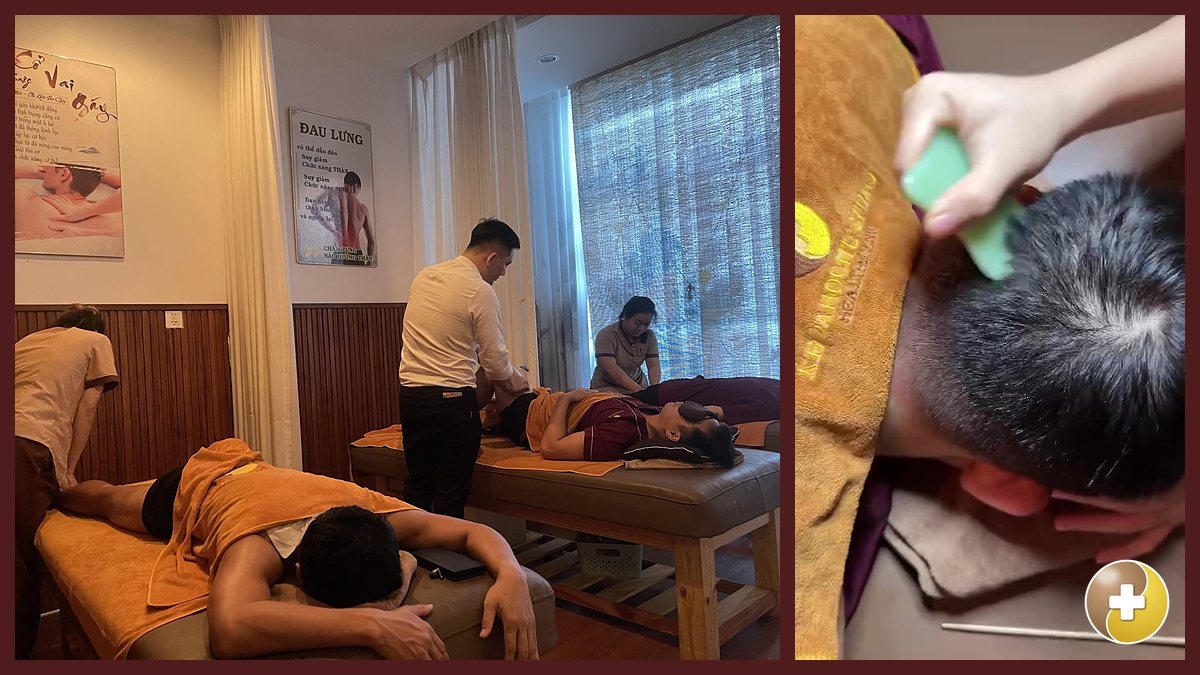
Quick answer: A head massage uses slow strokes, kneading and acupressure on the scalp, forehead, temples and back of the neck so the head muscles let go: your head feels lighter, eyes less strained, and rest comes easier. At Tong Gia Acupoint Wellness in Districts 12 and 9, Ho Chi Minh City, it always includes the neck, from about US$6.
Want Lương Y Tống Văn Huynh’s team to read your spine and posture in person?
What is a head massage, in plain Western terms?
A head massage means working the scalp, forehead, temples, the area around the eyes and the back of the neck with fingertips and palms: slow circles, gliding strokes, gentle kneading and pressure on specific points. Guests at Tong Gia Acupoint Wellness (Huyệt Đạo Tống Gia) often describe the same thing: ten minutes of the right kind of touch and the "tight hat" feeling fades, the eyes feel clearer and the shoulders drop on their own.
The Western explanation: the skull protects the cerebrum, cerebellum and brainstem, and the cerebrum is divided into frontal, parietal, temporal and occipital lobes. Over the skull lies a thick scalp rich in small blood vessels and sensory nerve endings. The forehead, temples and face are served mainly by the trigeminal nerve, the back of the head and neck by the occipital nerves. Under the skin sits a "muscle cap": the occipitofrontalis running from the eyebrows to the back of the head, the temporalis connecting down to the jaw joint, and small suboccipital muscles that balance the head on the neck.
Stress, long hours at a screen, jaw clenching and looking down at a phone keep these muscles contracted without you noticing. Over time, circulation in the scalp slows and a heavy, tight, dull ache builds by late afternoon. Slow, even, well-judged pressure lets the muscles release and signals safety to the brain, switching on the parasympathetic "rest and digest" system: breathing slows, the face softens. There is nothing mystical about it, and how much you feel differs from person to person.
In Ho Chi Minh City, the people who look for a head massage range from office workers and engineers in the Saigon Hi-Tech Park to riders in the midday sun, parents short on sleep and expats adjusting to the heat. At Tong Gia, a head massage is not a hair-salon wash; it is a hands-on wellness session that connects the head with the neck and spine, following the method of Lương Y (master of traditional Vietnamese wellness) Tống Văn Huynh.
Common causes: why your head needs it
- Eight to ten hours of screens: the eyes keep focusing, the muscles around them and across the forehead tighten; by evening the temples ache.
- Forward head posture: the further your head drifts forward, the harder the suboccipital and neck muscles work; heaviness creeps from the neck to the top of the head.
- Jaw clenching: concentration or worry tightens the temporalis and masseter, leaving a sore jaw and tight temples.
- Heat and helmets: riding at noon, sweat under a helmet, a hot, stuffy head at night.
- Air-conditioning on the neck, sleeping with wet hair: the neck chills, muscles contract, and you wake with a heavy head.
- Work pressure and overthinking: the mind keeps running even when the body is tired.
- Short or irregular sleep: late weekends, night shifts and jet lag leave no time for the head muscles to recover.
Most people have two or three of these at once, so a useful head massage is not just a pleasant scalp rub: it finds where the tension actually sits, which may be the temples, the base of the skull or between the shoulder blades. Our neck and shoulder massage Q&A explains how the shoulders feed head tension.
Other signs to watch
- A heavy head, as if wearing a hat a size too small; tight forehead or temples late in the day.
- Tenderness at the hairline at the back of the neck that spreads to the crown or behind the eyes.
- A scalp that feels stuck to the skull and hardly moves when you push it gently.
- Dry, tired, stinging eyes; brief blurring after long screen time.
- A sore jaw, grinding at night, tired sides of the head after chewing.
- Raised shoulders, a stiff neck that clicks when you turn it.
- Poor focus in the afternoon and trouble falling asleep. If sleep is the main issue, read acupressure for sleep in Saigon.
When to see a doctor
Please see a doctor at a medical facility, and do not massage, if you notice any of the following:
- A sudden, severe headache, "the worst ever", or weakness on one side, a drooping face, slurred speech or blurred vision: call 115 (Vietnam's ambulance line) immediately.
- Crushing chest pain, shortness of breath or cold sweats: call 115 immediately.
- Headache with fever, a stiff neck or repeated vomiting, or after a blow to the head.
- Repeatedly high blood pressure; according to the Tong Gia curriculum, readings from 180/110 are very high and need urgent care, especially with a headache.
- New spinning dizziness, ringing in the ears or hearing loss.
- A headache that changes pattern, worsens week by week or wakes you at night.
- Patchy hair loss, a red, swollen or weeping scalp, unexplained weight loss or lasting fatigue: get checked alongside any wellness care.
Skip head massage on a wounded, inflamed or fungal scalp, or after head and neck surgery until your medical team agrees. If you are pregnant, have a heart or blood-pressure condition or take blood thinners, tell your practitioner first so they keep the pressure light. This is a wellness service, not medical care.
The Y Tướng Học view: the head as the "sea of marrow"
The Tong Gia curriculum teaches that the face directly reflects the state of the organs and the central nervous system. Y Tướng Học (face reading for wellness) rests on the idea that "the signs are outside, the organs inside". For the head, three organ systems in traditional Eastern thinking come up most:
- Kidney (Thận): stores essence and produces marrow; the brain is called the "sea of marrow". When Kidney essence is low, the curriculum notes headaches, dizziness, ringing ears, weaker memory and very light sleep.
- Liver (Can): keeps qi flowing. When Liver qi stagnates, qi and blood push up to the head and the autonomic nervous system stays tense; Liver fire brings irritability, dry burning eyes and a bitter taste in the morning.
- Heart (Tâm): houses the spirit and governs thinking and sleep; excess Heart fire shows as restlessness, poor sleep and mouth sores.
| What the practitioner sees | What the Tong Gia curriculum notes | Priority area in a head massage |
|---|---|---|
| Flat or dented back of the skull | Low Kidney essence; deep muscle spasm at the base of the skull, upper neck C1–C3 prone to wear | Base of the skull, back hairline, C1–C3 |
| "Giáp" face: wide forehead, pointed chin | "Full above, empty below": headaches, poor sleep, heat rising; C1–C2 often warm | Cool the upper neck, then the lower back |
| Sunken, dull area between the eyebrows | Blocked flow along the midline (Governor Vessel), dizziness on standing | Mid-forehead, crown, midline of the head |
| Tight, ropey muscles all over | Liver–Kidney yin deficiency; tension headaches through the whole scalp muscle and neck | Whole scalp, temples, neck |
This is traditional reference knowledge that helps the practitioner choose where to start; it does not replace a medical check and is never used to judge anyone.
Spine segments and nerve-reflex areas involved
The head sits on the cervical spine, and the neck is the gateway for every signal travelling to the brain. In the Tong Gia curriculum, C1–C7 govern the head, face, neck and arms, while D1–D12 relate to circulation, breathing and digestion. For the nervous-system group (chronic headaches, long-term poor sleep, vestibular complaints, nervous exhaustion) it combines C1–C7, the upper back D1–D3 and the sacral area.
| Segment | Nerves and function | Signs when the head is tense | Related organ (Eastern view) |
|---|---|---|---|
| C1–C2 | Base of the skull, occipital nerves | Warm neck, heavy crown, light-headed on standing | Liver, Kidney |
| C3 | Deep neck muscles, face | Pressure behind the eyes, jaw fatigue | Kidney, Liver |
| C4–C7 | Neck, shoulders, arms | Raised shoulders, tired arms, tingling fingertips | Liver |
| D1–D3 | Chest, heart, lungs | Shallow breathing, tight chest under stress | Heart, Lung |
| Sacral area | Pelvic nerves | Light sleep, cold feet, tired lower back | Kidney |
"Related" here guides the session; it is not a medical finding. If only the scalp is rubbed and the neck stays braced, the head usually feels light for a few hours and then heavy again, which is why every Tong Gia head session starts or ends on the neck.
How Tong Gia works: spinal nerve-reflex balancing massage for the head
The method was built by Lương Y Tống Văn Huynh over more than 13 years of Eastern wellness practice, Y Tướng Học and spinal nerve-reflex balancing. A session follows five steps:
- Observe: complexion, forehead, the area between the brows, the eyes, head shape and posture; questions about screen hours, sleep and where the heaviness sits.
- Read the spine by hand: pressing, gliding and rolling to read four factors, as the curriculum teaches: skin temperature, the muscle cushion, the shape of each vertebra and your sensations, comparing left and right from C1 down to the upper back.
- Muscle release: trapezius, neck and suboccipitals first, then scalp, temples, forehead and jaw, using pushing, flicking and vibration techniques until the skin over the key point turns from dry to slightly moist.
- Targeted acupressure: Bách hội (GV20) on the crown to clear the head and calm the mind, Nội quan (PC6) on the wrist for tension, Thần môn (HT7) to support sleep, Thái Xung (LR3) on the foot when stress is high.
- Home guidance: a five-minute scalp routine, slow breathing, screen and pillow height.
| Service | Length | Price | Who it suits |
|---|---|---|---|
| Gội đầu trược khí (light herbal wash) | 45 min | 150,000 VND (about US$6) | A short, gentle reset after work |
| Herbal hair wash with neck and shoulder massage | 60 min | 250,000 VND (about US$10) | A clean scalp plus relaxed head, neck and shoulders |
| Head care session | 60 min | 750,000 VND (about US$29) | Long-running heaviness, tight temples, a warm neck; full neck reading and acupressure |
See all prices, our headache and dizziness acupressure page, and the Vietnamese head spa. Guests who tried the wash describe it in a Vietnamese head spa experience in Saigon, and common questions are in the head spa Q&A.
A typical session
A designer working on two monitors for nearly ten hours a day books a head care session. The practitioner notices his head sitting forward, the right shoulder higher than the left and visible tension at the temples. Reading the spine, C1–C2 feel warmer than the segments below, the right side of the back hairline is tender and the area between the shoulder blades is thick and hard. Work starts on the shoulders and upper back, moves to the neck and base of the skull, then the scalp from forehead to back, the temples and the jaw. Halfway through his breathing slows and his jaw lets go. The session ends with Bách hội and Nội quan, plus advice to raise his screens to eye level.
What guests feel
At first there is a pleasant soreness at the back hairline and temples, then warmth and a lighter head; many people doze off. Afterwards guests often report a clearer head, easier neck rotation and falling asleep faster that night. Mild sleepiness or slight tenderness the next day is common after muscle release. Everyone responds differently; Tong Gia helps the body rebalance and makes no promise that pain will be gone for good.
Want to learn this technique: how head massage affects the nervous system (Tong Gia training site).
Want Lương Y Tống Văn Huynh’s team to read your spine and posture in person?
Home care and prevention
- Five-minute scalp routine: fingertips, not nails, small slow circles from the front hairline over the crown to the back of the neck, on dry hair.
- Bách hội for one minute: where the midline of the head meets the line between the tops of the ears; gentle circles with slow breathing.
- 4–6 breathing: in through the nose for 4 seconds, out slowly for 6, for 5–10 minutes, as the Tong Gia curriculum suggests.
- Fix your desk: screen at eye level, phone raised instead of looking down; stand, roll the shoulders and look into the distance every 45–60 minutes.
- Keep the neck warm and hair dry: dry your hair before bed and keep air-conditioning off the back of your neck.
Book a session
- District 12: 225 Dương Thị Mười, Phường Tân Chánh Hiệp (Tan Chanh Hiep Ward, District 12). Open 8:00–19:00 daily.
- Vinhomes Grand Park, District 9: Căn T16-21 khu Manhattan, Phường Long Bình, TP. Thủ Đức (Unit T16-21, Manhattan zone, Long Binh Ward, Thu Duc City). Open 9:00–20:00 daily.
Book online or call, Zalo or WhatsApp +84 888 264 559. Tell us where your head feels heavy (forehead, temples, crown or neck) and which session you want. Real reviews are on each branch's Google Maps page. Living in or visiting Ho Chi Minh City? Come and try a Vietnamese Eastern wellness method built by Lương Y Tống Văn Huynh.
Visit us
- Đông Y Huyệt Đạo Tống Gia Quận 12 (District 12)
225 Dương Thị Mười, Phường Tân Chánh Hiệp, Quận 12, HCMC · 8:00–19:00 daily · 0888 264 559 · Directions on Google Maps - Đông Y Huyệt Đạo Tống Gia Quận 9 (Vinhomes Grand Park, District 9)
Căn T16-21 khu Manhattan, Vinhomes Grand Park, Phường Long Bình, TP. Thủ Đức, HCMC · 9:00–20:00 daily · 0888 264 559 · Directions on Google Maps
Want Lương Y Tống Văn Huynh’s team to read your spine and posture in person?
FAQ
What does a head massage do? It relaxes the scalp muscle cap, the temples, the jaw and the neck, improves circulation in the scalp and switches on the rest side of the nervous system. Many people feel a lighter head, less eye strain and sleep more easily. At Tong Gia the neck is always included so the effect lasts longer.
Is scalp massage good for hair, or does it cause hair loss? Fingertip massage with moderate pressure and no nails does not usually cause hair loss; the few hairs that fall during a wash were already due to shed. If hair falls out in patches or the scalp is red, swollen, very itchy or weeping, get it checked at a medical facility first.
How can I massage my head for stress at home? Sit upright, take a few 4–6 breaths, then make slow fingertip circles from the front hairline over the crown to the neck for about five minutes, and press Bách hội gently for one minute. Do it somewhere quiet with your phone away. If stress and poor sleep last for weeks, see a doctor as well.
How is a head massage different from a Vietnamese head spa? A head spa includes washing and rinsing with herbal water, with massage as one part. A Tong Gia head care session focuses on muscle release, reading the neck and acupressure around the head and neck, and suits long-running heaviness. For a light reset choose the wash; for deeper care choose head care.
How often should I get a head massage? If you work at a screen and often feel a heavy head, once a week for the first three to four weeks, then every two to four weeks, works for many guests, plus a five-minute routine at home. Your practitioner suggests a rhythm after reading your neck.
Who should avoid head massage? Anyone with a recent head injury, a sudden severe headache, a high fever, a wounded or infected scalp, or recent head and neck surgery without medical clearance. If you are pregnant, have a heart or blood-pressure condition or take blood thinners, tell the practitioner first.
Author: Lương Y Tống Văn Huynh – founder of Huyệt Đạo Tống Gia, a master of traditional Vietnamese wellness with over 13 years in Eastern wellness care, Y Tướng Học (face reading) and spinal nerve-reflex balancing massage.
Updated: 2026-11-16
Related guides
- Headache self-massage: seven simple steps at home, when to skip it, and a hands-on session at Tong Gia in Ho Chi Minh City
- Headache with eye pain: why your head and eyes ache together, when to get checked, and what your body needs
- Headache relief without painkillers: eight natural ways, when to get checked, and how Tong Gia supports you in Ho Chi Minh City
- What is the space between the eyebrows called? Glabella, Ấn Đường and why this spot tightens
- The Taiyang temple acupoint: where to find it, how to press it safely, when to skip it, and how Tong Gia cares for the head
- Head massage in Ho Chi Minh City: the types, what it really does and how to choose your session
This is a wellness service, not medical care.