
The Taiyang temple acupoint: where to find it, how to press it safely, when to skip it, and how Tong Gia cares for the head
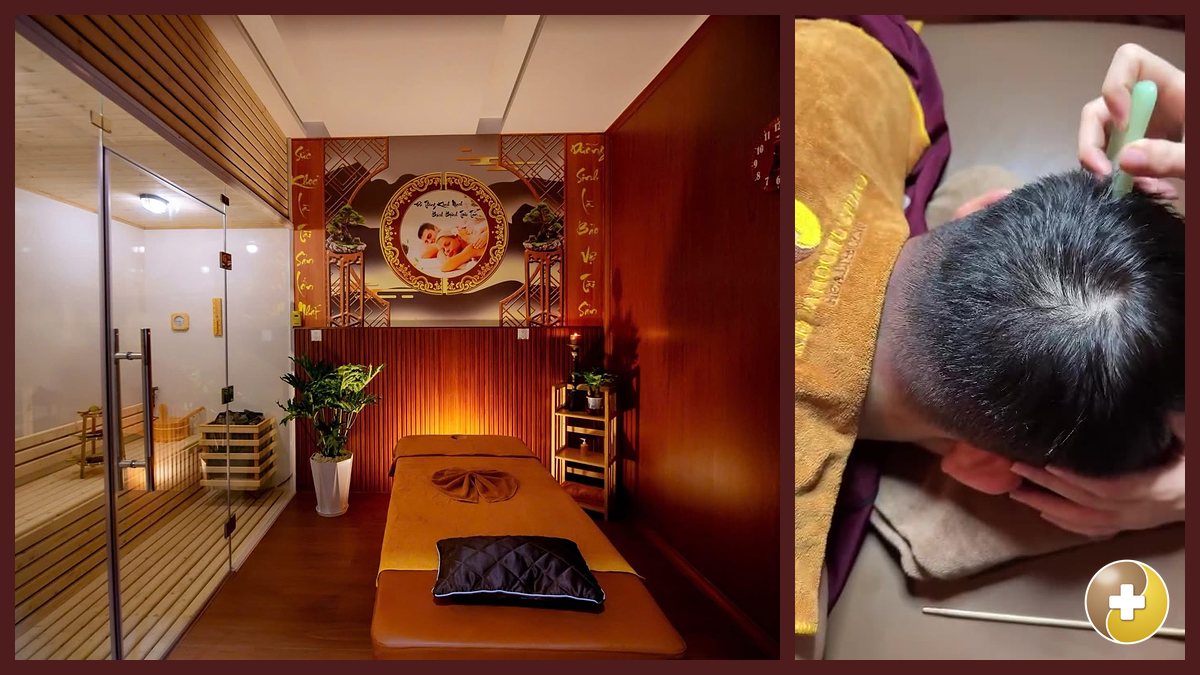
Quick answer: The Taiyang point (Vietnamese: huyệt thái dương) lies in the soft hollow at each temple, about one finger-width behind the midpoint between the outer eyebrow and the outer corner of the eye. Slow, light circles for 1–2 minutes help the forehead and eyes relax. A sudden severe headache needs medical help first. Tong Gia in Ho Chi Minh City offers hands-on head care.
Want Lương Y Tống Văn Huynh’s team to read your spine and posture in person?
What the Taiyang point is and where it sits
The Taiyang point, called huyệt thái dương in Vietnamese, sits in the soft hollow on each side of the head, roughly one finger-width behind the spot halfway between the tail of your eyebrow and the outer corner of your eye. If you clench your teeth lightly with a fingertip resting there, you will feel a muscle bulge and then relax. That is the temporalis, one of the strong chewing muscles. In traditional Eastern medicine, Taiyang is counted among the "extra points" of the head and face, and people press it when the head feels tight, the eyes are tired or the forehead feels heavy.
In Western anatomical terms, a few layers matter here. Under the skin lies the fascia and the temporalis muscle, which runs from the side of the skull down to the lower jaw. Beneath the muscle is the temporal bone, one of the thinner parts of the skull. The superficial temporal artery passes nearby (the pulse you can feel just in front of your ear), along with small sensory nerve branches of the face. The Tong Gia curriculum notes that the skull protects the cerebrum, cerebellum and brainstem, and that the cerebrum has frontal, parietal, temporal and occipital lobes. Because this area is thin and carries vessels and nerves, the Taiyang point only suits light pressure, never the firm pressure used on the back or the soles of the feet.
Among expats and visitors in Ho Chi Minh City, the people who ask about this point are usually:
- Remote workers and office staff who stare at screens all day and feel both temples squeezed by late afternoon.
- Motorbike riders in tight helmets, squinting through midday glare and traffic noise.
- People who clench or grind their teeth under stress and wake up with a tired jaw.
- Travellers adjusting to heat, air conditioning and a new time zone.
If your temples ache mainly from work pressure, our page on headache and dizziness acupressure covers that pattern. This guide focuses on the point itself: finding it correctly, pressing it safely, and understanding why tight temples often mean the neck, jaw, eyes and inner organs need attention too.
Why the temples get tight: common causes
- Jaw clenching and teeth grinding: the temporalis is a chewing muscle. If you clench while concentrating or grind at night, it works around the clock and the ache spreads across the sides of the head. Pain at the temple when chewing or opening the mouth wide usually involves the chewing muscles and the jaw joint.
- Eye strain: close work, squinting in bright sun and the wrong glasses tighten the muscles around the eyes, forehead and temples.
- Forward head posture: looking down at a phone or a low laptop makes the small muscles under the skull and along the neck brace all day. The Tong Gia curriculum links tight deep muscles at the base of the skull with the upper neck vertebrae C1–C3; many people feel it at the temples while the source sits in the neck.
- Stress: under pressure we frown, raise the shoulders and clench without noticing.
- Poor sleep, shift work, jet lag: see jet lag massage in Saigon.
- Saigon's environment: strong sun, dehydration, tight helmets, cold air blowing on the head, constant noise.
Signs to notice alongside temple pain
- Tender when pressed: a dull, sore feeling usually means a tight temporalis. Sharp pain, swelling, redness, or a hard, tender artery needs a medical check.
- Pain when chewing or opening the mouth, clicking in the jaw: points to the chewing muscles and jaw joint.
- Tight temples plus the back of the neck: often tension-type headache with a stiff neck and shoulders.
- One-sided throbbing, light sensitivity, nausea: suggests a migraine pattern; during an attack many people cannot bear touch on the head.
- Timing: on waking (think clenching, poor sleep), late afternoon (eyes, posture), after time in the sun.
When to see a doctor instead of pressing the point
Please see a doctor or go to a medical facility, and do not press the point yourself, if:
- This is the first strong headache of your life, or the pattern has changed: more often, stronger, waking you at night.
- You are over 50 and temple pain is new, with jaw fatigue when chewing, a tender scalp or blurred vision.
- The temple is swollen, hot or red, or you recently hit your head (do not massage a fresh knock).
- There is fever, a rash or blisters on the forehead or around the eye.
- You are pregnant with strong headaches, swollen legs or blurred vision, or your blood pressure reads very high.
- Headache comes with fatigue, pale skin or unexplained weight loss: get checked in parallel.
Call emergency services (115 in Vietnam) for a sudden, explosive headache unlike any before, or headache with vomiting, stiff neck, confusion, seizure, weakness or numbness on one side, a drooping face, slurred speech, double vision, chest pain, shortness of breath or cold sweats.
This is a wellness service, not medical care. If a doctor, dentist or eye specialist is already following you, keep to their advice; pressing the point is only relaxation support.
Eastern face reading: what the temples say about Liver, Gallbladder and Kidney
Face reading (Y Tướng Học) in the Tong Gia curriculum follows the idea "the outer form reflects the inner organs". For people whose temples tighten easily, three directions are usually considered. These are traditional concepts, not Western medical labels for organs.
- Liver (Can): stores blood and keeps energy flowing smoothly; linked to the eyes, tendons and emotions. When it is out of balance, the curriculum lists dry eyes, blurred vision, cramps, tight muscles, irritability, difficulty relaxing and light sleep.
- Gallbladder (Đởm): paired with the Liver. Under stress, the curriculum notes rib-side tightness and one-sided headache along the Gallbladder channel, which runs along the side of the head.
- Kidney and the "sea of marrow": when Kidney essence is low, the curriculum describes nervous exhaustion, headache, dizziness, ringing ears and light sleep, with tight deep muscles at the base of the skull (C1–C3).
Outer signs a practitioner may note first: a face wide at the cheekbones with a narrow forehead and pointed chin (Liver and Gallbladder strong, stress goes to the stomach and one side of the head); a broad forehead with a narrow chin (upper body "full", lower body "empty", the upper neck often warm); a prominent forehead (energy rising to the head); an uneven mouth or face (often with jaw-joint imbalance); eyebrows joined at the centre (deep tension, facial muscles always tight). This is reference knowledge from the tradition, used to choose where to check first, never to judge anyone. More in Eastern face reading for wellness.
Spine segments and reflex areas linked to the temples
According to the Tong Gia curriculum, the neck vertebrae C1–C7 relate to the head, face, neck and arms, and the thoracic vertebrae relate to circulation, breathing and digestion. For the nervous-system group (long-term headache, poor sleep, dizziness), the curriculum combines C1–C7, upper back T1–T3 and the sacral area.
| Spine level | Nerves and function | Common signs | Related organ (Eastern view) |
|---|---|---|---|
| C1–C3 | Back of the head, muscles under the skull | Ache rising from the neck to the temples, heavy head | Kidney (marrow), Liver |
| C3–C7 | Neck, shoulders, arms | Stiff neck, tired shoulders, clenching | Liver (tendons) |
| T1–T3 | Upper back, chest, breathing | Shallow breath under stress, "hot" head | Heart, Lung |
| T7–T9 | Mid back, liver, gallbladder, stomach | Bloating and one-sided headache under stress | Liver, Gallbladder, Spleen |
| Sacral area | Pelvic nerves, lower back | Light sleep, cold tired lower back | Kidney |
The table shows links to guide care, not a medical conclusion.
The Tong Gia method: spinal reflex balancing massage
This is a Vietnamese traditional wellness method developed by Lương Y Tống Văn Huynh, a master of traditional Vietnamese wellness with over 13 years in the field of Eastern wellness, face reading and spinal reflex balancing. For tight temples, the aim is to let the head "cool down": soften the neck, shoulders and jaw first, then work the head and face points, including Taiyang.
- Observation: complexion, eyes, the space between the brows, jaw symmetry, raised shoulders; questions about sleep, clenching and screen time.
- Reading the spine by hand: feeling skin temperature, stroking along the spine, pressing each segment from C1 down to the sacrum and comparing left with right.
- Muscle release: trapezius, neck, between the shoulder blades and the jaw, light to medium pressure in an even rhythm that creates a pleasant "wave" of sensation so the body can adjust itself.
- Precise acupressure: gentle work on Taiyang, Ấn Đường between the brows and Bách hội at the crown; Thái Xung on the foot, used in the tradition to ease tension and headache; Hợp cốc on the hand only when pregnancy is ruled out.
- Home care coaching: how to find and press Taiyang lightly, relax the jaw and breathe slowly.
A typical session
A typical head-care session for a designer working ten hours a day at a screen: the practitioner notices a slightly broad jaw line and hears that the guest wakes with a tired jaw. Reading the spine, C1–C2 feels warmer than the back, and the muscle under the skull on the right is thick and tender, spreading to the right temple. Work starts at the shoulders and neck, then moves to the jaw and temples with fingertip pressure. By mid-session breathing slows and the shoulders drop. It ends with the crown and Thái Xung, plus a short home routine.
Services and prices
- Head care, 60 min: 750,000 VND (about 29 USD), when tight temples and a heavy head are the main issue.
- Neck and shoulder care, 60 min: 550,000 VND (about 21 USD), first visit 399,000 VND (about 15 USD), when temple tension comes with a stiff neck.
- Herbal hair wash with neck and shoulder massage, 60 min: 250,000 VND (about 10 USD), for light relaxation after work.
See all prices, or read about the Vietnamese head spa and our guide to head spa questions in Saigon.
What guests feel
During the session most people feel a pleasant soreness in the neck and shoulders, then warmth; when the temples are worked, the eyes feel lighter and the forehead softens. Afterwards guests often describe a clearer head, sharper vision and easier sleep that night. Some feel sleepy, a common response as the body shifts into rest. Responses vary; Tong Gia supports the body's balance and does not promise that headaches will stop.
Want Lương Y Tống Văn Huynh’s team to read your spine and posture in person?
Pressing Taiyang at home, and prevention
- Press it correctly: sit back, place the pads of your middle fingers or thumbs in both temple hollows, circle slowly with your breath for 1–2 minutes, just enough to feel pleasantly sore. Do not press hard or rub firmly over the pulse.
- Unclench: lips together, teeth slightly apart, tongue resting on the palate; check a few times an hour.
- Neck before temples: press the hollows under the skull, squeeze the shoulders, then the temples; hold the crown point for 30 seconds.
- Rest your eyes: every 20 minutes or so, look into the distance for a short while; raise the screen to eye level.
- Slow 4–6 breathing: in through the nose for 4 seconds, out for 6, for 5 minutes before bed; drink enough water. For sleep support see acupressure for sleep.
Book a session
- District 12: 225 Dương Thị Mười, Tân Chánh Hiệp Ward (225 Duong Thi Muoi Street). Open 8:00–19:00 daily.
- Vinhomes Grand Park, District 9: Căn T16-21 khu Manhattan, Phường Long Bình, TP. Thủ Đức (unit T16-21, Manhattan zone, Long Binh Ward, Thu Duc City). Open 9:00–20:00 daily.
Book online, or call, Zalo or WhatsApp +84 888 264 559. Mention your main concern (tight temples, tired jaw, stiff neck, eye strain) so the practitioner can prepare. English-speaking guests are welcome; read real Google Maps reviews on each branch page. This is the method of Lương Y Tống Văn Huynh, founder of Huyệt Đạo Tống Gia; we invite you to experience it while you are in Ho Chi Minh City.
Visit us
- Đông Y Huyệt Đạo Tống Gia Quận 12 (District 12)
225 Dương Thị Mười, Phường Tân Chánh Hiệp, Quận 12, HCMC · 8:00–19:00 daily · 0888 264 559 · Directions on Google Maps - Đông Y Huyệt Đạo Tống Gia Quận 9 (Vinhomes Grand Park, District 9)
Căn T16-21 khu Manhattan, Vinhomes Grand Park, Phường Long Bình, TP. Thủ Đức, HCMC · 9:00–20:00 daily · 0888 264 559 · Directions on Google Maps
Want Lương Y Tống Văn Huynh’s team to read your spine and posture in person?
FAQ
Where is the Taiyang point and how do I press it? It is in the soft hollow at each temple, about one finger-width behind the midpoint between the outer eyebrow and the outer corner of the eye. Circle slowly with a fingertip for 1–2 minutes with your breath, pleasantly sore, never hard.
Why does my temple hurt when I press it? Most often the temporalis muscle is tight from clenching, grinding, eye strain or stress. If the temple is swollen, hot, sharply painful, or the pain is new after 50 with jaw fatigue or blurred vision, see a doctor soon.
What can I do for tension on both temples? Pause for a few minutes, unclench the jaw, breathe slowly, press the hollows under the skull, then the temples. Drink water and rest your eyes. If it returns for days, care for the whole neck and shoulder area, not just the temples.
Is it okay to press the Taiyang point every day? Light pressure for 1–2 minutes a day is usually fine for healthy adults. Skip it after a knock to the head or when the skin is inflamed, and avoid strong force. If you need it many times a day, get checked.
How is a session at Tong Gia different from pressing it myself? At Tong Gia the practitioner reads your face, checks the spine by hand from C1 down, releases the neck, shoulders and jaw first, then works Taiyang, the crown and the foot. Self-pressing reaches one spot and is good for upkeep between visits.
Author: Lương Y Tống Văn Huynh – founder of Huyệt Đạo Tống Gia, a master of traditional Vietnamese wellness with over 13 years in Eastern wellness care, Y Tướng Học (face reading) and spinal nerve-reflex balancing massage.
Updated: 2026-11-16
Related guides
- Headache self-massage: seven simple steps at home, when to skip it, and a hands-on session at Tong Gia in Ho Chi Minh City
- Headache with eye pain: why your head and eyes ache together, when to get checked, and what your body needs
- Headache relief without painkillers: eight natural ways, when to get checked, and how Tong Gia supports you in Ho Chi Minh City
- What is the space between the eyebrows called? Glabella, Ấn Đường and why this spot tightens
- The Taiyang temple acupoint: where to find it, how to press it safely, when to skip it, and how Tong Gia cares for the head
- Head massage in Ho Chi Minh City: the types, what it really does and how to choose your session
This is a wellness service, not medical care.