
Shoulder joint pain in Ho Chi Minh City: six common causes, the warning signs, and how Tong Gia can help
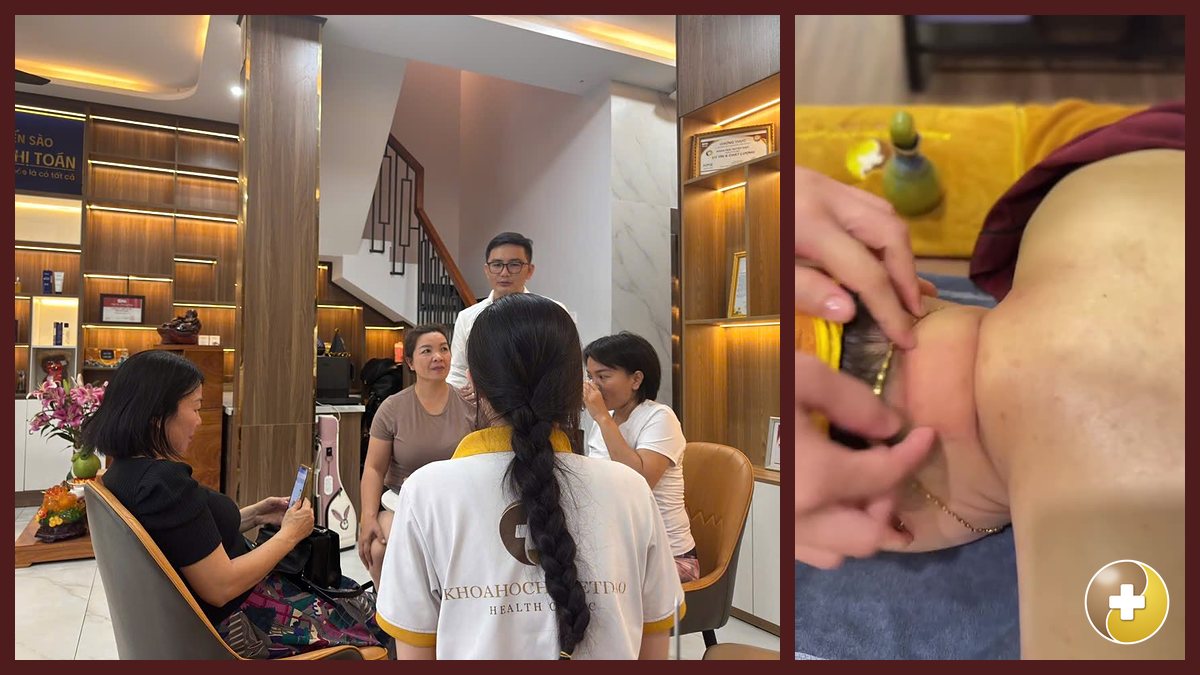
Quick answer: Shoulder joint pain usually comes from rotator cuff irritation after repeated lifting, frozen shoulder, a torn tendon, wear and tear, or pain spreading from the neck. Pain after a fall, a weak arm, a hot swollen joint or left shoulder pain with chest tightness needs a check now. Tong Gia Acupoint Wellness (Huyệt Đạo Tống Gia), District 12 and District 9, Ho Chi Minh City, cares for the shoulder by hand.
Want Lương Y Tống Văn Huynh’s team to read your spine and posture in person?
What is shoulder joint pain?
Shoulder joint pain is pain in the joint where the arm meets the body: on the outside of the shoulder, at the front, deep inside, sometimes running into the upper arm. The shoulder is the most mobile joint in the body; it lifts overhead, reaches behind and rotates. In return it relies less on bone and more on a cuff of four small tendons wrapped around the head of the arm bone (the rotator cuff), plus the joint capsule, a fluid cushion called the bursa, the biceps tendon and the deltoid muscle on top.
So shoulder joint pain is a symptom, not a disease. Pain when lifting to brush your hair is different from a shoulder that slowly stiffens until you cannot reach behind your back, and both differ from left shoulder pain with chest tightness. Some "shoulder" pain does not come from the joint at all but from the neck or internal organs.
In Ho Chi Minh City, Tong Gia Acupoint Wellness (Huyệt Đạo Tống Gia) sees it most in people aged 40 to 60, builders, painters and electricians working overhead, warehouse staff lifting to shelves, badminton, volleyball and pickleball players, gym-goers pressing overhead, swimmers, and office workers on a mouse all day with shoulders rolled forward. Many say it is worse at night when lying on that side.
Common causes: habits, work, posture and environment
- Rotator cuff irritation and impingement. When you lift the arm, the cuff tendons pass through a narrow gap under the bone at the top of the shoulder. Repeated overhead work, smashes, throws, presses, long swims or rounded shoulders rub and inflame them: pain on the outside of the shoulder in the mid-range of lifting, when dressing, and when lying on it.
- Frozen shoulder. The joint capsule thickens and tightens; the shoulder hurts, then stiffens until you cannot reach behind your back, brush your hair or reach high shelves. It is common at 40 to 60, in people with high blood sugar and after a period of little shoulder movement, and often lasts many months.
- Injury, torn tendon, dislocation. A fall on an outstretched hand, a sudden pull or an awkward lift can tear a tendon or dislocate the joint: clear weakness, you cannot lift the arm yourself though someone else can lift it, or the shoulder looks deformed. This needs a medical check, not massage.
- Bursitis, biceps tendon irritation, calcium deposits. An inflamed bursa aches on the outside; the biceps tendon at the front hurts after heavy carrying; calcium in a tendon can cause sudden severe pain.
- Wear and tear of the shoulder joint or the small joint at the end of the collarbone in older or heavy-labour workers: dull ache, clicking, morning stiffness.
- Pain "in the shoulder" from elsewhere. The neck can send pain with arm tingling; the heart can refer pain to the left shoulder, arm, neck or jaw with chest tightness; in the Tong Gia curriculum, because the liver sits under the diaphragm, liver and gallbladder problems sometimes cause right shoulder pain. Arthritis or gout make the joint swollen, hot and red.
| Type of pain | Common group | Clue |
|---|---|---|
| Outer shoulder, mid-range of lifting | Rotator cuff impingement | Hurts when dressing, lying on it |
| Pain then slow stiffening, cannot reach behind | Frozen shoulder | Months, age 40–60 |
| After a fall, weak, cannot lift yourself | Torn tendon, dislocation | Get checked now |
| Front of shoulder into the arm | Biceps tendon | After heavy carrying |
| With arm tingling, stiff neck | Neck spine | Worse bending the neck |
| Left shoulder with chest tightness | Heart | Call 115 |
Other signs to watch
- Weakness: cannot lift the arm, things drop at shoulder height.
- Stiffness: range shrinking even when someone helps lift the arm.
- Night pain, even lying still, getting worse.
- Swelling, heat, redness, fever.
- Arm tingling, stiff neck.
- Chest tightness, breathlessness with left shoulder pain; nausea with right shoulder pain after meals.
When to see a doctor
With any of the following, please see a doctor at a medical facility first and hold off on massage:
- Left shoulder pain with chest tightness, breathlessness or cold sweat, or pain spreading to the left arm, neck or jaw: call 115 now.
- Pain after a fall, accident or sudden pull; a deformed shoulder; no movement.
- Sudden weakness, unable to lift the arm yourself.
- A swollen, hot, red shoulder with fever.
- Right shoulder pain with nausea, fever, yellow skin or after fatty meals.
- Pain with growing arm numbness or weakness.
- Night pain getting worse with weight loss or long fatigue: get checked at a medical facility alongside any wellness care.
- A shoulder that keeps stiffening, or pain lasting more than two weeks.
If a medical facility already follows your shoulder, keep to their advice and tell the practitioner. This is a wellness service, not medical care.
The Y Tướng Học view: the Liver governs the sinews
Y Tướng Học holds that the outer appearance reflects the inner organs. In the Tong Gia curriculum, the shoulder moves thanks to tendons and ligaments, and in Eastern medicine these belong to the Liver:
- Liver governs the sinews: when strong, tendons are supple and joints flexible; when weak, muscles tighten, cramp and lose flexibility. The Liver stores blood at rest and sends it to the tendons in movement, so long late nights leave the tendons "dry" and shoulders stiff.
- Spleen governs the muscles: a weak Spleen leaves muscles soft and limbs tired.
- Kidney governs the bones: with age, weaker Kidney qi means less sturdy joints.
- Channels over the shoulder: the Large Intestine channel runs from the index finger up to the shoulder and neck; cold air-con on the shoulder slows the flow there.
What you can see yourself: eyebrows (read as the "surplus of the sinews", reflecting the Liver) that are sparse, dry or often knitted; tense cheekbones and a clenched jaw in people who brace; thin, ridged nails; shoulder muscles hard as wood or soft and cool; one shoulder rolled forward or lower. The curriculum notes that a bony face with high cheekbones often goes with fibrous muscle stuck at joint lines, so slow, deep tendon release suits it. These guide the care, never a medical verdict. See Eastern face reading Q&A.
Spine segments and nerve-reflex areas involved
In the Tong Gia curriculum, C1–C7 relate to the head, face, neck and arms; D1–D12 to circulation, breathing and digestion; and for the muscle, bone and joint group the work areas are C5–C7, L1–L5 and S1–S5. For the shoulder joint, the focus is the lower neck, where nerve roots reach the shoulder muscles, and the upper back, where the muscles holding the shoulder blade attach.
| Segment | Nerve / function | Often felt as | Eastern organ link |
|---|---|---|---|
| C4–C5 | Deltoid, rotator cuff, top of shoulder | Outer shoulder pain, hard to lift sideways | Liver: sinews |
| C5–C6 | Outer arm, biceps tendon | Front shoulder pain into the arm | Liver; Large Intestine channel |
| C7–D1 | Neck-back junction, trapezius | Heavy, raised shoulder | Liver qi stagnation |
| D1–D3 | Upper back, blade stabilisers | Blade not gliding, shallow breath | Lung |
| D11–D12 | Digestion, making qi and blood | Soft shoulder muscles, tired arms | Spleen and Stomach |
How Tong Gia works: spinal nerve-reflex balancing massage
This is a Vietnamese Eastern wellness method built by Lương Y Tống Văn Huynh, master of traditional Vietnamese wellness and founder of Tong Gia, with over 13 years in Eastern wellness, Y Tướng Học and spinal nerve-reflex balancing.
- Observe and ask which shoulder, which movement hurts, any fall, swelling, chest tightness or medical check; with a warning sign the practitioner stops and refers you on. A few gentle lifts show your range.
- Read the spine by hand: skin temperature, muscle padding, vertebra shape, sensation, both sides compared.
- Locate the key point, usually C4–C7, D1–D3 and around the joint; only warm, tight, tender areas are worked, and the joint is never cracked or yanked.
- Release the trapezius, levator scapulae, deltoid, chest and blade muscles with rhythmic, gradually deeper pressure and gentle pain-free movement.
- Acupressure: Jian Jing, Jian Yu at the top of the shoulder, Tian Zong on the blade, Qu Chi at the elbow, He Gu on the hand.
- Stop at the right moment and show you home exercises.
Suitable services (full price list):
- Neck and shoulder care, 60 minutes: 550,000 VND (about 21 USD), first visit 399,000 VND (about 15 USD); 90 minutes 750,000 VND (about 29 USD). See neck and shoulder massage.
- Herbal compress: 130,000 VND (about 5 USD) to warm a stiff, cold shoulder; never on a hot, swollen one.
- Cupping to clear cold, 30 minutes: 85,000 VND (about 3 USD).
A typical session. A composite, not one guest's story: a shopkeeper in District 12 in her fifties has had right shoulder pain when brushing her hair and hanging laundry, and wakes when lying on that side, for about six weeks; a medical check found an irritated tendon and advised gentle exercise. The practitioner sees the right shoulder rolled forward, a crease between the brows, thin nails. Around C5–C6 the right side is warmer with thick padding, and the trapezius and inner edge of the blade are hard. The session releases the right trapezius, chest, deltoid and blade muscles, presses Jian Jing, Jian Yu, Tian Zong and Qu Chi, then moves the shoulder gently within a pain-free range. Tender at the front of the shoulder at first, then warmth into the arm; at the end she lifts a little higher than before and the shoulder feels lighter.
How it feels. Tenderness at tight points, then warmth, the shoulder dropping, a lighter arm. Afterwards many guests lift more easily and sleep more quietly that night; some feel mild soreness for a day. A frozen shoulder usually takes a long time and needs patience and medical follow-up. Tong Gia helps the area rebalance without promising the pain will vanish. More answers in neck and shoulder massage Q&A, acupressure massage Q&A and, for active people, massage after running in Thu Duc.
Want Lương Y Tống Văn Huynh’s team to read your spine and posture in person?
Home care and prevention
- Pendulum: lean forward, let the sore arm hang and swing it in small circles for one to two minutes; only without injury, stop if pain grows.
- Wall walk: face a wall and walk your fingers up within a pain-free range, ten times.
- Sleep: do not lie on the sore side; on your back put a thin pillow under the arm, or hug a pillow on the other side.
- Cold or warm: fresh, hot strain gets a towel-wrapped ice pack for 10–15 minutes; a stiff, cold shoulder gets warmth for 15–20 minutes.
- Work and sport: avoid heavy overhead lifting, store things lower, warm up 5–10 minutes before racket sports or swimming, sit tall. See also sports recovery massage.
Book a session
- District 12: 225 Dương Thị Mười, Phường Tân Chánh Hiệp (Tan Chanh Hiep Ward, District 12). Open 8:00–19:00 daily.
- Vinhomes Grand Park, District 9: Căn T16-21 khu Manhattan, Phường Long Bình, TP. Thủ Đức (Unit T16-21, Manhattan zone, Long Binh Ward, Thu Duc City). Open 9:00–20:00 daily.
Book online or call, Zalo or WhatsApp +84 888 264 559. Real guest reviews are on each branch's Google Maps page. In Ho Chi Minh City? Come and try a Vietnamese Eastern wellness method built by Lương Y Tống Văn Huynh.
Visit us
- Đông Y Huyệt Đạo Tống Gia Quận 12 (District 12)
225 Dương Thị Mười, Phường Tân Chánh Hiệp, Quận 12, HCMC · 8:00–19:00 daily · 0888 264 559 · Directions on Google Maps - Đông Y Huyệt Đạo Tống Gia Quận 9 (Vinhomes Grand Park, District 9)
Căn T16-21 khu Manhattan, Vinhomes Grand Park, Phường Long Bình, TP. Thủ Đức, HCMC · 9:00–20:00 daily · 0888 264 559 · Directions on Google Maps
Want Lương Y Tống Văn Huynh’s team to read your spine and posture in person?
FAQ
What causes shoulder joint pain? It is a symptom, not a disease. Common causes are rotator cuff irritation from repeated lifting, frozen shoulder, torn tendons, bursitis, biceps tendon problems and wear and tear; pain can also come from the neck, the heart or the liver and gallbladder. Pain after a fall, inability to lift the arm, a hot swollen joint, or left shoulder pain with chest tightness needs a check straight away.
What kind of specialist should I see for shoulder pain? Usually a musculoskeletal or orthopaedic department; after a fall or accident, go to emergency. Left shoulder pain with chest tightness or breathlessness means calling 115 first, as the heart must be checked.
Why does my shoulder hurt when I lift my arm? Pain on the outside of the shoulder in the middle of the lift usually points to an irritated or pinched rotator cuff from overhead work, sport or hunching. If you cannot lift the arm yourself but someone else can, especially after a fall, get checked for a torn tendon.
Is shoulder pain at night serious? Night pain when lying on the shoulder is common with tendon irritation and frozen shoulder; changing sleep position and a pillow under the arm often help. Night pain even at rest that keeps growing, with weight loss, fever or swelling, should be checked soon.
Is massage good for shoulder joint pain? When pain comes from tight muscles around the shoulder, a mild tendon irritation already checked by a medical facility, or cold, muscle release and acupressure help the shoulder relax and move more easily. Tong Gia never cracks or yanks the joint and does not promise the pain will vanish. After injury, with a hot swollen joint or left shoulder pain with chest tightness, get checked first.
How long does shoulder joint pain take to ease? Muscle strain and mild tendon irritation often ease over days to a few weeks with sensible rest, gentle movement and better posture. Frozen shoulder usually lasts many months. If there is no improvement after two weeks, or it keeps stiffening, get checked.
Author: Lương Y Tống Văn Huynh – founder of Huyệt Đạo Tống Gia, a master of traditional Vietnamese wellness with over 13 years in Eastern wellness care, Y Tướng Học (face reading) and spinal nerve-reflex balancing massage.
Updated: 2026-11-15
Related guides
- Neck and shoulder muscle strain: how it differs from everyday stiffness, what to do in the first 48 hours and when massage makes sense in Ho Chi Minh City
- Pain below the shoulder blade in Ho Chi Minh City: six causes, the warning signs, and how Tong Gia can help
- Shoulder joint pain in Ho Chi Minh City: six common causes, the warning signs, and how Tong Gia can help
- Trigger points: why a knot in the shoulder or hip sends pain to the head or leg, and how Tong Gia finds and releases it in Ho Chi Minh City
- What is muscle release? How it feels, who it suits and when to skip it
- Is a neck and shoulder massager worth it? What it does, where it stops, and when hands-on care helps in Ho Chi Minh City
This is a wellness service, not medical care.