
Tailbone pain: common causes, when to see a doctor, and how Tong Gia cares for the area in Ho Chi Minh City
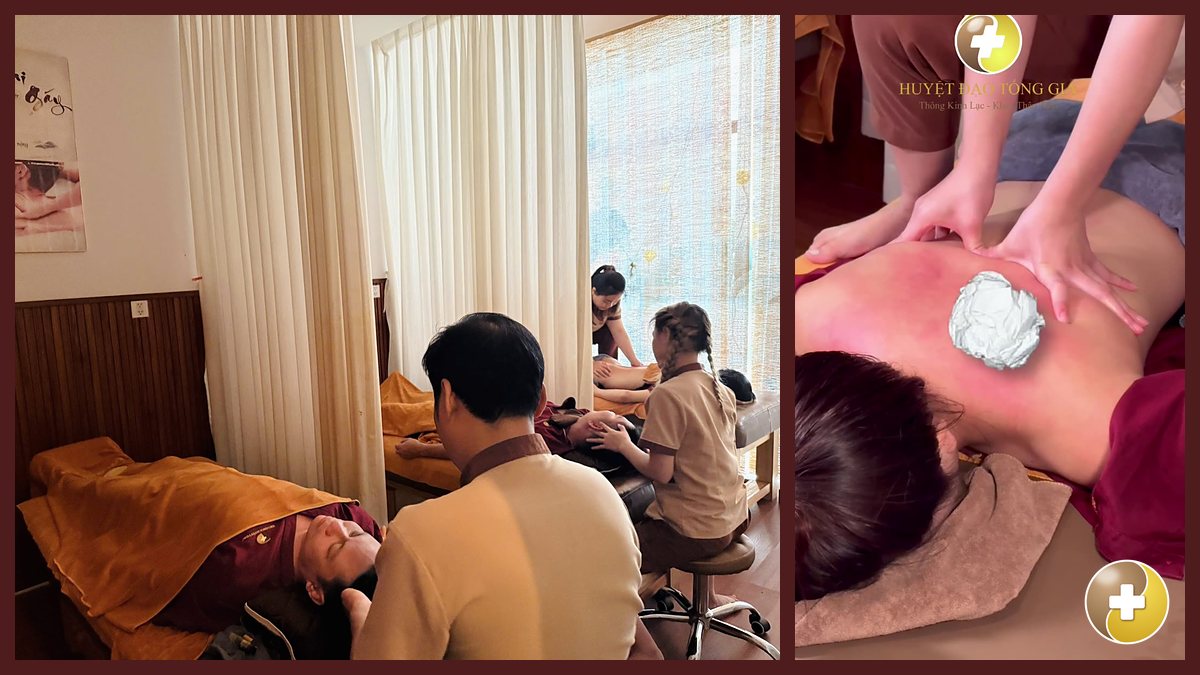
Quick answer: Tailbone pain is a symptom, not a disease: often a fall onto the bottom, long or reclined sitting, childbirth or tight pelvic floor muscles, sometimes pain referred from the lower back or anus. After a fall, with redness, pus or fever, see a doctor first. Tong Gia Acupoint Wellness in District 12 and District 9, Ho Chi Minh City, releases the lower back and glutes without pressing the coccyx.
Want Lương Y Tống Văn Huynh’s team to read your spine and posture in person?
Tailbone pain: what it is in Western terms, and who gets it
The tailbone (coccyx) is the small triangular bone at the very end of the spine, just above the crease of the buttocks, made of 3–5 tiny fused segments joined to the sacrum (S1–S5) above. Ligaments, tendons and the pelvic floor muscles attach to it, and when you sit, especially leaning back, the tailbone and the two sitting bones carry your weight. Tailbone pain, known as coccydynia in Western medical terms, is aching, sharp or pressing pain in this spot.
In Western medical terms it is a symptom, not a disease. It may come from the coccyx and the sacrococcygeal joint itself (after a fall, childbirth or poor sitting), from the surrounding muscles and ligaments, or it may be referred from elsewhere: the L5–S1 lumbar segment, the sacroiliac joint, the anus and rectum or the pelvis. Most cases are not dangerous and settle over weeks to months once pressure is taken off; a few need a prompt check-up.
In Ho Chi Minh City, Tong Gia Acupoint Wellness (Huyệt Đạo Tống Gia) sees tailbone pain mostly in women, especially after a vaginal birth (Western sources note it is more common in women); people who have slipped and landed on their bottom in a bathroom, on stairs or from a motorbike; office workers and gamers reclining for hours on hard chairs or sagging sofas; long-distance riders and delivery drivers on hard seats; and people who are very thin (little cushioning) or carrying extra weight.
Common causes: seven groups
| Cause group | Typical pattern | Who gets it | What to do |
|---|---|---|---|
| 1. Injury: a fall onto the bottom | Pain right after the fall, maybe bruising; sharp when sitting down or standing up | Slips, motorbike falls, sport | Get checked for a crack, fracture or dislocation |
| 2. Long or poor sitting | Dull ache after 30–60 minutes, sharp on standing; better leaning forward | Desk workers, drivers, couriers | Change how you sit, U-shaped cushion, lower back and glute care |
| 3. Pregnancy and childbirth | Pressure at the tailbone late in pregnancy and after birth, when breastfeeding seated | Pregnant women, new mothers | Tell your maternity team; gentle care, good posture |
| 4. Loose or worn sacrococcygeal joint | Pain moving from sitting to standing, a "clicking" feeling | Middle-aged, very thin or heavier people | Get checked if it lasts; reduce sitting pressure |
| 5. Tight pelvic floor and anal muscles | Deep pressure inside, discomfort on bowel movements and long sitting | Stress, constipation, after childbirth | Belly breathing, relaxation, lower back and glute care |
| 6. Pain referred from elsewhere | L5–S1 or sacroiliac pain, numbness down the leg; haemorrhoids, fissures; gynaecological or urinary problems | Varies | Get checked to find the true source |
| 7. Infection, tumour (uncommon) | Red, hot, swollen area with pus in the buttock crease (pilonidal cyst); steadily worsening or night pain, weight loss | Young men with hair in that area; people with health conditions | See a doctor now |
Sometimes the tailbone hurts "for no reason", with no fall to remember. Usually it is accumulated pressure: reclining on a soft sofa every evening, a hard motorbike seat every day, sitting on the floor or squatting for long periods. Each moment is minor, but months of it irritate the ligaments and tissue around the coccyx. Other habits that keep it going: slumped sitting, constipation and straining, tight trousers or a thick wallet in the back pocket, and stress, which tightens the pelvic floor the way it tightens the shoulders.
For the sitting-related pattern in detail, see our Vietnamese guide on tailbone pain when sitting; this article gives the wider overview of causes.
Signs worth noting
- Timing: pain on sitting down and standing up (coccyx and its joint); pain on bending forward (ligaments, pelvic floor); pain with bowel movements (pelvic floor, anus).
- Location: right on the tip; on both sides or one side (muscles, ligaments, sacroiliac joint); spreading into the buttock.
- Down the leg: tingling in the back of the thigh or calf suggests a lumbosacral nerve root.
- Skin in the buttock crease: swelling, redness, heat, a small opening that leaks fluid or pus.
- Urine, bowels, periods: pain that follows the cycle, burning urine, blood in the stool.
- Whole body: cold lower back, weak knees, night urination; or heaviness and a dragging feeling low in the belly with tiredness. Traditional wellness reads these as Kidney and Spleen clues.
When to see a doctor
Please see a doctor at a medical facility first, and skip massage on the tailbone area, if you have:
- Pain after a fall or accident, especially if severe, you cannot sit or it is bruised and swollen; older adults with fragile bones.
- Redness, heat, swelling or pus at the tailbone or buttock crease.
- Fever with tailbone pain.
- Saddle numbness (buttocks, perineum, inner thighs), trouble passing urine or loss of bladder or bowel control: go to the emergency department now.
- Leg numbness or weakness, or pain down the leg that keeps growing.
- Blood in the stool or a lasting change in bowel habits.
- Unexplained weight loss, lasting fatigue or night pain that lying down does not ease: get checked alongside any wellness care.
- Women with severe lower abdominal pain or unusual bleeding; pregnancy with rhythmic tightening.
- Pain lasting more than 6–8 weeks despite better sitting and rest.
This is a wellness service, not medical care.
The Y Tướng Học view: which organs, and how it shows on the face
According to the Tong Gia curriculum, the sacrum and coccyx belong to the Kidney system: the Kidney governs the bones and marrow and "opens into the two lower orifices" (urination and defecation), and it is paired with the Bladder, whose meridian runs down both sides of the spine to the sacrum. Tailbone pain with a cold lower back, weak knees and night urination is therefore looked at through the Kidney. The Liver governs the sinews (here, tight pelvic floor and glute muscles), and the Spleen holds things up: when its energy sinks, there is a dragging, heavy feeling low down. These are functional ideas, not a statement that any organ is diseased.
Y Tướng Học (face reading for wellness) says "the signs show outside, the organs lie inside." Its roots go back over 2,000 years, and Lương Y (master of traditional Vietnamese wellness) Tống Văn Huynh organised it into a way to plan care for each person. For this area the curriculum notes:
- "Do" (由) face: narrow forehead, full cheeks and jaw, a strong lower body. Prone to congestion, bowel trouble and haemorrhoids; very thick waist and hip muscles with heavy buttock and sacral ache.
- "Điền" (田) face, Earth type: square and full, Spleen–Stomach-led. With damp or sinking Spleen energy comes a heavy, dragging feeling low down.
- "Giáp" (甲) face: "full above, empty below": a hollow, cold low back and night urination.
- "Mục" (目) face: long and thin; little cushioning, so hard chairs quickly make the tailbone ache.
- "Dụng" (用) face: asymmetric; one hip higher, weight shifted to one side of the coccyx.
It is only a hint about where to look first, never a verdict. More in our Eastern face reading Q&A.
Spine segments and nerve-reflex zones involved
In the Tong Gia curriculum on spinal nerve-reflex balancing, the sacrum and coccyx S1–S5 relate to elimination, the anus and the lower pelvis; the lumbar segments L1–L5 relate to digestion, kidneys, urinary and reproductive function and the legs. For muscle and joint patterns the curriculum combines C5–C7, L1–L5 and S1–S5; for gynaecological and men's health patterns, D10–D12, L1–L3 and S1–S5.
| Segment / tissue | Nerves and function | Typical feeling | Related organ system |
|---|---|---|---|
| L4–L5 | Lower lumbar roots; legs | Stiff low back, ache into the buttocks after sitting | Kidney (bones), Liver (sinews) |
| L5–S1, sacroiliac joint | Sciatic nerve roots | One-sided pain from tailbone to buttock, maybe leg tingling | Liver and Kidney; Bladder meridian |
| S1–S5, sacrum | Elimination, lower pelvis | Ache at the base of the back, cycle-related pain, night urination | Kidney–Bladder |
| Coccyx and its ligaments | Anus, pelvic floor | Sharp tip pain on sitting down and standing up | Kidney (lower orifices) |
| Pelvic floor and anal muscles | Support the pelvic base, coordinate urination and bowels | Deep pressure, discomfort on bowel movements | Liver (tight sinews), Spleen (support) |
The Tong Gia method for tailbone pain
Lương Y Tống Văn Huynh, founder of Tong Gia, built this therapeutic-style wellness massage over more than 13 years in Vietnamese traditional wellness, face reading and spinal nerve-reflex balancing. For the tailbone the rule is: no strong direct pressure on the tip of the coccyx. Instead, the practitioner softens the muscles and ligaments pulling on it from the lower back, glutes and both sides of the sacrum. A session includes observation and questions (falls, recent birth, constipation, haemorrhoids, leg symptoms, check-ups; posture and hip level), reading the spine by hand from L3 down to the sacrum, muscle release of the lumbar erectors, gluteus maximus, piriformis and the sacral borders along the Bladder meridian, acupressure on Shenshu, Mingmen, Zhishi and Weizhong behind the knee, and advice on sitting, cushions and pelvic-floor breathing. Pain after an injury that has not been checked means the session stops and the guest is referred.
A typical session: the guest is often a woman around thirty, six months after a vaginal birth, whose tailbone aches after long breastfeeding sessions and who needs a hand to stand up; her postnatal check found no bone injury. The practitioner notes the right hip lower, weight shifted to one side, a pale face and cool hands. L5–S1 feels cool; the left glute and sacral border muscles are tight and refer pain towards the tailbone. The Mingmen–Shenshu area is warmed first, then the left glute and piriformis are released with light to moderate pressure, staying well clear of the coccyx tip, finishing with a warm herbal compress. Guests usually say the buttock "softens" and standing up feels easier.
Suitable services (full price list):
- Back and waist care, 60 minutes: 550,000 VND (about US$21); first visit 399,000 VND (about US$15). 90 minutes: 750,000 VND (about US$29), with more time for glutes and hips.
- Herbal compress: 130,000 VND (about US$5) over the lower back and sacrum after the session.
- Herbal steam: 120,000 VND (about US$5) for tight, chilly or stressed bodies.
How it feels: sore-but-good pressure in the glutes and beside the sacrum, warmth across the waist, and no direct pressure on the tailbone; afterwards sitting and standing usually feel easier, sometimes with mild glute soreness the next day. Tailbone pain settles slowly and needs weeks of better sitting habits. Tong Gia supports and helps rebalance; it does not promise the pain will vanish. See back massage Saigon Q&A and gua sha and herbal steam Q&A.
Want Lương Y Tống Văn Huynh’s team to read your spine and posture in person?
Self-care at home and prevention
- Change how you sit: upright or leaning slightly forward so your weight rests on the sitting bones; use a U-shaped or cut-out cushion; avoid long reclining on soft sofas.
- Stand up every 30–45 minutes; take breaks on long rides and use a padded seat.
- Avoid constipation: enough water and vegetables, no straining; a low stool under your feet in the bathroom helps.
- Pelvic-floor breathing for 5 minutes each evening: breathe in slowly into the belly, feel the pelvic floor "drop", breathe out longer.
- Cold or warmth at the right time: in the first 1–2 days after a fall use a cold pack, no heat and no massage; for sitting-related stiffness, gentle warmth on the lower back and a palm rub on both sides of the waist 50–100 times.
Guests describe their visits in back massage in Saigon: a first-hand experience.
Booking
Tong Gia has two branches in Ho Chi Minh City, open daily, with real reviews on Google Maps:
- District 12: 225 Dương Thị Mười, Phường Tân Chánh Hiệp (Tan Chanh Hiep Ward, District 12). Open 8:00–19:00 daily.
- District 9 – Vinhomes Grand Park: Căn T16-21 khu Manhattan, Phường Long Bình, TP. Thủ Đức (unit T16-21, Manhattan zone, Long Binh Ward, Thu Duc City). Open 9:00–20:00 daily.
Call, Zalo or WhatsApp +84 888 264 559, or book online. If you live in or are visiting Ho Chi Minh City, you are welcome to experience this Vietnamese traditional wellness method. Tell us when the pain started, whether you have had a fall or a recent birth, and whether you have seen a doctor.
Visit us
- Đông Y Huyệt Đạo Tống Gia Quận 12 (District 12)
225 Dương Thị Mười, Phường Tân Chánh Hiệp, Quận 12, HCMC · 8:00–19:00 daily · 0888 264 559 · Directions on Google Maps - Đông Y Huyệt Đạo Tống Gia Quận 9 (Vinhomes Grand Park, District 9)
Căn T16-21 khu Manhattan, Vinhomes Grand Park, Phường Long Bình, TP. Thủ Đức, HCMC · 9:00–20:00 daily · 0888 264 559 · Directions on Google Maps
Want Lương Y Tống Văn Huynh’s team to read your spine and posture in person?
FAQ
What causes tailbone pain? Tailbone pain is a symptom, not a disease. Common causes are a fall onto the bottom, long or reclined sitting, pregnancy and childbirth, a loose or worn sacrococcygeal joint and tight pelvic floor muscles; sometimes pain is referred from the lower back, sacroiliac joint or anus. After a fall, with pus, fever or saddle numbness, see a doctor straight away.
Why does my tailbone hurt when I sit? Reclining, hard chairs, motorbike seats and sagging sofas put your weight on the coccyx instead of the sitting bones, irritating it and its ligaments. Sitting upright or leaning slightly forward with a U-shaped cushion usually helps over time.
Why does my tailbone hurt for no reason? Without a fall, it is usually small pressure repeated for months: floor sitting, squatting, soft sofas, hard seats, straining with constipation. Steadily worsening pain, night pain, weight loss, blood in the stool or a red swelling in the buttock crease need a check-up.
Why is tailbone pain more common in women? A wider pelvis puts more load on the coccyx when sitting, and a vaginal birth can push it back; pregnancy also loosens the ligaments. Pain that follows the cycle, with lower abdominal pain or unusual bleeding, deserves a gynaecology check.
How long does tailbone pain after childbirth last? Many mothers improve over weeks to a few months with better sitting, a U-shaped cushion and avoiding constipation. If it is not easing after 6–8 weeks, gets worse, or comes with fever or bladder problems, go back to your doctor.
Does massage help tailbone pain? Massage at Tong Gia does not press the coccyx tip; it softens the glutes, sacral borders and lower back muscles that pull on it, and many guests sit and stand more easily afterwards. After a fall, get checked first. This is a wellness service, not medical care.
Author: Lương Y Tống Văn Huynh – founder of Huyệt Đạo Tống Gia, a master of traditional Vietnamese wellness with over 13 years in Eastern wellness care, Y Tướng Học (face reading) and spinal nerve-reflex balancing massage.
Updated: 2026-11-15
Related guides
- Back pain exercises at home: six gentle lower-back moves, how to breathe, when to stop, and when Tong Gia can help in Ho Chi Minh City
- How to give a back massage at home: setup, 5 steps in 10–15 minutes, what to avoid and who should skip it
- Herbal warm compress: how a mugwort, ginger and sea salt pouch differs from dry heat, and how to use one safely at home in Ho Chi Minh City
- Lower back pain: what causes it, when to see a doctor, and how Tong Gia supports the lower back in Ho Chi Minh City
- Upper back pain: what causes it, which signs need a doctor, and how Tong Gia supports the upper back in Ho Chi Minh City
- Tailbone pain: common causes, when to see a doctor, and how Tong Gia cares for the area in Ho Chi Minh City
This is a wellness service, not medical care.