
Upper back pain: what causes it, which signs need a doctor, and how Tong Gia supports the upper back in Ho Chi Minh City
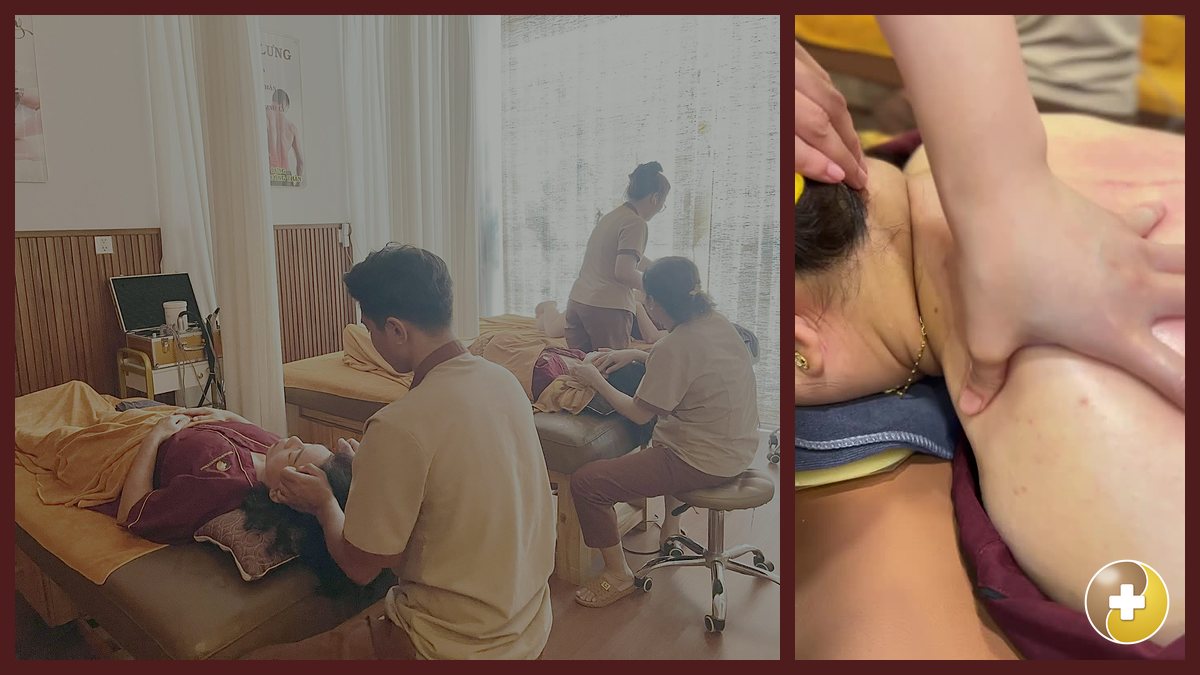
Quick answer: Upper back pain is usually tight muscles between the shoulder blades from hunched sitting and phone use; less often the neck, rib joints, lungs, heart or stomach. Chest tightness, breathlessness or cold sweats mean call 115. Tong Gia Acupoint Wellness in District 12 and District 9, Ho Chi Minh City, reads the spine by hand and releases the upper back.
Want Lương Y Tống Văn Huynh’s team to read your spine and posture in person?
Upper back pain: what it is in Western terms, and who gets it
Upper back pain is aching, tightness, burning or sharp pain from the base of the neck down to the middle of the back, including the shoulder blades and the band of muscle between them. Anatomically this is the thoracic spine, which the Tong Gia curriculum labels D1–D12, each vertebra joined to a pair of ribs. In Western medical terms upper back pain is a symptom, not a disease.
Because the rib cage braces it, the thoracic spine is more stable than the neck or lower back, so pain here is rarely a disc problem. Most of it is muscular: the middle trapezius, rhomboids and thoracic erector muscles are stretched for hours when you sit hunched with your head forward. But the upper back also sits directly behind the heart, lungs, oesophagus, stomach and gallbladder, so pain here can be referred pain from inside the chest or abdomen. That is why upper back pain deserves a closer reading than ordinary low back ache.
In Ho Chi Minh City, Tong Gia Acupoint Wellness (Huyệt Đạo Tống Gia) often sees it in:
- Office staff, developers and accountants at a laptop 8–10 hours a day, shoulders rounded, screen too low.
- Heavy phone users and students, head tipped forward for hours.
- Motorbike commuters gripping handlebars with tense shoulders and cool wind on the upper back.
- Tailors, hairdressers and electronics assembly workers leaning forward with arms extended all shift.
- New parents carrying a baby on one side and sleeping little.
To understand what your upper back pain means, look at four things: what it feels like, which side, when it appears and what comes with it. This guide follows that order, then explains the Vietnamese traditional view of the organs, the spine segments involved and how Tong Gia supports the upper back.
Common causes: six groups
| Cause group | Typical pattern | Who gets it | What to do |
|---|---|---|---|
| 1. Muscles and posture | Ache or burning between the shoulder blades, worse in the afternoon, better when stretching | Screen and phone users | Posture changes, stretching, muscle release |
| 2. Neck problems spreading down (C5–C7) | Pain from the neck to the shoulder blade, sometimes the arm; tingling fingers | Middle-aged adults, people who look down a lot | Get checked if arm numbness lasts; neck and shoulder care |
| 3. Rib joints, intercostal muscles | Sharp spot beside the spine, worse with deep breaths, twisting or coughing | After a cough, lifting or an awkward night | Rest, gentle movement; get checked with fever or breathlessness |
| 4. Lungs and pleura | Pain on deep breathing with cough, fever, breathlessness | After a cold or flu, older adults | See a doctor promptly |
| 5. Heart and aorta | Chest pressure spreading to the back, left shoulder or jaw; or sudden tearing pain through to the back | High blood pressure, cholesterol, diabetes, older adults | Call 115 now; no massage |
| 6. Digestive and other causes | Pain with hunger or after meals, acid reflux (stomach); under the right shoulder blade after fatty food (gallbladder); a burning strip followed by blisters (shingles); after a hard sit in fragile bones (compression fracture) | Varies | Get checked to find the cause |
Group 1 accounts for most cases. The head weighs around 4–5 kg, and every centimetre it moves forward makes the upper back muscles work harder to hold it. A whole day like that leaves the rhomboids and middle trapezius long, poorly fed and full of tight knots that refer pain when pressed. Other contributors: a low laptop screen, a chair without back support, a pillow that is too high or sleeping face-down, a heavy bag on one shoulder, air conditioning blowing on the neck, stress that makes you shrug and breathe into the chest, and gym or racket sports without a warm-up.
Signs worth noting
- Left or right: left-sided pain is often the mouse or baby-carrying side, but with chest pressure, breathlessness or pain into the left arm, think of the heart first. Pain under the right shoulder blade after a fatty meal may involve the gallbladder.
- Breathing: sharp pain on deep breaths, coughing or sneezing.
- Meals: pain on an empty stomach or after eating, with sour burps and bloating.
- Movement: pain when twisting or raising the arm, with tender knots that refer pain, usually means muscle.
- Arms: numbness or pins and needles in the arm or fingers suggests a neck nerve root.
- Whole body: shallow breathing, frequent sighing, catching colds, dry skin; or palpitations, poor sleep, irritability, tight shoulders. Traditional wellness reads these as clues about the Lung, Heart and Liver systems.
When to see a doctor
Some upper back pain must be checked straight away. Please see a doctor at a medical facility, and skip massage or acupressure, if you have:
- Chest tightness or pressure spreading to the back, left shoulder, left arm or jaw; shortness of breath; cold sweats; nausea: call 115 immediately.
- Sudden, severe, tearing pain between the shoulder blades, especially with high blood pressure: call 115 immediately.
- Pain on deep breathing with fever, cough, breathlessness or coughing blood.
- Pain after a fall or impact, or sudden upper back pain in an older person with fragile bones.
- Weakness or numbness in arms or legs, unsteady walking, bladder problems.
- Unexplained weight loss, lasting fatigue or night sweats: get checked alongside any wellness care.
- A burning strip on one side of the back that blisters a few days later.
- Yellowing skin, or pain under the right shoulder blade with fever after meals.
- Night pain that rest does not ease, or pain that grows week by week.
This is a wellness service, not medical care.
The Y Tướng Học view: which organs, and how it shows on the face
According to the Tong Gia curriculum, the upper back holds the "back-shu" points of the chest organs: Feishu (Lung) below the T3 spinous process, 1.5 cun to each side; Jueyinshu (Pericardium) at T4; Xinshu (Heart) at T5. So traditional wellness reads upper back strain through three systems:
- Lung: governs breath and shows in the nose and skin. Low Lung energy means breathlessness on effort, a soft voice, frequent colds and a pale face. Shallow chest breathers and frequent sighers often feel tight around D2–D4.
- Heart: houses the spirit and shows in the complexion and tongue. When it is weak there may be palpitations, light sleep and vivid dreams; the curriculum advises keeping the chest and back warm.
- Liver: governs the sinews. Long-term stress and anger make the Liver energy stagnate, leaving tight shoulders and irritability: the person who "carries everything on their shoulders".
Y Tướng Học (face reading for wellness) says "the signs show outside, the organs lie inside." Its roots go back more than 2,000 years, and Lương Y (master of traditional Vietnamese wellness) Tống Văn Huynh organised it into a way to plan care for each person. For the upper back, the curriculum notes:
- "Đồng" (同) face, the Metal type: long and square, firm bone and flesh, Lung-led. The upper back tends to stiffen or a vertebra protrudes around D3, affecting the breath; prone to sinus trouble, dry cough and dry skin.
- "Thân" (申) face: narrow forehead and chin, wide cheekbones; Liver and Stomach out of harmony. Stress goes straight to the stomach and the sides of the ribs, with key points around D7 and D9.
- "Vương" (王) face: bony with high cheekbones. Vertebrae tend to tilt and muscles turn fibrous.
- "Phong" (風) face: wide forehead, broad jaw. Back muscles twitch or tighten unevenly, and the sore point moves around.
Practitioners also note shoulder shape, breathing style and skin temperature. It is only a hint about where to look first, never a verdict. More in our Eastern face reading Q&A.
Spine segments and nerve-reflex zones involved
In the Tong Gia curriculum, the cervical segments C1–C7 relate to the head, face, neck and arms; the thoracic segments D1–D12 relate to circulation, breathing and digestion. For stress and sleep issues the curriculum combines C1–C7 with D1–D3; for organ-related patterns, D1–D12 with L1–L3; for neck and arm strain, C5–C7.
| Segment | Nerves and function | Typical upper-back feeling | Related organ system |
|---|---|---|---|
| C5–C7 into D1 | Lower neck roots; shoulders, arms | Ache from neck to shoulder blade, heavy shoulders, tingling hands | Liver (sinews), Kidney |
| D1–D3 | Upper thoracic roots; breathing | Tight base of the neck, heavy upper chest, shallow breath | Lung (Feishu at T3) |
| D4–D5 | Thoracic roots; circulation | Burning between the shoulder blades, with palpitations or poor sleep | Heart, Pericardium (T4, T5) |
| D6–D9 | Mid-thoracic roots; upper digestion | Mid-back pain, tight rib sides under stress | Liver and Stomach (D7, D9) |
| D10–D12 | Lower thoracic roots; digestion | Ache below the shoulder blades, bloating | Spleen–Stomach (T11, T12) |
The table shows related zones for planning care only. The curriculum also stresses that left chest pain is not always the heart, but unexplained chest-related pain is never massaged: it is checked first.
The Tong Gia method for upper back pain
Lương Y Tống Văn Huynh, founder of Tong Gia, built this therapeutic-style wellness massage over more than 13 years in Vietnamese traditional wellness, face reading and spinal nerve-reflex balancing. A session includes:
- Observation and questions: which side, when, any link to breathing or meals, arm numbness, work, sleep, previous check-ups; face, shoulders and breathing. Any heart or lung warning sign means stop and refer.
- Reading the spine by hand from C5 to D12: skin temperature, muscle padding, vertebra shape and your response, comparing both sides.
- Muscle release: trapezius, levator scapulae, rhomboids, thoracic erectors and the inner edge of the shoulder blade, pressure building gradually; cross-fibre "plucking" for fibrous bands, gentle vibration for tired, depleted bodies.
- Acupressure: Feishu, Jueyinshu and Xinshu either side of D3–D5, plus the neck for stressed guests. Warm skin is cooled, cool skin warmed; work stops when the skin at the key point turns slightly moist.
- Home-care advice: screen height, chest-opening stretch, belly breathing.
A typical session: the guest is often an office worker around thirty with burning between the shoulder blades every afternoon, worse on the mouse side, and trouble falling asleep; a doctor has already checked heart and lungs. The practitioner notes a long face, raised shoulders, head forward and shallow chest breathing. The right-side band from D3 to D6 is thick, hard and warm; D4 protrudes slightly. After releasing the right shoulder blade edge and pressing Feishu and Xinshu, the guest lies on their back for slow belly breaths. Guests often say the shoulders "drop" and breathing deepens.
Suitable services (full price list):
- Neck and shoulder care, 60 minutes: 550,000 VND (about US$21); first visit 399,000 VND (about US$15). 90 minutes: 750,000 VND (about US$29).
- Warming cupping, 30 minutes: 85,000 VND (about US$3), for a cold, stiff upper back after air conditioning or rain.
- Lung wellness care, 90 minutes: 900,000 VND (about US$35), for shallow breathers who catch colds easily.
How it feels: sore-but-good pressure between the shoulder blades, then lighter shoulders and deeper breathing; afterwards easier neck movement and better sleep, sometimes mild soreness the next day. Tong Gia supports and helps rebalance; it does not promise the pain will vanish. See neck and shoulder massage Saigon Q&A and cupping in Saigon Q&A.
Want Lương Y Tống Văn Huynh’s team to read your spine and posture in person?
Self-care at home and prevention
- Raise the screen to eye level, use a laptop stand and separate keyboard, sit back with relaxed shoulders.
- Open the chest every 45 minutes: forearms on a door frame, step forward until you feel a gentle stretch, hold 20–30 seconds.
- Belly breathing for 5 minutes each evening: one hand on the belly, breathe in slowly through the nose, breathe out longer.
- Keep the neck and upper back warm: no air conditioning blowing directly on you, dry your hair before bed, wear a jacket on night rides.
- Switch sides when carrying a baby or bags; use both backpack straps; choose a pillow that keeps the neck in line.
More common questions about back care are answered in back massage Saigon Q&A.
Booking
Tong Gia has two branches in Ho Chi Minh City, open daily, with real reviews on Google Maps:
- District 12: 225 Dương Thị Mười, Phường Tân Chánh Hiệp (Tan Chanh Hiep Ward, District 12). Open 8:00–19:00 daily.
- District 9 – Vinhomes Grand Park: Căn T16-21 khu Manhattan, Phường Long Bình, TP. Thủ Đức (unit T16-21, Manhattan zone, Long Binh Ward, Thu Duc City). Open 9:00–20:00 daily.
Call, Zalo or WhatsApp +84 888 264 559, or book online. If you live in or are visiting Ho Chi Minh City, you are welcome to experience this Vietnamese traditional wellness method. Tell us which side hurts, whether your arm tingles and whether you have had a check-up.
Visit us
- Đông Y Huyệt Đạo Tống Gia Quận 12 (District 12)
225 Dương Thị Mười, Phường Tân Chánh Hiệp, Quận 12, HCMC · 8:00–19:00 daily · 0888 264 559 · Directions on Google Maps - Đông Y Huyệt Đạo Tống Gia Quận 9 (Vinhomes Grand Park, District 9)
Căn T16-21 khu Manhattan, Vinhomes Grand Park, Phường Long Bình, TP. Thủ Đức, HCMC · 9:00–20:00 daily · 0888 264 559 · Directions on Google Maps
Want Lương Y Tống Văn Huynh’s team to read your spine and posture in person?
FAQ
What causes upper back pain? Upper back pain is a symptom, not a disease. Most often it is tight upper back muscles from hunched sitting, a forward head and heavy phone use; then neck problems spreading down, rib joints and intercostal muscles. Less often, but important, it comes from the lungs, heart, stomach or gallbladder. With chest tightness, breathlessness or fever, see a doctor straight away.
What does pain in the upper left back mean? Usually tight muscles on the left from carrying a baby, holding a phone or sleeping on that side. With chest pressure spreading to the left shoulder, arm or jaw, breathlessness or cold sweats, call 115 immediately and do not get a massage.
Is mid-back pain with shortness of breath dangerous? It can be. Mid-back pain with breathlessness, chest tightness, sweating or sudden tearing pain needs 115 at once. A sharp catch only on deep breaths, without fever or real breathlessness, is often muscular, but get it checked if it lasts.
Does massage help upper back pain? For muscular upper back pain, targeted release softens the muscles, lets the shoulders drop and deepens breathing; many guests feel lighter at once. At Tong Gia, practitioners only work once heart and lung warning signs are ruled out. This is a wellness service, not medical care.
Why does my upper back hurt when I wake up? Often a pillow that is too high, sleeping face-down with the head turned, a sagging mattress or air conditioning on the back. Night pain that position changes do not ease, or pain with weight loss or fever, needs a check-up.
Author: Lương Y Tống Văn Huynh – founder of Huyệt Đạo Tống Gia, a master of traditional Vietnamese wellness with over 13 years in Eastern wellness care, Y Tướng Học (face reading) and spinal nerve-reflex balancing massage.
Updated: 2026-11-15
Related guides
- Back pain exercises at home: six gentle lower-back moves, how to breathe, when to stop, and when Tong Gia can help in Ho Chi Minh City
- How to give a back massage at home: setup, 5 steps in 10–15 minutes, what to avoid and who should skip it
- Herbal warm compress: how a mugwort, ginger and sea salt pouch differs from dry heat, and how to use one safely at home in Ho Chi Minh City
- Lower back pain: what causes it, when to see a doctor, and how Tong Gia supports the lower back in Ho Chi Minh City
- Upper back pain: what causes it, which signs need a doctor, and how Tong Gia supports the upper back in Ho Chi Minh City
- Tailbone pain: common causes, when to see a doctor, and how Tong Gia cares for the area in Ho Chi Minh City
This is a wellness service, not medical care.