
What does acupressure do? Effects on muscles, nerves and the five organs, and how Tong Gia works in Ho Chi Minh City
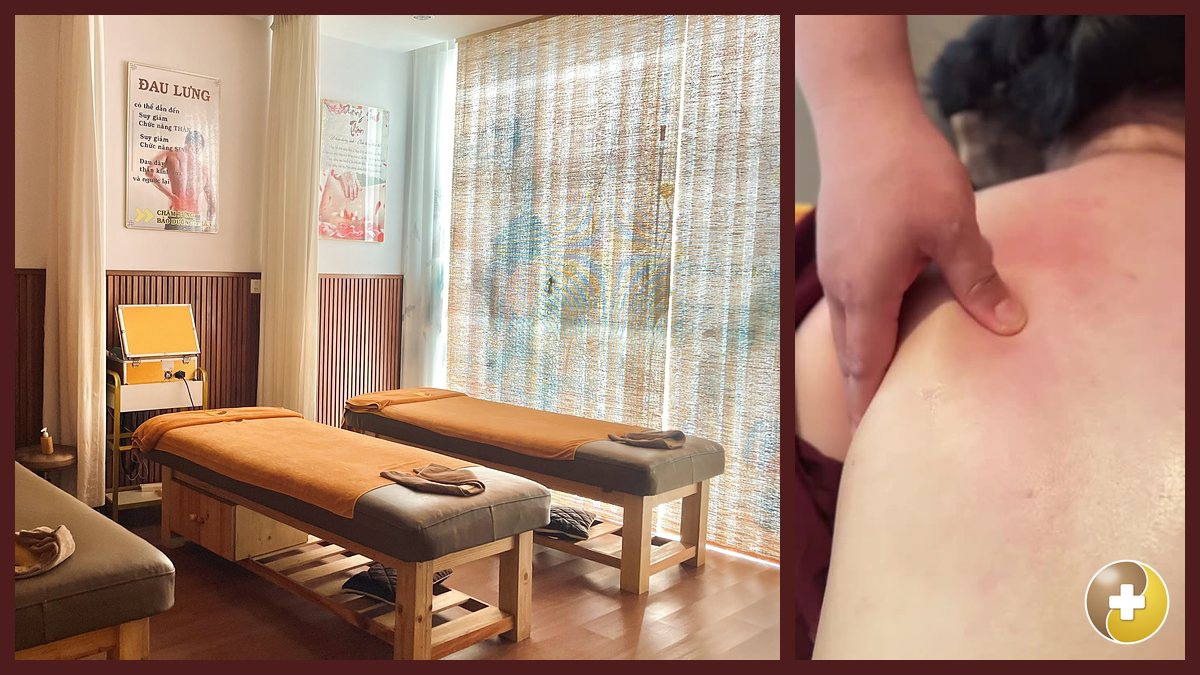
Quick answer: Acupressure loosens tight muscles, warms tired areas, supports circulation and helps the nervous system shift into rest, so many people feel lighter shoulders and sleep more deeply. Tong Gia Acupoint Wellness in Districts 12 and 9, Ho Chi Minh City observes you and reads the spine by hand before pressing.
Want Lương Y Tống Văn Huynh’s team to read your spine and posture in person?
What is acupressure, and what does it actually do?
Acupressure means pressing, kneading and gliding with the fingertips, thumbs and palms on acupoints and on muscle areas that hold tension. In Vietnam it usually comes together with massage under the name xoa bóp bấm huyệt: the massage part softens the muscles, the acupressure part works deeper on precise points. Many expats in Saigon have tried it once, felt good, and still wonder what really happened inside the body, and why one session leaves them light while another leaves them a little sore.
In plain Western terms:
- Muscles: steady pressure that builds slowly lets contracted fibres release. As the muscle softens, more blood reaches the soft tissue, the area warms up and the heavy, tired feeling fades. Most people notice this during the session.
- Nerves: skin and muscle are full of sensory endings. Slow, even pressure sends signals to the spinal cord and brain that help the body stop bracing and move from the "alert" state (sympathetic activity) toward the "rest" state (parasympathetic activity). That is why so many people fall asleep on the table.
- Breathing: once the shoulders, chest and upper back let go, the rib cage opens and breathing slows and deepens by itself.
- Sleep and mood: an hour or more lying still, touched in a calm rhythm, away from screens and traffic noise, is a genuine break for the mind. Many people sleep more deeply that night.
According to the Tong Gia curriculum, the method uses the soft pads of the fingertips, a refined sense of touch, to work gently on the central nervous system (the head) and the autonomic nervous system (along the spine). The same curriculum is clear that acupressure supports relaxation and the balance of qi and blood in Eastern terms; it does not replace medical follow-up for any illness.
| Common effect | Simple mechanism | What guests usually feel |
|---|---|---|
| Tight muscles release | Fibres let go, soft tissue gets more blood | Lighter shoulders, easier neck turns |
| Tired areas warm up | Local circulation increases | Less of that cold back after a day in air-con |
| Nervous system calms | Shift toward the rest state | Slower breathing, drowsiness, deeper sleep |
| Clearer head | Neck and base-of-skull muscles soften | Lighter head, more relaxed eyes |
| Calmer stomach | Mid-back and belly stop bracing | Less bloating, better appetite |
Among foreigners in Ho Chi Minh City, the people asking this question are usually laptop workers in co-working spaces and offices, teachers who stand all day, engineers at the Saigon Hi-Tech Park, frequent flyers with jet lag, and parents carrying small children. Most have no specific illness. They simply feel heavier every week, sleep lightly, and want a gentle, drug-free way to look after themselves.
Why so many people need it: habits, work, posture and environment
Most of the tension that acupressure helps with comes from daily life, not from a major injury. A muscle that braces for hours becomes tight, a tight muscle gets less blood, and a muscle with less blood tires even faster. The loop keeps going:
- Laptops and phones: the head drifts forward and the neck and trapezius muscles hold its weight for hours.
- Motorbike rides and traffic: raised shoulders, gripping hands, a back absorbing constant bumps.
- Standing shifts and lifting: teachers, chefs, retail staff; the lower back and calves carry the load all day.
- Air-conditioning blowing directly on you, late showers: cold makes muscles contract, so you wake up stiff.
- Late nights and stress: worried people raise their shoulders, clench the jaw and breathe shallowly without noticing.
- Too little movement: weak core and glutes make the back muscles work double.
- Irregular meals: rushed or late dinners leave the stomach full and the mid-back tight.
Because the cause is a repeated habit, the benefit also lasts longer with a regular rhythm and small changes at home. For a sense of how often, see our acupressure massage in Saigon Q&A.
Signs your body would welcome acupressure
- Stiff neck and shoulders, a crunchy sound when you turn your head.
- Headache at the back of the head or the temples in the late afternoon.
- A stiff back in the morning that takes a few minutes to bend.
- Mild tingling in the arm or hand after long sitting that eases when you move.
- Trouble falling asleep, light sleep, waking up tired.
- A heavy body, frequent bloating, poor appetite.
- Heavy legs and tight calves after standing.
- Frequent sighing, tightness between the shoulder blades under stress.
If three or more sound familiar, your body is asking for rest and care. For sleep in particular, read acupressure for sleep in Saigon.
When to see a doctor
Acupressure suits everyday tension. In some situations you should see a doctor first, or stop immediately:
- Chest pain or tightness, shortness of breath, cold sweat: call 115 at once; no massage, no acupressure.
- Sudden facial droop, slurred speech, weakness or numbness on one side: call 115 at once.
- Pain after a fall, accident or hard knock.
- Pain running down the leg with leg weakness, numbness in the buttocks, or changes in bladder or bowel control.
- Fever, an active infection, open wounds or skin disease where pressure would be applied.
- Unexplained weight loss, lasting fatigue, pale skin or dizziness like anaemia: get checked at a medical facility in parallel; acupressure is only for relaxation.
- Pregnancy: according to the Tong Gia curriculum, the Hegu (LI4) and Sanyinjiao (SP6) points are not used, Guanyuan is handled with caution and the abdomen is not worked on.
- Heart conditions, stents, pacemakers, blood thinners, kidney disease, high blood pressure: tell us first so we ask carefully and work gently, and keep following your doctor's instructions without stopping any prescription.
Also, the abdomen is never massaged right after a big meal. This is a wellness service, not medical care.
The Y Tướng Học view: how acupressure reaches the five organs
In Eastern medicine, acupoints sit on meridians, and each meridian connects to an organ system. So the effect of acupressure is not only softer muscles: pressing the right point in the right area supports the function of the related organ. According to the Tong Gia curriculum, the five organs work like this: the Liver stores blood, keeps qi flowing smoothly and governs the tendons; the Heart governs the blood vessels and houses the mind; the Spleen transforms food and governs the muscles and limbs; the Lungs govern qi, breathing and the skin; the Kidneys store essence and govern bones and marrow, linked to the lower back, knees and ears. Along both sides of the spine runs the Bladder meridian, home of the "back-shu" points for each organ.
Y Tướng Học (face reading for wellness) has a key saying: "the outer appearance shows the inner organs." Tong Gia practitioners look first, then choose points:
- Liver: shows in the eyes, nails and tendons. Signals: dry tired eyes, irritability, tight neck and shoulders, cramps.
- Heart: shows in the tongue and complexion. Signals: a pale or flushed face, poor sleep, palpitations. Neiguan (PC6) and Shenmen (HT7) are pressed gently to relax.
- Spleen and Stomach: show in the mouth, lips and flesh. Signals: pale lips, bloating, a heavy body, tired limbs. Zusanli (ST36) is used to support digestion.
- Lungs: show in the nose, skin and breath. Signals: dry skin, blocked nose, shallow breathing, frequent sighs.
- Kidneys: show in the ears, hair, bones and lower back. Signals: weak knees, a cold lower back, ringing ears, hair loss, forgetfulness.
The curriculum also uses face shapes to choose which part of the back to examine first: a square, full face points to D11–D12; a long, square face to D3; wide cheekbones to D7–D9; a broad forehead with a pointed chin to C1–C2 and the lower back. This is traditional reference knowledge to guide the hands, never a way to label illness or judge anyone. More in Eastern face reading for wellness.
Spine segments and nerve-reflex areas involved
According to the Tong Gia curriculum, the spine has 33 vertebrae and each section serves a group of functions. Nerve roots leave the spinal cord through the gaps between vertebrae, so the same pressing has a different emphasis depending on where it is done. Before working, the practitioner's hands read four objective factors: skin temperature, the muscle layer, the shape of each vertebra and your sensations.
| Spine section | Nerves and functions served | Signs when tight | Related organ (Eastern view) |
|---|---|---|---|
| Neck C1–C7 | Head, face, neck, arms | Heavy head, stiff neck, tired or tingling arms | Liver, Kidneys |
| Upper back D1–D3 | Circulation, breathing | Tightness between shoulder blades, shallow breath | Lungs, Heart |
| Mid back D7–D9 | Digestion, liver and gallbladder | Long back muscles pulling, side tension under stress | Liver, Spleen |
| Lower thoracic D11–D12 | Digestion | Bloating, slow digestion, broad tight muscle | Spleen, Stomach |
| Lumbar L1–L5 | Digestion, kidneys, urinary tract, legs | Tired lower back, heavy legs, cold back | Kidneys |
| Sacrum S1–S5 | Elimination, pelvic organs | Sore tailbone area after sitting | Kidneys |
The curriculum groups applications into four families: nervous system and mood (headache, poor sleep, dizziness) works on C1–C7, D1–D3 and the sacrum; muscles and joints (neck pain, tingling limbs) on C5–C7, L1–L5, S1–S5; internal organs and metabolism on D1–D12, L1–L3; and women's and men's health on D10–D12, L1–L3, S1–S5. All of this is supportive only. In short: what acupressure does depends heavily on pressing the right part of the spine.
How Tong Gia works: spinal nerve-reflex balancing massage
Tong Gia Acupoint Wellness (Huyệt Đạo Tống Gia) was founded by Lương Y (master of traditional Vietnamese wellness) Tống Văn Huynh, with over 13 years in Eastern wellness, Y Tướng Học and spinal nerve-reflex balancing. It is a Vietnamese Eastern method built on the Head-and-Spine school, with "three no's": no chemicals or herbs taken or injected, no needles, no rough force. A session goes in order:
- Observe: complexion, posture, shoulders, ears and lips are read to choose which organ and which back area to check.
- Ask and screen: health history, conditions, pregnancy, a recent meal; any warning sign means no session and advice to get checked at a medical facility.
- Read the spine by hand: pressing, gliding and rolling to feel temperature, muscle, vertebra shape and tender points, comparing left with right.
- Release the muscles: pushing, rotating, plucking and vibrating, with pressure building from one finger to the whole hand to create a "comfortable ache" that lets muscles let go.
- Press the right points: back-shu points of the organ identified, plus points on the arms and legs, stopping when the skin over the point turns from dry to slightly moist.
- Home care: one or two simple moves suited to you.
A typical session
A software engineer who works long hours on a laptop came to the District 9 branch one evening with a stiff neck and light sleep. Her right shoulder sat higher, her eyes looked dry. When her back was read, C5–C7 and the area between the shoulder blades felt warmer, with a ridge of tight muscle, while the lower back felt cool. The practitioner released the neck and upper back first, pressed around the Liver and Heart back-shu points, worked Neiguan and Shenmen, then warmed the lower back. She dozed off halfway and left turning her head easily, with a lighter head.
Services and prices
- Traditional Eastern massage: 60 minutes 450,000 VND (about 17 USD), 90 minutes 550,000 VND (about 21 USD).
- Neck and shoulder or lower back care: 60 minutes 550,000 VND (about 21 USD), first visit 399,000 VND (about 15 USD); 90 minutes 750,000 VND (about 29 USD).
- Full-body care, 120 minutes: 950,000 VND (about 37 USD).
Full prices on the price list; compare with massage prices in Ho Chi Minh City and read about traditional Vietnamese massage.
What you feel during and after
Tight spots feel achy, sometimes spreading toward the shoulder or hip, then warm up and let go. Pressure builds gradually, so it stays a comfortable ache, with no jerking and no joint cracking. Afterwards most people feel lighter, clearer and sleep deeper; some feel mild soreness for about a day. Experiences vary. Tong Gia helps the body rebalance and relax; it does not promise that pain will be gone after one session.
Want Lương Y Tống Văn Huynh’s team to read your spine and posture in person?
Home care and prevention
- Shenmen before bed: press gently on each wrist for 1–2 minutes while breathing slowly.
- Neiguan when tense: press gently on each forearm for 1–2 minutes during mild nervousness (real chest pain needs urgent medical attention).
- Warm the lower back: rub your palms until warm, place them on both sides of the lower back and rub up and down 50–100 times.
- Warm foot soak: 15–20 minutes at about 38–42°C before sleep; people with diabetes should test the water carefully.
- Stand up every 45 minutes and sleep before 11 pm: keep the neck warm and do not let air-con blow on your shoulders.
Book a session
- District 12: 225 Dương Thị Mười, Phường Tân Chánh Hiệp (Tan Chanh Hiep Ward, District 12). Open 8:00–19:00 daily.
- Vinhomes Grand Park, District 9: Căn T16-21 khu Manhattan, Phường Long Bình, TP. Thủ Đức (Unit T16-21, Manhattan zone, Long Binh Ward, Thu Duc City). Open 9:00–20:00 daily.
Book online or call, Zalo or WhatsApp +84 888 264 559. Tell us which area feels tight and any health conditions. Real reviews are on each branch's Google Maps page. Visiting Ho Chi Minh City? Come and try a Vietnamese Eastern wellness method built by Lương Y Tống Văn Huynh. More about the experience in an acupressure massage in Saigon.
Visit us
- Đông Y Huyệt Đạo Tống Gia Quận 12 (District 12)
225 Dương Thị Mười, Phường Tân Chánh Hiệp, Quận 12, HCMC · 8:00–19:00 daily · 0888 264 559 · Directions on Google Maps - Đông Y Huyệt Đạo Tống Gia Quận 9 (Vinhomes Grand Park, District 9)
Căn T16-21 khu Manhattan, Vinhomes Grand Park, Phường Long Bình, TP. Thủ Đức, HCMC · 9:00–20:00 daily · 0888 264 559 · Directions on Google Maps
Want Lương Y Tống Văn Huynh’s team to read your spine and posture in person?
FAQ
What does acupressure do? It loosens tight muscles, warms tired areas, supports circulation and helps the nervous system shift into rest, so many people feel lighter and sleep better. In the Eastern view, pressing the right area also supports the related organ. It supports wellbeing and does not replace medical care.
Is acupressure good for you? It suits everyday tension from sitting, riding, standing shifts, stress and light sleep, when done by a trained practitioner with moderate pressure and screening questions first. It is not suitable with chest pain, breathlessness, fever, a recent fall or other warning signs.
How soon will I feel a difference? Many people feel lighter during or right after the first session. To keep that feeling, a few sessions a few days apart and then spaced out usually help, along with better sitting and sleep habits. Everyone is different.
Is it normal to feel sore after acupressure? Mild soreness in released areas for about a day is common, especially the first time; warm water and rest help. If pain increases, swelling or large bruises appear, or you get a fever, get checked at a medical facility.
What is the difference between massage and acupressure? Massage mainly glides and kneads to soften wide muscle areas; acupressure presses deeper on specific points along the meridians. At Tong Gia both go together: release first, then press the points identified on the spine.
Can older parents visiting Vietnam have acupressure? Yes, with lighter pressure and careful questions about heart, blood pressure, bone density and blood thinners. For the first visit, coming with a family member is a good idea.
Author: Lương Y Tống Văn Huynh – founder of Huyệt Đạo Tống Gia, a master of traditional Vietnamese wellness with over 13 years in Eastern wellness care, Y Tướng Học (face reading) and spinal nerve-reflex balancing massage.
Updated: 2026-11-16
Related guides
- What does acupressure do? Effects on muscles, nerves and the five organs, and how Tong Gia works in Ho Chi Minh City
- Acupressure in Thu Duc: pressure chosen by reading your spine, at the branch that suits your ward
- Sore after acupressure: is it normal? How to tell ordinary aching from warning signs, why it happens and how to look after yourself after a session in Ho Chi Minh City
- What are gua sha and cupping: two Vietnamese folk warming methods, the cupping points and when to skip them
- Unblocking the meridians (đả thông kinh lạc): what it really means, how a hands-on session works and what you will feel in Ho Chi Minh City
- Herbal compress: what the warmth really does, where it goes and who it suits
This is a wellness service, not medical care.