
Herbal compress: what the warmth really does, where it goes and who it suits
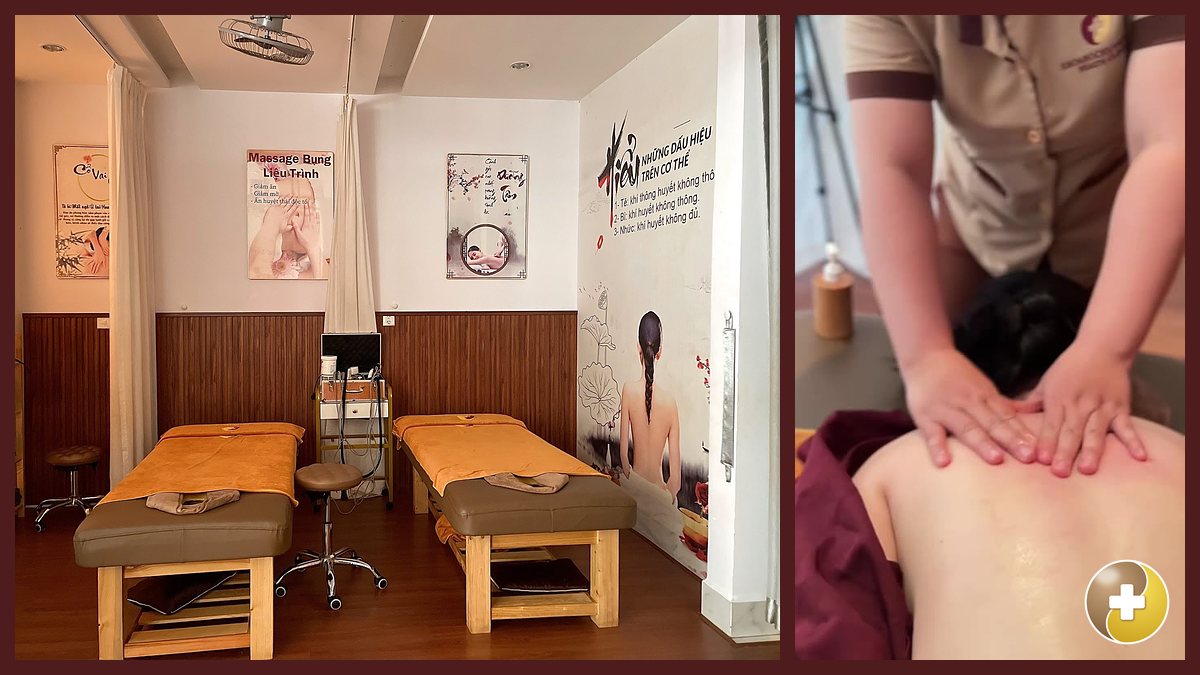
Quick answer: A herbal compress is a warm pouch of herbs on a cold, tired area such as the neck, shoulders or lower back to keep it warm and loosen the muscle. It works locally through the skin. At Tong Gia Acupoint Wellness (District 12 and Vinhomes Grand Park, Ho Chi Minh City) it costs 130,000 VND (about 5 USD).
Want Lương Y Tống Văn Huynh’s team to read your spine and posture in person?
What is a herbal compress, and what does it do?
A herbal compress (in Vietnamese, đắp thảo dược) is a warm pouch of herbs laid on a part of the body that feels cold, tired or tight, most often the neck and shoulders, the upper back, the lower back or the belly. It stays still for a while so the warmth can sink in. Massage works with pressure from the hands; a herbal compress works with heat and the scent of warm herbs. You feel one area slowly warming, the muscle softening, and your mind settling down.
From a Western physiology point of view, warmth on the skin widens the small blood vessels in that spot, more blood flows into the area, tight muscle relaxes and the feeling of pulling or pressure eases. Heat also stimulates sensory receptors in the skin and helps the autonomic nervous system shift toward its resting mode: breathing slows and the shoulders stop bracing. That is why many people doze off under a warm pack. The herbal smell rising from the warm pouch adds to the calm.
One point matters, so you know what to expect. According to the Tong Gia training manual, herbs applied on the skin act mainly locally: they keep the area warm and help you relax. Some components may pass through the skin to a limited degree, but they do not travel into the liver or kidneys, and a compress does not "draw out toxins". Knowing this helps you use it at the right moment and with the right expectations.
In Ho Chi Minh City, the people who ask for a herbal compress are often office workers under strong air-con, drivers, factory workers standing on long shifts, new mothers who want a warm back and belly, and older people whose back feels cold whenever the weather turns. At Tong Gia Acupoint Wellness (Huyệt Đạo Tống Gia), a compress is usually added to a massage or a regional session rather than booked alone.
Herbal compress vs. hot pack vs. herbal steam
| Type of warmth | What it does | Good when | Avoid when |
|---|---|---|---|
| Herbal compress | Deep warmth on one area, herbal scent, holds heat fairly long | Cold, tired neck, shoulders or lower back; after muscle release | The area is swollen, hot and red; broken skin; reduced feeling for heat |
| Dry hot pack (water bottle, salt bag) | Local warmth, no scent, cools faster | Quick home use for a tired back or cold belly | Water too hot; using it while falling asleep |
| Herbal steam | Warms the whole body, you sweat, pores open | After getting soaked in the rain, feeling chilled all over | Unstable blood pressure, exhaustion, empty stomach, pregnancy |
For more on steam and other warming services, read our gua sha and herbal steam Q&A.
Common reasons people look for a herbal compress
- Air-con blowing on the neck and back: offices set at 20–22°C make the muscles at the base of the neck and between the shoulder blades contract; by late afternoon they feel cold and stiff.
- Long hours at a screen or phone: the head drifts forward and the trapezius and levator scapulae hold it up all day, so blood supply to the muscle drops and it gets tired and cool.
- Getting caught in the rain: in the rainy season an afternoon storm can last an hour; by the time you get home on a motorbike your back is cold and shivery.
- Standing shifts, lifting, long drives: the lower back and the muscles along the spine ache, mornings start stiff.
- Ongoing stress: you brace your shoulders without noticing and wake up tired even after a full night.
- After childbirth, after illness, older age: the body feels weak and sensitive to cold and prefers gentle warmth over firm pressure.
Signs to notice: when warmth suits you and when it does not
A warm compress suits a body that is "cold and stiff", not an area that is "hot and swollen".
- Warmth suits you when: your neck or back feels cooler to the touch than other areas; the muscle forms a tight band that is tender to press; the ache gets worse in air-con or cool weather; a warm shower makes you feel better.
- Skip heat when: you knocked or sprained the area in the last two days; it is swollen, hot or red; the skin is scratched, irritated, sunburned or a wound has not closed.
- Take extra care if: you have diabetes, numbness in the hands or feet, or thin skin with age; you may not feel heat properly and can burn without noticing.
The Tong Gia manual teaches a temperature rule for hands-on work: "if high, bring it down; if low, bring it up". Only areas cooler than normal are warmed; an area that is already hot does not get more heat.
When to see a doctor
A herbal compress is wellness care for people who are healthy or simply tired, chilled and stiff. Please see a doctor at a medical facility first if you have:
- Neck pain spreading down the arm with numbness, weakness or dropping things.
- Back pain running down the leg with numbness or weakness, or night pain that rest does not ease.
- Strong dizziness, blurred vision, slurred speech, a drooping face or weakness on one side: go to emergency now.
- High fever, shaking chills, breathlessness or a cough that will not settle.
- A hot, swollen, red area, a new lump, or pain that keeps getting worse for no clear reason.
- Lasting fatigue, weight loss or very pale skin: get checked at a medical facility alongside any wellness care.
- Pregnancy, a heart condition, a stent or pacemaker, unstable blood pressure, or blood thinners: ask your medical team first.
Chest tightness, shortness of breath or cold sweats: call 115 immediately, no compress, no massage. This is a wellness service, not medical care.
Face reading (Y Tướng Học): who tends to suit a warm herbal compress
Y Tướng Học (face reading for wellness) rests on one line: "the signs show outside, the organs sit inside." In the Tong Gia manual, practitioners look at skin tone, posture and how the flesh feels before choosing where to warm. Tong Gia's face-reading notes link warming services mostly with two organ systems of Eastern wellness theory, the Kidney and the Spleen, with the shared sign "soft, cool flesh and a cold back":
- Soft, slack, cool flesh that stays dented after pressing: described as Spleen and Stomach cold; such people dislike cold, often have cold hands and feet and feel bloated easily.
- A cold lower back with soft muscle and a round, full face: the Water type, linked with the Kidney, which shows in the ears, hair, bones and lower back.
- Muscle that feels hard as wood: the manual calls this stuck qi and blood with constrained Liver qi, causing deep spasm in the trapezius and the long back muscles. This group often does well with a warm compress on the neck and shoulders before muscle release.
- Very pale, greyish skin: different from healthy fair skin; it needs gentle, short warmth and a medical check-up if it lasts.
These signs only guide where the hands look first. They are not health conclusions and never a judgement of anyone.
Spine and nerve-reflex zones involved
The Tong Gia manual divides the 33 vertebrae by the areas they serve: the neck (C1–C7) for the head, face, neck and arms; the thoracic spine (T1–T12) for circulation, breathing and digestion; the lumbar spine (L1–L5) for digestion, kidneys, urinary and reproductive function and the legs. Nerve roots leave between the vertebrae on both sides, and the Bladder meridian with the back-shu points runs alongside, so the pouch rests on the muscles beside the spine, never on the bony tips.
| Area (vertebrae) | Nerves and function | Typical feeling | Related organ system |
|---|---|---|---|
| Base of the neck, C5–C7 | Neck, shoulders, arms | Cold nape, heavy shoulders, stiff neck rotation | Liver (tendons), Bladder |
| Between the shoulder blades, T1–T3 | Breathing; Lung shu point below T3 | Cold, stiff upper back, shallow breathing | Lung (skin and pores) |
| Mid back, T7–T12 | Digestion; Spleen shu below T11, Stomach shu below T12 | Mid back tight like a board, heavy body in humid weather | Liver, Spleen and Stomach |
| Lower back, L1–L5 | Kidneys, urinary, legs; Kidney shu and Mingmen at L2 | Cold, aching lower back, cold feet | Kidney |
The table shows what is "related", not a health verdict. Acupoints do not act directly on internal organs; in traditional theory they help balance qi and blood and ease discomfort.
The Tong Gia method: spinal nerve-reflex balancing massage with a herbal compress
Every session follows the method of Lương Y Tống Văn Huynh, founder of Tong Gia and a master of traditional Vietnamese wellness with over 13 years of practice in Eastern wellness, Y Tướng Học and spinal nerve-reflex balancing. The method follows three "no" rules: no herbs or chemicals taken by mouth or injection, no needles, no rough force. Herbs here are only used outside the body, for warmth.
- Safety questions: fever, blood pressure, pregnancy, heart condition, diabetes, numbness, blood thinners, broken skin.
- Observation: complexion, shoulder line, breathing, skin.
- Reading the spine by hand: palm contact, stroking, pressing and rolling from the neck to the lower back to read skin temperature, muscle layer, vertebral shape and sensation, comparing left and right.
- Compress on the right area: the pouch is warmed, tested on the practitioner's own arm, then placed on the cool area over a towel, with frequent check-ins.
- Muscle release and acupressure: softening the neck, shoulders and back; pressing Dingchuan below C7, the Lung shu on the upper back, Kidney shu and Mingmen on the lower back, as the hands find.
- Home advice: keeping warm, air-con angle, stretches, and when to see a doctor.
Services and prices
- Herbal compress: 130,000 VND (about 5 USD), usually added to a massage.
- Neck and shoulder care, 60 minutes: 550,000 VND (about 21 USD), first visit 399,000 VND (about 15 USD); 90 minutes 750,000 VND (about 29 USD).
- Cupping to warm the back, 30 minutes: 85,000 VND (about 3 USD). See our cupping Q&A.
Full list on the price page. Neck and shoulder questions are answered in our neck and shoulder massage Q&A.
A typical session
One afternoon at the District 12 branch, the guest was an accountant who sits under air-con all day and said her nape felt cold and her shoulders heavy every afternoon. The practitioner checked first: no fever, no arm numbness, no chest pain, not pregnant. Her right shoulder sat higher and her head forward; breathing was shallow. Reading the spine, the skin around C6–C7 and between the shoulder blades felt cooler than the lower back, and the right trapezius was a tender band. A warmed herbal pouch, tested first, rested on the base of the neck and upper back for about ten minutes over a towel. Then came muscle release of the neck and shoulders and acupressure, with pressure increased step by step. She left with advice to angle the air-con, keep a light scarf at the office and stretch every hour.
What guests usually feel
As the pouch goes on, warmth spreads from the skin inward and the scent is soothing; many people breathe slower and drift off. Muscle release after the compress usually feels less sore. Afterwards the neck and back stay warm, turning the head is easier and the shoulders feel lower; many sleep deeply that night. Everyone is different, and Tong Gia does not promise that aches vanish after one session; the aim is warmer, looser muscles and better balance.
Want Lương Y Tống Văn Huynh’s team to read your spine and posture in person?
Self-care at home and prevention
- Use heat safely: a pack that is comfortably warm, over a towel, 15–20 minutes; never while falling asleep, never on broken skin or a hot, swollen area.
- Keep the nape and lower back warm: angle the air-con away, 26–27°C at night, a light jacket on evening rides.
- Warm the lower back: rub your palms until warm, place them on both sides of the lower back and rub up and down 50–100 times.
- Warm foot soak before bed: 15–20 minutes at about 38–42°C; if you have diabetes, test the water carefully.
- Move every 45–60 minutes: roll the shoulders, tuck the chin back, take a few belly breaths. Back care tips are also in our back massage Q&A.
How to book
Tong Gia has two branches in Ho Chi Minh City, open every day, with real customer reviews on Google Maps:
- District 12: 225 Dương Thị Mười, Phường Tân Chánh Hiệp (Tan Chanh Hiep Ward, District 12). Open 8:00–19:00 daily.
- District 9 – Vinhomes Grand Park: Căn T16-21 khu Manhattan, Phường Long Bình, TP. Thủ Đức (unit T16-21, Manhattan zone, Long Binh Ward, Thu Duc City). Open 9:00–20:00 daily.
Call, Zalo or WhatsApp +84 888 264 559, or book online. Say you would like a herbal compress with your massage so enough time is blocked, and mention pregnancy, diabetes, numbness or a heart condition. If you are visiting Ho Chi Minh City, this is a simple way to try a Vietnamese Eastern wellness method built by Lương Y Tống Văn Huynh.
Visit us
- Đông Y Huyệt Đạo Tống Gia Quận 12 (District 12)
225 Dương Thị Mười, Phường Tân Chánh Hiệp, Quận 12, HCMC · 8:00–19:00 daily · 0888 264 559 · Directions on Google Maps - Đông Y Huyệt Đạo Tống Gia Quận 9 (Vinhomes Grand Park, District 9)
Căn T16-21 khu Manhattan, Vinhomes Grand Park, Phường Long Bình, TP. Thủ Đức, HCMC · 9:00–20:00 daily · 0888 264 559 · Directions on Google Maps
Want Lương Y Tống Văn Huynh’s team to read your spine and posture in person?
FAQ
What does a herbal compress do? It warms an area that feels cold and tight, helps the muscle relax and eases the feeling of tension, and many people feel calmer and sleep better. The herbs act locally through the skin; they do not go into the liver or kidneys.
Is a herbal compress good for neck and shoulder stiffness? Yes, when the neck and shoulders are cold and stiff from air-con or screen work: warmth softens the muscle so the massage afterwards can be gentler. Skip it if the area was just injured, is swollen and hot, or if pain spreads into the arm with numbness; then see a doctor.
Can a herbal compress burn the skin? A pouch that is too hot or left too long on thin skin can sting or burn. At Tong Gia the practitioner tests the heat first, uses a towel and checks with you often. Tell the team if you have diabetes, numbness or very thin skin.
How often should I get a herbal compress? There is no fixed number. People who sit in air-con a lot often add it to a massage every one to two weeks; at home a gentle warm pack for 15–20 minutes is fine when you feel stiff.
Can I shower right after a herbal compress? Wait until your skin is dry and rest for about 30 minutes to an hour, then take a warm shower. Avoid cold water and sitting right in front of a fan or air-con.
Is a herbal compress safe during pregnancy? The belly and lower back are not warmed during pregnancy, and you should ask your medical team before using heat this way. Mention it when booking so the team can adjust the session.
Author: Lương Y Tống Văn Huynh – founder of Huyệt Đạo Tống Gia, a master of traditional Vietnamese wellness with over 13 years in Eastern wellness care, Y Tướng Học (face reading) and spinal nerve-reflex balancing massage.
Updated: 2026-11-16
Related guides
- What does acupressure do? Effects on muscles, nerves and the five organs, and how Tong Gia works in Ho Chi Minh City
- Acupressure in Thu Duc: pressure chosen by reading your spine, at the branch that suits your ward
- Sore after acupressure: is it normal? How to tell ordinary aching from warning signs, why it happens and how to look after yourself after a session in Ho Chi Minh City
- What are gua sha and cupping: two Vietnamese folk warming methods, the cupping points and when to skip them
- Unblocking the meridians (đả thông kinh lạc): what it really means, how a hands-on session works and what you will feel in Ho Chi Minh City
- Herbal compress: what the warmth really does, where it goes and who it suits
This is a wellness service, not medical care.