
What are gua sha and cupping: two Vietnamese folk warming methods, the cupping points and when to skip them
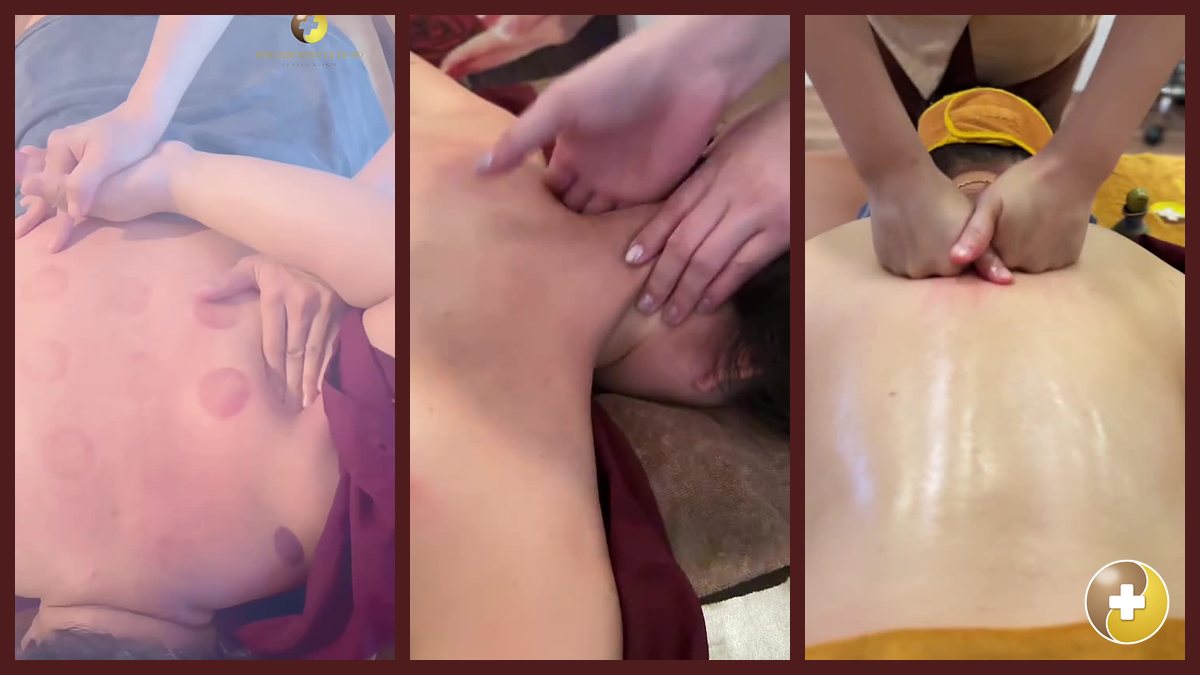
Quick answer: Gua sha (cạo gió) drags an oiled, round-edged tool over the skin; cupping (giác hơi) lifts the skin with suction cups. Both warm and loosen surface muscle; the purple marks are blood under the skin, not "bad wind". Tong Gia in Ho Chi Minh City offers dry cupping, 30 minutes for 85,000 VND (about 3 USD).
Want Lương Y Tống Văn Huynh’s team to read your spine and posture in person?
What are gua sha and cupping, and what do they do?
Scraping (Vietnamese cạo gió, known abroad as gua sha) and cupping (giác hơi) are two old Vietnamese ways of warming and "opening up" the surface muscles. People often say them together because they come to mind at the same moment: after a chill, getting soaked in the rain, a heavy head or an achy body, or when someone says you have "caught the wind".
Scraping means spreading oil on the skin and drawing a round-edged object such as a coin, a spoon or a horn tool over it in one direction, usually on the nape, along both sides of the spine and the upper back. After a few dozen strokes the skin shows red, purple or even dark streaks. Cupping means placing round cups of glass, bamboo or plastic on the skin and creating suction inside them with a flame or a pump, so the skin and the tissue under it are lifted. When the cups come off, round pink or purple marks remain.
In Western physiology terms, both act mechanically on the skin and surface muscle. Scraping breaks a few tiny blood vessels under the skin, and the blood that leaks out makes the streaks. Cupping pulls up the skin, the tissue under it and the thin fascia around the muscle; blood rushes into the area and small vessels may also leak, leaving round marks. Those marks are blood under the skin, not "bad wind" or "toxins" being pulled out. Along with them come warmth, a light tingling, looser muscles; many people feel lighter, breathe easier and sleep better. Scientific research on both methods is still limited, so this article only describes what people actually feel.
In Ho Chi Minh City, people who look for gua sha and cupping are often office workers under air-con all day, drivers, night-shift workers, cold-storage staff, and older people who grew up with family members scraping their back at home. This guide explains what each method is, how they differ, where the cupping points are, who should skip them and how Tong Gia Acupoint Wellness (Huyệt Đạo Tống Gia) works.
Gua sha vs. cupping at a glance
| Point | Scraping (gua sha) | Cupping |
|---|---|---|
| Force | Pressing and dragging along the skin | Lifting skin and surface muscle by suction |
| Tools | Coin, spoon, horn tool, oil | Glass, bamboo, plastic or silicone cups; flame or pump |
| Marks | Long red, purple, sometimes dark streaks | Round pink or purple marks; sliding cups leave long red lines |
| Feeling | Stinging, hot, tender along the strokes | Tight pulling, then spreading warmth |
| Control | Depends on the hand, easy to overdo | Suction, number of cups and time can be adjusted |
| At Tong Gia | No back scraping; facial gua sha only | Dry cupping to warm the back, no skin pricking |
Common reasons people want gua sha or cupping
- A sudden chill: stepping from the hot street into a 20°C room, or sleeping with a fan blowing on you; the neck and upper back tighten and you feel shivery and sore.
- Getting soaked: an afternoon storm can last an hour; by the time you reach home your back is cold and you start sneezing.
- Long hours at a screen: the upper back and shoulders set like a board, the head feels heavy by evening.
- Hard work, short sleep, irregular meals: you feel sluggish, achy all over and bloated.
- A common cold: runny nose, sore throat, light aches. Scraping or cupping may feel soothing but does not remove the virus.
- Family habit: many grew up seeing a mother or grandmother scrape the back whenever the weather changed.
"Catching the wind" is a folk phrase that covers many different states. Some are just muscles tightening in the cold; some are real illnesses that need a medical check.
Signs to watch before and after
- Dark streaks or dark cup marks: many believe darker means "more wind". In fact the colour depends on force, time, skin thickness, the state of small vessels and whether you take blood thinners. Very dark marks usually mean the method was too strong.
- Marks that fade slowly: normally they fade over a few days to a week. Much longer, or bruising easily where nothing was done, is worth a check-up.
- Blisters, stinging, oozing: often from too much suction, cups left too long, or a burn from fire cupping. Keep clean, do not pop, get checked at a medical facility if hot and swollen.
- Feeling faint, sweating or nauseous during the session: common when hungry, just after a big meal, very tired or when the method is too strong; stop and lie down.
When to see a doctor
Sometimes what family calls "caught the wind" is an emergency. Do not scrape or cup; get help at once if you have:
- A drooping mouth, slurred speech, weakness or numbness on one side, sudden blurred vision or severe dizziness: signs of stroke, call 115 now.
- Chest tightness, shortness of breath, cold sweats, pain spreading to the left arm or jaw: call 115 now.
- High fever, shaking chills, breathlessness, cloudy phlegm or a cough that will not settle.
- A sudden severe headache, stiff neck or repeated vomiting.
- Bruising all over without knocks, bleeding gums, frequent nosebleeds.
- Lasting fatigue, weight loss or very pale skin: get checked alongside any wellness care.
Who should skip or ask first: anyone on blood thinners or with a clotting disorder; pregnancy (no belly or lower back); scratched, inflamed or sunburned skin, fresh scars, varicose veins; very frail, very thin or elderly people with thin skin; small children; anyone very hungry, just after a big meal or after alcohol. This is a wellness service, not medical care.
Face reading (Y Tướng Học): who tends to "catch the wind"
Y Tướng Học (face reading for wellness) follows the line "the signs show outside, the organs sit inside". In the Tong Gia training manual, practitioners look at face shape, skin and muscle feel before touching, to choose where to warm and how gently, and to spot people who need a medical check instead:
- The "Đồng" (同) face: long and squarish with firm bone and muscle, the Metal type led by the Lung system. When unwell it is often from wind-cold; the upper back around T3 (Lung shu point) tends to stiffen. This is the person who "catches the wind" in air-con.
- Unevenly enlarged pores: described as weak Lung qi, easily affected by wind and cold, prone to colds and allergic noses. In Eastern theory the Lung governs the skin and pores.
- Ears that stick forward: described as weak Lung and Kidney qi, sensitive to wind and weather.
- Soft, cool flesh and a cold back: Spleen-Stomach cold or weak Kidney yang; gentle warming suits better than hard scraping.
- Muscle as hard as wood: stuck qi and blood with constrained Liver qi, often in people under long stress.
- A greyish nose tip or small purple veins on it: the manual links this with blood stagnation of the Heart system and advises caution about coronary disease. With chest tightness, this is a reason to get checked at a medical facility, not to scrape.
These signs only guide where to look first; they are not health conclusions and never a judgement.
Cupping points and the spinal nerve-reflex zones involved
The Tong Gia manual divides the 33 vertebrae: the neck (C1–C7) serves the head, face, neck and arms; the thoracic spine (T1–T12) circulation, breathing and digestion; the lumbar spine (L1–L5) digestion, kidneys, urinary and reproductive function and the legs. Nerve roots exit between the vertebrae on both sides, and the Bladder meridian with the back-shu points of the organs runs alongside. That is why folk scraping zones and the main cupping points sit on the muscles beside the spine. Cups go on muscle, never on the bony tips.
| Point / zone | Location (manual) | Spine and function | Typical feeling | Related system |
|---|---|---|---|---|
| Dingchuan | Below C7, 0.5 cun to the side | C7: neck, shoulders, arms | Shivery nape in a draught, heavy shoulders | Lung |
| Lung shu (Phế du) | Below T3, 1.5 cun to the side | T1–T3: breathing | Cold, stiff upper back, sneezing | Lung |
| Heart shu, Jueyin shu | Below T5 and T4, 1.5 cun to the side | T4–T5: circulation | Tired upper back, palpitations with stress | Heart; light work only, ask about heart issues |
| Spleen shu, Stomach shu | Below T11 and T12, 1.5 cun to the side | T7–T12: digestion | Tight mid back, heavy body, bloating | Liver, Spleen and Stomach |
| Kidney shu, Mingmen | Kidney shu below L2, 1.5 cun to the side; Mingmen in the hollow below L2 | L1–L5: kidneys, legs | Cold, aching lower back | Kidney |
The table shows what is "related", not a health verdict. Acupoints do not act directly on internal organs; in traditional theory they help balance qi and blood and ease discomfort. More cups is not better: the practitioner only cups areas the hands find cold and tight. The manual's temperature rule, "if high, bring it down; if low, bring it up", means cold areas are warmed, hot or swollen areas are left alone.
The Tong Gia method: spinal nerve-reflex balancing massage
Every session follows the method of Lương Y Tống Văn Huynh, founder of Tong Gia and a master of traditional Vietnamese wellness with over 13 years of practice in Eastern wellness, Y Tướng Học and spinal nerve-reflex balancing. Its three "no" rules: no chemicals or herbs taken by mouth or injection, no needles or anything invasive, no rough force. So there is no hard back scraping and no skin pricking; cupping is dry, placed in a sequence:
- Safety questions: fever, chest pain, breathlessness, blood pressure, pregnancy, blood thinners, easy bruising, skin condition.
- Observation: complexion, breathing, shoulder line, the skin of the back and any old marks.
- Reading the spine by hand from C7 to L5: skin temperature, muscle layer, vertebral shape, sensation, left versus right.
- Muscle release first so the cups sit evenly and need less suction.
- Acupressure and cups on the right zones: Dingchuan and Lung shu up top, Kidney shu and Mingmen low, only where needed.
- Home advice: keep warm, shower a few hours later, when to get a medical check.
Services and prices
- Cupping to warm the back, 30 minutes: 85,000 VND (about 3 USD).
- Traditional Eastern massage: 60 minutes 450,000 VND (about 17 USD), 90 minutes 550,000 VND (about 21 USD).
- Herbal steam: 120,000 VND (about 5 USD), good after a soaking or when chilled all over.
See the price page, our cupping Q&A, the cupping experience guide and the gua sha and herbal steam Q&A for the facial gua sha service.
A typical session
One evening at the Vinhomes Grand Park branch, the guest was an engineer from the Hi-Tech Park who had been sitting in a cold office and felt a shivery nape and heavy shoulders; he had planned to ask family to scrape his back. The practitioner checked: no fever, no chest pain, no arm numbness, no blood thinners. Breathing was shallow, shoulders raised. The skin around C7 and T1–T3 felt cooler than lower down, and the muscle between the left shoulder blades was a tender band; the lower back was warm and did not need cups. After releasing the neck and upper back and pressing Dingchuan and Lung shu, a few static cups went on the base of the neck and upper back and came off as the skin turned pink. He left with advice to angle the air-con, wear a collar at the office and take a warm shower a few hours later.
What guests usually feel
As a cup first draws, the skin feels tight, then warmth spreads within seconds; the massage beforehand makes the pull gentler. Afterwards the back and shoulders are warm, the neck turns more easily and breathing deepens; many sleep deeply that night. Marks may feel tender for a day or two, then fade. Everyone differs, and Tong Gia does not promise that aches disappear after one visit.
Want Lương Y Tống Văn Huynh’s team to read your spine and posture in person?
Self-care at home and prevention
- If you still scrape at home: enough oil, light strokes in one direction, stop when the skin turns pink, never chase dark streaks; not when hungry, after a big meal or with high fever.
- Do not use a home cupping set without guidance, and never prick the skin.
- Keep the nape and lower back warm: angle the air-con away, 26–27°C at night, a light jacket for evening rides.
- Warm the lower back: rub your palms until warm, place them on both sides of the lower back and rub up and down 50–100 times.
- Care for the marks: no scratching or scrubbing, avoid harsh sun. More back tips in our back massage Q&A.
How to book
Tong Gia has two branches in Ho Chi Minh City, open every day, with real customer reviews on Google Maps:
- District 12: 225 Dương Thị Mười, Phường Tân Chánh Hiệp (Tan Chanh Hiep Ward, District 12). Open 8:00–19:00 daily.
- District 9 – Vinhomes Grand Park: Căn T16-21 khu Manhattan, Phường Long Bình, TP. Thủ Đức (unit T16-21, Manhattan zone, Long Binh Ward, Thu Duc City). Open 9:00–20:00 daily.
Call, Zalo or WhatsApp +84 888 264 559, or book online. Say whether you want cupping alone or with massage, and mention blood thinners, easy bruising, pregnancy or a heart condition. Visiting Ho Chi Minh City is a good chance to try a Vietnamese Eastern wellness method built by Lương Y Tống Văn Huynh.
Visit us
- Đông Y Huyệt Đạo Tống Gia Quận 12 (District 12)
225 Dương Thị Mười, Phường Tân Chánh Hiệp, Quận 12, HCMC · 8:00–19:00 daily · 0888 264 559 · Directions on Google Maps - Đông Y Huyệt Đạo Tống Gia Quận 9 (Vinhomes Grand Park, District 9)
Căn T16-21 khu Manhattan, Vinhomes Grand Park, Phường Long Bình, TP. Thủ Đức, HCMC · 9:00–20:00 daily · 0888 264 559 · Directions on Google Maps
Want Lương Y Tống Văn Huynh’s team to read your spine and posture in person?
FAQ
What are gua sha and cupping? Gua sha means spreading oil and stroking the skin with a coin or horn tool in one direction; cupping means placing cups that create suction to lift the skin and surface muscle. Both warm and loosen the muscle and feel soothing when you are chilled or achy; neither replaces a medical check when you are ill.
Do dark gua sha marks mean more "bad wind"? No. Red, purple or dark streaks are blood leaking from tiny vessels under the skin. Darker marks usually come from more force, longer scraping, thin skin or blood thinners.
How long do cupping marks last? Usually a few days to about a week. If marks last much longer, blister, become hot and swollen, or you bruise easily elsewhere, get checked.
Should cupping include pricking the skin? Pricking breaks the skin and can get infected if tools are not sterile. Tong Gia follows a no-invasive rule and only does dry cupping; do not prick your skin at home.
Where are the main cupping points? Mostly beside the spine on the Bladder meridian: Dingchuan below C7, the Lung shu below T3, the back-shu points of the mid back, and Kidney shu and Mingmen at L2. Cups go on muscle, not on the bony tips.
Can I shower after gua sha or cupping? Wait a few hours, use warm water, avoid cold water and air-con blowing on you, and do not scrub the marks. If a blister forms, keep it clean and dry.
Author: Lương Y Tống Văn Huynh – founder of Huyệt Đạo Tống Gia, a master of traditional Vietnamese wellness with over 13 years in Eastern wellness care, Y Tướng Học (face reading) and spinal nerve-reflex balancing massage.
Updated: 2026-11-16
Related guides
- What does acupressure do? Effects on muscles, nerves and the five organs, and how Tong Gia works in Ho Chi Minh City
- Acupressure in Thu Duc: pressure chosen by reading your spine, at the branch that suits your ward
- Sore after acupressure: is it normal? How to tell ordinary aching from warning signs, why it happens and how to look after yourself after a session in Ho Chi Minh City
- What are gua sha and cupping: two Vietnamese folk warming methods, the cupping points and when to skip them
- Unblocking the meridians (đả thông kinh lạc): what it really means, how a hands-on session works and what you will feel in Ho Chi Minh City
- Herbal compress: what the warmth really does, where it goes and who it suits
This is a wellness service, not medical care.