
What does herbal steam do? Benefits, how long to steam and who should skip it in Ho Chi Minh City
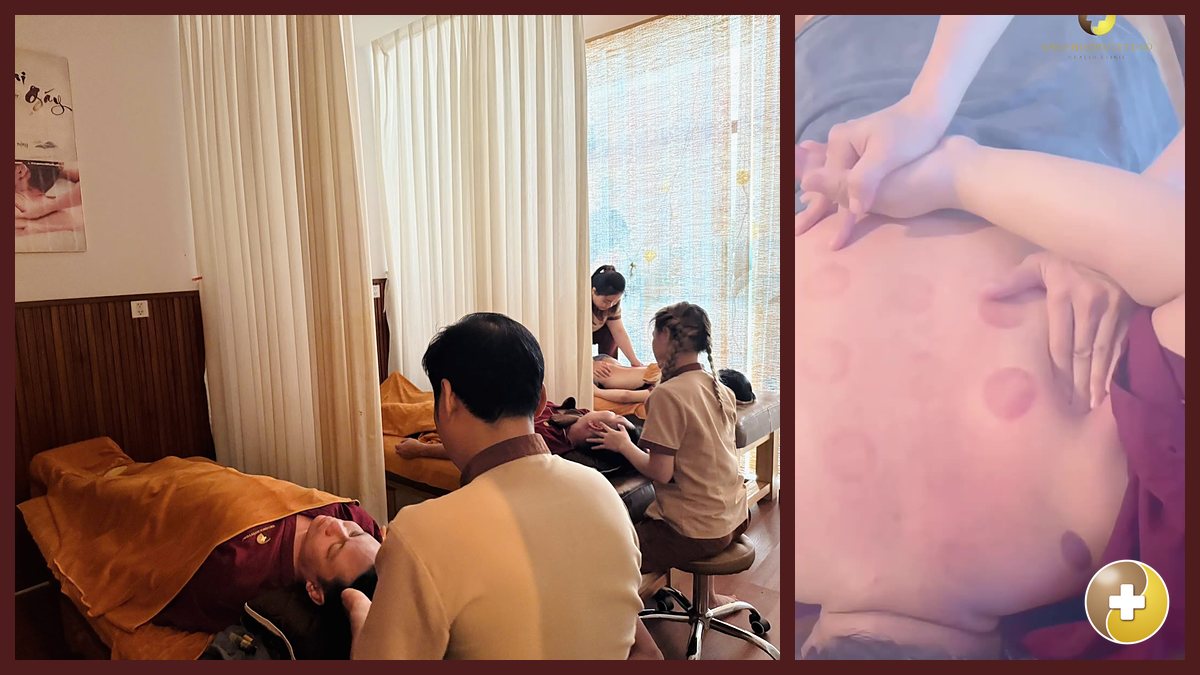
Quick answer: Herbal steam warms the body gradually, opens the small blood vessels under the skin, brings a light sweat, softens neck and back muscles and calms the mind. 10–15 minutes is enough; skip it when hungry, full or after alcohol. Tong Gia in District 12 and Vinhomes Grand Park, Ho Chi Minh City, steams before massage.
Want Lương Y Tống Văn Huynh’s team to read your spine and posture in person?
What is herbal steam and what does it do?
Herbal steam means sitting in warm, moist air scented with herbs, letting your body warm up from the skin inward until you sweat lightly. In Western terms, your body works to keep its core temperature steady: small blood vessels under the skin widen to release heat, your heart beats a little faster and your sweat glands switch on to cool you down. At the same time, warm muscle fibres become softer and easier to stretch, your breathing slows, and the parasympathetic side of the nervous system, the "rest and digest" side, gets a chance to take over after a stressful day.
What people usually notice:
- Relaxation: warmth and the herbal scent slow your breathing; many people feel sleepy while steaming.
- A light sweat: if you sit in air-con all week and almost never sweat, you feel noticeably "lighter" afterwards.
- Softer muscles before massage: a warm neck and back let the practitioner work deeper with less soreness.
- Easier breathing: warm, moist air eases a dry nose when the rainy season turns the weather.
- Better sleep that night: warming up and then cooling down helps many people fall asleep.
What Tong Gia does not claim: steam does not "detox" you, does not melt fat and does not replace a check-up. Sweat is mostly water and salts; your liver and kidneys do the real clearing. Steam is a wellness step that makes the body comfortable and ready for the muscle release that follows.
How is it different from a gym sauna or steam room?
At a gym you go in alone, time yourself, share the room and rarely get herbs; many people sit for a long time right after heavy training. At Tong Gia Acupoint Wellness (Huyệt Đạo Tống Gia) the steam carries herbs, a practitioner asks about your health first, times the session to your condition and places it before massage. The goal is comfort, not endurance.
Why do people in Ho Chi Minh City need warming up?
It sounds odd in a hot city, but daily habits leave many residents "cold inside":
- Air-con all day: office workers in District 12 or the Saigon Hi-Tech Park sit under a vent for 8–10 hours; the skin rarely sweats and neck muscles tighten to hold warmth.
- Long static postures: laptop work and two hours on a motorbike keep the neck and upper back tense, with poor circulation.
- Afternoon rain and wind: riding home in a wet shirt exposes the back of the neck and the area between the shoulder blades.
- Ongoing stress: the "fight or flight" side of the nervous system stays on, breathing stays shallow and muscles struggle to let go.
- Little exercise: a week without sport or sweat leaves the body heavy and sleep shallow.
Eastern wellness calls cold wind and air-con chill "wind-cold" from outside. The Tong Gia curriculum notes that when Lung qi is weak, pores open unevenly and wind and cold enter easily. Warming at the right time and to the right degree helps the body rebalance; hotter is not better.
Signs your body needs warmth, and signs to watch while steaming
- The back of the neck and the area between the shoulder blades feel colder than elsewhere, with tight bands of muscle.
- You feel stuffy and sluggish and have not sweated all week.
- Cold hands and feet, especially after long hours in air-con.
- A dry, slightly blocked nose when the weather turns, shallow breathing.
- Difficulty falling asleep because your body feels tense.
While steaming, a light sweat all over and pinkish skin mean "enough". If you feel dizzy, see spots, notice a pounding heart, shortness of breath, nausea or a growing headache, leave the steam room straight away, sit somewhere airy, sip warm water and tell the practitioner.
When to see a doctor, and who should skip steam
Heat makes the heart beat faster and widens blood vessels, so some people should ask a health professional first or skip steam: anyone with heart disease, a stent or a pacemaker; unstable high or low blood pressure; pregnancy; high fever or recent illness; alcohol in the last hours; an empty stomach or a very full one; inflamed skin, open wounds or burns.
Please see a doctor at a medical facility instead of steaming it away if you have:
- A fever lasting several days, a long-lasting cough or breathlessness on exertion.
- Constant fatigue, pale skin and frequent dizziness (signs that may point to anaemia) or unexplained weight loss; get checked in parallel with any wellness care.
- A fast or irregular heartbeat even at rest.
- Fainting during or after steam.
Chest tightness, shortness of breath or cold sweats: call 115 immediately.
This is a wellness service, not medical care.
The Y Tướng Học view: what skin, sweat and complexion show
Y Tướng Học (face reading for wellness) at Tong Gia rests on one idea: "the signs show outside, the organs lie inside". For steam, three organs matter most in Eastern wellness:
- The Lung governs skin and body hair: per the Tong Gia curriculum, it nourishes the skin and keeps the protective qi working. People with weak Lung qi catch colds easily, sweat readily or have dry skin.
- Sweat is the fluid of the Heart: people who get palpitations and pour with sweat in heat need short, gentle, closely watched steam.
- The Spleen governs the flesh: soft, cool muscle that stays dented when pressed points to weak Spleen qi.
The curriculum's chapter on flesh signs describes what practitioners look for. Clean skin with fine pores, a clear glow and a light, fresh sweat show strong Lung qi. Sudden dullness, heavy-smelling or oily sweat and itchy rashes are linked to damp-heat patterns; uneven pores and frequent colds to weak Lung qi. A rosy complexion means the Heart and Lung work well together; a very pale or sallow face with dizziness and breathlessness is a sign to get checked at a medical facility as well. People with a "Đồng" (同) face, long and squarely built, belong to the Metal element with the Lung in charge; when out of balance they tend toward dry skin, nasal discomfort in cold weather and tightness around the D3 vertebra (Lung Shu point).
These observations only guide which areas to work and how much heat to use. They are never used to judge illness or character.
Vertebrae and nerve-reflex zones involved
According to the Tong Gia curriculum, the neck (C1–C7) governs the head, face, neck and arms; the thoracic spine (D1–D12) relates to circulation, breathing and digestion; the lumbar spine (L1–L5) relates to digestion, kidneys, urinary and reproductive function and the legs.
| Vertebrae / area | Nerve and function link | Common signs | Organ (Eastern view) |
|---|---|---|---|
| C1–C6 (neck) | Head, face, neck, arms | Heavy head, stiff neck after air-con days | Liver (governs the sinews) |
| C7 (base of neck) | Neck-back junction; Dingchuan point, Dazhui on the Governor vessel | Cold base of neck, goosebumps in a draught, sneezing | Lung |
| D1–D3 (between shoulder blades) | Circulation, breathing; Lung Shu below T3 | Tight upper back, shallow breathing, dry skin | Lung |
| D4–D5 | Circulation; Pericardium Shu (T4), Heart Shu (T5) | Palpitations and heavy sweating in heat | Heart, Pericardium |
| D11–D12 | Digestion; Spleen Shu, Stomach Shu | Soft muscle, cold hands and feet, poor appetite | Spleen, Stomach |
| L2 (lower back) | Kidneys, legs; Kidney Shu below L2 | Cold lower back, tired knees | Kidney |
The table shows links only, never a conclusion about disease. One of the curriculum's eight golden rules is temperature balancing: "if high, lower it; if low, raise it". Cold skin and slack muscle are warmed; a hot, tight, increasingly sore area is not given extra heat but released gently instead. That is why every visit starts by reading the spine before deciding how long you steam.
The Tong Gia method: steam first, spinal nerve-reflex balancing massage after
- Questions and observation: heart, blood pressure, pregnancy, fever, alcohol, last meal; complexion, skin and shoulder posture. If steam does not suit you, you get massage instead.
- Reading the spine by hand: press-and-lift and press-and-shift to feel skin temperature, then strokes along both sides of the spine to compare left and right.
- Herbal steam: usually 10–15 minutes, shorter on your first visit.
- Muscle release and acupressure: while the muscles are warm, the base of the neck, shoulder blades and back are released; Dingchuan, Lung Shu or Kidney Shu are pressed depending on what was found. Pressure builds gradually and stops at the threshold.
- Self-care advice: staying warm, drinking water, what to do that evening.
- Herbal steam: 120,000 VND (about 5 USD).
- Traditional Vietnamese massage, 60 min: 450,000 VND (about 17 USD), after steam for neck, shoulders and back.
- Herbal compress: 130,000 VND (about 5 USD), when only one area such as the back or knees needs warmth.
A typical session
A common early-evening visit: an office worker who has sat in air-con all week, stiff neck, cold hands, feeling "stuffy". The practitioner notices a pale complexion and finds the area between the shoulder blades colder than the lower back, with a band of tight muscle around C7–D3. She steams for 12 minutes until a light sweat appears, dries off and sips warm water. Then the base of the neck and shoulder blades are released and Lung Shu and Dingchuan pressed; the already warm lower back only gets light strokes. She leaves with advice to wear a light jacket in air-con and soak her feet that night.
What you feel during and after
During steam: gradual warmth, slower breathing, sweat on the forehead and neck first. During massage: shoulders soften faster, mild soreness where muscles were tight. Afterwards: light, a little sleepy and thirsty; many sleep more deeply that night. Results vary and Tong Gia does not promise the tension will be gone after one visit.
Read more: gua sha and herbal steam Q&A, a herbal steam visit, traditional Vietnamese massage Q&A, plus cupping, gua sha and herbal steam and all prices.
Want Lương Y Tống Văn Huynh’s team to read your spine and posture in person?
Self-care at home and prevention
- Soak your feet in warm water for 10–15 minutes in the evening.
- Sip warm water before and after steaming; avoid iced drinks while sweating.
- Keep the neck and upper back covered in air-con and on evening rides; change out of wet clothes quickly.
- Move every 45–60 minutes: roll your shoulders and take a few deep breaths.
- Be careful with home steam pots: do not cover yourself for long, never steam hungry, full or exhausted, keep the pot at a safe distance, and stay with older relatives or children.
After steam, wait until the sweat dries and your body settles, then take a quick warm shower; no cold shower straight away and no standing in front of a fan.
Booking
The method was built by the founder, Lương Y (master of traditional Vietnamese wellness) Tống Văn Huynh, with over 13 years in Eastern wellness, Y Tướng Học (face reading for wellness) and spinal nerve-reflex balancing. It is a Vietnamese approach you can experience while you live in or visit Ho Chi Minh City. Both branches open every day:
- District 12: 225 Dương Thị Mười, Phường Tân Chánh Hiệp (Tan Chanh Hiep Ward, District 12). Daily 8:00–19:00.
- Vinhomes Grand Park: Căn T16-21 khu Manhattan, Phường Long Bình, TP. Thủ Đức (Unit T16-21, The Manhattan, Long Binh Ward, Thu Duc City, formerly District 9). Daily 9:00–20:00.
Real customer reviews are on Google Maps, linked from each branch page. WhatsApp or Zalo +84 888 264 559, or book online. If you have a heart condition, blood pressure issues or are pregnant, mention it when you book.
Visit us
- Đông Y Huyệt Đạo Tống Gia Quận 12 (District 12)
225 Dương Thị Mười, Phường Tân Chánh Hiệp, Quận 12, HCMC · 8:00–19:00 daily · 0888 264 559 · Directions on Google Maps - Đông Y Huyệt Đạo Tống Gia Quận 9 (Vinhomes Grand Park, District 9)
Căn T16-21 khu Manhattan, Vinhomes Grand Park, Phường Long Bình, TP. Thủ Đức, HCMC · 9:00–20:00 daily · 0888 264 559 · Directions on Google Maps
Want Lương Y Tống Văn Huynh’s team to read your spine and posture in person?
FAQ
What does herbal steam do? It warms the body gradually, widens small blood vessels under the skin, brings a light sweat, softens neck and back muscles and relaxes the mind; many people sleep better that night. It does not melt fat or replace a check-up. At Tong Gia, steam usually comes before massage so muscle release is easier.
How long should I stay in the steam? Usually 10–15 minutes, less on your first time. A light sweat all over and pinkish skin mean you have had enough. If you feel dizzy, breathless or your heart pounds, step out, sit somewhere airy and sip warm water.
Should I steam before or after a massage? At Tong Gia, before. Warm muscles let the practitioner work deeper with less soreness. If the spine reading finds an area that is hot, tight and increasingly sore, the steam may be shorter or skipped that day.
Will herbal steam help me lose weight? The weight you lose right after steam is mostly water from sweat and returns when you drink. Steam does not burn fat. For weight loss you need diet and regular exercise; steam simply relaxes you and softens muscles.
Is herbal steam safe with high blood pressure? Heat speeds up the heart and widens blood vessels, so people with unstable blood pressure or heart disease should ask a health professional first. Mention it when booking; the practitioner may suggest gentle massage or a herbal compress instead.
Can I shower right after herbal steam? Wait until the sweat dries and your body settles, then take a quick warm shower. Avoid cold water and fans straight away, since the skin is still warm and open.
Author: Lương Y Tống Văn Huynh – founder of Huyệt Đạo Tống Gia, a master of traditional Vietnamese wellness with over 13 years in Eastern wellness care, Y Tướng Học (face reading) and spinal nerve-reflex balancing massage.
Updated: 2026-11-15
Related guides
- How often should you get acupressure? Rhythm by goal, the rest gap between sessions and when to space them out
- Is acupressure safe? Where the real risks come from, who should be careful and what Tong Gia asks before every session in Ho Chi Minh City
- Can you shower after cupping? How long to wait, how to shower and what the marks mean
- What are meridians? A plain-language guide to the 12 main channels, acupoints and why Tong Gia practitioners in Ho Chi Minh City work where it does not hurt
- Who should not do cupping? Groups who must ask first, areas never cupped and how Tong Gia checks your health in Ho Chi Minh City
- What does herbal steam do? Benefits, how long to steam and who should skip it in Ho Chi Minh City
This is a wellness service, not medical care.