
Xoa bóp, the Vietnamese rub-and-press massage: how the hands read your body, what a session includes and who it suits
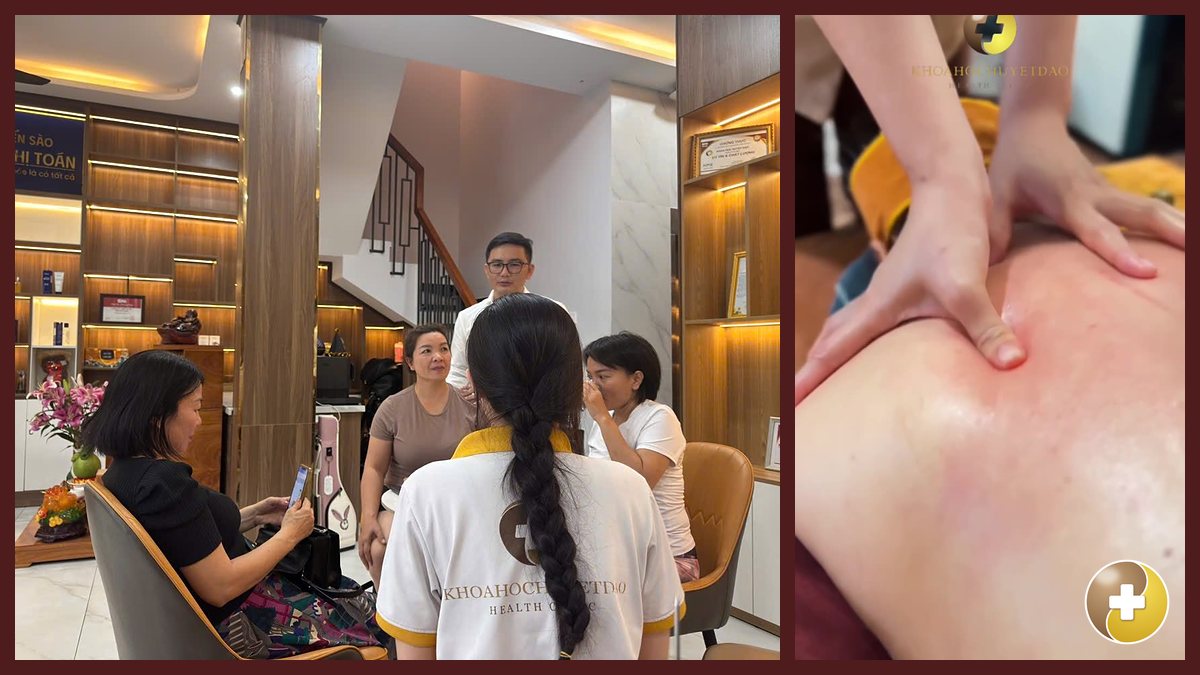
Quick answer: Xoa bóp is the Vietnamese word for massage by hand: rubbing, stroking, pressing and kneading skin, muscles and acupoints so tight muscles let go and the nervous system shifts into rest mode. At Tong Gia Acupoint Wellness in District 12 and Vinhomes Grand Park, Ho Chi Minh City, a 60-minute Eastern massage costs 450.000₫ (about US$17).
Want Lương Y Tống Văn Huynh’s team to read your spine and posture in person?
What is xoa bóp? The Western view and the Eastern view
Xoa bóp (say "swa bop") is what Vietnamese people call hands-on bodywork: xoa means to rub, bóp means to squeeze or knead. Grandparents in the countryside did it for each other after a day in the rice field, mothers rub a child's belly when it is bloated, and grown children knead their parents' shoulders before bed. In a shop you will often see it written as "xoa bóp bấm huyệt", rub-and-press massage with acupressure. This page is for anyone living in or visiting Ho Chi Minh City who wants to receive xoa bóp, not for people who want to open a massage business.
From a Western point of view nothing mysterious happens in a session. Pressure and long strokes stretch muscle fibres that have stayed contracted, more blood flows into the area, so the skin warms and the muscle softens. Skin and muscle hold a dense network of sensory receptors. When they are stimulated in a steady rhythm, signals travel to the spinal cord and brain, and the autonomic nervous system moves from "fight" mode (sympathetic) toward "rest" mode (parasympathetic): heart rate slows, breathing deepens, shoulders drop, and many people fall asleep halfway through. Because spinal nerve roots exit on both sides of the spine between the vertebrae, work along both sides of the spine usually feels more calming than work anywhere else.
From the Eastern point of view, xoa bóp helps qi and blood flow, keeps the channels open, and supports balance between the five organ systems: Liver, Heart, Spleen, Lung and Kidney. These are functional systems in traditional thinking, not the same as the anatomical organs. At home we simply squeeze where it aches. In the Tong Gia approach the hands must "read" first and work second, because the aching spot is not always the source.
The hand techniques and what each one does
The Tong Gia curriculum splits hand movements into two groups: movements for reading the body and movements for releasing it. Here is what your practitioner is doing at each moment:
| Technique | How it is done | Purpose | What you feel |
|---|---|---|---|
| Press-and-lift / press-and-shift | Whole palm laid on the skin, lifted or slid slightly | Read skin temperature zone by zone | Warm, light, like being wrapped |
| Stroking and probing | Strokes along muscles, tendons and the spinal groove with palm, one or three fingers | Find knots, fibrous bands, deep or shallow tension | Some spots smooth, some "that's the one" |
| Fine rolling | Fingertip circles, pushes and turns over each vertebra | Read the shape of each vertebra and tender points | Small, focused pressure |
| Push and rotate | Pressure into a muscle mass, then rotation | Release thick, hard, immobile muscle | Firmer, then a clear lightness |
| Plucking | Across the muscle fibres | Soften fibrous, tight bands | "Good pain", muscle lets go |
| Vibration | Steady rhythmic shaking | Calm soft, thick muscle and a tired, tense nervous system | Drowsy, lighter head |
| Deep gliding | Slow deep glides in hollows and grooves | Find and release small leftover points | Deep but never rough |
Common reasons people look for xoa bóp
- Desk and phone posture: office staff, developers and remote workers in Thu Duc, District 12 or the Saigon Hi-Tech Park. The neck muscles hold a head of roughly 4–5 kg tilted forward for hours, so they tire, stiffen and sometimes send tension up into the head.
- Riding, driving and long shifts: motorbike commuters, drivers, factory workers. The lower back and calves carry load for hours; by evening the legs feel heavy.
- Ongoing stress: business owners, parents juggling work and children, newcomers adjusting to a new city. The sympathetic system stays switched on, shoulders creep up, sleep is shallow.
- Air conditioning, rain and weather swings: cold neck, cold back and an achy body, common in Saigon's rainy season.
- Jet lag and long flights: stiff back and legs after many hours in a seat.
- Age: older muscles are less elastic; many expats bring visiting parents for a gentle session.
According to the Tong Gia curriculum, the ache appears in one place but the root may sit elsewhere: an aching back rooted in the Kidney system, poor sleep rooted in the Heart and Liver, heaviness and bloating rooted in the Spleen and Stomach. That is why a skilled session does not only squeeze the spot you point to. See also our traditional Vietnamese massage experience.
Signs your body is asking for a session
- Stiff neck in the morning; heavy shoulders by late afternoon.
- A hard lump in the upper shoulder that sends a dull ache up to the neck.
- Lower back fatigue after standing; hard to straighten up after bending over the sink.
- Taking a long time to fall asleep, waking tired.
- Heavy head and tired eyes after screen work.
- Cold, heavy legs in the evening.
- Irritability, frequent sighing, poor appetite.
These are hints for self-care, not a verdict about any illness. If they get worse, appear suddenly, or come with the warning signs below, get checked at a medical facility first.
When to see a doctor
Xoa bóp is wellness care. Please see a doctor at a medical facility before booking if you have any of the following:
- Sudden severe headache, dizziness with slurred speech, facial droop, or weakness on one side: call 115.
- Neck or back pain spreading into an arm or leg with marked numbness, weakness, trouble gripping or walking, or bladder changes.
- A recent fall or impact, suspected fracture, new sprain, or a hot, red, swollen area.
- Fever, skin infection, open wounds or an unusual rash where you want to be massaged.
- Swelling in the legs that keeps increasing, or one calf that is painful and swollen.
- Long-lasting fatigue, unexplained weight loss, or pale skin: get checked at a medical facility alongside any wellness care.
- Pregnancy, a stent, a pacemaker or blood thinners: tell us first so the practitioner uses light pressure and avoids certain points.
Chest tightness, shortness of breath, cold sweat: call 115 immediately; no massage, no acupressure. The Tong Gia curriculum lists this as safety rule number one. Keep taking anything prescribed by your doctor exactly as instructed. This is a wellness service, not medical care.
Y Tướng Học: what the hands read in your skin and muscle
Y Tướng Học (face reading for wellness) rests on the idea "the signs show outside, the organs lie inside". Lương Y Tống Văn Huynh, a master of traditional Vietnamese wellness, brought it into bodywork so the practitioner already has a direction before touching: face shape, skin tone, how you sit. Once the hands are on, they keep reading the quality of the flesh. The Tong Gia curriculum describes these "flesh types":
| Flesh type | In balance | Out of balance | Organ system (traditional view) |
|---|---|---|---|
| Soft as cotton | Soft, warm, springs back at once | Flabby, cool, dent stays; cold hands and feet, easy bloating | Spleen and Stomach cold and weak, damp retention |
| Firm, not puffy | Dense muscle hugging the bones, rosy skin | Hard as wood, dry, tender; aching all over, tension headaches | Qi and blood stagnation, constrained Liver qi |
| Skin like jade, rosy | Moist skin, red lips, visible healthy colour | Very pale or sallow, dizzy, short of breath, poor sleep; or dark patches | Heart and Spleen both weak; Liver blood stasis |
| Fresh-smelling skin | Clean skin, fine pores, light natural sweat | Dull skin, sour sweat, itching; or open pores, catching colds easily | Damp-heat in Liver and Gallbladder; weak Lung qi |
In practice: a manager under heavy pressure whose upper back feels like wood needs slow, deep, repeated release; someone whose muscle is cool and soft needs warmth and gentle vibration, not force. These signs only guide where to feel first. They are not fortune telling and never replace a medical check. More in Eastern face reading for wellness.
Vertebrae and reflex zones involved
The school's motto is "the spine is a person's life". The head is the centre of the central nervous system; the spine is the axis of the autonomic system that keeps the body running on its own. The 33 vertebrae divide the work: neck C1–C7 for head, face, neck and arms; upper and mid back D1–D12 for circulation, breathing and digestion; lower back L1–L5 for digestion, kidneys, urinary and reproductive organs and the legs; sacrum and coccyx S1–S5 for elimination and the pelvic floor.
| Spinal zone | Nerves and functions | Common complaints | Related organ system |
|---|---|---|---|
| C1–C7, D1–D3, sacral zone | Head, face, neck, arms; nervous and emotional balance | Headache, poor sleep, stress, dizziness | Heart, Liver |
| C5–C7, L1–L5, S1–S5 | Muscles, bones and joints of neck, shoulders, lower back, legs | Stiff neck, tingling hands, low back pain, pain down the leg | Liver (tendons), Kidney (bones) |
| D1–D12, L1–L3 | Circulation, breathing, digestion, metabolism | Shallow breathing, bloating, poor appetite, heaviness | Lung, Heart, Spleen–Stomach, Liver |
| D10–D12, L1–L3, S1–S5 | Urinary, reproductive, pelvic area | Cold lower back, tired knees, menstrual discomfort | Kidney, Liver |
The curriculum is explicit that these groupings guide wellness care only and do not replace check-ups at a medical facility.
The Tong Gia method: spinal nerve-reflex balancing massage
Xoa bóp at Tong Gia follows spinal nerve-reflex balancing, built by Lương Y Tống Văn Huynh over more than 13 years of Eastern wellness practice. No needles, nothing to swallow or inject, no rough force. A session runs in this order:
- Ask and observe: where it aches, for how long, how you sleep, any pregnancy or health conditions; a look at face, skin tone and posture.
- Read the spine by hand: four things are checked: skin temperature, the muscle layer (knotted, hard or slack), the shape of each vertebra, and tender or tingling points. Left is compared with right, top with bottom.
- Choose where to work: only the "excited" zones (warmer, tight, more tender) are worked directly; cool, under-active zones are left alone.
- Muscle release: push and rotate, plucking, vibration and deep gliding, with 5 pressure levels from one finger up to whole-body weight, always within "good pain".
- Acupressure on the right points: for example points beside the mid-back for heaviness and poor appetite, or lower-back points when the lower back feels cold and tired.
- Stop at the right time: when the skin over the key point turns from dry to slightly moist, the practitioner stops.
- Home care tips: a few points to press yourself and habits to change.
A typical session: an office worker from Thu Duc came to the Vinhomes Grand Park branch after work with heavy shoulders, a foggy head and broken sleep. Her right shoulder sat higher than the left; along the spine the lower neck and upper back felt warmer and the right trapezius was a hard band. Most of the hour went into releasing C5–C7 and D1–D3 with push-and-rotate and plucking, mixed with light vibration, then pressing points at the back of the neck. She dozed off midway, and afterwards said turning her head felt easier. She was advised to raise her screen and stand up every hour. Everyone responds differently; the session supports balance and does not promise instant results.
| Service | Length | Price | Good for |
|---|---|---|---|
| Eastern (Đông y) massage | 60 / 90 min | 450.000₫ (about US$17) / 550.000₫ (about US$21) | A first full-body xoa bóp with acupressure |
| Neck-shoulder or lower-back care | 60 / 90 min | 550.000₫ (about US$21; first visit 399.000₫, about US$15) / 750.000₫ (about US$29) | Tension focused in the neck or lower back |
| Full-body care | 120 min | 950.000₫ (about US$37) | Many tired areas, a long unhurried session |
Guests usually describe tenderness at first over the hard spots, then a clear release, warmth, slow breathing and drowsiness; afterwards lighter shoulders and deeper sleep that night, sometimes mild soreness for a day or two. Related reading: acupressure massage in Saigon: questions, neck and shoulder massage in Saigon. Want to learn this technique: what licences a xoa bóp business needs, an article for trainees at Tong Gia Training (in Vietnamese).
Want Lương Y Tống Văn Huynh’s team to read your spine and posture in person?
Home care and prevention
- Press Nội Quan (PC6, 内关) when stressed: inner wrist, about three finger-widths above the crease between the two tendons; gentle circles for 1–2 minutes each side.
- Press Thần Môn (HT7, 神门) before bed: on the wrist crease, little-finger side, 1–2 minutes each side with slow breathing.
- Press Túc Tam Lý (ST36, 足三里) when heavy and off your food: below the knee on the outer side, 1–2 minutes each side until a mild ache; add gentle circles around the navel a while after meals.
- Change position every hour: screen at eye level, stand, stretch, roll the neck slowly.
- Keep neck and back warm: a light layer in air-conditioned rooms, no cold air blowing straight at the neck, enough warm water.
Use only light pressure at home. If you are pregnant, do not press Tam Âm Giao (SP6, 三阴交) or Hợp Cốc (LI4, 合谷). Stop and get checked at a medical facility if pain grows or numbness spreads.
Book a session
- District 12 branch: 225 Dương Thị Mười, Phường Tân Chánh Hiệp (Tan Chanh Hiep ward, District 12), open 8:00–19:00 daily.
- District 9 branch: Căn T16-21 khu Manhattan, Vinhomes Grand Park, Phường Long Bình, TP. Thủ Đức (unit T16-21, Manhattan zone, Vinhomes Grand Park, Thu Duc City), open 9:00–20:00 daily.
Call, Zalo or WhatsApp +84 888 264 559, or use the booking page. Tell us where it aches, your work hours and how you sleep; the practitioner will suggest the package and areas that suit you. If you are visiting Ho Chi Minh City, a session is a simple way to experience a Vietnamese Eastern wellness method first-hand.
Visit us
- Đông Y Huyệt Đạo Tống Gia Quận 12 (District 12)
225 Dương Thị Mười, Phường Tân Chánh Hiệp, Quận 12, HCMC · 8:00–19:00 daily · 0888 264 559 · Directions on Google Maps - Đông Y Huyệt Đạo Tống Gia Quận 9 (Vinhomes Grand Park, District 9)
Căn T16-21 khu Manhattan, Vinhomes Grand Park, Phường Long Bình, TP. Thủ Đức, HCMC · 9:00–20:00 daily · 0888 264 559 · Directions on Google Maps
Want Lương Y Tống Văn Huynh’s team to read your spine and posture in person?
FAQ
What is xoa bóp and how is it different from a spa massage? Xoa bóp is the Vietnamese term for rubbing, stroking, pressing and kneading the body by hand. Many spa massages spread oil evenly for relaxation. At Tong Gia the practitioner reads your spine by hand first, then releases the tight zones and presses points that match them.
Is xoa bóp suitable for my elderly parents visiting Vietnam? Yes, with light, gradually increasing pressure. Tell us about health conditions, anything prescribed, stents or pacemakers. After a recent fall, or with pain spreading down a leg or weakness on one side, please get checked at a medical facility first.
Does it hurt? Will I bruise? Tight spots feel tender, a kind of good pain. Pressure rises step by step through 5 pressure levels and the practitioner checks with you; no rough force is used. A few people feel mild soreness in the worked area for a day or two.
How often should I get xoa bóp? It depends on your body and situation. The Tong Gia curriculum stresses steady upkeep plus healthy habits rather than a single session. After your first visit, ask the practitioner when it makes sense for you to come back.
Can I have xoa bóp while pregnant or with a health condition? Tell us first. During pregnancy points such as Tam Âm Giao (SP6) and Hợp Cốc (LI4) are avoided and pressure stays light. With heart or blood pressure conditions or blood thinners, keep following your medical team's advice. Chest pain or breathlessness means call 115, no massage.
How much does a session cost in Ho Chi Minh City? Eastern massage 60 minutes 450.000₫ (about US$17), 90 minutes 550.000₫ (about US$21). Neck-shoulder or lower-back care 60 minutes 550.000₫, first visit 399.000₫ (about US$15). Full-body care 120 minutes 950.000₫ (about US$37).
Author: Lương Y Tống Văn Huynh – founder of Huyệt Đạo Tống Gia, a master of traditional Vietnamese wellness with over 13 years in Eastern wellness care, Y Tướng Học (face reading) and spinal nerve-reflex balancing massage.
Updated: 2026-11-16
Related guides
- What does acupressure do? Effects on muscles, nerves and the five organs, and how Tong Gia works in Ho Chi Minh City
- Acupressure in Thu Duc: pressure chosen by reading your spine, at the branch that suits your ward
- Sore after acupressure: is it normal? How to tell ordinary aching from warning signs, why it happens and how to look after yourself after a session in Ho Chi Minh City
- What are gua sha and cupping: two Vietnamese folk warming methods, the cupping points and when to skip them
- Unblocking the meridians (đả thông kinh lạc): what it really means, how a hands-on session works and what you will feel in Ho Chi Minh City
- Herbal compress: what the warmth really does, where it goes and who it suits
This is a wellness service, not medical care.