
Acupressure for back pain: what it can do, which points are used and when to skip it
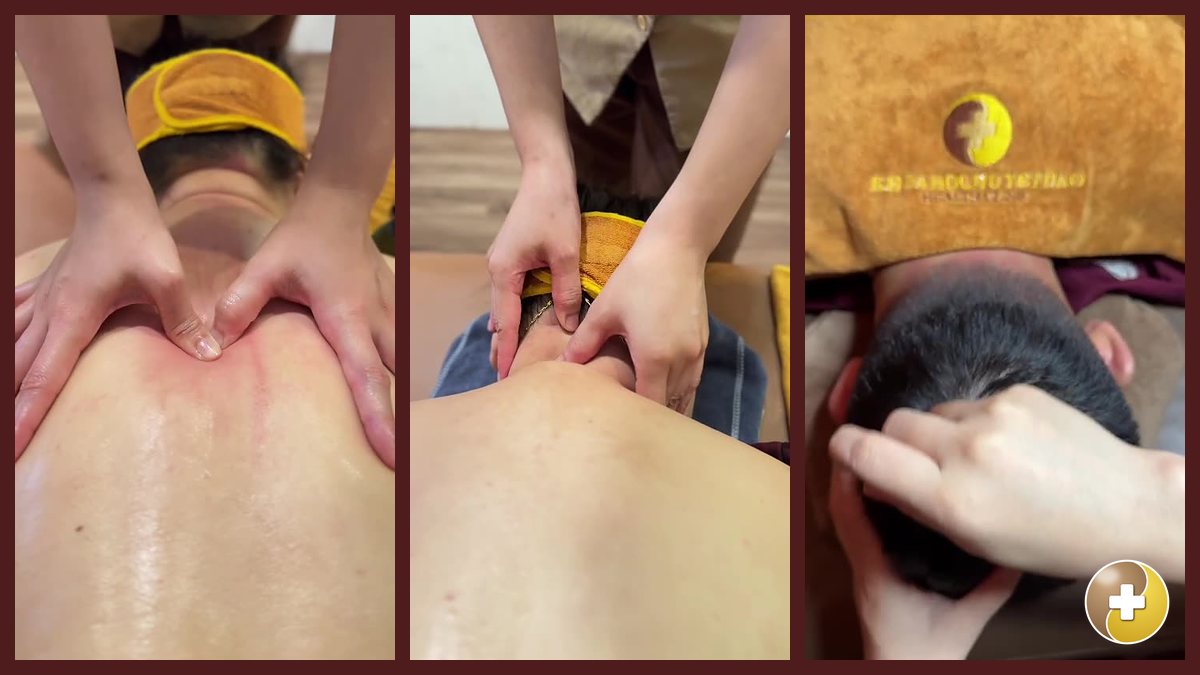
Quick answer: Acupressure for back pain softens the lower-back muscles and leaves the back warmer and lighter, often using Shenshu, Mingmen, Zhishi and Weizhong; it does not replace a medical check for leg weakness or bladder changes. Tong Gia Acupoint Wellness (Huyệt Đạo Tống Gia), Ho Chi Minh City, reads the spine before pressing.
Want Lương Y Tống Văn Huynh’s team to read your spine and posture in person?
Acupressure for back pain: what it can and cannot do
Acupressure for back pain means pressing and kneading specific points along both sides of the spine, around the lower back and sacrum and on the legs, combined with muscle release so the back softens and warms. Many people in Ho Chi Minh City look for it because they want hands-on care rather than reaching for painkillers every time the back aches. Before you go, it helps to know what acupressure can realistically do.
In Western terms most back pain is mechanical: the erector spinae, the quadratus lumborum and the glutes tighten after hours of sitting, standing, bending or lifting; ligaments and the small joints of the spine get overloaded; some people also have wear and tear, a bulging disc or a postural imbalance. Pressing the right places helps muscles let go, improves blood flow to them and sends calming signals through the nervous system, so the back feels lighter, moves more easily and you sleep more deeply. The Tong Gia curriculum notes that acupoints do not act directly on kidney cells; in traditional thinking, stimulating them helps regulate qi and blood and keep the meridians open, supporting comfort.
Acupressure does not push a herniated disc back into place, does not remove bone spurs and does not replace a medical check when warning signs appear. If a disc problem has been confirmed by a medical facility, keep following its advice; the session is gentle support, with no cracking or twisting. Guests who come for back pain include office workers, drivers, shop staff on their feet all day, market traders bending over goods, Hi-Tech Park engineers on shifts and new mothers carrying babies. If you wonder whether it hurts, see acupressure massage in Saigon: Q&A.
Common causes of back pain that respond to hands-on care
- Long sitting: a rounded back and lower-back muscles holding on for hours.
- Long standing and bending: selling, machine work, gardening, cooking; the lower back and buttocks tire by afternoon.
- Lifting badly: bending from the waist instead of squatting, twisting while holding something heavy.
- Long motorbike rides: vibration, traffic jams, low seats.
- Cold and damp: sleeping under air conditioning, late showers, backless clothes; in traditional thinking the back easily "catches cold", muscles contract and ache dully.
- Stress and short sleep: muscles never rest and brace even in bed.
- After childbirth, extra weight, little exercise: weak core and glutes leave the lower back carrying the load.
Signs to note before booking acupressure
- Pain spreading to the buttock, back of the thigh or calf; numb feet.
- A cold back, feeling cold easily, cold hands and feet, frequent night urination.
- Tired lower back and knees, quickly worn out when standing.
- One side clearly worse, uneven hips, leaning when you walk.
- Pregnancy, blood thinners, high blood pressure, kidney disease or diabetes: mention them in advance.
Following the curriculum, the practitioner asks about pregnancy, kidney conditions, blood pressure, diabetes, clotting problems and anything you take daily before choosing points and pressure.
When to see a doctor
Please see a doctor at a medical facility instead of booking acupressure if you have:
- Leg numbness or weakness that keeps getting worse; numbness in the groin or buttocks; difficulty passing or holding urine or stool: go to emergency immediately.
- Fever with flank pain, burning urination or blood in the urine; cramping flank pain spreading to the lower abdomen.
- A puffy face or swollen legs, persistently foamy urine.
- Pain after a fall or accident, particularly in older adults or people with osteoporosis.
- Night pain that rest does not ease; weight loss, ongoing fatigue or pale skin: get checked in parallel.
- Upper-back pain spreading to the chest, chest tightness, shortness of breath or cold sweats: call 115 immediately.
This is a wellness service, not medical care. According to the Tong Gia curriculum, when a guest shows warning signs, a supportive session is never offered in place of a medical check.
The Y Tướng Học view: Eastern back care starts with the Kidney
In Eastern tradition the back belongs to the Kidney. The Tong Gia curriculum describes the Kidney as storing essence and governing bones and marrow, linked to the lower back, knees and ears; its partner, the Bladder meridian, runs down both sides of the spine where Shenshu (BL23) sits. Two patterns are described: Kidney yin deficiency ("not enough cooling water"), often with warm palms and soles, night sweats and tired back and knees; and Kidney yang deficiency ("not enough warming fire"), often with feeling cold, a cold and tired lower back and night urination. These are traditional concepts, not Western disease names; the practitioner only notes the direction to decide whether to warm or to soothe.
Y Tướng Học (face reading for wellness), developed by Lương Y Tống Văn Huynh, a master of traditional Vietnamese wellness, rests on "the appearance is outside, the organ is inside." For back pain the practitioner looks at:
- The ears: full, rosy ears suggest strong Kidney energy; thin, pale ears suggest supporting and warming the lower back.
- The hair: dry, falling or early grey hair together with tired back and knees belongs to the Kidney group of signs in the curriculum.
- The nose bridge: the curriculum sees the nose as a miniature of the spine; a crooked bridge often goes with a tilted spinal axis, so L4–L5–S1 and the pelvis deserve attention.
- Face shape: a round, full face tends towards a cool lower back and soft muscles; narrow above and wide below means thick lumbar and hip muscles that congest; a wide forehead and narrow chin calls for supporting the lower back.
Vertebrae, nerve reflex areas and the points often used for the back
The curriculum links the lumbar spine L1–L5 with digestion, kidneys, urinary and reproductive function and the legs; muscle–bone–joint concerns are checked at C5–C7, L1–L5 and S1–S5.
| Vertebrae | Nerves / function | What you feel | Related organ |
|---|---|---|---|
| D11–D12 | Lower back and waist, digestion | Tired waist, large areas of tight back muscle | Spleen and Stomach |
| L1–L3 | Kidneys, urinary tract, front of thigh | Lower-back fatigue, cool back, night urination | Kidney |
| L4–L5 | Nerve roots to buttocks and legs | Low back ache spreading to the buttock, numb legs | Kidney |
| S1–S5 | Pelvis, elimination | Sacral and tailbone ache, hard to sit long | Kidney |
| Point | Location | Traditional action |
|---|---|---|
| Shenshu (BL23) | Below the L2 spinous process, 1.5 cun to each side | Back-shu point of the Kidney; supports Kidney qi, strengthens back and knees |
| Mingmen (GV4) | The hollow below the L2 spinous process | Warms Kidney yang; helps a cold, tired back |
| Zhishi (BL52) | Below L2, 3 cun to each side | Supports the Kidney, strengthens the back |
| Weizhong (BL40) | Middle of the crease behind the knee | "For back pain, look to Weizhong"; opens the back meridians |
| Taixi (KI3) | Hollow between the inner ankle bone and the Achilles tendon | Source point of the Kidney meridian |
The Tong Gia method: acupressure within spinal nerve-reflex balancing
At Tong Gia Acupoint Wellness (Huyệt Đạo Tống Gia), acupressure is part of a Vietnamese traditional method developed by Lương Y Tống Văn Huynh over more than 13 years: spinal nerve-reflex balancing massage. A back session:
- Questions and observation: health history and work; posture, hips, ears and nose bridge.
- Reading the spine by hand: four factors, namely skin temperature, the muscle layer, vertebra shape (raised, raised and shifted, shifted, sunken and shifted, sunken) and sensation, comparing left with right and top with bottom.
- Muscle release: softening the erector spinae, lumbar muscles and glutes, working only overactive areas (warm, tight, more painful) and never pressing directly on underactive ones.
- Acupressure on the right area: opening the Bladder meridian along the spine, pressing Shenshu, Zhishi and Mingmen, plus Weizhong for back pain. Pressure rises from one finger to the whole hand and arm and stops when the skin turns from dry to slightly moist.
- Self-care advice: rubbing the lower back, sitting posture, safe lifting.
No cracking or forceful twisting. Points and tight spots feel deeply tender yet pleasant, then the whole lower back warms as if under a compress; many guests say their legs feel lighter and fall asleep. Afterwards bending and standing up are easier and sleep is deeper; mild tenderness the next day usually fades within a day or two.
A typical visit: a trader from Hóc Môn market who bends over her goods from early morning comes in with a cold, tired lower back, a hand on her hip every afternoon and two or three trips to the toilet at night. The practitioner notices thin ears, cool skin over the lower back, soft lumbar muscles, a slightly sunken L4–L5 and a tight right buttock. The 60-minute session warms the lower back, presses Shenshu, Mingmen and Zhishi, releases the right buttock and works Weizhong on both legs, ending with advice to squat when stacking low goods and to rub the lower back each evening. Because the night urination has lasted a long time, she is also advised to get checked at a medical facility.
| Service | Duration | Price |
|---|---|---|
| Back and waist care | 60 min | 550,000 VND (≈ 21 USD); first visit 399,000 VND (≈ 15 USD) |
| Back and waist care | 90 min | 750,000 VND (≈ 29 USD) |
| Kidney wellness care | 75 min | 750,000 VND (≈ 29 USD) |
Read guest stories in acupressure massage in Saigon: a guest experience, acupressure in District 12 and back massage in Saigon: Q&A.
Want Lương Y Tống Văn Huynh’s team to read your spine and posture in person?
Home care and prevention
- Rub the lower back every evening: as taught in the curriculum, rub your palms until warm, place them on both sides of the lower back and rub up and down 50–100 times until warm.
- Knead Weizhong: sitting down, use your thumb on the middle of the knee crease for 1–2 minutes each side; skip it if the area is swollen or has prominent varicose veins.
- Keep the lower back warm: no air conditioning on your back, cover it while sleeping.
- Lift properly: squat, keep the back straight, hold the load close and stand up with your legs.
- Stand up every 45 minutes if you sit a lot; walk 20–30 minutes a day.
How to book
- District 12 branch: 225 Dương Thị Mười, Tân Chánh Hiệp Ward (District 12), 8:00–19:00 daily.
- District 9 branch: Unit T16-21, Manhattan subdivision, Vinhomes Grand Park, Long Bình Ward, Thủ Đức City (former District 9), 9:00–20:00 daily.
- Hotline / Zalo / WhatsApp: +84 888 264 559.
- Online booking: /dat-lich.
When booking, say where the pain is, how long you have had it and any health conditions. If you are in Ho Chi Minh City, it is a chance to experience Vietnamese traditional acupressure in person.
Visit us
- Đông Y Huyệt Đạo Tống Gia Quận 12 (District 12)
225 Dương Thị Mười, Phường Tân Chánh Hiệp, Quận 12, HCMC · 8:00–19:00 daily · 0888 264 559 · Directions on Google Maps - Đông Y Huyệt Đạo Tống Gia Quận 9 (Vinhomes Grand Park, District 9)
Căn T16-21 khu Manhattan, Vinhomes Grand Park, Phường Long Bình, TP. Thủ Đức, HCMC · 9:00–20:00 daily · 0888 264 559 · Directions on Google Maps
Want Lương Y Tống Văn Huynh’s team to read your spine and posture in person?
FAQ
Does acupressure help back pain? Combined with muscle release it softens the back muscles, improves blood flow and makes the back feel lighter and move more easily, with deeper sleep. It does not move a herniated disc back into place and does not replace a medical check when warning signs appear.
Which acupressure points are used for back pain? The Tong Gia curriculum often uses Shenshu (BL23), Mingmen (GV4), Zhishi (BL52) and Weizhong (BL40) behind the knee. The practitioner chooses points after reading your spine by hand.
Can I manage back pain without painkillers? Many people combine muscle release, acupressure, warm compresses, regular standing breaks and gentle exercise. If something has been prescribed for you, do not stop it on your own; acupressure is relaxation support.
Is acupressure safe during pregnancy? Tell us before booking. The curriculum avoids Hegu (LI4) and Sanyinjiao (SP6) in pregnancy, is careful with Guanyuan (CV4) and does not work the abdomen; pressure stays light and you lie on your side.
How many sessions until my back feels better? Muscle fatigue from sitting or standing often feels lighter after the first visit; to keep it, come every 1–2 weeks at first and change daily habits. Pain lasting over 4–6 weeks or getting worse should be checked.
How much is a back session? Back and waist care is 550,000 VND (about 21 USD) for 60 minutes, 399,000 VND (about 15 USD) on the first visit, and 750,000 VND (about 29 USD) for 90 minutes.
Author: Lương Y Tống Văn Huynh – founder of Huyệt Đạo Tống Gia, a master of traditional Vietnamese wellness with over 13 years in Eastern wellness care, Y Tướng Học (face reading) and spinal nerve-reflex balancing massage.
Updated: 2026-11-16
Related guides
- Acupressure for back pain: what it can do, which points are used and when to skip it
- Back acupoints: where they sit along the spine, what they relate to and how to press them safely
- Should I get a massage for back pain? When it helps, when to wait and when to get checked first
- Pain between the shoulder blades: why this strip of the back burns, three types to tell apart, and how Tong Gia cares for it in Ho Chi Minh City
- Back pain from sitting too long: why your lower back tires and how to care for it
- What causes back pain? A map of four areas, warning signs and Vietnamese spinal nerve-reflex care
This is a wellness service, not medical care.