
What causes back pain? A map of four areas, warning signs and Vietnamese spinal nerve-reflex care
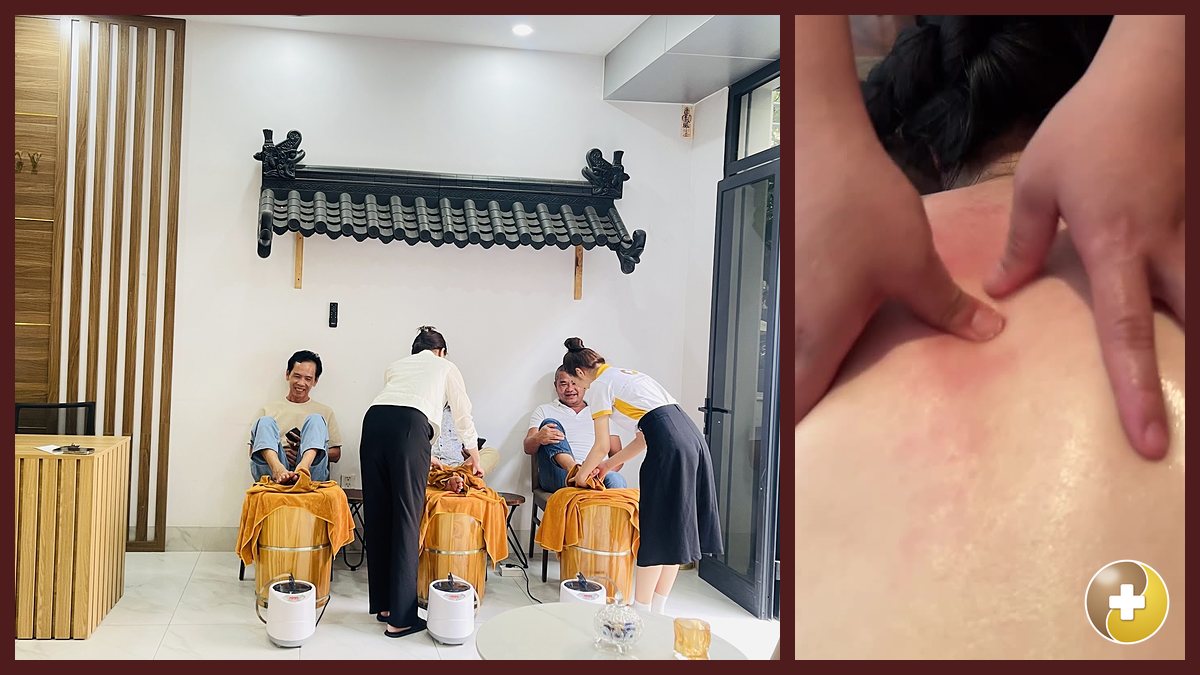
Quick answer: Most back pain comes from overloaded muscles and ligaments after long sitting, lifting or motorbike riding; then discs and nerve roots; less often the kidneys, stomach, lungs or heart. Where it hurts tells you which group. Tong Gia Acupoint Wellness in District 12 and District 9, Ho Chi Minh City, reads the spine by hand.
Want Lương Y Tống Văn Huynh’s team to read your spine and posture in person?
Back pain: one word, many possible causes
Back pain is any ache, stiffness, tightness, sharp pain or burning between the base of the neck and the tailbone. In Western medical terms it is a symptom, not a disease. Your back holds a 33-segment spine, dozens of layers of muscle and ligament, intervertebral discs and the nerve roots that leave the spinal cord on each side. Right in front of it sit the lungs, heart, stomach, pancreas, kidneys and, in women, the uterus. A problem in any of these can be felt in the back. So the honest answer to "what causes back pain?" is: it depends on where it hurts, what kind of pain it is, and what comes with it.
The reassuring part is that most adult back pain is mechanical. Muscles, ligaments and the small joints behind the spine get overloaded by posture, awkward movement or simply too little movement. This pain usually gets worse when you hold one position, eases when you change position or walk around, and settles over days to a few weeks. A smaller group comes from discs and nerve roots; a smaller group still comes from internal organs or conditions that need a prompt medical check.
In Ho Chi Minh City, Tong Gia Acupoint Wellness (Huyệt Đạo Tống Gia) sees back pain every day at both branches, District 12 and District 9. The picture is familiar to many expats: long hours at a laptop in air-conditioned offices in the Saigon Hi-Tech Park or District 1, motorbike commutes on bumpy roads, carrying children, gym sessions squeezed in after work, and long-haul flights home. Each pattern tends to hurt a different part of the back, because the cause is different.
This guide is an overview map. It sorts the causes of back pain into four zones (upper back, mid back, lower back, sacrum and tailbone) and by type of pain, then explains the Vietnamese traditional view of the organs, the spine segments involved, and how a Tong Gia session works.
Common causes, sorted by area and by habit
Use this table to understand your pattern and to describe it clearly when you get checked or talk to a practitioner. It is not a tool for drawing your own conclusions.
| Area | Common mechanical causes | Causes that need a medical check | Who gets it |
|---|---|---|---|
| Upper back, between the shoulder blades (T1–T6) | Rounded posture over phones and low screens; tight trapezius and rhomboids from shrugged shoulders; high pillows | Pain with chest tightness, breathlessness, long-lasting cough, fever; pain spreading to the left arm | Desk workers, students, people under stress |
| Mid back, below the shoulder blades (T7–T12) | Long slumped sitting, twisting to one side, tight spinal erectors in the thoracic segment | Pain with upper-stomach pain, reflux, nausea; one-sided pain with yellow skin or fever; sudden pain in older adults after a hard sit | Long sitters, irregular eaters |
| Lower back, the waist (L1–L5) | Muscle strain and ligament sprain from poor lifting, long sitting, motorbike riding; facet-joint wear | Pain down the leg with numbness or weakness (disc, nerve root); one-sided flank pain with burning urine or blood (kidney, urinary tract) | Drivers, manual workers, new mothers, middle-aged adults |
| Sacrum and tailbone (S1–S5) | Hard chairs, sitting on the floor, sitting on one buttock; tight sacroiliac joints | Pain after a fall on the bottom; severe period pain or unusual bleeding; numbness in the saddle area | Women, long sitters, anyone who has just fallen |
Causes can also be sorted by mechanism: (1) overloaded muscles and ligaments; (2) age-related wear of discs and joints; (3) irritated or compressed nerve roots; (4) internal organs referring pain to the back: kidneys, stomach, pancreas, lungs, uterus; (5) inflammation, infection, fracture or tumour: uncommon, but they need early assessment; (6) stress and short sleep, which keep muscles braced and lower your pain threshold.
Habits that make any back more vulnerable:
- Long sitting and "phone neck": a forward head makes the upper back muscles hold it up all day; a slumped lower back loads the lumbar discs more than standing does.
- Lifting with the back instead of bending the knees, or twisting while carrying.
- Motorbike commuting with hips folded for hours and every pothole travelling up the spine.
- Too little movement: weak abdominal and glute muscles leave the back muscles doing extra work.
- Poor sleep set-up: very soft mattresses, high pillows, hammock naps, sleeping on the stomach.
- Cold and damp: air conditioning blowing on your back, late showers, getting caught in the rain.
- Ongoing stress: raised shoulders, clenched jaw and back muscles braced without you noticing.
Signs worth noting
- One side or both sides: even pain on both sides is often muscular or postural; one-sided pain can be a tight muscle, the sacroiliac joint, or an organ on that side.
- Does position change it? Relief when you move suggests a mechanical cause; pain at night that rest and position changes do not ease needs checking.
- Breathing and eating: a stab in the upper back when you breathe deeply or cough; mid-back pain after meals with reflux or bloating.
- Does it travel? Down the buttock and leg with pins and needles suggests a nerve root; into the arm or chest needs attention to the heart and lungs.
- Urine: burning, frequency, red or cloudy urine, fever with one-sided flank pain.
- Whole-body clues: cold lower back, weak knees, waking at night to urinate, feeling cold; or feeling hot, dry mouth, light sleep; or tight ribs and irritability. Vietnamese traditional wellness reads these as organ clues, explained below.
- Morning stiffness: under 30 minutes and easing is usually muscle and joint; over 30 minutes in a young person for months deserves a check for inflammatory back conditions.
When to see a doctor
If any of the following apply, please see a doctor at a medical facility first and skip massage or acupressure on the back for now:
- Upper or mid back pain with chest pain, breathlessness or sweating, or pain spreading to the jaw or left arm: call 115 (Vietnam emergency) immediately.
- Back pain with severe abdominal pain, a pulsing feeling in the belly, or a sudden tearing pain.
- Numbness in the saddle area, inability to pass urine, or loss of bladder or bowel control: go to emergency.
- Leg weakness, foot drop, tripping, numbness spreading in both legs.
- Pain after a fall, accident or blow, or sudden back pain in older adults with fragile bones.
- Fever or chills with back pain; one-sided flank pain with burning urine or blood.
- Unexplained weight loss, ongoing fatigue, pale skin, or a history of cancer: get checked at a medical facility in parallel, not only external care.
- Night pain that rest does not ease, pain that worsens week by week, or pain lasting more than 4–6 weeks despite rest and posture changes.
- Pregnancy with back pain plus bleeding or cramping.
This is a wellness service, not medical care. If you are already following a doctor's plan, Tong Gia only offers supportive care alongside it.
The Y Tướng Học view: each part of the back reflects an organ
Vietnamese traditional wellness does not see the back as muscle and bone alone. According to the Tong Gia curriculum, the Bladder meridian runs down both sides of the spine and carries the back-shu points of the organs: Lung shu (BL13, 肺俞) below the T3 spinous process, Heart shu (BL15, 心俞) below T5, Liver shu (BL18, 肝俞) in the mid back, Spleen shu (BL20, 脾俞) below T11 and Kidney shu (BL23, 腎俞) below L2, each 1.5 cun out to the side. Each stretch of the back is read as a mirror of its organ:
- Upper back – Lung and Heart: people who cough, breathe shallowly or feel anxious often have tight or raised segments around T3–T5.
- Mid back – Liver and Spleen-Stomach: the Liver governs smooth flow, the tendons and the emotions; stress and frustration tend to tighten the long muscles of the mid back, often with bloating and tight ribs.
- Lower back – Kidney: the Kidney governs the bones; the lower back is called "the house of the Kidney". The curriculum lists lower back ache, weak knees and tiring quickly when standing as signs of reduced Kidney function.
- Sacrum – Kidney and Bladder: heaviness at the base of the back after long sitting.
The core idea of Y Tướng Học (face reading for wellness) is "the signs show outside, the organs lie inside". Lương Y Tống Văn Huynh, master of traditional Vietnamese wellness, uses face shape to choose which part of the back to examine first. A square, fleshy 田-shaped face points to T11–T12; a long, square 同-shaped face to T3; a face with wide cheekbones and a narrow forehead (申) to T7–T9; a face wide at the forehead and narrow at the chin (甲) to the upper neck and a cool, hollow lower back; round (圓) and jowly (由) faces to the lower back and hips; a long, thin face (目) to thin spinal muscles; an uneven face (用) to a spine that tends to tilt. This is a wellness reading to decide where to start, not a medical conclusion and never a judgement of anyone. Most back pain is still muscular, so please don't assume "back pain means weak kidneys".
Spine segments and nerve-reflex zones involved
According to Tong Gia's spinal nerve-reflex balancing curriculum, the 33 vertebrae are grouped by what they serve: neck C1–C7 (head, face, neck, arms); thoracic T1–T12 (circulation, breathing, digestion); lumbar L1–L5 (digestion, kidneys, urinary and reproductive organs, legs); sacrum and coccyx S1–S5 (elimination and the lower pelvis). Nerve roots leave the spinal canal through gaps between the vertebrae, and that is exactly where a practitioner's fingers feel during spine reading.
| Segment | Nerves, functions served | Typical back pain | Related organ (traditional) |
|---|---|---|---|
| T1–T5 | Circulation, breathing; heart, lungs | Ache between the shoulder blades, stab on deep breath | Lung (BL13 at T3), Heart (BL15 at T5) |
| T6–T10 | Upper digestion; liver, gallbladder, stomach | Mid-back pain after long sitting or stress, with bloating | Liver, Gallbladder, Spleen-Stomach |
| T11–T12, L1 | Digestion; thoracolumbar junction | Tired band across the upper waist | Spleen-Stomach (BL20, BL21) |
| L2–L3 | Kidneys, urinary tract, hip flexion | Aching waist, cold lower back, slow to straighten up | Kidney (BL23, Mingmen GV4 at L2) |
| L4–L5, S1 | Legs; roots of the sciatic nerve | Low back pain when bending or lifting; pain into buttock and leg | Kidney (bones), Liver (tendons) |
| S2–S5, coccyx | Elimination, lower pelvis | Heavy base of the back, period-related ache | Kidney – Bladder |
The table describes links for choosing where to work, not medical conclusions. In Western anatomy the kidneys sit behind the abdominal lining between T12 and L3, so kidney pain tends to be higher, one-sided and comes with urinary signs, while muscular pain changes with posture.
The Tong Gia method: spinal nerve-reflex balancing, matched to the cause
The method was built by Lương Y Tống Văn Huynh, founder of Tong Gia, over more than 13 years of practice in traditional Vietnamese wellness, Y Tướng Học and spinal nerve-reflex balancing. Because back pain has many causes, there is no one-size routine. A session follows three ideas: read the face to understand the organs, read the spine by hand to find the zone, then work the right segments and functions.
- Observe and ask: where, since when, what makes it worse, does it travel, your job, how you sit, whether you have had a medical check; then face, ears and standing posture.
- Read the spine by hand: pressing, stroking and rolling to feel skin temperature, the muscle cushion, the shape of each vertebra and your response. Each segment is compared with those above, below and on both sides (the Symmetry principle). Hot, tight, tender areas are the "excited" zones to work.
- Muscle release where the load sits: trapezius and rhomboids for the upper back, thoracic erectors for the mid back, lumbar erectors, quadratus lumborum and glutes for the lower back. Pressure builds through 5 pressure levels (one finger, whole hand, bent arm, straight arm, whole-body weight), focused on excited zones only.
- Acupressure on the right points: the back-shu point of the segment involved, Mingmen (GV4), and Weizhong (BL40, 委中) in the centre of the knee crease, following the saying "for back pain, look to Weizhong". Hot skin is cooled, cold skin warmed; work stops when the skin at the key point turns from dry to slightly moist.
- Home-care advice for your cause: screen height, lifting technique, stretches, and how to rub the Kidney shu area.
A typical session: an accountant around 40 describes pain that "moves around": the upper back in the morning, the waist by late afternoon. A medical check has already found nothing worrying. The practitioner notes a 申-shaped face, the right shoulder higher than the left and the head forward. Spine reading finds a tight, warm band at T7–T9 on the right and a cool, slightly hollow L2. The practitioner releases the mid-back band first with a steady rhythm, then warms the Kidney shu and Mingmen area and finishes on Weizhong. The guest reports soreness at first, then easier breathing and a spreading warmth, and leaves with advice to raise the screen and stand up every 45 minutes.
Suitable services (see the price list):
- Back and waist care, 60 min: 550,000₫ (about US$21); first visit 399,000₫ (about US$15); 90 min: 750,000₫ (about US$29). Suits most posture, sitting, riding and lifting pain.
- Traditional Eastern massage, 90 min: 550,000₫ (about US$21) for pain in both the upper and lower back.
- Kidney wellness care, 75 min: 750,000₫ (about US$29) for a cold lower back, weak knees and night-time urination.
What you feel: tight points along the back feel sore but pleasant, often with spreading warmth and drowsiness near the end. Afterwards most guests say the back feels lighter, bending and turning are easier and sleep is deeper; a few feel mild muscle tiredness the next day, like after light exercise. Long-standing pain usually needs a few sessions 5–7 days apart plus habit changes. Tong Gia supports balance; it does not promise the pain will go away. Read more in back massage in Saigon: questions answered, what a back massage session feels like and Eastern face reading for wellness.
Want Lương Y Tống Văn Huynh’s team to read your spine and posture in person?
Self-care at home and prevention, by cause
- Posture pain: screen at eye level, sit back in the chair with a small cushion behind the waist, stand and walk every 30–45 minutes.
- Lifting pain: bend the knees, keep loads close, never twist while carrying; 10–15 minutes of gentle stretches daily, stopping if pain or leg numbness increases.
- Cold-related pain: keep air conditioning off your back; the Tong Gia curriculum suggests rubbing your palms warm, placing them on both sides of the lower back and rubbing up and down 50–100 times until warm; soak your feet in warm water for 15–20 minutes before bed.
- Stress pain: a few minutes of slow belly breathing every hour, drop the shoulders, sleep before 11 pm.
- Keep moving with muscular pain; total bed rest usually weakens the muscles. If any warning sign above applies, see a doctor first. For acupressure basics, see acupressure massage in Saigon.
Booking
Tong Gia has two branches in Ho Chi Minh City, open every day, with genuine guest reviews on Google Maps:
- District 12: 225 Dương Thị Mười, Phường Tân Chánh Hiệp (Tan Chanh Hiep Ward). Open 8:00–19:00 daily.
- Vinhomes Grand Park, District 9: Căn T16-21 khu Manhattan, Phường Long Bình, TP. Thủ Đức (Unit T16-21, Manhattan zone, Long Binh Ward, Thu Duc City). Open 9:00–20:00 daily.
Book online or call, Zalo or WhatsApp +84 888 264 559. Tell us where it hurts, for how long, whether it travels and whether you have had a medical check, so we can suggest 60 or 90 minutes. Staff can help in simple English; a translation app works well for details.
Visit us
- Đông Y Huyệt Đạo Tống Gia Quận 12 (District 12)
225 Dương Thị Mười, Phường Tân Chánh Hiệp, Quận 12, HCMC · 8:00–19:00 daily · 0888 264 559 · Directions on Google Maps - Đông Y Huyệt Đạo Tống Gia Quận 9 (Vinhomes Grand Park, District 9)
Căn T16-21 khu Manhattan, Vinhomes Grand Park, Phường Long Bình, TP. Thủ Đức, HCMC · 9:00–20:00 daily · 0888 264 559 · Directions on Google Maps
Want Lương Y Tống Văn Huynh’s team to read your spine and posture in person?
FAQ
What are the most common causes of back pain? Most back pain comes from overloaded muscles and ligaments: long sitting, phone posture, poor lifting, motorbike commuting and too little movement. Next come disc and joint wear and irritated nerve roots. Less often the pain comes from the kidneys, stomach, lungs, heart or pelvis, or from inflammation or fracture.
How do I know if my back pain is from my kidneys? Kidney pain is usually one-sided, higher up at the flank, and comes with burning urine, blood in the urine or fever. Pain that changes with posture is usually muscular. If you suspect the kidneys, see a doctor and get tested.
Why do I get pain between my shoulder blades at work? A forward head over a laptop or phone, a low screen and shrugged shoulders keep the trapezius and rhomboids working all day. If the pain comes with chest pain, breathlessness or sweating, call 115 immediately.
How long should back pain last before I see a doctor? Muscular pain usually settles in days to a few weeks. Pain lasting over 4–6 weeks, night pain, worsening pain, fever, weight loss or leg weakness all mean you should get checked.
Can massage help every kind of back pain? No. Muscle release suits posture, strain, cold and stress-related pain. Kidney problems, infection, fracture or severe disc problems need a medical check first. This is a wellness service, not medical care.
Is a first visit at Tong Gia suitable for tourists? Yes. The first back and waist session is 399,000₫ (about US$15) for 60 minutes. Book by WhatsApp +84 888 264 559 and mention where the pain is and any recent flights or long rides.
Author: Lương Y Tống Văn Huynh – founder of Huyệt Đạo Tống Gia, a master of traditional Vietnamese wellness with over 13 years in Eastern wellness care, Y Tướng Học (face reading) and spinal nerve-reflex balancing massage.
Updated: 2026-11-16
Related guides
- Acupressure for back pain: what it can do, which points are used and when to skip it
- Back acupoints: where they sit along the spine, what they relate to and how to press them safely
- Should I get a massage for back pain? When it helps, when to wait and when to get checked first
- Pain between the shoulder blades: why this strip of the back burns, three types to tell apart, and how Tong Gia cares for it in Ho Chi Minh City
- Back pain from sitting too long: why your lower back tires and how to care for it
- What causes back pain? A map of four areas, warning signs and Vietnamese spinal nerve-reflex care
This is a wellness service, not medical care.