
Pain between the shoulder blades: why this strip of the back burns, three types to tell apart, and how Tong Gia cares for it in Ho Chi Minh City
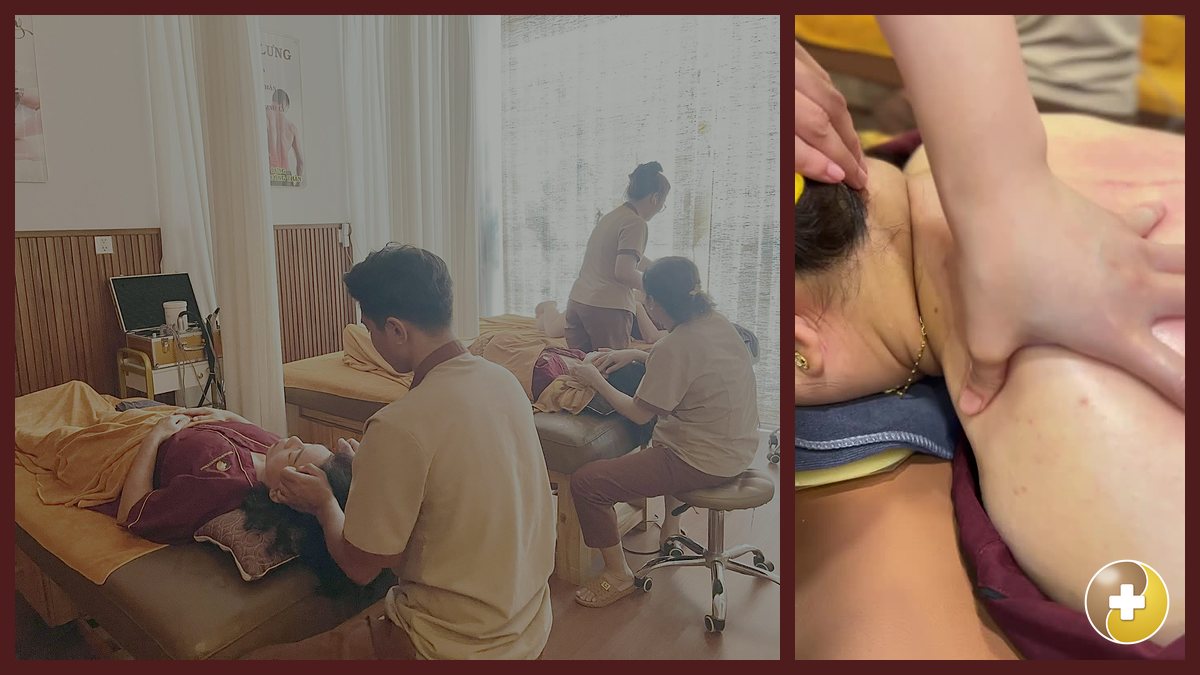
Quick answer: Pain between the shoulder blades is usually overstretched rhomboid and middle trapezius muscles from slumped laptop and phone posture; less often the neck, a rib joint, stomach or heart. Pain going through to the chest, breathlessness or cold sweats means call 115. Tong Gia Acupoint Wellness in District 12 and District 9 releases this area by hand.
Want Lương Y Tống Văn Huynh’s team to read your spine and posture in person?
What is pain between the shoulder blades, and who gets it?
Pain between the shoulder blades is an ache, burn, sharp catch or "knot" in the narrow strip of back between your spine and the inner edges of both shoulder blades, roughly from the level of the second thoracic vertebra down to the lower tip of the shoulder blade (around T7). People describe it as "a brick sitting in the middle of my back" or "I just want someone to press right there". In Western terms it is a symptom, not a disease name: what it means depends on how it feels, when it comes and what comes with it.
Anatomically there are three layers. On the surface is the middle part of the trapezius. Under it lie the rhomboids, which run from the spine (C7 to T5) diagonally down to the inner border of each shoulder blade and pull the blades together. Deeper still are the spinal erector muscles and the small joints where each rib meets the spine. When your shoulders roll forward over a laptop, the shoulder blades slide away from the spine and the rhomboids are held on stretch for hours. That is why this strip tires early and stays sore.
What makes this area different from the lower back is that it sits right behind the heart, lungs, oesophagus and stomach. Most cases are muscular, but a few are pain referred from inside. Knowing the difference lets you relax about the common kind and act fast on the rare kind.
Among expats and visitors in Ho Chi Minh City, Tong Gia often sees this pain in:
- Remote workers and digital nomads working from café tables, sofas and hotel desks with the laptop far too low.
- Office and tech staff in District 1, Thủ Đức and the Hi-Tech Park, eight to ten hours at a screen.
- Long-haul travellers after overnight flights and bus rides with the head slumped forward.
- Motorbike riders and Grab users who spend long rides with arms forward and shoulders braced.
- New parents feeding and carrying a baby, often on little sleep.
- People under stress who breathe shallowly into the upper chest and shrug without noticing.
Common causes: habits, work, posture and environment
It helps to sort pain between the shoulder blades into three types. Use this table to check yourself before reading on:
| Type | How it feels | Usual causes (Western view) | What to do |
|---|---|---|---|
| 1. Burning ache along the strip | Warm, heavy, burning; worse in the afternoon; eases when you arch back or someone presses it | Overstretched rhomboids and middle trapezius from rounded shoulders; tight knots in the muscle | Fix your set-up, stretch, have the area released |
| 2. Sharp spot beside the spine | Feels "stuck", one point only; worse when twisting, breathing deeply, coughing | Rib–spine joint or intercostal muscle strain after lifting or sleeping awkwardly | Rest, gentle movement; get checked if it lasts or comes with fever or breathlessness |
| 3. Deep pain through to the chest, or spreading | Deep, dull, unchanged by position; or spreading to the arm, chest or upper belly | Lower neck nerve roots (C6–C7); stomach or reflux; gallbladder (under the right blade); heart or aorta | Get checked; heart signs mean call 115 |
Type 1 is by far the most common. Muscles held long for hours get less blood flow and form tender knots that refer a burning feeling around them. Things that make it worse in Saigon life:
- Low screens and stools without backrests at cafés and co-working spaces.
- Mouse and keyboard too far away, so the mouse-side shoulder blade is pulled outwards; many people burn more on the right.
- Scrolling in bed with a pillow propping the head, chin tucked to chest.
- Air-con blowing straight onto your back, especially after a late shower with wet hair.
- Shallow chest breathing under deadlines, which makes the upper-back muscles help with every breath.
- Lots of chest and pressing work at the gym with little back work, so the chest pulls the shoulders forward.
Signs worth noting
- Changes with position: arching, rolling the shoulders or pressing the spot makes it better or worse. This points to muscle or joint, the easiest group to care for.
- Hurts on deep breaths, coughs or sneezes: often a rib joint or intercostal muscle; with fever, coughing up phlegm or breathlessness, get checked.
- Tingling down the arm or into the fingers: suggests a lower neck nerve root; the pain starts at the nape and spreads down between the blades.
- Linked to meals: worse after a big meal or when hungry, with sour burps or burning behind the breastbone.
- Mainly on the left with chest tightness or breathlessness on stairs: think heart first.
- Whole-body signs: frequent sighing and shallow breathing; or palpitations and broken sleep; or irritability, tired eyes and a tight neck. The Eastern wellness tradition reads these as Lung, Heart and Liver signs (see below).
When to see a doctor
Because this area sits behind vital organs, some situations need medical care, not massage. Please see a doctor or call emergency services if you have:
- Chest pain or pressure spreading to the back between the shoulder blades, the left shoulder, arm or jaw; shortness of breath; cold sweats; nausea: call 115 now. In women, older adults and people with diabetes, a heart attack may show up mainly as upper back pain, tiredness and breathlessness.
- Sudden, severe tearing pain between the shoulder blades, especially with high blood pressure: call 115 now.
- Sudden breathlessness, coughing up blood, or fever with a lingering cough.
- Pain after a fall or impact, or sudden sharp pain in someone older or with weak bones.
- Numbness or weakness in the arms or legs, unsteady walking, bladder changes.
- Pain under the right shoulder blade with yellowing skin or fever after a fatty meal.
- A burning band on one side followed by a blistering rash a few days later.
- Unexplained weight loss, night sweats or pain at night that rest does not ease: please get checked at a medical facility alongside any wellness care.
This is a wellness service, not medical care. If you are already following medical advice, keep doing so; Tong Gia only offers supportive care once the warning signs above have been ruled out.
The Y Tướng Học view: which organs, and what the signs look like
According to the Tong Gia curriculum, a line of "back transport points" named after the organs runs 1.5 cun (body-inches) either side of the spine. The strip between the shoulder blades holds three in a row: Lung Shu (BL13, 肺俞) at T3, Jueyin Shu (BL14, 厥阴俞) for the pericardium at T4, and Heart Shu (BL15, 心俞) at T5. At the lower tip of the shoulder blade sits Diaphragm Shu (BL17, 膈俞) at T7. The distance from the midline to the inner edge of the shoulder blade is taken as 3 cun. In other words, the spot that burns is the back door of the three organs inside the chest.
- Lung governs qi and breathing and shows in the nose, skin and breath. Signals: dry skin, a blocked nose, shallow breathing, frequent sighing; its emotion is sadness.
- Heart governs the blood vessels and houses the spirit, showing in the tongue and complexion. Signals: a pale or flushed face, poor sleep, palpitations; its emotions are too much excitement or worry. The curriculum describes Jueyin Shu as opening the chest and Heart Shu as calming the spirit.
- Liver stores blood, keeps qi flowing and governs the sinews. Signals: dry, tired eyes, irritability, a tight neck and shoulders, cramps. People who "carry everything on their shoulders" and swallow their frustration often tighten this strip from the nape down.
Y Tướng Học (face reading for wellness) has a guiding line: "the signs show outside, the organs lie inside". It has roots going back more than 2,000 years; Lương Y Tống Văn Huynh, a master of traditional Vietnamese wellness, has systematised it for organ-based care. In the curriculum's ten face types, these are the ones whose upper back needs a careful look:
- Đồng (同) face: long but square, firm bone and flesh, Lung-dominant. The back tends to tighten or show a raised vertebra around T3, affecting breathing. Advice: keep breathing deep, keep the neck and chest warm when the weather turns.
- Mục (目) face: long, narrow and lean, with weak qi and blood. The muscles along the spine are thin and vertebrae may sit low; only gentle tonifying techniques such as vibration are used.
- Vương (王) face: bony, high cheekbones, skin close to bone. Vertebrae may twist; muscles turn fibrous and cling to the joints, so plucking and deep pushing are used to free them.
- Dụng (用) face: uneven, one side larger than the other. The spinal axis leans, one side tight and one side slack, which explains pain on just one shoulder blade; both sides are balanced together.
These observations are a school's reference knowledge to decide where to start, not a medical judgement and never a way to label anyone.
Spine segments and nerve-reflex zones involved
In Tong Gia's spinal nerve-reflex balancing method, the neck (C1–C7) relates to the head, face, neck and arms, and the thoracic spine (T1–T12) to circulation, breathing and digestion. Nerve roots leave between the vertebrae, exactly where the fingertips search when reading the spine.
| Segment | Nerves and functions | Typical feeling between the blades | Related organ |
|---|---|---|---|
| C6–C7 into T1 | Lower neck roots; shoulders, arms | Pain from the nape down between the blades, tingling fingers | Liver (governs sinews) |
| T1–T3 | Upper thoracic roots; breathing; zone combined for stress and poor sleep | Tight base of neck, burning at the top of the strip, shallow breathing | Lung (BL13 at T3) |
| T4–T5 | Thoracic roots; circulation | Burning right in the middle, with palpitations or light sleep | Pericardium, Heart (BL14, BL15) |
| T6–T7 | Mid-thoracic roots; upper digestion | Ache at the lower tip of the blades, fullness after meals | BL17 at T7; links to Liver and Stomach at T7–T9 |
The table speaks only of "related" zones to choose where to work. When reading the back, practitioners check four objective factors: skin temperature (warmer means an overactive zone, cooler an underactive one), the muscle layer (knotted, hard, slack or fibrous), the shape of each vertebra (raised, raised-and-shifted, shifted, sunken-and-shifted, sunken) and the sensation at the point.
The Tong Gia method: spinal nerve-reflex balancing massage
The method was built by Lương Y Tống Văn Huynh, founder of Tong Gia Acupoint Wellness (Huyệt Đạo Tống Gia), from over 13 years of practice in Eastern wellness, Y Tướng Học and spinal nerve-reflex balancing. It is a Vietnamese traditional approach: no needles, no ingested or injected chemicals, no rough force. A session for the strip between the shoulder blades runs like this:
- Observe and ask: which of the three types, which side, when, any tingling, any link to meals or breathing, have you been checked; then the face, shoulder posture and breathing pattern. Any heart or lung warning sign and the session stops with advice to get medical care first.
- Read the spine by hand: press-and-lift to feel skin heat, stroke along the spinal groove and the inner edge of the blades, probe and roll each vertebra from C6 to T7, comparing left and right, upper and lower.
- Muscle release: middle trapezius, rhomboids, thoracic erectors and the inner border of the blades. Work focuses on the overactive zones only (warm skin, hard muscle, sharper tenderness), never pressing straight into the underactive ones. Pressure builds through 5 pressure levels; plucking cuts across fibrous bands, vibration suits thin or tired muscles.
- Acupressure in the right zone: BL13, BL14 and BL15 on both sides of T3–T5, plus the nape for stressed guests. Work stops when the skin over the key point turns from dry to slightly moist; warm skin is cooled, cool skin is warmed.
- Self-care coaching: screen height, shoulder-blade squeezes, belly breathing, keeping the back warm.
A typical session: a common guest is a remote worker in their thirties who has spent weeks on a laptop at café tables and describes a burning patch between the blades by late afternoon, a little worse on the mouse side, and shallow breathing; a check-up has already ruled out heart and lung problems. The practitioner notices rounded shoulders, a forward head and breathing high in the chest. Reading the spine, the right rhomboid feels like a warm, ropey band from T3 to T6. The practitioner releases that band first with plucking, then works BL13 and BL15 on both sides and finishes with slow belly breaths lying face up. Guests usually say the pressure feels "sore but good", the shoulders drop and a deeper breath comes easily.
Suitable services (see the price list):
- Neck and shoulder care, 60 minutes: 550,000 VND (about 21 USD), first visit 399,000 VND (about 15 USD); 90 minutes: 750,000 VND (about 29 USD). Fits most screen-related pain between the blades. More in neck and shoulder massage in Saigon.
- Warming cupping, 30 minutes: 85,000 VND (about 3.3 USD), an add-on for a back stiffened by air-con or rain; see cupping in Saigon.
- Heart wellness care, 75 minutes: 750,000 VND (about 29 USD), for burning at T4–T5 with palpitations, light sleep or worry, once a check-up has shown the heart is fine.
What guests feel: during the session the knots ache in a pleasant way; the curriculum calls this creating a "sensation wave" so the muscle contracts, lets go and the body rebalances itself. Afterwards most people report easier neck turns, a warm upper back and deeper sleep that night; a few feel mild muscle soreness the next day. Tong Gia supports and helps rebalance; it does not promise the pain will be gone. For more on the back services, read back massage in Saigon, and for face reading see Eastern face reading for wellness.
Want Lương Y Tống Văn Huynh’s team to read your spine and posture in person?
Self-care at home and prevention
- Raise the screen to eye level: a laptop stand plus a separate keyboard and mouse kept close, elbows by your sides. In a café, stack a few books under the laptop.
- Shoulder-blade squeeze every hour: sit tall, drop the shoulders, draw the blades back and together as if holding a pen between them, hold 5 seconds, repeat 10 times.
- Doorway chest stretch: forearms on each side of a door frame, step one foot forward until the chest stretches gently, hold 20–30 seconds.
- Five minutes of belly breathing before bed: one hand on the belly, breathe in slowly through the nose so the belly rises, breathe out longer than in.
- Keep the upper back warm: angle the air-con away from your back, dry your hair before lying down, wear a light jacket on night rides.
Booking
Tong Gia has two branches in Ho Chi Minh City, open every day, with genuine guest reviews on Google Maps:
- District 12: 225 Dương Thị Mười, Phường Tân Chánh Hiệp (Tân Chánh Hiệp Ward, District 12). Open 8:00–19:00 daily.
- Vinhomes Grand Park, District 9: Căn T16-21 khu Manhattan, Phường Long Bình, TP. Thủ Đức (unit T16-21, Manhattan block, Long Bình Ward, Thủ Đức City). Open 9:00–20:00 daily.
Book online or call, Zalo or WhatsApp +84 888 264 559. When booking, mention which type of pain you have, which side, any tingling and whether you have been checked, so the team can suggest the right session.
Visit us
- Đông Y Huyệt Đạo Tống Gia Quận 12 (District 12)
225 Dương Thị Mười, Phường Tân Chánh Hiệp, Quận 12, HCMC · 8:00–19:00 daily · 0888 264 559 · Directions on Google Maps - Đông Y Huyệt Đạo Tống Gia Quận 9 (Vinhomes Grand Park, District 9)
Căn T16-21 khu Manhattan, Vinhomes Grand Park, Phường Long Bình, TP. Thủ Đức, HCMC · 9:00–20:00 daily · 0888 264 559 · Directions on Google Maps
Want Lương Y Tống Văn Huynh’s team to read your spine and posture in person?
FAQ
What causes pain between the shoulder blades? Most often overstretched rhomboid and middle trapezius muscles from rounded shoulders over a laptop or phone, or air-con on the back. Less often the neck, a rib joint, the stomach, the gallbladder or the heart. Pain going through to the chest with breathlessness or cold sweats means call 115.
Is pain between my shoulder blades serious? Usually not, if it changes with position and eases when you arch back or press the spot. Get checked if it is deep and unchanged by movement, wakes you at night, or comes with fever, weight loss, chest pressure or breathlessness.
Why does the area between my shoulder blades burn after working on a laptop? Rounded shoulders slide the blades away from the spine and keep the rhomboids on stretch for hours. Stretched muscles get less blood flow and form tender knots that feel warm and burning, often worse on the mouse side.
Can massage help pain between the shoulder blades? For muscular pain, releasing the rhomboids and trapezius in the right zone usually softens the strip, lets the shoulders drop and makes breathing easier. Tong Gia only works once heart and lung warning signs are ruled out.
How much is a neck and upper back session at Tong Gia? Neck and shoulder care is 550,000 VND (about 21 USD) for 60 minutes, 399,000 VND (about 15 USD) on your first visit, and 750,000 VND (about 29 USD) for 90 minutes. Warming cupping can be added for 85,000 VND.
How do I book a session as a visitor in Ho Chi Minh City? Book online at /dat-lich or message +84 888 264 559 on Zalo or WhatsApp. Write which side hurts, any tingling and whether you have been checked, and the team will suggest a session at the District 12 branch or the Vinhomes Grand Park branch in District 9.
Author: Lương Y Tống Văn Huynh – founder of Huyệt Đạo Tống Gia, a master of traditional Vietnamese wellness with over 13 years in Eastern wellness care, Y Tướng Học (face reading) and spinal nerve-reflex balancing massage.
Updated: 2026-11-16
Related guides
- Acupressure for back pain: what it can do, which points are used and when to skip it
- Back acupoints: where they sit along the spine, what they relate to and how to press them safely
- Should I get a massage for back pain? When it helps, when to wait and when to get checked first
- Pain between the shoulder blades: why this strip of the back burns, three types to tell apart, and how Tong Gia cares for it in Ho Chi Minh City
- Back pain from sitting too long: why your lower back tires and how to care for it
- What causes back pain? A map of four areas, warning signs and Vietnamese spinal nerve-reflex care
This is a wellness service, not medical care.