
Lower back pain with tired, weak knees: common causes, when to get checked, and how Tong Gia cares for the back and legs in Ho Chi Minh City
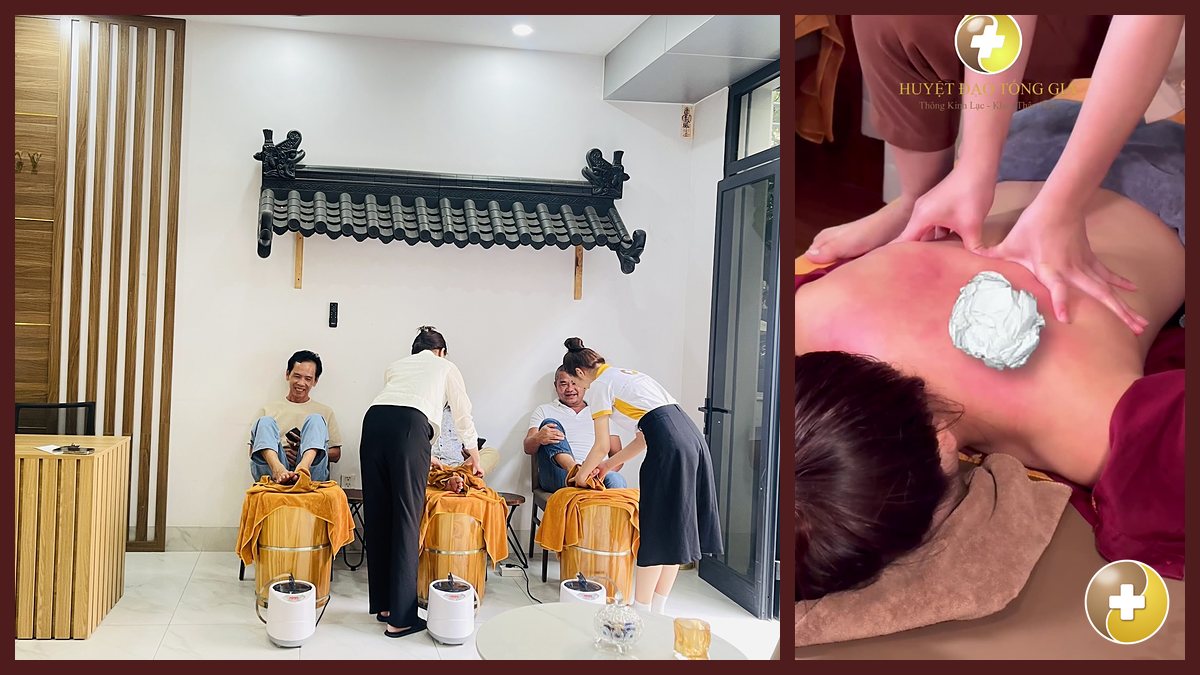
Quick answer: A sore lower back with weak knees is a symptom pattern, not a disease, usually from muscles overloaded by long sitting or standing, joint wear and low activity. Eastern medicine reads it through the Kidney and Liver. Swollen knees, leg numbness or blood in the urine need a check-up first. Tong Gia in District 12 and District 9, Ho Chi Minh City, cares for back and legs together.
Want Lương Y Tống Văn Huynh’s team to read your spine and posture in person?
Back pain with weak knees: what it is in Western terms, and who gets it
Many people describe the same complaint in slightly different words: a dull ache across the lower back, knees that feel tired or "hollow" after standing, stairs that suddenly seem steeper by late afternoon. In Western medicine this is a pattern of symptoms, not one specific disease. The lower back and the knees are separate regions, but they sit on one load-bearing chain: lumbar spine, pelvis, hips, thighs, knees. When one link weakens or works at a poor angle, the next link takes over the load, so the two areas often tire together.
From a Western anatomy point of view, nerve roots that leave the lumbar spine also supply the thigh muscles and the skin around the knee. That is why some people think they have "knee trouble" when the source is partly in the lower back, and others feel "back pain" that is really a gait change from weak knees. For this reason Tong Gia does not stop at the sore spot; the practitioner reads the lumbar spine and the legs as one system.
In Ho Chi Minh City we see this pattern most in:
- People who stand for work: shop and market staff, supermarket cashiers, factory workers in Tan Binh, Tan Thoi Hiep and the Saigon Hi-Tech Park. By the end of the afternoon shift, back and knees both feel heavy.
- Office workers sitting 8–10 hours a day: the glutes and thighs do little work and slowly weaken, so the lower back has to brace instead.
- Long-distance motorbike riders and ride-hailing drivers: hips and knees stay bent for hours, and road vibration travels up into the lumbar spine.
- Adults over 45: discs, knee cartilage and muscle mass all thin gradually with age.
- Women after childbirth or around menopause: lifting a baby, weaker core muscles and, in Western terms, a period when bones tend to lose density.
Common causes: six groups
The table groups the usual causes so you can describe your situation more clearly at a check-up or to our practitioner. It is not a tool to label yourself.
| Cause group | Typical feeling | Often seen in | Sensible next step |
|---|---|---|---|
| 1. Muscle fatigue from posture, long sitting or standing | Waist and knees ache by evening, better after a night's rest | Office staff, factory and retail workers | Change position often, light movement, muscle-release care |
| 2. Weak glutes and thighs, poor movement chain | Knees wobble on stairs, unstable on one leg, back tires on long walks | Inactive people, recent weight gain | Strength work for thighs and hips, posture correction |
| 3. Wear in the lumbar spine and knee joints | Morning stiffness, clicking knees, aching after standing | Middle-aged adults, long-term manual workers | Get checked to know the degree; keep moving, keep warm |
| 4. Irritated lumbar nerve roots | Pain from the back into the buttock or thigh, with numbness or tingling | Ages 30–55, heavy lifting, long sitting | Get checked first; massage only once cleared |
| 5. Extra weight, low activity, thinning bones | Back and knees ache together on long walks; legs tired by evening | Older adults, women after menopause | Bone density check if at risk; weight control, regular exercise |
| 6. Whole-body causes | Lasting ache with fatigue, pallor, swollen legs, urinary changes, weight loss | People with blood, thyroid, blood-sugar or kidney conditions | Medical check-up with blood and urine tests |
Daily habits also make the back and knees tire faster: slumping, sitting on the floor or squatting for long periods, standing with weight on one leg, thin-soled or high-heeled shoes all day, air-conditioning blowing on the waist and legs, sudden weekend sport after a sedentary week, and short or late sleep.
Signs worth noting
- Timing: worse late in the day (usually muscle overload); morning stiffness under 30 minutes that loosens up (often muscle or joint); pain at night that rest does not ease (needs a check-up).
- Location: a band across both sides of the waist, the front of the knee on stairs, the back of the knee after standing. Sharp one-sided flank pain that comes in waves is a different story and needs a medical check-up.
- Feeling cold: a cold back and knees, craving warmth, disliking air-conditioning. In the Tong Gia curriculum this is a typical feature of Kidney yang deficiency in Eastern terms.
- Feeling hot: warm palms and soles in the evening, night sweats, dry mouth, dream-filled sleep: the Kidney yin deficiency direction in Eastern terms.
- Signs beyond back and knees that Eastern medicine reads together: ringing ears, dry or thinning hair, forgetfulness, waking at night to urinate, low energy in the afternoon.
- At the knee: swelling, heat, redness, locking, or the knee giving way. Nerve signs: numbness, pins and needles, one weak leg.
A single sign proves nothing. As the curriculum notes, whether the kidneys are actually weak is a question for urine tests and creatinine–eGFR in Western medicine; "Kidney yin" and "Kidney yang" are Eastern functional ideas, not Western kidney disease.
When to see a doctor
Please see a doctor at a medical facility first, and skip massage or acupressure on the back and knees, if you have any of these:
- A swollen, hot or red knee, fluid on the knee, or pain after a fall or sports injury.
- Numbness or weakness spreading into the legs; numbness in the saddle area, trouble passing urine or loss of bladder control: go to the emergency department now.
- Blood in the urine, tea-coloured or very foamy urine, or colicky flank pain spreading to the lower belly.
- Fever or chills with back pain and burning urine.
- Swelling of the face or legs, very little urine, or blood pressure that is hard to control.
- Lasting fatigue, pallor or unexplained weight loss: get checked alongside any wellness care.
- Back pain with chest tightness, shortness of breath or cold sweats: call 115 immediately.
People with high blood pressure, diabetes, those over 60 or with kidney disease in the family should have regular urine and kidney-function tests. This is a wellness service, not medical care. If you already follow a doctor's plan, keep to it; Tong Gia only offers supportive care alongside it.
The Y Tướng Học view: Kidney governs bones, Liver governs sinews
In the Tong Gia curriculum, Eastern medicine regards the Kidney as the "root of the constitution", and the Kidney governs the bones and produces marrow. When this function weakens, the curriculum lists exactly this picture: weary back and knees, loose teeth, forgetfulness; and under signs of declining Kidney function: an aching lumbar area, tired and weak knees, tiring fast when standing. The Liver governs the sinews: a balanced Liver keeps tendons supple and joints flexible; a weak one shows as stiffness and cramps. So for back-and-knee fatigue, the Eastern reading usually starts with the Kidney (bones, lower back) and then the Liver (tendons around the knee).
| Eastern direction | What people usually report | Care direction in the curriculum |
|---|---|---|
| Kidney yang deficiency ("not enough fire to warm") | Feeling cold, cold hands and feet, cold weary back and knees, frequent clear urine, night urination, tiredness | Keep the back, belly and feet warm; warm foot soaks |
| Kidney yin deficiency ("not enough water to cool") | Warm palms and soles, evening flushes, night sweats, poor sleep, weary back and knees, ringing ears | Sleep early, avoid late nights and very spicy food |
Y Tướng Học (Vietnamese face-and-body reading for wellness) rests on one line: "the signs show outside, the organs lie inside." It has roots of more than 2,000 years, and Lương Y (master of traditional Vietnamese wellness) Tống Văn Huynh organised it for everyday care at Tong Gia. The Kidney shows in the ears, hair, bones and lower back. Notes from the curriculum relevant here: thick, well-formed, pinkish ears suggest strong Kidney qi; thin, soft ear rims with a flat bone behind the ear are linked to Kidney qi or yang deficiency with weary back and knees, cold, night urination and ringing ears; a flat back of the head carries a similar note; a round "Viên" face of the pure-Water type tends to a cold lower back with soft lumbar muscles. These signs only help the practitioner choose where to read the spine more carefully; they are not used to name a disease or judge anyone. You can read more in our Eastern face reading Q&A.
Spine segments and nerve-reflex zones involved
In the Tong Gia curriculum on spinal nerve-reflex balancing, the lumbar segments L1–L5 relate to digestion, kidneys, urinary and reproductive function and the legs; the sacrum S1–S5 relates to elimination and the lower pelvis. For muscle, bone and joint complaints the curriculum combines C5–C7, L1–L5 and S1–S5.
| Segment / zone | Nerves and function | Typical back-and-knee feeling | Related organ system |
|---|---|---|---|
| D10–D12 | Lower thoracic; digestion, transition to the lumbar area | Ache at the upper waist, with bloating | Spleen–Stomach |
| L1–L3 | Kidneys, urinary tract; the kidneys lie at about T12–L3 | Band of ache, cold back, hard to straighten after sitting | Kidney (Shenshu, Mingmen, Zhishi at L2 level) |
| L3–L5 | Legs: thigh, knee, lower leg | Tired front of the thigh, weak knees on stairs | Kidney (bones) and Liver (sinews) |
| L5–S1 | Roots running into the buttock and back of the leg | Tight back of the knee and thigh, sometimes numbness | Liver, Kidney; Bladder meridian |
| S1–S5 | Elimination, lower pelvis | Heavy base of the spine after sitting | Kidney–Bladder pair |
The Bladder meridian runs down both sides of the spine to the back of the knee (point Weizhong); the Kidney meridian runs up the inner leg past Taixi at the inner ankle. That is why back-and-knee care at Tong Gia covers both the back and the legs. The table shows related zones for planning care, not a way to name a disease.
The Tong Gia method for back pain with weak knees
The method was built by Lương Y Tống Văn Huynh, founder of Tong Gia, over more than 13 years in Vietnamese traditional wellness, face reading and spinal nerve-reflex balancing. Three steps: read the face to understand the organs, read the spine by hand to find the zone, then care for each segment and function. A session includes:
- Questions and observation: how long, when it gets worse, numbness, knee swelling, standing or sitting job, check-ups so far; pregnancy, kidney conditions, blood pressure, diabetes; ears, posture, hip level, how the feet land.
- Reading the spine by hand: gliding, pressing and rolling to feel skin temperature, the muscle layer, the shape of each vertebra and your response, from D10 down to S1, comparing left and right.
- Muscle release: along the Bladder meridian beside the spine, the lumbar and buttock muscles, then the back of the thigh, knee and calf, building pressure gradually through five levels and focusing on overactive zones.
- Acupressure on the right points: Shenshu (BL23), Mingmen (GV4) and Zhishi (BL52) at the L2 level; Weizhong (BL40) behind the knee for back pain; Taixi (KI3) and Fuliu (KI7) near the inner ankle. Warm skin is cooled, cool skin is warmed; work stops when the skin over the key point turns from dry to slightly moist.
- Home-care guidance: rubbing the lower back, pressing Taixi, foot soaks, thigh and hip strengthening, standing posture at work.
A typical session: the guest is often over 45 with a standing job, saying that for a year every afternoon brings a heavy waist and tired knees, stairs need the handrail, and she wakes once or twice at night to urinate and feels cold under the air-conditioner. A knee check-up showed mild wear needing no intervention. The practitioner notices thin, pale ear rims; on the spine, the L2 area is cool and slightly hollow, the lumbar muscles are soft, but the left side at L4–L5 is firmer, and both knee pits are tight. Work starts by warming Mingmen and Shenshu gently, then releasing the left lumbar side, the knee pits and calves, finishing with Taixi on both sides. The guest says the back "warmed up like a hot pack" and dozes off in the second half; afterwards a few steps feel lighter on the knees.
Suitable services (single-visit prices, see the price list):
- Back and waist care, 60 min: 550,000 VND (about 21 USD); first visit 399,000 VND (about 15 USD); 90 min: 750,000 VND (about 29 USD).
- Kidney wellness session, 75 min: 750,000 VND (about 29 USD) for long-standing weary back and knees with a cold back, night urination and afternoon fatigue.
- Tired, heavy legs care, 60 min: 500,000 VND (about 19 USD) when knees and calves are the main complaint.
What guests feel: firm spots along the waist and behind the knees feel tender but pleasant, and many notice warmth spreading from the waist down the legs. Afterwards most describe a lighter back, steadier steps and deeper sleep; a few feel mild muscle tiredness the next day. Long-standing cases usually need several sessions 5–7 days apart plus habit changes. We support and rebalance; we do not promise the ache will vanish. See also our back massage Q&A, a back massage session story and the acupressure massage Q&A.
Want Lương Y Tống Văn Huynh’s team to read your spine and posture in person?
Self-care at home and prevention
- Rub the lower back each evening: warm your palms, place them on both sides of the waist and rub up and down 50–100 times until warm.
- Press Taixi, the hollow between the inner ankle bone and the Achilles tendon, 1–2 minutes each side with gentle pressure.
- Warm foot soak for 15–20 minutes at about 38–42°C before bed; people with diabetes should test the temperature carefully.
- Strengthen thighs and glutes: slow sit-to-stand from a chair, lying hip bridges, regular walking.
- Sleep before 11 pm, keep the back, belly and feet warm, eat less salt, drink enough water and do not hold in urine.
Booking
Tong Gia has two branches in Ho Chi Minh City, open daily, with real reviews on Google Maps:
- District 12: 225 Dương Thị Mười, Phường Tân Chánh Hiệp (Tan Chanh Hiep Ward, District 12). Open 8:00–19:00 daily.
- District 9 – Vinhomes Grand Park: Căn T16-21 khu Manhattan, Phường Long Bình, TP. Thủ Đức (unit T16-21, Manhattan zone, Long Binh Ward, Thu Duc City). Open 9:00–20:00 daily.
Call, Zalo or WhatsApp +84 888 264 559, or book online. If you live in or are visiting Ho Chi Minh City, this is a chance to experience a Vietnamese traditional wellness method developed by Lương Y Tống Văn Huynh. When booking, tell us whether the back or the knees bother you more, for how long, any numbness or knee swelling, and whether you have seen a doctor.
Visit us
- Đông Y Huyệt Đạo Tống Gia Quận 12 (District 12)
225 Dương Thị Mười, Phường Tân Chánh Hiệp, Quận 12, HCMC · 8:00–19:00 daily · 0888 264 559 · Directions on Google Maps - Đông Y Huyệt Đạo Tống Gia Quận 9 (Vinhomes Grand Park, District 9)
Căn T16-21 khu Manhattan, Vinhomes Grand Park, Phường Long Bình, TP. Thủ Đức, HCMC · 9:00–20:00 daily · 0888 264 559 · Directions on Google Maps
Want Lương Y Tống Văn Huynh’s team to read your spine and posture in person?
FAQ
What causes lower back pain with weak knees? Usually overloaded back and thigh muscles from long sitting or standing, age-related wear in the spine and knees, weak glutes and thighs, or extra weight; less often irritated nerve roots or whole-body conditions. Eastern medicine calls it weary back and knees and looks at the Kidney and Liver.
Does back pain with tired knees mean weak kidneys? Not necessarily. Most back pain comes from muscles, ligaments and the spine. "Weak Kidney" in Eastern medicine is a functional idea, not Western kidney disease. Only urine and blood tests can show how your kidneys work.
My elderly parent has aching legs and back. Should we worry? Often it is weak muscles and joint wear. But swelling of the legs, numbness, weakness, weight loss, lasting fatigue or night pain mean a medical check-up first, then gentle wellness care.
What can I do if my knees and back ache after sitting all day? Stand and walk every 30–45 minutes, straighten the knees, avoid floor sitting and long squats. In the evening rub the lower back and soak the feet. A hot, swollen or locking knee needs a medical check-up.
Does massage help back pain with weak knees? For muscle and posture-related aching, massage softens the muscles and improves circulation in the back and legs, and many people feel lighter and sleep better. It supports, but does not replace, a medical check-up when warning signs appear.
How long until it feels better? Muscle-related aching often eases within days of rest and better movement. Long-standing cases usually need several sessions 5–7 days apart with habit changes. If nothing improves after 4–6 weeks, get checked.
Author: Lương Y Tống Văn Huynh – founder of Huyệt Đạo Tống Gia, a master of traditional Vietnamese wellness with over 13 years in Eastern wellness care, Y Tướng Học (face reading) and spinal nerve-reflex balancing massage.
Updated: 2026-11-17
Related guides
- Hip and side cramps: six common causes, telling them from deeper pain, and how Tong Gia can help
- Pain in the middle of the back: four types to tell apart, warning signs, and how Tong Gia cares for it in Ho Chi Minh City
- Back pain and kidney failure: the signs that actually matter, the tests to ask for, and safe back care in Ho Chi Minh City
- Where is kidney back pain felt? Location, type of pain, warning signs, and how to tell it apart from a sore back muscle
- Swayback lower back pain: how an over-arched lower back causes aching, when to get checked, and how Tong Gia cares for it in Ho Chi Minh City
- Lower back pain with tired, weak knees: common causes, when to get checked, and how Tong Gia cares for the back and legs in Ho Chi Minh City
This is a wellness service, not medical care.