
Pain in the middle of the back: four types to tell apart, warning signs, and how Tong Gia cares for it in Ho Chi Minh City
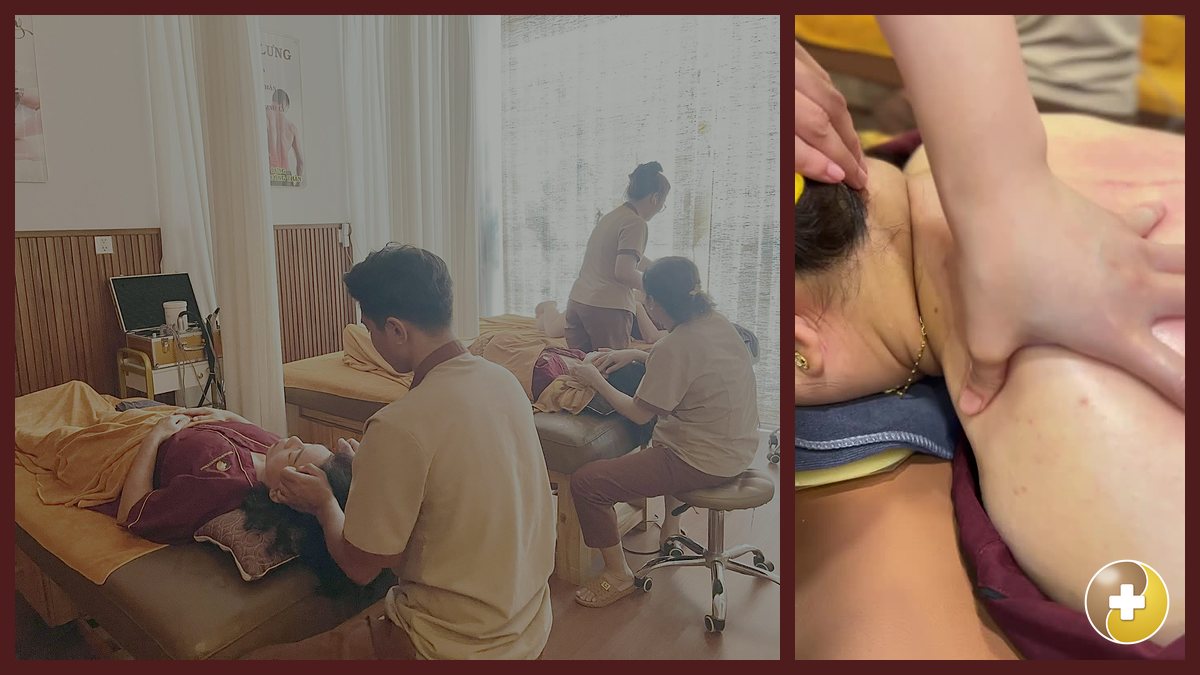
Quick answer: Pain in the middle of the back is usually the lower thoracic muscles overstretched by slumping or long bending; less often a rib joint, a vertebra, or pain from the stomach, gallbladder, pancreas or kidneys. Pain that ignores posture needs a medical check. Tong Gia in District 12 and District 9 releases this area by hand.
Want Lương Y Tống Văn Huynh’s team to read your spine and posture in person?
What is pain in the middle of the back, and who gets it?
Pain in the middle of the back means aching, burning or stiffness in the band between the bottom of the shoulder blades and the waist – roughly the lower thoracic spine, vertebrae D7 to D12. Some people feel it right on the spine, some as a horizontal band across both sides, some just as a tired mid-back every afternoon. In Western medicine it is a symptom, not a disease name; how it hurts, when and with what decides the likely cause.
This area is special in two ways. First, it is the hinge between the stiff rib-cage spine and the mobile lower back. When you slump or your upper back rounds, the fold lands right here, and the erector spinae muscles must both hold your upper body and stay stretched. Second, in front of it lie the stomach, liver, gallbladder and pancreas, and slightly lower on each side the kidneys (which, per the Tong Gia course book, sit beside the spine from T12 to L3). So mid-back pain is mostly muscular, but a small share is referred from organs – worth knowing so nothing is missed.
In Ho Chi Minh City we see it in office workers on chairs without back support, factory workers bent over a line in District 12 and Thu Duc, drivers and couriers, gardeners and home cooks who stoop, people who eat late and fast or drink in the evening, and older adults whose backs slowly round.
Common causes: posture, work, habits, environment
| Type | Feels like | Usual cause (Western view) | What to do |
|---|---|---|---|
| 1. Aching band | Heavy, warm, burning across the mid-back; worse by afternoon, better lying down or arching back | Lower thoracic spinal muscles overstretched by slumping, a rounded back, long bending | Change posture, stretch, release the muscles |
| 2. Sharp catch at one point | A "stuck" pain beside the spine, worse when twisting or breathing in | Rib–vertebra joint, intercostal muscle, after lifting or sleeping awkwardly | Rest, gentle movement; get checked if it lasts |
| 3. Pain on the bone | Tapping one vertebra hurts, worse standing | Osteoporotic compression in older adults, injury, inflammation | Medical check first, no massage yet |
| 4. Deep pain unchanged by position | Dull, inside, linked to meals, alcohol or urination; or with chest tightness | Stomach, gallbladder, pancreas, kidney, heart, aorta; shingles | Get checked soon; heart signs – call 115 |
Type 1 is the most common. When you slump, the pelvis tips back, the lower back loses its natural curve and the thoracic spine rounds; the fold of the whole upper body lands in the middle of the back. The spinal muscles here act like the line holding a fishing rod – the more you bend, the tighter it pulls. Tight muscle gets less blood and develops knots that spread an ache to both sides. Things that make it worse: chairs without a backrest or sinking sofas, a laptop on your lap or a low table, lifting and twisting together, eating a big meal and sitting folded over, air-con blowing on your back, and stress with shallow breathing.
Accompanying signs to watch
- Changes with posture – better when you arch or walk, tender on the muscle: muscular, the easiest group.
- Worse on a deep breath, cough or sneeze: often rib joint or intercostal muscle; with fever, phlegm or breathlessness, get checked.
- Linked to meals: worse hungry or after a heavy meal, with acid or burning above the navel.
- More on the right, after fatty meals, with yellowing skin: think gallbladder.
- Boring through from upper belly to back after alcohol or fatty food, easing when you lean forward: think pancreas – urgent check.
- Lower on both sides with fever or burning urine: think kidney.
- A burning strip on one side followed by blisters: shingles.
- Whole-body clues: bloating, poor appetite, tired limbs; or irritability, tight flanks, bitter taste; or a cold back and night urination – read in Eastern medicine as Spleen-Stomach, Liver-Gallbladder, Kidney.
When to see a doctor
If pain is severe, sudden, or comes with fever, numbness, weakness, chest pain or breathing difficulty, please see a doctor first. In particular:
- Chest tightness spreading to the back, breathlessness, cold sweat, nausea – call 115. In women, older adults and people with diabetes a heart attack may show mainly as back pain and fatigue.
- Sudden, tearing pain in someone with high blood pressure – call 115.
- Severe upper-belly pain boring into the back with vomiting – emergency.
- Fever, burning or bloody urine, yellow skin or eyes.
- Pain on the bone in an older person or after a fall; weakness in both legs; bladder or bowel changes.
- Unexplained weight loss, night sweats, night pain that rest does not ease – please get a medical check alongside any wellness care.
This is a wellness service, not medical care. If you are under medical follow-up, keep to your doctor's plan; Tong Gia only supports once these signs are ruled out.
The Eastern face-reading view: which organs, what signs
The mid-back holds many of the "back-shu" points of the digestive organs. Per the Tong Gia course book, these sit on the Bladder meridian 1.5 cun from the midline, and in Liver care the sequence Liver-shu → Gallbladder-shu → Spleen-shu is the main working area on the back. Spleen-shu is below the spinous process of T11 and Stomach-shu below T12. In other words, the middle of your back is the "back side" of the Liver, Gallbladder, Spleen and Stomach group. The Liver stores blood and governs the sinews (Liver-shu is used for pent-up Liver qi, tight flanks, fatigue and tension); the Gallbladder-shu for indigestion, bloating and a bitter taste; the Spleen governs muscle and limbs, and a weak Spleen leaves the back muscles soft.
Vietnamese face reading says "the sign is outside, the organ is inside." With roots over 2,000 years old, it was systematised for organ-based care by Master Tống Văn Huynh, a master of traditional Vietnamese wellness. The course book notes: the "Thân" face (wide in the middle, narrow at both ends, broad cheekbones) typically shows Liver–Stomach disharmony – stress brings stomach pain and tight flanks – with key points clinging around D7 and D9 (Liver-shu, Spleen-shu) and a contracted strip of muscle along the back; the square, fleshy "Điền" face (Spleen-Stomach type) has thick back muscles that stiffen in large plates around D11–D12; the long narrow "Mục" face has thin spinal muscles and sinking vertebrae, needing a gentle touch; people with prominent cheekbones tend to have deeply bound, tight back muscles. The practitioner also looks at how you sit, whether your belly is distended and the colour of your lips. This is observation for choosing where to work, never a medical verdict or a judgement.
Vertebrae and nerve reflex zones
| Vertebrae | Nerve, function | Typical mid-back complaint | Related organ |
|---|---|---|---|
| D6–D8 | Mid-thoracic roots; upper digestion | Ache below the shoulder-blade tips, fullness after meals | Liver, Stomach |
| D7–D10 | Thoracic roots; liver and gallbladder | Contracted strip along the back, tight flanks, bitter taste | Liver, Gallbladder (D7, D9 in the "Thân" face) |
| D11–D12 | Lower thoracic roots; digestion | Large stiff plate across the upper waist, poor appetite | Spleen, Stomach (below T11, T12) |
| D12–L2 | Into the lumbar spine; kidney, urinary | Ache low on both sides, cold back, night urination | Kidney (Kidney-shu below L2) |
Per the course book, D1–D12 govern circulation, breathing and digestion, and the "internal organs and metabolism" group is worked through D1–D12 with L1–L3 – always as support. By hand the practitioner reads skin temperature, the muscle layer, the shape of each vertebra and point tenderness before choosing a technique.
The Tong Gia method: spinal nerve reflex balancing massage
This Vietnamese Eastern method was developed by Master Tống Văn Huynh, founder of Tong Gia Acupoint Wellness, from the Head-and-Spine school and over 13 years of practice. Three "No"s: no ingested or injected chemicals or herbs, no needles, no brute force. A mid-back session:
- Observe and ask: which of the four types, links to meals, alcohol or urination, medical check or not; face, sitting posture, belly, lips. Heart, pancreas or kidney signs mean we stop and refer you.
- Read the spine by hand from D6 to L2: skin temperature, the spinal groove, each vertebra, left versus right.
- Release the muscles in warm, tight "excited" zones only, pressure building through five levels; push-and-rotate for thick plates, plucking for fibrous bands, vibration for thin, exhausted muscle.
- Press the points: Liver-shu → Gallbladder-shu → Spleen-shu, Stomach-shu on both sides, then open the Bladder line; stop when the skin turns from dry to slightly moist.
- Home care: chair set-up, meal timing, stretches, warmth.
A typical session: an accountant around forty with a tired mid-back every afternoon and frequent bloating; she gulps lunch and sits straight back down, and her stomach check showed nothing serious. Her face is wide at the cheekbones, she slumps with rounded shoulders. D7–D9 on the right is warm with a vertical band of tight muscle; D11–D12 is a stiff plate on both sides. The practitioner releases the warm band first, presses Liver-shu, Gallbladder-shu and Spleen-shu gently, then warms the upper waist. She says it is "sore but light", breathes deeper and feels her belly soften; advice: eat slowly and walk 10 minutes before sitting again.
Suitable services (see the price list): Back and waist care 60 min: 550,000 VND (about US$21), first visit 399,000 VND (about US$15); 90 min: 750,000 VND (about US$29); Spleen-Stomach wellness 75 min: 750,000 VND (about US$29) for mid-back pain with bloating, after a medical check; Liver wellness 75 min: 750,000 VND for stress and tight flanks.
What you feel: sore-but-pleasant points, a warm back, sitting upright more easily and breath reaching the belly; most sleep well that night. We support balance and do not promise the pain will vanish. More reading: back massage Q&A, a back massage experience in Saigon, Eastern face reading Q&A.
Want Lương Y Tống Văn Huynh’s team to read your spine and posture in person?
Self-care at home and prevention
- Sit with support: hips to the backrest, a small cushion behind the lower back, screen at eye level.
- Open the back every hour: sit tall, hands behind your head, lift the chest gently, hold 5 seconds, 8–10 times; then rotate gently to each side.
- Eat slowly and don't fold over after meals: a 10-minute walk after lunch, dinner about 3 hours before bed.
- Belly breathing 5 minutes before sleep, breathing out longer than in.
- Keep the back warm; after rain or air-con, see our cupping Q&A.
Book a session
- District 12: 225 Dương Thị Mười, Tân Chánh Hiệp Ward (District 12). Open 8:00–19:00 daily.
- Vinhomes Grand Park, District 9: Unit T16-21, Manhattan zone, Long Bình Ward, Thủ Đức City. Open 9:00–20:00 daily.
Both branches have genuine guest reviews on Google Maps. Book online or call / Zalo / WhatsApp +84 888 264 559, and tell us which type of mid-back pain you have and whether it is linked to meals.
Visit us
- Đông Y Huyệt Đạo Tống Gia Quận 12 (District 12)
225 Dương Thị Mười, Phường Tân Chánh Hiệp, Quận 12, HCMC · 8:00–19:00 daily · 0888 264 559 · Directions on Google Maps - Đông Y Huyệt Đạo Tống Gia Quận 9 (Vinhomes Grand Park, District 9)
Căn T16-21 khu Manhattan, Vinhomes Grand Park, Phường Long Bình, TP. Thủ Đức, HCMC · 9:00–20:00 daily · 0888 264 559 · Directions on Google Maps
Want Lương Y Tống Văn Huynh’s team to read your spine and posture in person?
FAQ
What causes pain in the middle of the back? Mostly the lower thoracic spinal muscles overstretched by slumping, a rounded back, long bending or lifting while twisting. Less often a rib joint, an osteoporotic vertebra, or pain from the stomach, gallbladder, pancreas, kidneys or heart. Pain that ignores posture, with fever or chest tightness, needs a medical check.
Is mid-back pain with shortness of breath dangerous? It can be. With chest tightness, sweating or pain into the left arm or jaw, call 115 now. A sharp catch on a deep breath after twisting is often muscular, but get checked if it lasts.
Why does the middle of my back hurt after sitting? Slumping folds the whole upper body at the mid-back and keeps those muscles stretched for hours. A backrest, a lumbar cushion, a higher screen and hourly breaks help.
Can stomach problems cause mid-back pain? Yes, stomach, gallbladder and pancreas pain can be felt in the middle of the back, usually linked to meals or alcohol and not changing with posture. Get those checked first.
Does massage help mid-back pain? For muscular pain, releasing the spinal muscles and pressing the back-shu points helps the back soften and warm up; many guests sit straighter afterwards. We only work once heart, pancreas or kidney signs are ruled out.
How long is a session? Most guests choose 60 minutes of back and waist care; 90 minutes suits a stiff back from neck to waist. Your practitioner will suggest after reading your spine.
Author: Lương Y Tống Văn Huynh – founder of Huyệt Đạo Tống Gia, a master of traditional Vietnamese wellness with over 13 years in Eastern wellness care, Y Tướng Học (face reading) and spinal nerve-reflex balancing massage.
Updated: 2026-11-17
Related guides
- Hip and side cramps: six common causes, telling them from deeper pain, and how Tong Gia can help
- Pain in the middle of the back: four types to tell apart, warning signs, and how Tong Gia cares for it in Ho Chi Minh City
- Back pain and kidney failure: the signs that actually matter, the tests to ask for, and safe back care in Ho Chi Minh City
- Where is kidney back pain felt? Location, type of pain, warning signs, and how to tell it apart from a sore back muscle
- Swayback lower back pain: how an over-arched lower back causes aching, when to get checked, and how Tong Gia cares for it in Ho Chi Minh City
- Lower back pain with tired, weak knees: common causes, when to get checked, and how Tong Gia cares for the back and legs in Ho Chi Minh City
This is a wellness service, not medical care.