
Duong sinh massage in Saigon: regular massage to keep well, read by face and spine
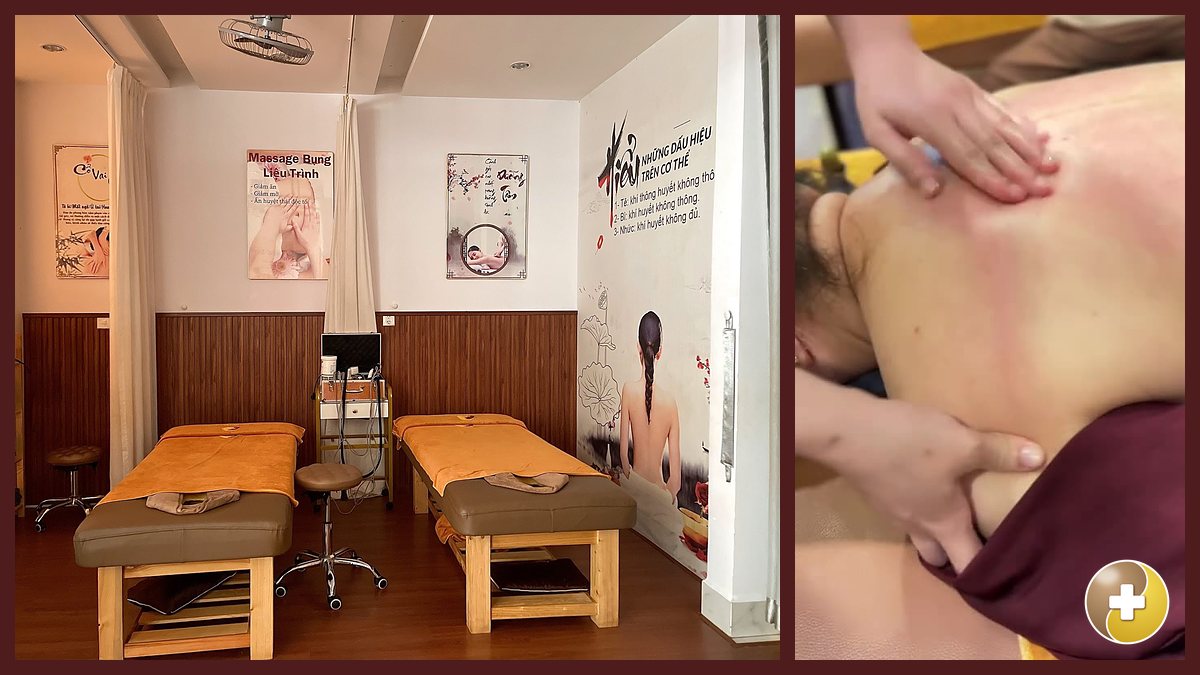
Quick answer: Duong sinh massage is regular hands-on massage and acupressure to keep the body well before pain sets in: softer muscles, better circulation, deeper sleep. At Tong Gia Acupoint Wellness (Huyệt Đạo Tống Gia), Districts 12 and 9, Ho Chi Minh City, it starts with face and spine reading; 60 minutes is 450,000₫ (about US$17).
Want Lương Y Tống Văn Huynh’s team to read your spine and posture in person?
What is duong sinh massage?
Massage dưỡng sinh means rubbing, kneading, pressing, gliding and acupressure on the muscles and along the spine, done regularly so the body stays well, instead of waiting until something hurts. Dưỡng sinh means "nourishing life": a session is not about one hard rub-down, but about giving the body a chance to let go, keep blood and energy moving, eat and sleep better, and then repeating that at a rhythm that suits you. Unlike a relaxation massage that strokes the whole body evenly, Eastern-style duong sinh massage reads the body first: which areas are tight, which are weak, which organ system is sending signals. Only then are pressure and focus chosen.
In plain Western terms: everything that happens has a physiological basis. Slow, steady pressure lets contracted muscle fibres release and improves blood and lymph flow in soft tissue; rubbed skin warms as local vessels widen; gentle rhythmic input to the skin and the muscles along the spine travels into the nervous system and helps the autonomic system switch from "alert" (sympathetic) to "rest" (parasympathetic). Breathing slows, you get drowsy, digestion settles. That is why so many people leave hungry, light and sleep more deeply that night.
| Point | Relaxation massage | Duong sinh massage (Eastern style) | Medical check-up |
|---|---|---|---|
| Goal | Feel nice during the hour | Keep well long-term, help the body rebalance | Find the cause of illness, prescribe |
| Before starting | Pick an oil and a length | Face reading, screening, spine reading | History, tests, scans |
| Pressure and focus | Even over the whole body | Builds gradually; deeper on tight areas, light on weak ones | As prescribed by medical staff |
| Afterwards | No advice | Home routine, notes for next time | Follow-up visit |
In Ho Chi Minh City, people who book duong sinh massage are often remote workers who want to keep their neck and shoulders soft, retirees who want to move easily, manual workers who want a weekly "recharge", and busy parents who want better sleep. If you are new to Vietnamese massage, start with a traditional Vietnamese massage experience.
Why massage before it hurts: habits, work, posture, environment
The Tong Gia curriculum notes that pain shows up in one place while its source often lies elsewhere: an organ system out of balance, a shifted vertebra, a wrong daily habit. City life tires the body in familiar ways:
- 8–10 hours at a screen: neck, trapezius and upper back muscles hold the head all day; no pain at first, just slow stiffening.
- Long motorbike rides: vibration runs up the spine; hands and shoulders grip the handlebars.
- Standing shifts, lots of walking: calves, heels and low back carry the load; legs feel like lead at night.
- Lifting and bending: low back and hip muscles tighten to protect the spine.
- Air-conditioning versus heat: muscles contract suddenly; neck and back stiffen.
- Stress and late nights: raised shoulders, shallow breathing, a mind that will not rest.
- Too little movement: muscles do not stretch enough, circulation slows, you feel sluggish.
When muscles pull for months they shift posture and load the nerve-root areas beside the spine; by the time it hurts, the tight loop has become a habit. Regular duong sinh massage helps undo that loop while it is still mild, and gives your practitioner a chance to point out which habit needs changing.
Signs your body wants a duong sinh session
- By evening your neck is stiff and you keep squeezing your shoulders.
- Your back is stiff in the morning and takes a few minutes to bend.
- Heavy legs and tight calves after a day on your feet.
- Enough hours of sleep, but not deep sleep.
- Frequent sighing, tightness between the shoulder blades under stress.
- Cold hands, feet or back.
- A heavy head and tired eyes after screen work.
- One shoulder or one side of the back more tired than the other.
These are not illnesses, but reminders. Massage at this stage is far gentler than once things are painful and locked. If your neck is the main issue, read neck and shoulder massage in Saigon.
When to see a doctor
Duong sinh massage is for people who are well or mildly tired. See a doctor first, or stop at once, if you have:
- Chest pain or tightness, shortness of breath, cold sweat: call 115 immediately; no massage, no acupressure.
- Sudden facial droop, slurred speech, weakness or numbness on one side: call 115 immediately.
- Pain after a fall, accident or knock; a possible fracture or bad sprain.
- Pain down a leg with weakness, numbness in the buttocks, or bladder or bowel changes.
- Fever, infection, open wounds, skin disease or severe varicose veins in the area.
- Unexplained weight loss, lasting fatigue, pale skin or dizziness like anaemia: get checked at a medical facility in parallel.
- Pregnancy: according to the Tong Gia curriculum, Hegu (LI4) and Sanyinjiao (SP6) are not used, Guanyuan is handled with caution, and the abdomen is not worked on.
- Heart disease, stents, pacemakers, blood thinners, kidney disease, high blood pressure, severe osteoporosis: tell us first; keep following your doctor's instructions and do not stop any prescription.
No abdominal massage right after a big meal. This is a wellness service, not medical care.
Y Tướng Học (face reading for wellness): choosing pressure and focus
The curriculum rests on the principle "the signs show outside, the organs lie inside". In massage, reading the face is not fortune-telling; it tells the hands whether to go light or deep and which part of the back to check first:
- Square or bottom-heavy, fleshy faces: thick back muscles that tend to lock in large patches, often around T11–T12 or the low back and hips.
- Long, narrow, thin faces: weaker energy and blood, thin muscles along the spine, sunken vertebrae; gentle tonifying techniques, light vibration, no heavy force.
- Bony, angular faces: fibrous muscle stuck around the joints; controlled deeper pushing.
- Round faces (Water type, Kidney): a cool lower back and soft muscles that need warming.
- Asymmetric tension or wandering sore spots: both sides are balanced, not just the sore one.
- Wide cheekbones (Liver and Stomach out of harmony): key points often at T7 and T9.
Complexion matters too: the Liver shows in eyes, nails and tendons; the Heart in tongue and face colour; the Spleen-Stomach in lips and muscle; the Lung in nose, skin and breath; the Kidney in ears, hair, low back and knees. This is reference knowledge from the school to guide the hands, never a medical conclusion or a judgment of character. More in Eastern face reading for wellness.
Spine and nerve-reflex areas involved
According to the Tong Gia curriculum the spine has 33 vertebrae, and nerve roots exit between them to supply muscles, skin and organs; each section mirrors a group of functions. The practitioner's hands read four objective signs: skin temperature (warmer means overactive, cooler means underactive), the muscle layer, the shape of the vertebrae, and your own sensation.
| Spinal section | Nerves and functions | Common signs | Organ system (Eastern view) |
|---|---|---|---|
| Neck C1–C7 | Head, face, neck, arms | Heavy head, stiff neck, tired arms | Liver, Kidney |
| Upper back T1–T3 | Circulation, breathing | Chest-back tightness, shallow breath | Lung, Heart |
| Mid back T7–T9 | Digestion, liver, gallbladder | Tight bands along the spine | Liver, Spleen |
| T11–T12 | Digestion | Bloating, large tight patches | Spleen-Stomach |
| Low back L1–L5 | Kidneys, urinary tract, legs | Tired back, heavy legs, cold back | Kidney |
| Sacrum S1–S5 | Elimination, pelvic area | Tailbone ache after long sitting | Kidney |
Duong sinh massage does not need to be strong everywhere; it concentrates on areas that are tight and warm, following the rules below.
The Tong Gia method: spinal nerve-reflex balancing
Tong Gia was founded by Lương Y Tống Văn Huynh, a master of traditional Vietnamese wellness with over 13 years in Eastern wellness, Y Tướng Học and spinal nerve-reflex balancing; it is a Vietnamese Eastern method built on the Head and Spine school and the legacy of Lương y Nguyễn Tham Tán and Thầy Công Kim Thắng. It keeps "three no's": no chemicals or herbs by mouth or injection, no needles, no rough force. The hands follow 8 golden rules, summed up as "read right, work right, stop at the right time":
| Rule | What it means | What you feel |
|---|---|---|
| 1. Symmetry | Compare left with right, top with bottom, spine with limbs | Both sides are checked, not only the sore one |
| 2. Overactive areas | Focus on warm, tight, sore areas; never work directly on underactive ones | Weak spots are handled lightly |
| 3. Zone and point | Survey area → key zone → key point | Hands stop exactly on "the spot" |
| 4. Sensation waves | Soft rhythmic pressure creating a comfortable ache so muscle self-adjusts | A pleasant, rhythmic ache |
| 5. Pressure levels | 5 pressure levels: one finger, whole hand, bent arm, straight arm, whole body | Pressure builds slowly, no jerks |
| 6. Direction | The spinal canal is the axis for pushing and rotating | No cracking or forceful twisting |
| 7. Dosage | Stop when the skin over the key point turns from dry to moist | Never overworked |
| 8. Temperature | Watch skin temperature: cool hot areas, warm cold ones | Cold areas warm up |
Steps of a session
- Observation: face, complexion, posture, gait.
- Screening: conditions, pregnancy, current prescriptions; warning signs mean no session and advice to get a medical check first.
- Spine reading by hand: pressing, stroking, rolling to find warm, cool or tight areas.
- Muscle release: pushing, rotating, flicking and vibrating with rising pressure, from neck and shoulders down to back, low back and limbs.
- Acupressure in the right area: back points of the organ system involved, such as Ganshu (BL18), Pishu (BL20) and Shenshu (BL23), plus a few limb points such as Neiguan (PC6), Zusanli (ST36) and Taixi (KI3).
- Home routine: a few movements to do at home and habits to change.
A typical session
A software developer in his thirties came to the District 12 branch on a Friday afternoon. Nothing hurt in particular; he wanted "maintenance" after a week at the screen and daily rides from Go Vap. The practitioner saw a right shoulder higher than the left, a forward head, a greyish complexion and red, tired eyes. On the back, the neck and right upper back (T1–T3) were warm with tight bands, while the low back felt cooler. The 90-minute session released both sides of the neck and shoulders, focusing on the right, worked down the back, pressed Liver and Kidney points, warmed the low back, and finished with Zusanli and the soles of the feet. He left with an easier neck, lower shoulders, softer eyes and a sleepy feeling, plus three tips: raise the screen to eye level, stretch every 45 minutes, sleep before 11 pm.
Services and prices
- Eastern massage (Massage Đông y): 60 min 450,000₫ (about US$17), 90 min 550,000₫ (about US$21). The standard duong sinh full-body session with acupressure, good for regular visits.
- Full-body care, 120 min: 950,000₫ (about US$37), for a long, thorough session.
- Extra 30 minutes on one area: 199,000₫ (about US$8), for deeper work on the neck or legs.
Full list on the prices page. Bringing parents? Read booking a massage for parents in Vietnam. Want a long session? See 120-minute full-body massage.
How it feels
Many guests are surprised to be observed and asked carefully before lying down. Tight spots ache, warm up and then let go; pressure builds through the 5 levels, so it is a comfortable ache, with no cracking or jerking. Tell your practitioner if it feels strong. Many people fall asleep. Afterwards your neck and shoulders usually feel lighter, your back warm and your head clear, and you sleep better; a worked area may feel slightly tender for about a day. Drink warm water and rest. Responses vary. Tong Gia helps the body rebalance and relax; it does not promise to end any illness in one visit.
Want Lương Y Tống Văn Huynh’s team to read your spine and posture in person?
Home care and prevention
- Rub the low back: warm your palms, place them on both sides of the low back and rub up and down 50–100 times.
- Press Zusanli (ST36): gently 1–2 minutes each leg until you feel mild fullness; walk slowly 10–15 minutes after meals.
- 4–6 breathing and Shenmen before bed: 4 seconds in, 6 seconds out for 5–10 minutes; press Shenmen (HT7) 1–2 minutes each wrist.
- Warm foot soak and sole rub: water about 38–42°C for 15–20 minutes before bed (test carefully if you have diabetes), then rub each sole 3–5 minutes.
- Posture: screen at eye level, stretch every 45 minutes, keep neck and back warm in air-conditioning, sleep before 11 pm.
Book a session
- District 12: 225 Dương Thị Mười, Phường Tân Chánh Hiệp (Tan Chanh Hiep Ward, District 12). Open 8:00–19:00 daily.
- Vinhomes Grand Park, District 9: Căn T16-21 khu Manhattan, Phường Long Bình, TP. Thủ Đức (unit T16-21, Manhattan zone, Long Binh Ward, Thu Duc City). Open 9:00–20:00 daily.
Book online or call, Zalo or WhatsApp +84 888 264 559. Tell your practitioner which areas tire most, any conditions, and whether you want 60, 90 or 120 minutes. Real reviews are on each branch's Google Maps page. When you are in Ho Chi Minh City, come and try this Vietnamese Eastern method by Lương Y Tống Văn Huynh.
Visit us
- Đông Y Huyệt Đạo Tống Gia Quận 12 (District 12)
225 Dương Thị Mười, Phường Tân Chánh Hiệp, Quận 12, HCMC · 8:00–19:00 daily · 0888 264 559 · Directions on Google Maps - Đông Y Huyệt Đạo Tống Gia Quận 9 (Vinhomes Grand Park, District 9)
Căn T16-21 khu Manhattan, Vinhomes Grand Park, Phường Long Bình, TP. Thủ Đức, HCMC · 9:00–20:00 daily · 0888 264 559 · Directions on Google Maps
Want Lương Y Tống Văn Huynh’s team to read your spine and posture in person?
FAQ
What is duong sinh massage? Regular Vietnamese massage and acupressure to keep the body well before pain sets in: softer muscles, better circulation, deeper sleep. At Tong Gia it begins with face and spine reading before pressure and focus are chosen. It is a wellness service, not medical care.
How is it different from a relaxation massage? A relaxation massage strokes the whole body evenly to feel nice in the moment. Duong sinh massage reads the body first, goes deeper on tight areas and lighter on weak ones, uses organ-related acupoints, and gives home tips to keep you well.
How often should I get a massage? There is no single number. People who sit all day with tired shoulders may come more regularly; healthy people keeping well can come less often. Your practitioner suggests a rhythm after reading your spine, with no pressure to buy packages.
Does it hurt? Tight areas ache a little, but pressure builds through 5 levels into a comfortable ache, with no cracking. Say so if it is too strong. A worked area may feel slightly tender for about a day.
Is it suitable for older parents? Yes, after careful questions about heart conditions, blood pressure, osteoporosis and blood thinners. Pressure is kept light, unsafe areas are avoided, and the session stops at any unusual sign; anyone under medical follow-up keeps their appointments.
How much does it cost? Eastern massage is 450,000₫ for 60 minutes (about US$17) and 550,000₫ for 90 minutes (about US$21); full-body care for 120 minutes is 950,000₫ (about US$37). Book on +84 888 264 559.
Author: Lương Y Tống Văn Huynh – founder of Huyệt Đạo Tống Gia, a master of traditional Vietnamese wellness with over 13 years in Eastern wellness care, Y Tướng Học (face reading) and spinal nerve-reflex balancing massage.
Updated: 2026-11-16
Related guides
- What does acupressure do? Effects on muscles, nerves and the five organs, and how Tong Gia works in Ho Chi Minh City
- Acupressure in Thu Duc: pressure chosen by reading your spine, at the branch that suits your ward
- Sore after acupressure: is it normal? How to tell ordinary aching from warning signs, why it happens and how to look after yourself after a session in Ho Chi Minh City
- What are gua sha and cupping: two Vietnamese folk warming methods, the cupping points and when to skip them
- Unblocking the meridians (đả thông kinh lạc): what it really means, how a hands-on session works and what you will feel in Ho Chi Minh City
- Herbal compress: what the warmth really does, where it goes and who it suits
This is a wellness service, not medical care.