
Restorative massage in Ho Chi Minh City: why you stay tired, and what a Tong Gia session does about it
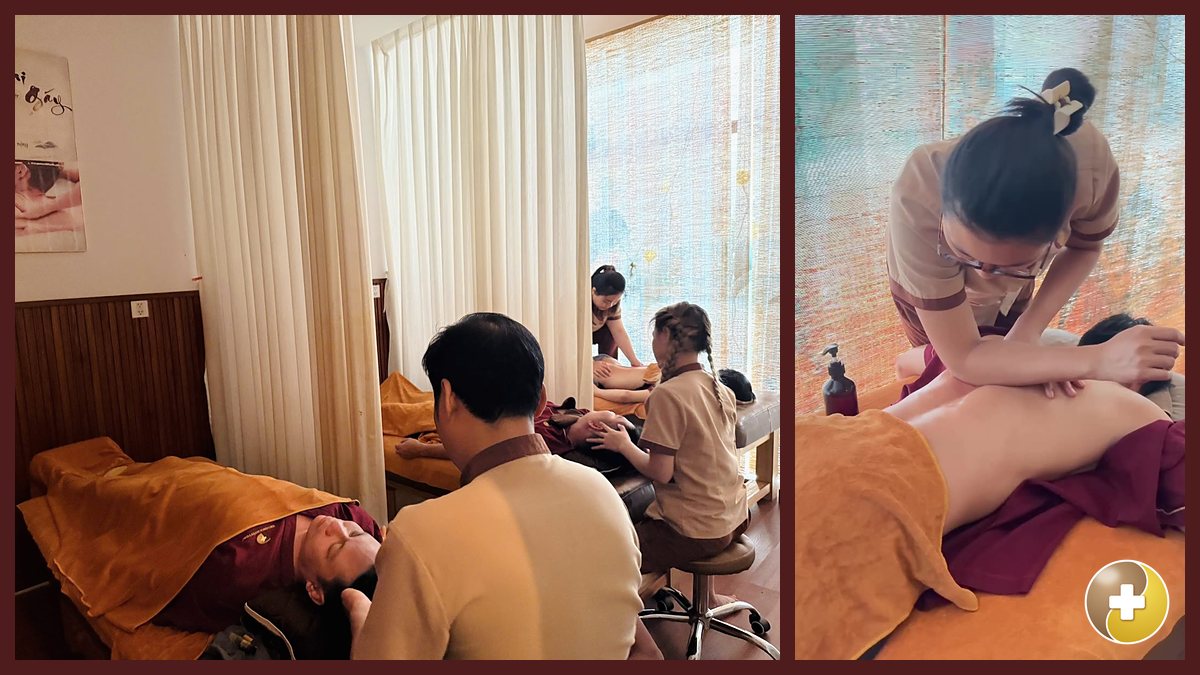
Quick answer: A restorative massage is a hands-on session of muscle release and acupressure that lets the body relax deeply, improves circulation in soft tissue and shifts the nervous system into rest mode, so a worn-out body recovers more easily. Tong Gia offers it in District 12 and District 9, Ho Chi Minh City.
Want Lương Y Tống Văn Huynh’s team to read your spine and posture in person?
What is a restorative massage, and why does your body stop bouncing back?
Many expats and long-stay visitors in Ho Chi Minh City describe the same pattern: you sleep seven hours and still wake up heavy, your shoulders feel like they carry a backpack all day, the afternoon slump arrives on schedule, and a lazy weekend does not fix Monday. Usually this is not an illness. It is a body that has been overspent: a project deadline, a move to a new country, a newborn, caring for a relative, long flights and time-zone changes, or hard training with too little rest.
In Western physiology terms, recovery depends on two things: rest that is deep enough and circulation that is good enough. The autonomic nervous system has two branches. The sympathetic branch is the accelerator: alert, faster heartbeat, muscles braced for work. The parasympathetic branch is the brake: rest, digestion and repair. Weeks on the accelerator keep the neck, shoulder and spinal muscles permanently tight, sleep stays shallow, digestion slows and fatigue lingers.
A restorative massage works on exactly those two levers. According to the Tong Gia curriculum, massage relaxes muscles, improves circulation in soft tissue, reduces tension and supports the body's own recovery process. The curriculum is also clear about the limits: massage does not "detox the liver" and does not replace the work of any organ. It simply creates better conditions for the body to do its own job.
People who usually look for this kind of session:
- Office and tech workers who sit 9–10 hours a day, including engineers at the Saigon Hi-Tech Park.
- New arrivals still adjusting to heat, humidity and a new time zone.
- Parents with months of broken sleep.
- People who have recovered from an illness, with a medical professional's all-clear, but do not yet feel like themselves.
- Weekend runners, pickleball, badminton and gym players with muscle soreness that hangs on.
- Older parents visiting from abroad who complain of stiff backs, light sleep and poor appetite.
Read more in the 120-minute full body massage Q&A and the jet lag massage Q&A.
Common reasons the body struggles to recover
- Short or shallow sleep: late nights, phones in bed, an air-conditioner set too cold, waking at 3 a.m. Shallow sleep means muscles never fully let go.
- One posture for hours: head forward, shoulders rounded, back curved. The spinal muscles hold you up all day and blood flow to soft tissue drops, so heaviness builds towards evening.
- Long-term stress: according to the Tong Gia curriculum, ongoing mental pressure tightens the whole scalp muscle (occipitofrontalis) and the shoulder-lifting muscles, so neck fatigue spreads up into the head. Stressed people also breathe shallowly.
- Irregular eating: skipped breakfasts, late dinners, eating fast, lots of sweet and fatty food. The curriculum lists these as habits that tire the Spleen–Stomach system, the source of energy for the whole body in Eastern terms.
- The wrong dose of exercise: either almost none, or very hard sessions followed by long breaks.
- Heat outside, cold inside: sweating in the midday sun, then sitting under a cold air-conditioner that blows on the neck and back.
- Caring for others: weeks of broken sleep with no hour for yourself.
Signs worth noticing
- Seven hours of sleep, yet a stiff neck and heavy back on waking.
- Shoulders that are always tight, a neck that catches when you turn.
- Heavy arms and legs; two flights of stairs leave you short of breath.
- Poor appetite, bloating after meals, strong sleepiness after lunch.
- Poor focus, forgetfulness, a short temper.
- Cold hands and feet, a cold, aching lower back when the weather turns.
- Catching colds more often, and taking longer to shake them off.
At Tong Gia these signs help choose which areas to work on and how long a session you need. They are not used to name any illness.
When to see a doctor
Fatigue is a shared sign of many conditions, some of which need tests and medical follow-up. Please see a doctor at a medical facility first, or at the same time, if you have:
- Tiredness lasting more than 2–4 weeks with no clear reason, not improved by rest.
- Unintended weight loss, low fever in the afternoon, night sweats.
- Pale skin and lips, dizziness on standing: this can be linked to anaemia and should be checked at a medical facility.
- Strong thirst, frequent urination, cuts that are slow to close.
- Low mood or loss of interest for weeks, or dark thoughts: speak to a medical professional or someone close to you now.
- Recent surgery or childbirth, a heart condition, a stent or pacemaker, blood thinners, or pregnancy: ask a medical professional before any massage.
- Chest pain, breathlessness, cold sweats, fainting, a drooping face or weakness on one side: call 115 immediately and do not have a massage.
This is a wellness service, not medical care. Massage helps the body relax and supports recovery; it does not replace a check-up when the signs above appear.
The Y Tướng Học view: which organ systems are involved when you are worn out
Y Tướng Học (face reading for wellness) in the Tong Gia curriculum follows one principle: "the signs show outside, the organs lie inside". Body build, complexion and shape reflect the state of the organ systems. Here "organs" means functional systems in Eastern wellness, not anatomical organs. For stamina and recovery, the curriculum points to four of them:
Spleen–Stomach, the root of acquired energy. The Stomach receives food, the Spleen turns it into essence and produces qi and blood for the whole body; the Spleen governs the muscles and limbs. The Spleen-qi weak pattern shows as poor appetite, bloating after meals, tiredness, reluctance to talk and a sallow complexion.
Kidney, the root of inborn energy. The Kidney stores essence and governs bones and marrow. The Kidney-yang weak pattern shows as feeling cold, cold hands and feet, a cold aching lower back and knees, waking at night to urinate, and sluggishness. People who overwork for years are described as "strong in front, empty behind".
Heart, which houses the spirit. Heart-qi weakness brings palpitations and breathlessness on exertion, spontaneous sweating and a pale face; combined Heart–Spleen weakness adds dizziness and poor sleep.
Liver, which keeps qi flowing and governs the tendons. Long stress makes Liver qi stagnate: irritability, tight tendons, sleep that will not deepen.
What a Tong Gia practitioner looks at:
- Skin colour: very pale or sallow skin is listed in the curriculum as a sign of Heart–Spleen weakness.
- Flesh versus bone: a soft, puffy build points to Spleen weakness with damp, and constant heaviness.
- The back of the skull: a flat occiput is linked to insufficient Kidney essence, very light sleep and tight deep muscles at the base of the skull.
- Lips, tongue, limbs: pale lips, a swollen tongue with tooth marks, tired limbs and soft muscles are signs of a tired Spleen–Stomach.
The curriculum stresses that one sign alone proves nothing. Reading signs only helps decide where to start; it never names a disease.
Spine and nerve-reflex areas involved in lasting tiredness
In the Tong Gia curriculum on spinal nerve-reflex balancing, the 33 vertebrae are grouped by the areas they serve; the spinal cord runs inside the spinal canal and nerve roots exit on both sides between the vertebrae.
| Vertebrae / area | Serves (per the curriculum) | Common signs when worn out | Organ system (Eastern view) |
|---|---|---|---|
| C1–C7 (neck) | Head, face, neck, arms | Heavy head, stiff neck, tired shoulders, poor focus | Kidney (base of skull), Liver |
| T1–T3 (upper back) | Circulation, breathing | Shallow breathing, tightness between the shoulder blades | Heart, Lung |
| T4–T12 (mid back) | Circulation, breathing, digestion | Poor appetite, bloating, mid-back ache; Spleen point beside T11 | Spleen–Stomach, Liver |
| L1–L5 (lower back) | Digestion, kidneys, urinary and reproductive organs, legs | Aching lower back, heavy legs, night urination; Kidney points at L2 | Kidney |
| S1–S5 and coccyx | Elimination, lower pelvis | Aching hips, discomfort when sitting long | Kidney |
For nervous exhaustion and long-term poor sleep, the curriculum combines the neck (C1–C7), the upper back (T1–T3) and the sacral area. The table shows "related" areas for choosing where to work, not a conclusion about any disease.
The Tong Gia method: restorative massage with spinal nerve-reflex balancing
Every session follows the method of Lương Y Tống Văn Huynh, a master of traditional Vietnamese wellness who founded Tong Gia Acupoint Wellness (Huyệt Đạo Tống Gia) and has over 13 years of practice in Eastern wellness, Y Tướng Học and spinal nerve-reflex balancing. Unlike a standard relaxation massage with a fixed routine, the practitioner reads your spine first and then decides where to work, how firmly and when to stop.
- Observation: questions about sleep, food, work and the last few months, plus heart conditions, blood pressure, blood thinners and pregnancy; a look at complexion, posture, shoulder height and build.
- Reading the spine by hand: the fingers glide and press along the spine from neck to tailbone, comparing left with right and top with bottom (the Symmetry principle), looking for "excited" zones: warmer skin, tighter muscle, more tenderness. The curriculum says to work only on those zones and never press hard on weak ones.
- Muscle release: neck, shoulders, the long back muscles, glutes and calves, with pressure built up through 5 pressure levels. For a soft, depleted body the practitioner uses vibration, which the curriculum describes as creating relaxing waves for nervous exhaustion.
- Acupressure on the right points: Tỳ du (BL20, 脾俞) beside T11 for the Spleen; Thận du (BL23, 肾俞) at L2 for the Kidney and lower back; Túc tam lý (ST36, 足三里) below the knee to strengthen digestion and qi; Khí hải (CV6, 气海) below the navel to ease fatigue; and Bách hội (GV20, 百会) on the crown to clear the head and calm the mind. Tam âm giao (SP6) is not used in pregnancy. When the skin at a point turns from dry to slightly moist, that point is done.
- Self-care guidance: rubbing the lower back, slow breathing, bedtime, a gentle exercise plan.
A typical session: the guest is often an office worker in their late thirties who has spent three months on a deadline, sleeping five or six hours. The practitioner notices a slightly sallow face and a right shoulder sitting higher than the left. Along the spine, the lower neck and the area between the shoulder blades are tight and warm, while the lower back is soft and a little cool. The neck and shoulders are released first for about twenty minutes; the lower back only gets warm, gentle pressure on the Kidney points. Many guests fall asleep while the calves and ST36 are worked on. At the end, the practitioner suggests bed before 11 p.m. that night and plenty of warm water.
Suitable services (single-session prices, see the full price list):
- Vietnamese Eastern massage, 90 min: 550,000 VND (about 21 USD); 60 min: 450,000 VND (about 17 USD). General tiredness, full-body release and basic acupressure.
- Full-body care, 120 min: 950,000 VND (about 37 USD). For deep exhaustion after a long, demanding period.
- Spleen–Stomach or Kidney wellness session, 75 min: 750,000 VND (about 29 USD). For tiredness with poor appetite and bloating, or with a cold, aching lower back and night urination.
What guests feel: a pleasant ache on tight points, which the curriculum calls "creating a sensation wave" so the body can adjust itself, then warmth and slower breathing. Afterwards most describe a lighter body, softer shoulders and deeper sleep that night; some feel mild muscle soreness the next day, like after light exercise. Tong Gia supports balance; results depend on your constitution and lifestyle, and one session does not promise full recovery. See also the traditional Vietnamese massage Q&A and the acupressure for sleep Q&A.
Want Lương Y Tống Văn Huynh’s team to read your spine and posture in person?
Self-care at home and prevention
- Protect your bedtime: in bed before 11 p.m., screens off 30 minutes earlier, air-conditioner around 26–27 °C, belly and neck covered.
- 4–6 breathing: breathe in through the nose for 4 seconds and out slowly for 6, for 5–10 minutes a day.
- Warm the lower back: rub your palms until warm, place them on both sides of the lower back and rub up and down 50–100 times.
- Eat on time and eat warm: no skipped breakfast, no late dinners, chew slowly, fewer iced drinks and sweets.
- Move at the right dose: about 30 minutes of walking a day; every 45–60 minutes at a desk, stand up, roll your shoulders and look up for a few breaths.
Booking
- District 12: 225 Dương Thị Mười, Phường Tân Chánh Hiệp, Quận 12 (District 12), daily 8:00–19:00.
- Vinhomes Grand Park: Căn T16-21 khu Manhattan, Phường Long Bình, TP. Thủ Đức (Thu Duc City, former District 9), daily 9:00–20:00.
WhatsApp or Zalo +84 888 264 559 (0888 264 559 inside Vietnam), or book online. You can read genuine reviews on Google Maps from each branch page. Mention "restorative massage", the length you want and any recent illness or health condition so the practitioner can adjust the pressure. Staff mainly speak Vietnamese and reply in English with a translation tool. If you live in or visit Ho Chi Minh City, you are welcome to try this Vietnamese wellness method in person.
Visit us
- Đông Y Huyệt Đạo Tống Gia Quận 12 (District 12)
225 Dương Thị Mười, Phường Tân Chánh Hiệp, Quận 12, HCMC · 8:00–19:00 daily · 0888 264 559 · Directions on Google Maps - Đông Y Huyệt Đạo Tống Gia Quận 9 (Vinhomes Grand Park, District 9)
Căn T16-21 khu Manhattan, Vinhomes Grand Park, Phường Long Bình, TP. Thủ Đức, HCMC · 9:00–20:00 daily · 0888 264 559 · Directions on Google Maps
Want Lương Y Tống Văn Huynh’s team to read your spine and posture in person?
FAQ
What does a restorative massage actually do? It relaxes tight muscles, improves circulation in soft tissue and helps the nervous system shift into rest mode, which supports the body's own recovery. Many guests sleep more deeply that night. It is wellness care, not a substitute for a check-up when tiredness lasts without reason.
I have been exhausted for weeks. Should I book a massage? Yes, once anything that needs a check-up has been ruled out. Tiredness over 2–4 weeks with weight loss, fever or pale skin should be checked at a medical facility first or at the same time. Tell the practitioner what you are going through so the pressure and areas fit you.
How is it different from a regular relaxation massage? A relaxation massage usually follows the same routine for everyone. At Tong Gia the practitioner reads your spine by hand first, finds the tight zones, then releases and presses those areas, building up through 5 pressure levels and stopping once the point has responded.
How often should I come to get my energy back? During a very tiring period many guests come once a week for a few weeks, then every 2–4 weeks. The right rhythm depends on your work and body; the practitioner will suggest one after the first visit and you decide.
Can I have a massage soon after being sick? After a fever, surgery, childbirth or an illness still being monitored, ask a medical professional first. Once you are cleared, choose a gentle session focused on the neck and shoulders with warm, light pressure, and mention it when you book.
I feel a bit sore after the massage. Is that normal? Mild muscle soreness or sleepiness is common, much like after light exercise, and usually fades within a day or two. Drink warm water and sleep early. If pain grows, bruising spreads or dizziness lasts, contact Tong Gia and get checked.
Author: Lương Y Tống Văn Huynh – founder of Huyệt Đạo Tống Gia, a master of traditional Vietnamese wellness with over 13 years in Eastern wellness care, Y Tướng Học (face reading) and spinal nerve-reflex balancing massage.
Updated: 2026-11-16
Related guides
- What does acupressure do? Effects on muscles, nerves and the five organs, and how Tong Gia works in Ho Chi Minh City
- Acupressure in Thu Duc: pressure chosen by reading your spine, at the branch that suits your ward
- Sore after acupressure: is it normal? How to tell ordinary aching from warning signs, why it happens and how to look after yourself after a session in Ho Chi Minh City
- What are gua sha and cupping: two Vietnamese folk warming methods, the cupping points and when to skip them
- Unblocking the meridians (đả thông kinh lạc): what it really means, how a hands-on session works and what you will feel in Ho Chi Minh City
- Herbal compress: what the warmth really does, where it goes and who it suits
This is a wellness service, not medical care.