
Traditional massage in Vietnam: the hand techniques, their roots and a session at Tong Gia
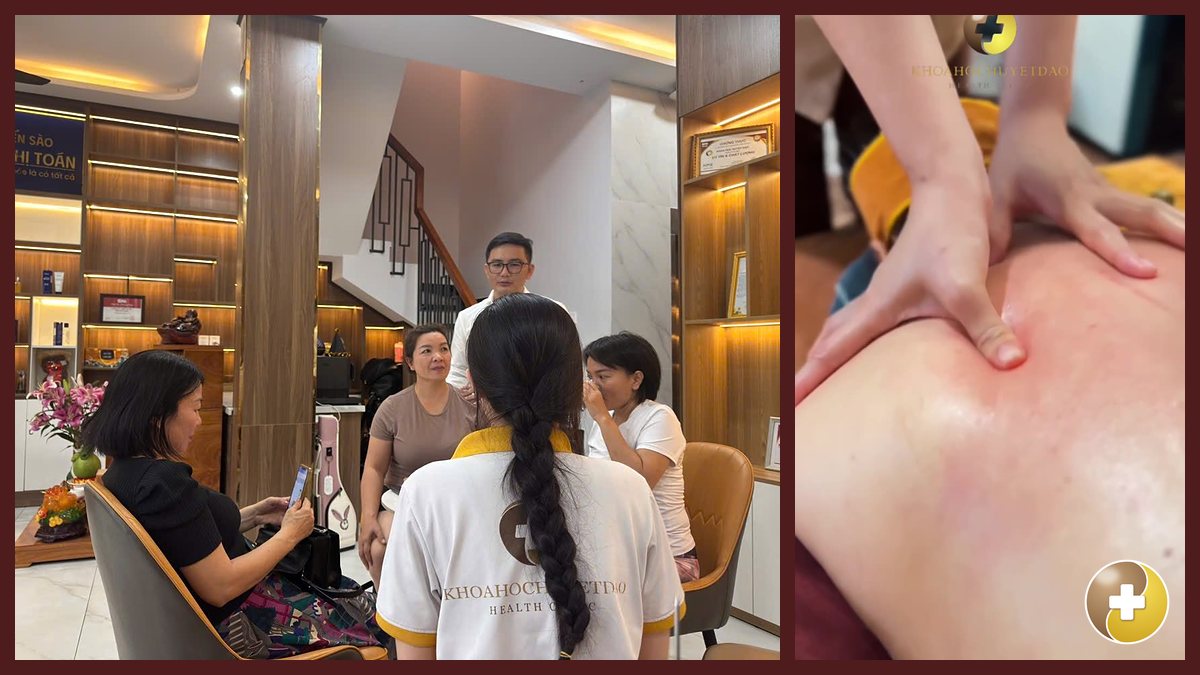
Quick answer: Traditional Vietnamese massage is hands-on rubbing and acupressure based on Eastern medicine: the practitioner reads your body first, then uses push, turn, flick and vibration techniques on the right zones. Tong Gia in District 12 and Vinhomes Grand Park, Ho Chi Minh City, works from the spine; 60 minutes costs 450,000 VND.
Want Lương Y Tống Văn Huynh’s team to read your spine and posture in person?
What is traditional massage in Vietnam?
Traditional massage in Vietnam, which older Vietnamese call xoa bóp bấm huyệt (rubbing, kneading and acupressure), means using the hands on skin, muscle, tendons and acupoint areas according to Eastern medical theory, so that qi and blood flow and the body rebalances itself. Unlike a relaxation massage that spreads oil evenly over the whole body, traditional massage reads the body first, chooses the zones and points, and only then works. Many expats and visitors in Ho Chi Minh City look for it because they want a session with roots and reasoning behind it, not just pressure for its own sake.
In Western terms, the skin is full of receptors for pressure, vibration and stretch. When the hands press, stroke and vibrate at the right rhythm, these receptors send new signals up the spinal cord, so dull aching fades; tight muscle releases; more blood reaches the area, so the skin warms; breathing slows and the parasympathetic nervous system, the "rest" side, becomes more active. That is why a good session leaves you lighter and sleepier.
At Tong Gia Acupoint Wellness (Huyệt Đạo Tống Gia), traditional massage takes the form of spinal nerve-reflex balancing massage. According to the Tong Gia curriculum, the method grew from the head-and-spine heritage of Lương y Nguyễn Tham Tán and teacher Công Kim Thắng, and was developed into its own method by Lương Y (master of traditional Vietnamese wellness) Tống Văn Huynh. The school's motto: "The human spine is human life. To love life is to look after the spine forever." For a broader introduction, see our traditional Vietnamese massage page.
| Reading techniques (Tong Gia curriculum) | How it is done | What it tells the practitioner |
|---|---|---|
| Áp (resting the palm) | Lift-and-rest, glide the palm over the skin | Skin temperature: warmer or cooler zones |
| Vuốt and Ấn (stroke and press) | Stroke along muscles, tendons and the spinal groove with the palm, one or three fingers; probe | Tight bands, grooves, shallow or deep layers |
| Vê (fine rolling) | Small circles, pushes and turns with the fingertip | Shape of the vertebrae, "good ache" points |
In short: in true traditional massage the hands read first and work second. The curriculum calls this skill cảm thủ, reading with the soft pads of the fingertips and working gently on the central nervous system (head) and the autonomic nervous system (spine).
Why people look for traditional massage
- Stiff neck, shoulders and back from laptops and phones, common among office workers, engineers and drivers.
- Long shifts on your feet: factory and warehouse staff, market traders; aching lower back and calves.
- Stress and light sleep: a busy mind, shoulders held up, tired on waking.
- Sluggish digestion: eating fast or late, sitting straight after meals.
- Cold back and feet, tired knees: air-con, rain, age.
- Jet lag and travel: long flights into Tan Son Nhat leave the back and legs stiff; see the traditional Vietnamese massage Q&A.
- Wanting non-invasive care: no needles, no chemicals, no rough force.
The Tong Gia curriculum teaches that pain shows up in one place but its source often lies elsewhere. The five organ systems of Eastern medicine are functional systems: Liver governs smooth flow and the sinews, Heart governs blood vessels and houses the spirit, Spleen governs transformation and the flesh, Lung governs qi and the skin, Kidney relates to the lower back, knees, bones and ears. These are functional concepts, not statements that your organs are ill.
Signs your body is asking for care
- Neck and shoulders feel wooden; you cannot turn your head fully.
- Mid-back tight as a board after screen time; lower back aches when standing.
- Waking tired, broken sleep, frequent sighing.
- Cold hands and feet, mild numbness after long sitting.
- Bloating and poor appetite under stress.
- A massage elsewhere helps for a day, then the ache returns.
When to see a doctor
Traditional massage is wellness care. Please see a doctor at a medical facility first, and do not use massage instead, if you have:
- Pain after an accident, fall or hard knock; a possible fracture or dislocation.
- Back pain spreading down the leg with numbness, leg weakness or bladder or bowel changes.
- Fever, a hot red swollen joint, an open wound or infected skin.
- One calf swollen, hot and painful (a clot must be ruled out; no massage).
- Sudden severe headache, or dizziness with slurred speech or one-sided weakness: call 115.
- Ongoing fatigue, unexplained weight loss or pallor: get checked in parallel.
If you are pregnant, take blood thinners, have heart disease, a stent or pacemaker, severe osteoporosis or recent surgery, tell us first so the practitioner can lighten the pressure and avoid certain zones. Chest tightness, shortness of breath and cold sweats: call 115 at once. This is a wellness service, not medical care.
Face reading: traditional massage starts with looking
Y Tướng Học (face reading for wellness) holds that "the outer form reflects the inner organs". In the Tong Gia curriculum, ten face shapes, each named after a Chinese character, are linked to a constitution, an Eastern-medicine tendency and a section of the back to check first:
- Square, full face (田): Earth type, Spleen and Stomach; thick back muscles, large tight patches around D11–D12.
- Long, squared face (同): Metal type, Lung; tightness around D3, affecting breathing.
- Wide forehead, pointed chin (甲): "full above, weak below"; hot, reactive C1–C2 and a cool, hollow lower back.
- Wide cheekbones (申): Liver and Stomach out of harmony; key points often at D7–D9.
- Long, narrow, thin face (目): thin spinal muscles; the curriculum calls for gentle tonifying techniques such as vibration.
- Bony face (王): fibrous bands clinging to joints; deeper flicking and pushing are needed.
Face reading is not fortune-telling; it decides where to feel first and how firm to be. It is only a hint, never a medical conclusion, and never used to judge anyone. More in our face reading for wellness Q&A.
Spine and nerve-reflex zones: why Tong Gia's traditional massage starts from the spine
In the Tong Gia curriculum, the head is the centre of the central nervous system and the spine is the centre of the autonomic system. Spinal nerve roots leave on both sides through the gaps between vertebrae, exactly where the fingertips probe. So a Tong Gia session always travels along the spine, whether the discomfort is in the shoulder, stomach or legs.
| Spinal zone | Governs (curriculum) | Common complaints | Related organ system |
|---|---|---|---|
| Cervical C1–C7 | Head, face, neck, arms | Stiff neck, headaches, tingling hands | Liver, Kidney (C1–C3) |
| Thoracic D1–D5 | Breathing, circulation | Shallow breath, palpitations, stiff upper back | Lung, Heart |
| Thoracic D6–D12 | Digestion | Bloating, board-like mid-back | Liver, Spleen–Stomach |
| Lumbar L1–L5 | Digestion, kidneys, urinary, reproductive, legs | Cold, tired lower back; heavy legs | Kidney |
| Sacral S1–S5, coccyx | Elimination, lower pelvis | Tired buttocks, numb back of thighs | Kidney, Bladder |
The table shows related zones for choosing where to work, not a conclusion about illness. Acupoints do not act on organs directly; in traditional theory they help regulate qi and blood.
The Tong Gia method: spinal nerve-reflex balancing massage
Every session at both branches follows the method of Lương Y Tống Văn Huynh, founder of Tong Gia, with over 13 years of practice in Eastern wellness, face reading and spinal nerve-reflex balancing. The "three nos": no chemicals or herbs taken or injected, no needles, no rough force. The hands follow eight principles: symmetry, focus only on overactive zones (warmer, tight, more tender), locate the smallest key point, create a wave of "good ache", build pressure in five levels (one finger, whole hand, bent arm, straight arm, whole body), align force with the spinal canal, stop when the skin turns from dry to slightly moist, and bring skin temperature back towards normal.
| Traditional technique | Used for (curriculum) | What guests often feel |
|---|---|---|
| Đẩy and Xoay (push and turn) | Thick, hard, immobile tight areas | Muscle "unknotting", growing warmth |
| Bật (cross-fibre flick) | Fibrous, rope-like bands | A sharp moment, then lightness |
| Rung (vibration) | Soft, thick tissue; nervous exhaustion | Drowsiness, slower breathing |
| Bỉ, Miết, Lách (deep glide, groove search) | Hollow areas, searching gaps for new key points | A clear "good ache" spreading out |
| Compression and wave methods | Helping stiff vertebrae move; waves from neck to tailbone | The back feels longer and lighter |
Services and prices (same at both branches)
- Eastern-medicine massage, 60 min: 450,000 VND (about 17 USD); 90 min: 550,000 VND (about 21 USD). The basic way to experience traditional massage.
- Full-body care, 120 min: 950,000 VND (about 37 USD). When several areas ache; see the 120-minute full-body Q&A.
- Neck-shoulder or lower-back care, 60 min: 550,000 VND (about 21 USD), first visit 399,000 VND (about 15 USD).
Full list on the price page.
A typical session
One morning at the Vinhomes Grand Park branch, a man in his sixties came in; his son had booked a 90-minute Eastern-medicine massage because his father had been used to traditional rubbing back in the countryside. He described a tired lower back when standing, cold feet at night and broken sleep. Screening: blood pressure monitored and stable, no blood thinners, no pain spreading down the legs. His face was round and full, the complexion slightly pale. Reading the spine, the skin around L2–L3 felt cooler, the muscle soft; a warm, raised band sat at D11–D12. The practitioner used push-and-turn on the band, warmed the cool lower back only with vibration and light rubbing, pressed the Kidney shu points, and finished by rubbing the soles and showing him how to warm his lower back before bed.
What guests usually feel
Pressure builds gradually from fingertip to palm, so few people are startled by pain; at key points there is a "good ache" that spreads and dissolves. Many doze off during back vibration. Afterwards the body feels warm and light, neck and back move more easily, and sleep is often deeper. Everyone is different; Tong Gia does not promise an end to pain in one session, only to help the body loosen and rebalance. Read a guest's account in a traditional Vietnamese massage experience and the acupressure massage Q&A.
Want Lương Y Tống Văn Huynh’s team to read your spine and posture in person?
Self-care at home and prevention
- Warm the lower back: rub your palms until warm, place them on both sides of the lower back and rub up and down 50–100 times.
- Rub the soles: in the evening, rub the sole of each foot for 3–5 minutes.
- Press Túc tam lý: about four finger-widths below the knee, outside the shin bone; gentle pressure 1–2 minutes each side.
- Breathe and move: every 45–60 minutes stand, roll the shoulders, breathe in slowly through the nose and out longer.
- Sleep before 11 pm so the body can rest.
Booking
Tong Gia is open every day. You can check the star rating and real reviews on each branch's Google Maps profile before you come:
- District 12 branch: 225 Dương Thị Mười, Tân Chánh Hiệp ward (Phường Tân Chánh Hiệp), District 12. Open 8:00–19:00 daily. See District 12 page.
- Vinhomes Grand Park branch: unit T16-21, Manhattan zone (Căn T16-21 khu Manhattan), Vinhomes Grand Park, Long Bình ward, Thu Duc City. Open 9:00–20:00 daily. See Vinhomes Grand Park page.
Call, Zalo or WhatsApp +84 888 264 559, or book online. Mention "Eastern-medicine massage" with 60, 90 or 120 minutes, the branch and your time; tell us in advance about pregnancy, blood thinners or heart conditions. More about the approach on our Eastern wellness page.
Visit us
- Đông Y Huyệt Đạo Tống Gia Quận 12 (District 12)
225 Dương Thị Mười, Phường Tân Chánh Hiệp, Quận 12, HCMC · 8:00–19:00 daily · 0888 264 559 · Directions on Google Maps - Đông Y Huyệt Đạo Tống Gia Quận 9 (Vinhomes Grand Park, District 9)
Căn T16-21 khu Manhattan, Vinhomes Grand Park, Phường Long Bình, TP. Thủ Đức, HCMC · 9:00–20:00 daily · 0888 264 559 · Directions on Google Maps
Want Lương Y Tống Văn Huynh’s team to read your spine and posture in person?
FAQ
What is traditional massage in Vietnam? Called xoa bóp bấm huyệt, it is hands-only rubbing and acupressure based on Eastern medicine: the hands read the body first, then work with push, turn, flick, vibration and deep-glide techniques on chosen zones and points.
Is traditional massage painful? At Tong Gia pressure rises through five levels, from one finger to the whole hand. Tight points give a "good ache" that fades. There is no rough force; ask for lighter pressure at any time.
How is it different from Thai or spa massage? Spa massage usually spreads pressure evenly, Thai massage stretches a lot. Tong Gia traditional massage starts with observation and reading the spine by hand, then focuses on tight, warm zones and organ-related points.
How much does traditional massage cost at Tong Gia? 60 minutes 450,000 VND (about 17 USD), 90 minutes 550,000 VND (about 21 USD), full-body care 120 minutes 950,000 VND (about 37 USD), same at both branches.
Can elderly parents have traditional massage? Yes, with careful questions about health conditions, blood pressure, bone density and blood thinners, and lighter pressure. Older guests often enjoy vibration and warming of the lower back and soles.
Do you have English-speaking booking? Yes. Message +84 888 264 559 on WhatsApp or Zalo, or book online; tell us the branch, time and any health conditions.
Author: Lương Y Tống Văn Huynh – founder of Huyệt Đạo Tống Gia, a master of traditional Vietnamese wellness with over 13 years in Eastern wellness care, Y Tướng Học (face reading) and spinal nerve-reflex balancing massage.
Updated: 2026-11-16
Related guides
- What does acupressure do? Effects on muscles, nerves and the five organs, and how Tong Gia works in Ho Chi Minh City
- Acupressure in Thu Duc: pressure chosen by reading your spine, at the branch that suits your ward
- Sore after acupressure: is it normal? How to tell ordinary aching from warning signs, why it happens and how to look after yourself after a session in Ho Chi Minh City
- What are gua sha and cupping: two Vietnamese folk warming methods, the cupping points and when to skip them
- Unblocking the meridians (đả thông kinh lạc): what it really means, how a hands-on session works and what you will feel in Ho Chi Minh City
- Herbal compress: what the warmth really does, where it goes and who it suits
This is a wellness service, not medical care.