
What is Eastern medicine massage? Principles, spine, five organ systems and what a session at Tong Gia includes
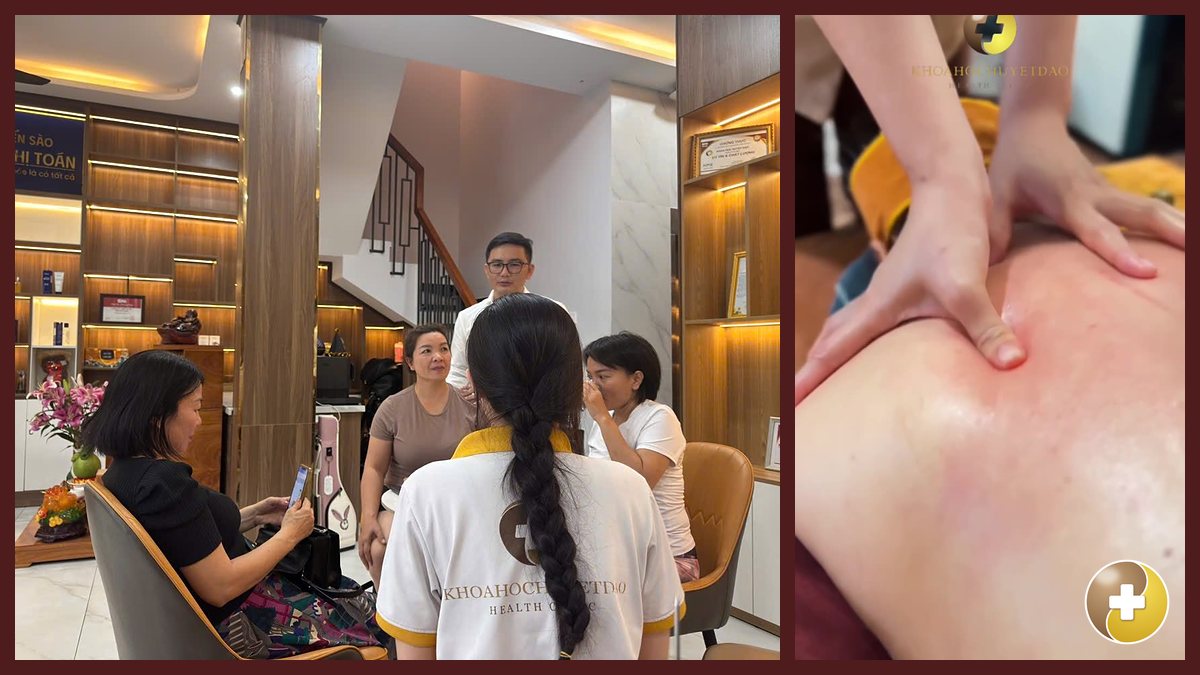
Quick answer: Eastern medicine massage uses the hands on muscles, points and channels according to traditional theory, so energy and blood flow and the five organ systems stay balanced. At Tong Gia Acupoint Wellness (District 12 and Vinhomes Grand Park, Ho Chi Minh City) it starts with face reading and reading the spine; 60 minutes costs 450,000 VND (about 17 USD).
Want Lương Y Tống Văn Huynh’s team to read your spine and posture in person?
What is Eastern medicine massage?
Eastern medicine massage (in Vietnamese "massage Đông y") uses the hands to rub, knead, press, glide and roll over muscles, tendons, acupressure points and channels, following traditional theory: the body is one connected whole, energy and blood must flow, and the five organ systems (Liver, Heart, Spleen, Lung, Kidney) must stay in balance. Vietnamese people also call it "xoa bóp bấm huyệt" (massage and acupressure). Unlike a relaxation massage that covers the whole body evenly, Eastern medicine massage asks "it aches here, but where does it start?" and chooses zones, points and pressure for each person.
In Western terms, what you feel during a session has clear explanations. Pressing and gliding lengthens muscle fibres that have been clenching and brings more blood to the area, so the skin warms. Skin and muscle hold many sensory receptors; steady rhythmic stimulation sends signals to the spinal cord and brain, and the autonomic nervous system shifts from "brace" (sympathetic) to "rest" (parasympathetic): heart rate slows, breathing deepens, muscles let go, and many people fall asleep. Nerve roots leave the spine on both sides, which is why work along the spine often feels more deeply relaxing than elsewhere.
In Ho Chi Minh City, people asking what Eastern medicine massage is are often expats who have tried spa massage and want something more traditional, wellness travellers, and Vietnamese families looking for the kind of massage their grandparents knew. This page explains the principles, what a session at Tong Gia includes, and who should or should not book. For a quick overview of local styles, see our traditional Vietnamese massage Q&A.
How it compares with relaxation, Thai and Swedish massage
| Aspect | Relaxation / Swedish | Thai | Eastern medicine (Tong Gia way) |
|---|---|---|---|
| Theory | Muscle anatomy, circulation | Stretching along energy lines | Energy and blood, channels, five organ systems; spine and nervous system |
| How it starts | Oil, full body | Set stretching sequence | Questions, face reading, reading the spine by hand |
| Where it works | Evenly everywhere | Evenly everywhere | Focus on tight, warm "excited" zones |
| Acupressure | Little or none | Pressing along lines | Yes, points chosen by organ system and spinal zone |
| Pressure | Light to medium | Medium to strong, lots of stretching | Built up over five levels, "pleasant ache", never rough |
Common reasons people look for it
- Neck, shoulder and back fatigue from screens and phones.
- Stress and light sleep: the mind will not switch off, shoulders brace, you wake tired.
- Bloating, poor appetite, a heavy body: rushed meals, late dinners, sitting straight after eating.
- Cold back, cold feet, tired knees: air-con, monsoon rain, age.
- Physical work and long shifts: tired lower back and calves, night cramps.
- Staying well: nothing serious yet, but you would rather look after yourself before pain arrives.
The Tong Gia training puts it simply: pain shows in one place but often starts somewhere else. One person's back pain is rooted in the Kidney system, another's poor sleep in the Heart and Liver, another's bloating and fatigue in the Spleen and Stomach. The five organs in Eastern medicine are functional systems, not exactly the anatomical organs: the Liver stores blood and governs the sinews; the Heart governs the vessels and houses the mind, linked to sleep and complexion; the Spleen transforms food and governs the muscles; the Lung governs energy and the skin; the Kidney is tied to the lower back, knees, bones and ears. Saying "Liver energy is constrained" describes a functional state in traditional theory, not a liver disease.
Signs your body may be asking for care
The Tong Gia organ-feature chart lists where each system shows and the signals that often appear. These are prompts for self-care, not a medical finding:
- Liver: dry, tired eyes; irritability; tight neck and shoulders; cramps.
- Heart: a pale or flushed face; trouble sleeping; palpitations.
- Spleen-Stomach: pale lips; bloating; a heavy body; tired limbs.
- Lung: dry skin; a blocked nose; shallow breathing; frequent sighing.
- Kidney: tired knees; a cold back; ringing ears; hair loss; forgetfulness.
When several signals last at once, an Eastern medicine massage helps show which area is out of balance. If they worsen, appear suddenly or come with the warning signs below, get checked first.
When to see a doctor, and who should not book
This is wellness care. Please see a doctor at a medical facility first if you have:
- A sudden severe headache, or dizziness with slurred speech, a drooping face or one-sided weakness: call 115.
- Back or neck pain spreading into an arm or leg with numbness, weakness or difficulty walking.
- Fever, skin infection, open wounds, a fracture or a fresh sprain.
- Leg swelling that keeps increasing, breathlessness lying down, rapid weight gain.
- Severe abdominal pain, vomiting blood or black stools.
- Lasting fatigue, unexplained weight loss or very pale skin: get checked alongside any wellness care.
- Pregnancy, a stent, a pacemaker or blood thinners: tell us first so pressure stays light and certain points and areas are avoided.
Chest tightness, shortness of breath or cold sweats: call 115 immediately, no massage, no acupressure. Keep taking anything your medical team has prescribed; a massage is never a reason to stop. This is a wellness service, not medical care.
Face reading (Y Tướng Học): the session starts with looking
Y Tướng Học (face reading for wellness) has roots over 2,000 years old, in the classic line "what is inside shows outside". Lương Y Tống Văn Huynh systematised it and brought it into massage: before touching you, the practitioner reads the face to choose which part of the back to check first. In the Tong Gia training, ten face shapes named after Chinese characters are each linked to a constitution and a key back zone:
| Face shape | How it looks | Main system | Back zone checked first |
|---|---|---|---|
| Điền (田) | Square, full | Spleen-Stomach | D11–D12 |
| Đồng (同) | Long but square, firm | Lung, Large Intestine | D3 |
| Giáp (甲) | Wide forehead, pointed chin | Heart fire high, Liver constrained, Kidney low | C1–C2 and lower back |
| Thân (申) | Broad cheekbones, narrow ends | Liver-Gallbladder, Spleen-Stomach | D7–D9 |
| Viên (圓) | Round, more padding than bone | Kidney, Bladder | Lower back (cool, soft) |
| Mục (目) | Long, narrow, thin | Liver and Spleen weak | Thin spinal muscles, sunken vertebrae |
The practitioner also feels the muscle: wood-hard means stagnation and a constrained Liver; slack, cool and slow to spring back means a cold, weak Spleen. Face reading is a hint for where to start, not fortune-telling, not a medical verdict and never used to judge anyone. More in our Eastern face reading Q&A.
Spine and nerve-reflex zones: why Tong Gia works from the spine
The school's message in the Tong Gia training is: "The human spine is human life." The head is the centre of the central nervous system (awareness, command); the spine is the axis of the autonomic nervous system (keeping life running automatically). The 33 vertebrae serve different regions: C1–C7 head, face, neck and arms; D1–D12 circulation, breathing and digestion; L1–L5 digestion, kidneys, urinary and reproductive function and legs; S1–S5 elimination and the lower pelvis. The training groups needs into four functional groups:
| Group | Common feelings | Spinal zones worked | Related systems |
|---|---|---|---|
| 1. Nerves and mind | Headache, poor sleep, stress, dizziness | C1–C7, D1–D3, sacrum | Heart, Liver |
| 2. Muscles, bones, joints | Neck fatigue, back pain, tingling limbs | C5–C7, L1–L5, S1–S5 | Liver (sinews), Kidney (bones) |
| 3. Internal organs, metabolism | Bloating, poor appetite, shallow breath, fatigue | D1–D12, L1–L3 | Spleen-Stomach, Lung, Liver |
| 4. Women's and men's health | Period discomfort, cold lower belly, lower back ache | D10–D12, L1–L3, S1–S5 | Liver, Kidney |
The training stresses this is support according to the school's material and never replaces a medical check. Points do not act directly on organs; in traditional theory they help regulate energy and blood and ease discomfort.
The Tong Gia method: spinal nerve-reflex balancing massage
At Tong Gia Acupoint Wellness (Huyệt Đạo Tống Gia), Eastern medicine massage means the spinal nerve-reflex balancing method developed by Lương Y Tống Văn Huynh, master of traditional Vietnamese wellness and founder, over more than 13 years in Eastern wellness and face reading. The training traces it to the Head and Spine school of Lương y Nguyễn Tham Tán and Master Công Kim Thắng. It is a Vietnamese tradition you can experience while you are in Ho Chi Minh City.
The "three no's"
- Nothing to swallow or inject: no Western chemicals, no Eastern herbs taken internally.
- No needles: nothing invasive.
- No rough force: no hard mechanical rubbing, no violent point pressing.
What a session includes
- Screening: heart history, blood pressure, pregnancy, blood thinners, injuries.
- Observation: face shape, complexion, lips, tongue, ears, posture, shoulder line.
- Reading the spine by hand: with the soft pads of the fingertips, pressing, gliding and rolling to read four objective signs: skin temperature, muscle layer, vertebra shape (raised, raised-tilted, tilted, sunken-tilted, sunken) and sensation.
- Locating: narrowing from a survey zone to a key area and then a key point, the small root that shapes the whole picture.
- Muscle release: pushing and turning for thick tight muscle, flicking across fibrous bands, vibrating for soft weak areas, gliding into hollows and grooves; pressure built over five levels, from one finger to the whole body.
- Acupressure: the "Du" points beside the spine and points on the channel of the system that needs care.
- Stopping at the right moment: when the skin over the key point turns from dry to slightly moist; heat lowered where high, raised where low; home advice.
Services and prices
- Eastern-style wellness massage 60 min: 450,000 VND (about 17 USD); 90 min: 550,000 VND (about 21 USD). A good first experience.
- Heart / Kidney / Liver / Spleen-Stomach wellness 75 min: 750,000 VND (about 29 USD) when one system's signals stand out.
- Full-body care 120 min: 950,000 VND (about 37 USD) from head and spine to feet.
Full price list; the Eastern wellness page; stories in traditional Vietnamese massage experience and acupressure massage Q&A.
A typical session
One afternoon at the Vinhomes Grand Park branch, an engineer from the Saigon Hi-Tech Park, new to Eastern medicine massage, says his shoulders tire, his sleep is light and he often feels bloated after lunch. No heart history, normal blood pressure. Broad cheekbones, narrow forehead, pointed chin: a "Thân" face; lips a little pale; left shoulder higher. Reading the spine, the skin at D7–D9 is warmer, the long back muscles form a band, the nape at C1–C2 slightly warm, the lower back normal. The practitioner releases the neck, shoulders and mid back, presses Can du, Tỳ du, Thái xung and Túc tam lý, moving on once the mid-back skin turns moist. He leaves with belly breathing, a clockwise belly rub 30 minutes after meals and a short walk after lunch.
What you feel during and after
Reading the spine is gentle, and many people are surprised that the practitioner finds their tired spots before they mention them. Release on the tight zones brings a "pleasant ache" that rises and fades like waves; points feel like a mild, warm pressure. Afterwards the body feels lighter, breathing deeper, the mind calm, and sleep comes more easily that night; a few people feel slightly tired the next day. Everyone differs; we do not promise an end to pain or poor sleep, only support for your body to rebalance.
Want Lương Y Tống Văn Huynh’s team to read your spine and posture in person?
Self-care at home and prevention
- Belly breathing daily: in through the nose for about 4 seconds, out slowly for about 6, for 5–10 minutes.
- Warm the lower back: rub your palms warm, place them either side of the lower back, rub up and down 50–100 times.
- Soles and foot soak: rub each sole 3–5 minutes at night; soak your feet in water around 38–42°C for 15–20 minutes before bed (diabetics, test the temperature).
- Change position every 45–60 minutes: roll the shoulders, stretch the back, sit tall.
- Sleep before 11 pm, eat slowly, do not sit straight after meals. Do not wait for pain to start looking after yourself. More in our acupressure experience guide.
How to book
Tong Gia Acupoint Wellness has two branches in Ho Chi Minh City, open every day, with real customer reviews on Google Maps:
- District 12: 225 Dương Thị Mười, Phường Tân Chánh Hiệp (Tan Chanh Hiep Ward, District 12). Open 8:00–19:00 daily.
- District 9 – Vinhomes Grand Park: Căn T16-21 khu Manhattan, Phường Long Bình, TP. Thủ Đức (unit T16-21, Manhattan zone, Long Binh Ward, Thu Duc City). Open 9:00–20:00 daily.
Call, Zalo or WhatsApp +84 888 264 559, or book online. On a first visit allow a few extra minutes for questions and observation, and mention pregnancy, heart conditions, blood pressure or blood thinners.
Visit us
- Đông Y Huyệt Đạo Tống Gia Quận 12 (District 12)
225 Dương Thị Mười, Phường Tân Chánh Hiệp, Quận 12, HCMC · 8:00–19:00 daily · 0888 264 559 · Directions on Google Maps - Đông Y Huyệt Đạo Tống Gia Quận 9 (Vinhomes Grand Park, District 9)
Căn T16-21 khu Manhattan, Vinhomes Grand Park, Phường Long Bình, TP. Thủ Đức, HCMC · 9:00–20:00 daily · 0888 264 559 · Directions on Google Maps
Want Lương Y Tống Văn Huynh’s team to read your spine and posture in person?
FAQ
What is Eastern medicine massage? Hands rub, knead, press and glide over muscles, points and channels according to traditional theory, so energy and blood flow and the five organ systems stay balanced. At Tong Gia it starts with face reading and reading the spine by hand, then muscle release and acupressure on the right zones.
How is it different from a spa relaxation massage? Relaxation massage covers the whole body evenly for comfort. Eastern medicine massage looks for the root of the tiredness by organ system and spinal zone, focuses on tight areas, chooses points selectively and builds pressure to suit you.
Does Eastern medicine massage hurt? Tight areas give a 'pleasant ache' that rises and fades like a wave. Tong Gia never uses rough force; pressure builds from light to moderate according to your feedback.
Who should not have it? Anyone with fever, open wounds, a fracture or fresh sprain, chest pain, breathlessness or stroke signs should see a doctor first. If you are pregnant, have a stent or take blood thinners, tell us so the work stays light and certain points are avoided.
Is it suitable for tourists on a short stay? Yes. A 60-minute session (450,000 VND, about 17 USD) is a good introduction, and many visitors book after long flights or days of walking. Bring your questions; practitioners explain each step in simple terms.
Will it help me sleep? Many people sleep more deeply the same night because muscles relax and the nervous system shifts into rest mode. Insomnia lasting several weeks deserves a medical check alongside any wellness care.
Author: Lương Y Tống Văn Huynh – founder of Huyệt Đạo Tống Gia, a master of traditional Vietnamese wellness with over 13 years in Eastern wellness care, Y Tướng Học (face reading) and spinal nerve-reflex balancing massage.
Updated: 2026-11-16
Related guides
- What does acupressure do? Effects on muscles, nerves and the five organs, and how Tong Gia works in Ho Chi Minh City
- Acupressure in Thu Duc: pressure chosen by reading your spine, at the branch that suits your ward
- Sore after acupressure: is it normal? How to tell ordinary aching from warning signs, why it happens and how to look after yourself after a session in Ho Chi Minh City
- What are gua sha and cupping: two Vietnamese folk warming methods, the cupping points and when to skip them
- Unblocking the meridians (đả thông kinh lạc): what it really means, how a hands-on session works and what you will feel in Ho Chi Minh City
- Herbal compress: what the warmth really does, where it goes and who it suits
This is a wellness service, not medical care.