
Neck and shoulder pain from factory shifts in Japan: causes, Japanese phrases and care on your trip home
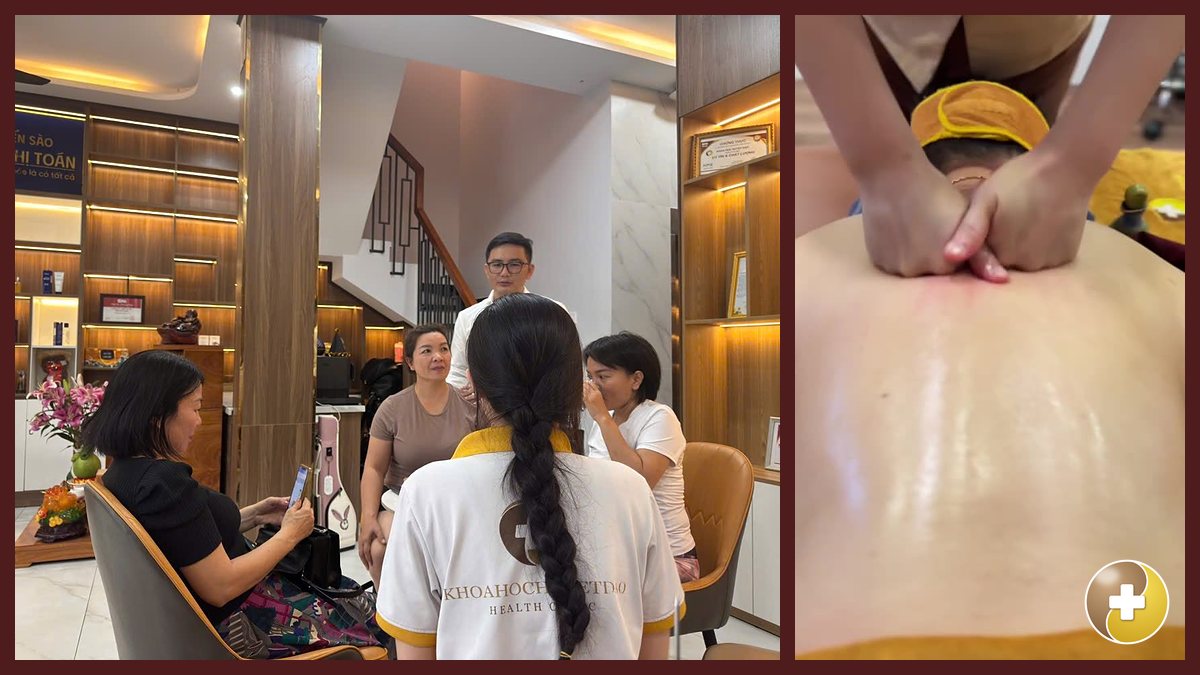
Quick answer: Neck and shoulder pain from factory shifts in Japan usually comes from standing at the line with your head bent, short sleep after night shifts and cold plant floors. Shoulder rolls and a warm neck help; in Japanese it is 肩こり (katakori). In Ho Chi Minh City, Tong Gia Acupoint Wellness reads the spine by hand, then relaxes the muscles and applies acupressure.
Want Lương Y Tống Văn Huynh’s team to read your spine and posture in person?
Why shift work in a Japanese factory leaves your neck and shoulders so stiff
January in Aichi, Osaka, Saitama or Fukuoka means mornings only a few degrees above zero. You cycle to the plant in the dark for the early shift, or walk out of a night shift at five in the morning with your shoulders pulled up to your ears from the cold. Inside, the work is precise and repetitive: assembling car parts, checking electronic components, packing lunch boxes on a line that runs through the night. Eight hours, plus overtime (残業, zangyō), with your head bent toward the conveyor. By the weekend, many technical interns, engineers and students doing part-time shifts say the same thing: my neck feels like stone.
Japanese has a word for this: 肩こり (katakori), a stiff, heavy, aching feeling across the neck, the top of the shoulders and the upper shoulder blades, sometimes climbing into the head. It ranks among the most common physical complaints in Japanese national health surveys, so it is not a problem only foreign workers face. In Western terms, most cases are mechanical neck and shoulder pain. The upper trapezius, levator scapulae, splenius and the small muscles under the skull work non-stop to hold a head that weighs about 4.5 to 5.5 kg in a forward position, and the further you bend, the more load the neck carries. Muscles held in one contraction for hours get less blood flow, waste products build up, and you feel heaviness, heat and tender knots.
It shows up most in:
- New technical interns still learning the line pace, who tense up to keep up.
- QC and maintenance engineers who peer at small parts, look up at machines, then sit at a computer.
- Students on night shifts in food plants and warehouses who also attend class by day.
- Welders, painters and assemblers working under car bodies with the neck tipped back and arms raised.
- People on shift rotations in Ho Chi Minh City factories and at Saigon Hi-Tech Park, whose routine looks much the same.
For the bigger picture of the neck and back after the flight home, read our main guide on spine care after a long-haul flight.
Common causes: the line, the night shift and the cold
- Standing with the head bent: line benches are set to an average height, so taller and shorter workers both adjust their posture. A 20 to 30 degree bend for a full shift keeps the back of the neck stretched and tense.
- Looking up and reaching high: work under a vehicle or on high racks compresses the upper neck joints and loads the muscles below the skull.
- One-sided repetition: a nut runner, cutter or tape gun in the dominant hand thousands of times a shift, so one shoulder always aches more.
- Night shifts and rotations: two-shift (二交代) or three-shift (三交代) patterns flip the body clock. Daytime sleep is light, and ongoing sleep debt makes muscles slower to relax and pain feel stronger.
- Cold floors and drafts: loading doors open all winter, plus a cold bike ride to work. Muscles contract to hold heat.
- Protective gear and lifting: helmets, goggles, crates on and off pallets, with few chances to pause.
- Stress: fear of mistakes or slowing the line, limited Japanese, homesickness. The shoulders rise and the jaw clenches without you noticing.
- Dorm life: a thin futon on the floor, a pillow that does not fit, late video calls home on your side.
- The trip home: about six hours in the air, heavy suitcases of gifts, then a long car ride to the family home.
If your neck is stiff right after landing, see also stiff neck after a long flight.
Related signs to watch for
- A heavy head at the back of the skull or temple aches after night shifts: tight suboccipital and splenius muscles.
- Fingers tingling briefly when you sleep on your arm or hold a tool for long: tension around C5 to C7 and the nerves to the arm.
- A hard knot between the shoulder blades, burning after long standing.
- Waking up unable to turn your head, turning your whole body instead.
- Mild dizziness when changing position after a short sleep.
- Shallow daytime sleep, then lying awake on your night off.
- Dry, tired eyes, irritability and calf cramps: in Eastern thinking often linked to the Liver.
- Cold hands, a cold lower back and ringing ears in winter: often linked to the Kidney.
The Tong Gia curriculum puts it simply: pain shows up in one place, but its source is often somewhere else.
When to see a doctor
Most katakori eases with rest, enough sleep, warmth and stretching. With any of the following, please see a doctor at a medical facility and do not rely on massage. In Japan the ambulance number is 119; in Vietnam it is 115.
- Neck, shoulder or upper back pain with chest pain or tightness, shortness of breath, cold sweats, or pain spreading to the jaw or left arm: call 119 in Japan or 115 in Vietnam right away.
- A drooping face, slurred speech, weakness or numbness on one side, double vision or unsteady walking: call an ambulance.
- A sudden severe headache, or high fever with a neck so stiff you cannot bring your chin to your chest.
- Arm numbness or weakness that keeps getting worse, dropping things, weakness in both arms or legs.
- Pain after a workplace accident, fall or blow to the head or neck: get checked and tell your company or supervising organisation so they can guide you through work-accident insurance (労災, rōsai).
- Pain that worsens at night at rest, with fever, unexplained weight loss or lasting fatigue.
- After the flight home, one calf swollen, painful, warm or red, or sudden breathlessness: this can be a clot; get checked now and do not have your legs massaged.
- Pregnancy or recent surgery: check with your own care team first.
Tong Gia does not read X-rays or MRI scans and does not make medical plans; if you have results from a hospital in Japan, bring them or tell us so the staff know which areas to keep gentle. This is a wellness service, not medical care.
Japanese phrases for neck and shoulder pain
Three words to remember: 肩こり (katakori), stiff shoulders; 首こり (kubikori), stiff neck; 首が痛い (kubi ga itai), my neck hurts. In Japan people usually go to an orthopaedics department, 整形外科 (seikei geka), for neck and shoulder pain. Bring your residence card (在留カード, zairyū kādo) and health insurance card (保険証, or a My Number card registered for insurance). If your Japanese is still basic, ask your company, supervising organisation or school about an interpreter.
| English | Japanese | Romaji | When to use it |
|---|---|---|---|
| My shoulders are very stiff. | 肩こりがひどいです。 | Katakori ga hidoi desu. | To start describing the problem |
| My neck hurts. | 首が痛いです。 | Kubi ga itai desu. | Pain in the neck |
| My shoulder hurts. | 肩が痛いです。 | Kata ga itai desu. | Pain in the shoulder |
| It hurts when I turn my neck. | 首を回すと痛いです。 | Kubi o mawasu to itai desu. | Hard to turn your head |
| My hand feels numb. | 手がしびれます。 | Te ga shibiremasu. | Tingling fingers or hand |
| I feel dizzy. | めまいがします。 | Memai ga shimasu. | Dizziness |
| It has hurt since three days ago. | 三日前から痛いです。 | Mikka mae kara itai desu. | Saying how long |
| It gets worse after night shifts. | 夜勤のあと、痛くなります。 | Yakin no ato, itaku narimasu. | Describing your work |
| My chest feels tight. | 胸が苦しいです。 | Mune ga kurushii desu. | Warning sign: emergency |
| Please call an ambulance. | 救急車を呼んでください。 | Kyūkyūsha o yonde kudasai. | Asking someone to call 119 |
| Please speak slowly. | ゆっくり話してください。 | Yukkuri hanashite kudasai. | When you cannot follow |
The marks in "ū" and "ō" mean a long vowel: hold the sound a beat longer.
The Y Tướng Học view: Liver, Kidney and Heart
Y Tướng Học (face reading for wellness) is a tradition over 2,000 years old built on one line: the signs show outside, the organs lie inside. Lương Y (traditional practitioner) Tống Văn Huynh organised this knowledge so staff read the face before they touch the neck. For shift workers, three organ systems are checked most.
Liver: tendons and blood. In the Tong Gia curriculum the Liver nourishes tendons and ligaments; when it is weak, muscles cramp and stiffen. The Liver also stores blood: at rest, blood returns to the Liver to be replenished. Rest at the wrong hours means tendons are less nourished, so a tight neck after months of night shifts makes sense in this framework. The Liver opens into the eyes (hours of inspection leave them dry and red) and is tied to anger and frustration. Eyebrows are seen as the surplus of the tendons; a knitted brow and creased forehead show the face and neck holding tension. People with high, thinly covered cheekbones are noted to have tight, cramp-prone trapezius and back muscles. The Gallbladder channel, paired with the Liver, is described as helping ease head and neck-shoulder pain.
Kidney: the root of the spine. The Kidney governs bone and marrow and corresponds to winter. A flat back of the skull is read as weak Kidney essence, often with deep muscle spasm around the upper neck, C1 to C3. A "Giáp" face (wide forehead, pointed chin) is noted for heat around C1 and C2 and a heavy head when short of sleep.
Heart: sleep. The Heart houses the spirit; deep sleep and a rosy face mean it is settled. Night shifts bring broken sleep, a pale or flushed face and palpitations. The curriculum groups headaches and poor sleep with the zones C1 to C7, D1 to D3 and the sacrum. This is observation for wellness, not fortune-telling or a medical finding.
Vertebrae and nerve-reflex areas involved
| Vertebrae | Nerves / function (anatomy) | Typical sign on shifts | Organ (Eastern view) | Outer sign (Y Tướng Học) |
|---|---|---|---|---|
| C1–C2 | Atlas and axis for turning the head; suboccipital muscles; greater occipital nerve from C2 to the scalp | Heavy head, ache up to the crown after night shifts | Kidney, Liver | Flat back of the skull; "Giáp" face with heat at C1–C2 |
| C3–C4 | Cervical plexus; phrenic nerve (C3–C5) to the diaphragm; upper trapezius, levator scapulae | Both sides of the neck tight, shoulders raised, shallow breathing when the line speeds up | Liver, Lung | Creased forehead, knitted brows |
| C5–C7 | Roots of the brachial plexus (C5–T1) to shoulder, arm and fingers | Dominant shoulder aching, fingers tingling with tools | Liver (tendons) | Uneven shoulders, high cheekbones |
| C7–T1 | Neck-chest junction, loaded when the head juts forward; C8–T1 roots to forearm and little finger | Hard bump at the base of the neck when inspecting | Kidney, Bladder channel | Forward head, rounded upper back |
| T1–T4 | Upper thoracic sympathetic chain (heart rate, airways); rhomboids, erector spinae | Ache between the shoulder blades, slight chest tightness | Lung (T3), Heart | Dry skin, frequent sighing |
The table lists related zones for hand reading, not a cause. The Tong Gia curriculum places neck and shoulder aches in its muscle-bone-joint group, working C5 to C7, L1 to L5 and S1 to S5 together, so people who stand all shift have the lower back read too.
Want Lương Y Tống Văn Huynh’s team to read your spine and posture in person?
How Tong Gia helps rebalance your neck and shoulders
Every session follows the spinal nerve-reflex balancing massage of Lương Y Tống Văn Huynh, founder of Huyệt Đạo Tống Gia (Tong Gia Acupoint Wellness), with over 13 years in traditional Vietnamese wellness, Y Tướng Học and this method.
- Questions and observation: what shift, standing or sitting, day or night, dominant hand, years on the line, hours of sleep, tingling, dizziness, calf swelling after the flight. Then posture, shoulder height, complexion, brows, cheekbones and ears.
- Reading the spine by hand: four factors from C1 down to the sacrum: skin temperature, the muscle layer, the shape of each vertebra and sensation, comparing left with right.
- Muscle release: suboccipitals, trapezius, levator scapulae, the dominant-side shoulder blade and the upper back, pressure building through five levels while staff check how you feel.
- Acupressure: Phong Trì and Thiên Trụ at the back of the neck, Kiên Tỉnh on top of the shoulder, Đại Chùy at its base, Thiên Tông on the shoulder blade, the Liver back point, and Thái Xung on the foot when stress is high. Work on a point stops when the skin turns from dry to slightly moist.
- Self-care: two or three moves you can do in a ten-minute break back in Japan.
You may feel tender spots at the back of the neck and on the dominant shoulder; as the muscle lets go the tenderness usually fades and the neck turns more easily. Some sleep long and deep that night, others feel a little sore for a day. Results vary and no one can promise the pain will be gone after one session.
- Neck and shoulder care, 60 minutes: 550,000 VND (about 21 USD), first visit 399,000 VND (about 15 USD).
- Neck and shoulder care, 90 minutes: 750,000 VND (about 29 USD) for years of shift work, upper back tension and broken sleep.
- Cold-releasing cupping, 30 minutes: 85,000 VND (about 3 USD) as an add-on after a Japanese winter.
Approximate rate 1 USD ≈ 26,000 VND; payment in VND. See prices and neck and shoulder massage.
From Tân Sơn Nhất airport, the District 12 branch (225 Dương Thị Mười, Phường Tân Chánh Hiệp) lies to the north and is usually not a long ride, depending on traffic. The Vinhomes Grand Park branch (Căn T16-21 khu Manhattan, Phường Long Bình, TP. Thủ Đức) is farther, especially at evening rush hour, and handy if you work at Saigon Hi-Tech Park; see massage for Thu Duc Hi-Tech Park workers. To stop on your way from the airport, read massage near Tan Son Nhat airport.
Self-care between shifts, and a word on Japanese pain patches
- Chin tucks: draw the chin straight back, hold five seconds, eight to ten times.
- Shoulder rolls: up, back and down, ten slow circles.
- Chest opener: clasp your hands behind your back, draw the shoulders back for 10 to 15 seconds, five times.
- Side neck stretch: ear toward shoulder, the same-side hand adding a very light pull, 15 seconds each side.
- Eye break: look into the distance for about 20 seconds after each round of inspection.
Switch hands when you can, and ask your team leader (班長, hanchō) about a mat or bench adjustment if the line height does not suit you. Keep the neck warm with a scarf or neck warmer. Stick カイロ (kairo) heat packs on clothing, never on bare skin, and not while sleeping, to avoid low-temperature burns. After work, soak in a bath at 38 to 40°C for 10 to 15 minutes; after a night shift, sleep in a dark room in one long block and skip alcohol as a sleep aid. The Tong Gia curriculum also suggests slow belly breathing (in through the nose for about four seconds, out for about six, for 5 to 10 minutes).
Drugstores in Japan sell 湿布 (shippu) patches, cooling (冷湿布) or warming (温湿布). They contain active ingredients: read the label and ask a pharmacist (薬剤師) first if you are pregnant, have asthma, allergies or sensitive skin. Do not use them on broken skin or under a heat pack, and remove them if the skin burns. Patches only soothe the spot for a few hours; posture, sleep and warmth still matter.
A suggested plan for your trip home
Direct flights from Narita, Haneda, Kansai or Chubu to Ho Chi Minh City take about six hours; from Fukuoka some routes are direct and others connect. Vietnam is two hours behind Japan, so jet lag is mild, but a week of night shifts can still flip your sleep.
| When | What your neck needs | What to do |
|---|---|---|
| 1–2 weeks before | No build-up before the trip | Message us to book; avoid piling on overtime right before you fly |
| Last shift | Reset to daytime sleep | Sleep one long block, warm bath, split gifts into lighter bags |
| Flight day | No slumped sleep | Neck pillow, walk once or twice, sip water, go easy on alcohol |
| Landing day | Rest and adjust to the heat | Let family lift the suitcases, light meal, sleep on Vietnam time |
| Day 2–3 | Release months of shift tension | A 60 or 90 minute neck and shoulder session |
| 2–3 days before returning to Japan | Ready for the first shift | A lighter session; read preparing your body before the flight back |
Book from Japan before you fly
Call, Zalo or WhatsApp +84 888 264 559 (0888 264 559 in Vietnam) with your landing date and time, where it aches (back of the neck, top of the shoulder, between the blades, any tingling) and which branch you prefer. Mention your type of shift so staff can suggest 60 or 90 minutes. You can also book online or read how to book a massage in Saigon from abroad.
- District 12 branch: 225 Dương Thị Mười, Phường Tân Chánh Hiệp (Tan Chanh Hiep Ward), Ho Chi Minh City. Open 8:00–19:00 daily (10:00–21:00 Japan time).
- Vinhomes Grand Park branch: Căn T16-21 khu Manhattan, Vinhomes Grand Park, Phường Long Bình, TP. Thủ Đức (Thu Duc City). Open 9:00–20:00 daily (11:00–22:00 Japan time).
Slots fill up before Tết, so message early. Real customer reviews are on Google Maps on each branch page.
Visit us
- Đông Y Huyệt Đạo Tống Gia Quận 12 (District 12)
225 Dương Thị Mười, Phường Tân Chánh Hiệp, Quận 12, HCMC · 8:00–19:00 daily · 0888 264 559 · Directions on Google Maps - Đông Y Huyệt Đạo Tống Gia Quận 9 (Vinhomes Grand Park, District 9)
Căn T16-21 khu Manhattan, Vinhomes Grand Park, Phường Long Bình, TP. Thủ Đức, HCMC · 9:00–20:00 daily · 0888 264 559 · Directions on Google Maps
Map of our two branches
Want Lương Y Tống Văn Huynh’s team to read your spine and posture in person?
What guests say on Google Maps
“I had tired eyes and tired neck and shoulders… my eyes felt less strained and I slept better… and there was a herbal foot soak, very comfortable.” (translated from a Vietnamese review)
— Thanh H., Google Maps review · District 12 branch · 12/2025 · See on Google Maps
Quoted from public reviews, shortened where marked (…). Experiences vary from person to person; reviews are not a substitute for seeing a doctor when something feels wrong.
Related guides for your trip
- Frequent-Flying Parcel Couriers With Heavy Suitcases: Sore Shoulders, Aching Back and Poor Sleep
- Crane operators abroad: neck and back pain from looking down all shift, and care on a visit to Vietnam
- Neck, shoulder and wrist pain from garment factory work in Japan: causes and recovery on your trip home
FAQ
Is neck and shoulder pain from factory shifts in Japan serious? Usually it is katakori, mechanical muscle tension from standing at the line with the head bent, short sleep and cold floors. It tends to ease with rest, warmth and stretching. Chest pain, breathlessness, a drooping face, worsening arm weakness or pain after a workplace accident need urgent care: call 119 in Japan.
What can I do for a stiff neck during a shift in Aichi or Osaka? In a ten-minute break, do chin tucks, shoulder rolls, a chest opener and a gentle side neck stretch. Keep your neck warm, put heat packs on clothing rather than skin, soak in a warm bath after work and sleep in a dark room after night shifts.
How do I say neck and shoulder pain in Japanese? Stiff shoulders is 肩こり (katakori), a stiff neck is 首こり (kubikori), my neck hurts is 首が痛いです (kubi ga itai desu), and my hand is numb is 手がしびれます (te ga shibiremasu). For neck and shoulder pain, people in Japan usually visit 整形外科 (seikei geka), orthopaedics.
Are Japanese pain patches (shippu) OK to use? They contain active ingredients and only soothe the area for a few hours. Read the label, ask a pharmacist if you are pregnant or have asthma, allergies or sensitive skin, and never use them on broken skin or under a heat pack. They do not replace stretching, sleep and posture changes.
When should I book a session on a two-week trip home? Rest on landing day and sleep on Vietnam time. Book a 60 or 90 minute neck and shoulder session on day two or three, and a lighter one two or three days before flying back. Message +84 888 264 559 from Japan to hold a slot, especially around Tết.
How much is neck and shoulder care at Tong Gia? Neck and shoulder care is 550,000 VND for 60 minutes (399,000 VND on a first visit) and 750,000 VND for 90 minutes; cold-releasing cupping is 85,000 VND for 30 minutes. That is roughly 21, 15, 29 and 3 USD at 1 USD ≈ 26,000 VND; payment is in VND.
Author: Lương Y Tống Văn Huynh – founder of Huyệt Đạo Tống Gia, a master of traditional Vietnamese wellness with over 13 years in Eastern wellness care, Y Tướng Học (face reading) and spinal nerve-reflex balancing massage.
Updated: 2026-11-15
Related guides
This is a wellness service, not medical care.