
Stiff neck after a long flight: why it locks up after 15–20 hours, and how to care for it in Ho Chi Minh City
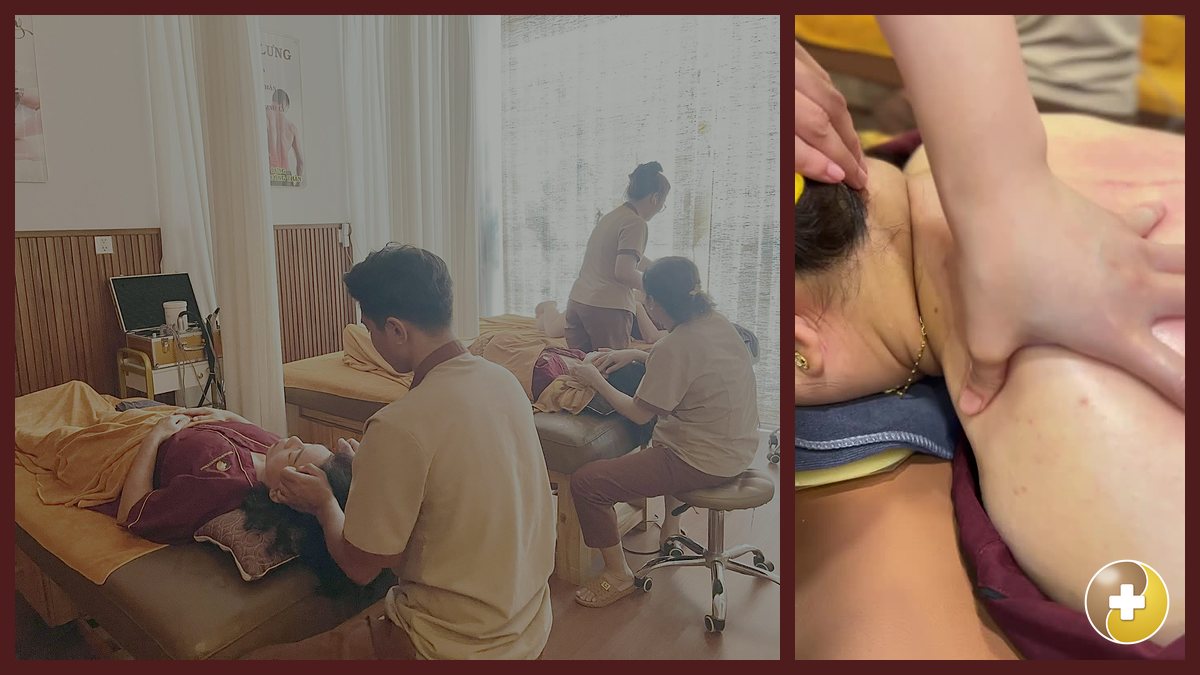
Quick answer: A stiff neck after a long flight usually comes from hours in one posture, sleeping slumped, a cold air vent and dry cabin air, which keep the neck muscles tight. Tong Gia Acupoint Wellness (Huyệt Đạo Tống Gia) in District 12 and Vinhomes Grand Park, Ho Chi Minh City, reads the neck by hand and releases it.
Want Lương Y Tống Văn Huynh’s team to read your spine and posture in person?
What a stiff neck after a long flight is, and who gets it
Flying home for Tết from the US, Canada, Europe or Australia usually means 15–20 hours door to door, transfers included. By the time you land at Tan Son Nhat, your neck can feel locked: turning to spot your suitcase on the belt pulls at the back of the head, both shoulders feel like you have been carrying a sack of rice, and an ache climbs from the hairline at the back of the skull to the crown. Often only one side is stiff, the side your head dropped to while you slept upright.
In Western terms this is mostly muscle strain and stiffness of the soft tissue around the neck, not a disease in itself. The neck has 7 vertebrae (C1–C7) holding up a head of about 5 kg. When the head tips forward or sideways, the load on the muscles at the back of the neck multiplies. Sit still in a narrow seat for hours and the small muscles under the skull, the upper trapezius and the levator scapulae have to hold the head up without a break. Blood flow slows, the muscles run short of oxygen, and even after you stand up they do not want to let go.
It is common among:
- Overseas Vietnamese (Việt kiều) flying home for Tết 2027 in economy, hour after hour.
- Older parents travelling with their children, whose neck joints are already worn and who doze longer in the seat.
- Office workers who already carry a forward-head posture; the flight just makes it obvious.
- Tall travellers, because the headrest sits below the neck and keeps pushing the head forward.
- Anyone lifting heavy suitcases and gift boxes into the overhead bin while the neck is cold and stiff.
Then Saigon in the days before Tết: market runs, cleaning the house, taking parents to see relatives on a motorbike, and late nights awake with jet lag and a phone in hand. The neck never gets a rest. This article focuses on the neck and shoulders; for the whole spine on a long-haul trip, read our main guide, spine care after a long-haul flight.
Common causes: the seat, upright sleep and cold air
- One fixed posture for too long: a narrow seat, a headrest that does not fit, looking down at the seat-back screen, a phone or a laptop on the tray table. A muscle held at one length for hours loses its spring.
- Sleeping slumped: the head falls to one side or forward. One side is stretched, the other shortened, so you wake with one stiff side that twinges when you turn. It works like neck pain after sleeping on a bus, only longer.
- Air vents and dry cabin air: the overhead vent blows on the back of the neck for hours and cold muscles tighten. Cabin air is dry, and many people drink little to avoid the toilet queue.
- Little movement: long sitting slows circulation; the legs swell and the neck and shoulders feel heavy too. Legs are covered in swollen legs after a long flight.
- Lifting bags overhead with a twist, when the muscles are already tight, can strain the neck and shoulder. See neck and shoulder muscle strain.
- Stress and short sleep: tight connections and a broken body clock keep muscles braced without you noticing. The Tong Gia course material notes that long-running mental pressure tightens the muscles of the scalp and the shoulder lifters, with aching that spreads up into the head.
- What was already there: wear in the neck joints or years of laptop posture. The flight does not create these, it makes them louder.
- A sudden change of climate: from a cold, dry winter into hot, humid Saigon, sweating, then straight into air-conditioning with a damp neck.
Signs that often come with it
- An ache from the back of the neck to the crown or temples, like a hat that is too tight. If your forehead throbbed and ears blocked on landing, that is a separate pressure issue.
- Trouble turning the head to one side, so you turn your whole body to look behind.
- Hard knots at the base of the neck or on top of the shoulders, tender when pressed.
- Brief tingling in the arm after sleeping on it, gone when you move. Lasting numbness or weakness is different, see below.
- Dry eyes, dry nose, dry skin after many hours in the cabin.
- Poor sleep from jet lag: muscles that never rest stay stiff longer; see jet lag and sleep after flying to Vietnam.
Muscle stiffness usually eases over a few days with gentle movement, warmth and sleep. Pain that keeps rising, spreads down the arm, weakens the hand or comes with fever is not simple muscle fatigue.
When to see a doctor
If a stiff neck after a long flight comes with any of these, see a doctor at a medical facility rather than relying on massage:
- Neck stiffness with fever, a severe headache, nausea or sensitivity to light, or you cannot bring your chin to your chest: go to an emergency room now.
- A sudden "thunderclap" headache, or sudden neck pain with dizziness, double vision, slurred speech, a drooping face, or weakness or numbness on one side: call 115 (Vietnam's emergency number).
- Lasting numbness or weakness in the arm or hand, dropping things, or unsteady walking.
- Pain after an injury: a bag falling on your head, a fall, a hard brake.
- Neck or left shoulder pain with chest pain or tightness, shortness of breath, cold sweats, or pain spreading to the jaw: call 115 immediately, no massage.
- After a long flight, one calf swollen, painful, warm or red, or sudden breathlessness: get checked now, no leg massage.
- Pain that is not easing after about a week, pain at night at rest, unexplained weight loss, or osteoporosis in older travellers: get checked alongside any wellness care.
This is a wellness service, not medical care. If any sign above applies, practitioners will not start and will ask you to get checked first.
The Y Tướng Học view: the Liver governs the sinews, the Kidney the spine
Y Tướng Học (face reading for wellness) has roots of more than 2,000 years in the idea that what is inside shows outside. Lương Y (traditional healer) Tống Văn Huynh systematised it for care at Tong Gia Acupoint Wellness (Huyệt Đạo Tống Gia): the signs show outside, the organs lie inside. It is observation for wellness care, not fortune-telling and not a statement that anyone has a disease.
Liver and the sinews. In this tradition the Liver stores blood, keeps energy moving and nourishes the sinews. Its early signals are tight shoulders and neck, cramps, dry tired eyes and irritability, which is exactly how many people feel after a long-haul flight. On the face, the eyebrows are read as the "surplus" of the sinews; knitted brows, a furrowed forehead and tense cheekbones show the face and neck are braced. Shoulders that feel hard as wood mean pressure has built up for a while and deserve proper muscle release.
Kidney and the spine. Bone, and so the spine, belongs to the Kidney, which is also linked to the lower back and the ears. A rounded occipital bone is read as a solid Kidney root; blocked ears on landing, a cold lower back or tired knees make practitioners look beyond the neck.
Lung, skin and nose. Dry cabin air dries the nose and skin. The Tong Gia course material advises keeping the neck and chest warm and out of direct cold drafts, and drinking enough warm water. A light scarf on board is worth packing.
The Gallbladder channel. The course material notes this channel's role in easing aches of the head, neck and shoulders; Phong Trì (GB20) at the base of the skull and Kiên Tỉnh (GB21) on top of the shoulder lie on it.
Spine segments and nerve-reflex zones involved
In the Tong Gia material, the neck (C1–C7) relates to the head, face, neck and arms, and the upper back (D1–D12, the thoracic spine) to circulation, breathing and digestion. Nerve roots leave the spinal cord through the gaps between vertebrae, which is where a practitioner's fingers read.
| Vertebrae | Nerves / function (Western anatomy) | What shows up after a flight | Organ | Outer sign (Y Tướng Học) |
|---|---|---|---|---|
| C1–C2 | Joint that lets the head rotate; small muscles under the skull; greater occipital nerve from C2 to the scalp | Heavy head, ache to the crown, hard to turn after upright sleep | Kidney, Liver | Flat back of the head |
| C3–C4 | Cervical plexus; phrenic nerve (C3–C5) to the diaphragm; upper trapezius, levator scapulae | Both sides of the neck tight, shoulders hunched, shallow breathing | Liver, Lung | Furrowed forehead, knitted brows, rock-hard neck muscles |
| C5–C7 | Nerve roots to shoulder, arm and fingers (brachial plexus C5–T1) | Sore shoulders, knots on the shoulder blade, brief arm tingling | Liver | Uneven shoulders, tense cheekbones |
| C7–T1 (Đại Chùy point) | Neck-to-chest junction that takes the load of a forward head | Hard bump at the base of the neck | Kidney, Bladder channel | Forward-head posture, rounded upper back |
| T1–T4 | Upper thoracic sympathetic chain linked to heart rate and airways; rhomboids | Ache between the shoulder blades, shallow breath | Lung, Heart | Dry skin and nose |
These are related areas, not a statement of cause. The course material groups neck and shoulder aches with muscles and joints (C5–C7 with the lower back and sacrum), and headaches and poor sleep with the nervous system (C1–C7, T1–T3 and the sacrum). So a traveller with a stiff neck and jet lag is read along the neck, upper back and sacrum, not just rubbed for five minutes at the nape.
The Tong Gia method after a long-haul flight
Sessions follow the method of the founder, Lương Y Tống Văn Huynh, with more than 13 years in Eastern wellness, Y Tướng Học and spinal nerve-reflex balancing, a Vietnamese traditional approach you can try while you are in Ho Chi Minh City.
- Questions and observation: flight length, which side you slept on, heavy lifting, any arm tingling, fever or calf swelling; then neck posture, shoulder height, complexion, brows, cheekbones and ears.
- Reading the spine by hand along C1–C7 and T1–T4: skin temperature, the muscle layer, the shape of each vertebra and tenderness, left against right. Warm, tight, sensitive areas are the focus.
- Muscle release of the muscles under the skull, the trapezius, the levator scapulae and the upper back, from light to firmer pressure, with mostly one finger or the flat hand around the neck and a steady rhythm.
- Acupressure on Phong Trì (GB20), Thiên Trụ (BL10), Kiên Tỉnh (GB21), Đại Chùy (GV14) and Thiên Tông (SI11), stopping when the skin over the point turns from dry to slightly moist.
- Self-care tips: two or three stretches that suit what was found, pillow height, getting back onto Vietnam time.
Three options that fit (full price list, more on neck and shoulder massage):
- Neck & shoulder care, 60 min: 550,000 VND (about 21 USD); first visit 399,000 VND (about 15 USD). For a stiff neck and heavy head after landing.
- Neck & shoulder care, 90 min: 750,000 VND (about 29 USD). For marked stiffness reaching the upper back, with jet lag.
- Cupping to release cold, 30 min: 85,000 VND (about 3 USD). An add-on if the vent blew on your neck all flight, only when your skin and condition suit it.
What guests tend to feel: travellers often say pressure near the hairline feels sore but good, the body warms up, turning the head is easier by the end and sleep comes more easily that night. Some feel mild muscle soreness the next day that settles within a day or two. Everyone is different; Tong Gia supports and helps rebalance the neck and shoulders, and does not promise the stiffness will be gone after one session. Bringing older parents? Read neck and shoulder massage for elderly parents, and for other questions from overseas Vietnamese, Viet kieu wellness visit to Saigon.
Want Lương Y Tống Văn Huynh’s team to read your spine and posture in person?
Self-care on the plane, at home and before the flight back
- Support the neck on board: sit right back, set the headrest level with your neck, wear a U-pillow turned towards the side you drop to, and do not let it push your head forward. Wrap a scarf and turn the vent away from your neck.
- Every 1–2 hours, walk the aisle, roll the shoulders ten times, tuck the chin five times. Sip water; go easy on alcohol and coffee.
- Lift with your legs: bend the knees, keep the bag close, ask for help with the overhead bin.
- At home, warm compress 15–20 minutes on the neck and shoulders, or a warm shower. No heat on a fresh bump that is swollen and hot.
- Three gentle moves morning and night: chin tuck for 5 seconds, ear towards shoulder for 15–20 seconds each side, hands clasped behind the back to open the chest. Stop if pain rises or the arm tingles. Press Phong Trì for 1–2 minutes.
- For the first 2–3 days, avoid long heavy motorbike rides and heavy lifting for Tết; split the housework.
- Before flying back, book a neck session one or two days ahead. Questions about massage after flying are also answered in jet lag massage in Saigon: Q&A.
How to book
- District 12: 225 Dương Thị Mười, Phường Tân Chánh Hiệp, Quận 12. Daily 8:00–19:00.
- Vinhomes Grand Park: Căn T16-21 khu Manhattan, Phường Long Bình, TP. Thủ Đức (Unit T16-21, The Manhattan, Thu Duc City, formerly District 9). Daily 9:00–20:00.
Both branches have genuine guest reviews on Google Maps. WhatsApp or Zalo +84 888 264 559 (0888 264 559 in Vietnam), or book online. Tết weeks are busy, so message before you fly with your flight length, which side is stiff and whether your parents are coming too. More for returning families on our overseas Vietnamese page.
Visit us
- Đông Y Huyệt Đạo Tống Gia Quận 12 (District 12)
225 Dương Thị Mười, Phường Tân Chánh Hiệp, Quận 12, HCMC · 8:00–19:00 daily · 0888 264 559 · Directions on Google Maps - Đông Y Huyệt Đạo Tống Gia Quận 9 (Vinhomes Grand Park, District 9)
Căn T16-21 khu Manhattan, Vinhomes Grand Park, Phường Long Bình, TP. Thủ Đức, HCMC · 9:00–20:00 daily · 0888 264 559 · Directions on Google Maps
Want Lương Y Tống Văn Huynh’s team to read your spine and posture in person?
What guests say on Google Maps
“The space is clean, cosy and smells lovely, and it feels very pleasant… after the session my neck and shoulders felt light, my body much more relaxed and my mind clearer and calmer.” (translated from a Vietnamese review)
— Anh Thư N., Google Maps review · Vinhomes Grand Park branch (District 9) · 11/2026 · See on Google Maps
“Worth a visit, skilled technicians. My neck and shoulders had been tired for a long time, and after the first session I felt lighter right away.” (translated from a Vietnamese review)
— Quyên P., Google Maps review · District 12 branch · 2025 · See on Google Maps
Quoted from public reviews, shortened where marked (…). Experiences vary from person to person; reviews are not a substitute for seeing a doctor when something feels wrong.
Related guides for your trip
FAQ
Is a stiff neck after a long flight something to worry about? Usually it is muscle strain from sitting 15–20 hours, sleeping upright and cold air, and it eases over a few days with gentle movement, warmth and sleep. Get checked right away if it comes with fever, a severe headache, arm weakness, slurred speech, chest pain, breathlessness or one swollen painful calf; call 115 if needed.
Why does my neck only get stiff after flying? On board, your neck holds a head of about 5 kg in one position for hours, in a narrow seat with a poor headrest, under a cold vent and in dry air. The muscles under the skull, the trapezius and the shoulder lifters stay braced and circulation slows, so they are still tight when you land.
One side of my neck is stiff after sleeping on the plane. What should I do? The stiff side is usually the one your head dropped towards. Use a warm compress for 15–20 minutes, gently tilt the ear to the opposite shoulder for 15–20 seconds, roll the shoulders, and do not crack the neck. Numbness down the arm, weakness or rising pain means getting checked at a medical facility.
How long does neck stiffness last after a long-haul flight? Muscle stiffness usually eases within a few days once you sleep on Vietnam time, move gently and avoid heavy lifting. If it has not improved after about a week, hurts at night or keeps getting worse, get it checked.
Can I get a neck massage right after landing in Saigon? Rest, drink water and walk around for a few hours first. Without warning signs such as fever, chest pain, breathlessness or a swollen painful calf, you can come that afternoon or the next day. Older parents or anyone with health conditions should mention them when booking.
60 or 90 minutes of neck and shoulder care after a flight? For a stiff neck and heavy head, 60 minutes at 550,000 VND (about 21 USD), or 399,000 VND on a first visit. For marked stiffness into the upper back with jet lag, 90 minutes at 750,000 VND (about 29 USD). A 30-minute cupping add-on is 85,000 VND.
Author: Lương Y Tống Văn Huynh – founder of Huyệt Đạo Tống Gia, a master of traditional Vietnamese wellness with over 13 years in Eastern wellness care, Y Tướng Học (face reading) and spinal nerve-reflex balancing massage.
Updated: 2026-11-15
Related guides
- Neck and shoulder muscle strain: how it differs from everyday stiffness, what to do in the first 48 hours and when massage makes sense in Ho Chi Minh City
- Stiff neck after a long flight: why it locks up after 15–20 hours, and how to care for it in Ho Chi Minh City
- Pain below the shoulder blade in Ho Chi Minh City: six causes, the warning signs, and how Tong Gia can help
- Shoulder joint pain in Ho Chi Minh City: six common causes, the warning signs, and how Tong Gia can help
- Trigger points: why a knot in the shoulder or hip sends pain to the head or leg, and how Tong Gia finds and releases it in Ho Chi Minh City
- What is muscle release? How it feels, who it suits and when to skip it
This is a wellness service, not medical care.