
Wintering in Vietnam: looking after your body for one to three months in hot, humid, air-conditioned Saigon
Quick answer: When wintering in Vietnam, most bodies need one to two weeks to adapt to Saigon's heat and humidity. A dry nose and scratchy throat usually come from air-conditioning and constant temperature swings. Drink steadily, avoid midday sun, keep your neck warm indoors. Tong Gia in District 12 and Vinhomes Grand Park offers a weekly lung-focused routine.
Want Lương Y Tống Văn Huynh’s team to read your spine and posture in person?
What wintering in Vietnam does to your body
Every year, more people swap a northern winter for a few months in Ho Chi Minh City. Vietnamese families living in Moscow, Saint Petersburg, Novosibirsk or Vladivostok come home from November or December until February or March, often staying through Tết. Long-haul visitors from Europe, North America and Russia do the same and call it wintering, or in Russian, "зимовка". It is a lovely idea, and also a real change for the body.
A one-week holiday is short enough that you simply push through. A stay of one to three months is different: your body has to move house. You leave freezing, dry air and centrally heated rooms, fly nine to ten hours or more, and land in Saigon's dry season, when daytime temperatures usually sit above 30°C, the sun is strong and the air is humid. Then you step into a mall, a café, a Grab car or a bedroom cooled to 18–20°C. Your nose and airways may go through five or six of these swings a day.
In Western physiology, heat adaptation is a real, measurable process: you start sweating earlier and more, blood vessels under the skin widen to release heat, and blood volume and heart rate adjust. It usually takes one to two weeks, longer for older adults, people who rarely exercise, and anyone with a chronic condition. During that time it is normal to feel tired, thirsty and a little foggy. At the same time your upper airway is working overtime. The nose warms, moistens and filters every breath; a layer of mucus and tiny cilia traps dust and germs and moves them out. Cold, dry air-conditioned air dries that layer, which is why you wake up with a stiff, crusty nose and a scratchy throat.
If you have just stepped off a long flight with a stiff back and neck, start with our cornerstone guide to spine care after a long-haul flight. This page is about the weeks that follow: breathing, nose and throat, skin and energy while you live in the heat.
Why long-stay visitors get a dry nose, sore throat and heat fatigue
- Constant hot–cold swings: 33°C outside, 18°C inside. Each time you walk in or out, the lining of the nose has to tighten and relax its blood vessels. Do that all day and you get a blocked or runny nose and morning sneezing. We cover this in detail in blocked nose in a hot, humid climate with air-con.
- Dry air from air-conditioning and the cabin: AC cools and removes moisture at the same time. Sleeping with the airflow on your face is the classic cause of a dry cough at night; see persistent dry cough from air-con.
- Not drinking enough for the amount you sweat: in a Russian winter you rarely feel thirsty. Here you lose far more water than you notice.
- Strong sun and high UV: winter skin burns quickly; walking at noon brings headaches and dizziness.
- Trapped sweat: heavy fabrics and long car rides lead to prickly heat and an itchy scalp.
- Small time shift, big lifestyle shift: Moscow is four hours behind Saigon, Vladivostok three hours ahead and Novosibirsk on the same time. The jet lag is mild, but late dinners, iced coffee and Tết parties still disturb sleep.
- Less deliberate movement: you avoid the heat, sit in cold rooms, round your shoulders and breathe from the upper chest.
Heat on its own can drain you too; our article on feeling tired in hot weather explains why.
Signs that often come along in the first weeks
- Dry, crusty or blocked nose at night, sneezing in the morning, a runny nose when walking from sun into cold air.
- Itchy throat, dry cough at night or early morning, a slightly hoarse voice.
- Shallow breathing, frequent sighing, getting winded on stairs in the heat.
- Skin that feels tight indoors and oily outdoors, prickly heat on the neck and back, cracked lips.
- Afternoon sluggishness, a heavy head, cramps in the calves after heavy sweating.
- A stiff neck where the AC blows, tense shoulders, an aching band between the shoulder blades.
- Loose stools or bloating for a few days, lighter sleep when the room is too cold.
If these ease week by week, your body is adapting. If they get worse, last longer than expected, or you notice anything in the next section, do not wait.
When to see a doctor
Please see a doctor or go to a medical facility if you notice any of the following:
- Chest pain or tightness, shortness of breath, cold sweats: call 115 (Vietnam's ambulance number) straight away.
- Heat stroke signs: high temperature, hot red skin, confusion, slurred speech, no sweating, fainting after time in the sun. Call 115 and move the person somewhere cool.
- One calf swollen, painful, warm or red in the days after a long flight, or sudden breathlessness. Get checked immediately and do not have the leg massaged.
- A cough lasting more than two weeks, coughing up blood, new wheezing, or needing to sit up to breathe.
- High fever with cough and cloudy phlegm, bluish lips or fingertips, night sweats, unexplained weight loss.
- Sudden high fever with headache, pain behind the eyes, body aches, a rash or bleeding gums: mosquitoes are around all year in Saigon, so get tested early.
- Repeated diarrhoea or vomiting with little urine, especially in children and older adults; blistering sunburn with fever.
- If you live with asthma, COPD, heart disease or diabetes, or take blood thinners, bring your prescriptions and ask your doctor how to keep your routine in the new climate. Never stop prescribed inhalers on your own.
Tong Gia does not read X-rays or MRI scans and does not replace medical advice. This is a wellness service, not medical care.
The Eastern view: Lung, Spleen and Kidney, and what the face shows
Tong Gia Acupoint Wellness (Huyệt Đạo Tống Gia) follows a Vietnamese Eastern wellness method built by Lương Y (traditional healer) Tống Văn Huynh over more than 13 years. In this tradition the Lung (Phế) is not just the organ in your chest. It is a whole system that governs breath, the movement of fluids, the skin and its pores, the nose and throat, the voice and your resistance to wind and cold. The Lung belongs to the Metal element, is paired with the Large Intestine, and is linked to grief. It is called the "delicate organ" because cold, heat and dryness reach it first. A winter visitor gets all three: cold AC wind, outdoor heat and dry indoor air.
Tong Gia's training material describes two common patterns. Lung qi deficiency means "not enough push": weak cough, breathlessness on effort, a quiet voice, sweating easily, dislike of wind, catching colds often, a pale face and pale tongue. Lung yin deficiency means "not enough moisture": dry cough, dry throat, hoarseness, flushed cheeks, night sweats, a red tongue with little coating. People who sit in dry AC all day and drink little tend toward the second; people who sneeze whenever the AC starts tend toward the first. These are wellness concepts used to guide care, not a judgement about your lungs.
The Lung works with the Spleen, which in this tradition "produces phlegm" that the Lung stores, so iced drinks and sweets can mean more phlegm. It also works with the Kidney, which "grasps" the in-breath; older adults with weaker Kidney energy often feel short of breath.
Y Tướng Học (face reading for wellness) rests on one line: "what shows outside reflects the organs inside". With winter visitors, Tong Gia practitioners look at:
- The nose, the gateway of the Lung. An upturned nose with visible nostrils and soft wings is described as an "open gate", prone to allergies and feeling cold.
- The point between the eyebrows (Ấn Đường). A narrow, sunken area with vertical lines points to stuck Lung energy: shallow breathing, sighing, sinus trouble.
- Skin and pores. Uneven, enlarged pores are linked with weak Lung energy and catching wind and cold easily; smooth skin with fine pores reflects strong Lung energy.
- The mouth. A mouth that rests slightly open lets cold air straight in, so the throat is dry in the morning and snoring is common.
- Face shape. A long but square "Đồng (同)" face belongs to the Metal type, centred on Lung and Large Intestine: dry cough, dry cracked skin, constipation, and a tight or prominent T3 vertebra.
The spine and the nerve-reflex areas involved
In anatomy, the diaphragm, your main breathing muscle, is driven by the phrenic nerve from C3 to C5, and sympathetic fibres to the lungs leave the upper thoracic spine. When you hunch in a cold room, the neck and the muscles between the shoulder blades tighten, the rib cage expands less and breathing gets shallower. Massage does not act on lung tissue itself; what hands can do is help the muscles around the neck, shoulders and upper back let go, so the chest and diaphragm move more freely.
| Vertebrae | Nerves / function (anatomy) | What winter visitors notice | Organ (Eastern view) | Outward sign (face reading) |
|---|---|---|---|---|
| C1–C3, base of skull | Occipital nerves, suboccipital muscles; skin sensitive to cold airflow | Stiff neck under the AC, heavy head, blocked nose with forehead pressure | Lung (opens to the nose); Liver governs tendons | Narrow brow area with vertical lines; upturned nose |
| C3–C5 | Phrenic nerve to the diaphragm, breathing rhythm | Shallow breathing, sighing, winded on stairs | Lung governs qi | Rounded shoulders, flat chest, quiet voice |
| C7–T1 (Đại chùy, Định suyễn points) | Neck–chest junction; trapezius tension | Sneezing, dislike of wind, dry cough with temperature swings | Lung (protective qi) | Cool skin at the nape, uneven pores |
| T3–T4 (Phế du, Quyết âm du) | Sympathetic fibres to lungs, bronchi, heart | Night-time dry cough, mild chest tightness, ache between shoulder blades | Lung and Heart | Đồng-shaped face; tight or prominent T3 |
| T11–T12 (Tỳ du, Vị du) | Sympathetic fibres to stomach, intestines, pancreas | Bloating, more phlegm after iced or sweet food | Spleen and Stomach | Pale lips, swollen tongue with tooth marks |
| L1–L2 (Thận du) | Kidney and adrenal area; water and salt balance | Strong thirst, dark urine, lower-back ache, short breath in older adults | Kidney grasps the breath | Dull ears, cold lower back |
How Tong Gia helps you rebalance during a long stay
The method is spinal nerve-reflex balancing combined with face reading. A session usually runs like this:
- Questions and screening: where you came from, how long you are staying, your AC temperature at night, how much you drink; pregnancy, asthma, heart or lung conditions, fever, a lingering cough, current prescriptions. Any warning sign above means no session and advice to get checked first.
- Observation: resting breath, chest or belly breathing, voice, complexion, nose, brow area, skin and posture.
- Reading the spine by hand: skin temperature, muscle tone, the shape of each vertebra and how you feel, comparing left and right. People who live in AC often show warm, tight "active" zones at the base of the skull, C7 and T3–T4.
- Muscle release of the shoulders, upper back and chest so the diaphragm and rib cage move more easily, from light to medium pressure.
- Acupressure: Phế du and Định suyễn on the back, Trung phủ and Đản trung on the chest, and points along the inner arm such as Xích trạch, Liệt khuyết and Thái uyên; Hợp cốc only when pregnancy is ruled out. Gentle rubbing of Nghênh hương beside the nose until warm.
- Breathing and home care: a few minutes of belly breathing or pursed-lip breathing, plus simple habits for AC and water.
What it usually feels like: the tight band at the nape and between the shoulder blades aches a little and then softens; the chest feels lighter, breaths go deeper, the nose may clear for a while and you feel warm and sleepy. Everyone responds differently, and no session promises an end to a blocked nose or cough.
Three services that suit a long stay (per session; full list on our prices page; approximate exchange rates, payment in VND):
- Lung wellness care, 90 min: 900,000 VND (about US$35 / €30). Shoulders, upper back and chest, the Lung points and breathing practice.
- Nose and sinus care, 60 min: 350,000 VND (about US$13.5 / €12). Face, nose, forehead and nape; for a dry nose or night-time blockage from AC.
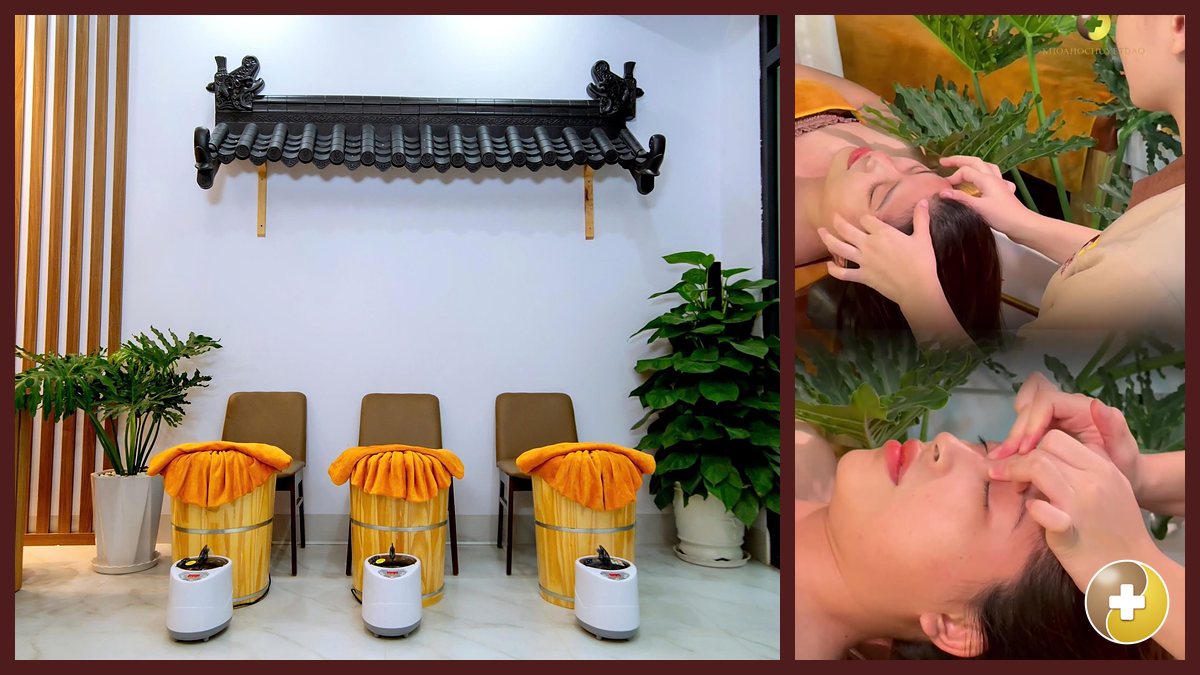
- Herbal steam: 120,000 VND (about US$4.6 / €4). Warming and relaxing after a session; tell us first about heart conditions, blood pressure or pregnancy. See herbal steam for a cold.
From the airport: from Tân Sơn Nhất airport, the District 12 branch (225 Dương Thị Mười, Tân Chánh Hiệp Ward) is the closer one, usually around 30–45 minutes by car depending on traffic. The Vinhomes Grand Park branch (Unit T16-21, Manhattan zone, Long Bình Ward, Thủ Đức City) is further away and takes longer, especially at rush hour. Most long-stay guests simply pick the branch nearest their apartment.
Want Lương Y Tống Văn Huynh’s team to read your spine and posture in person?
A suggested schedule for one to three months
| Period | What to do | At Tong Gia |
|---|---|---|
| Days 1–3 | Sleep, sip water through the day, walk early morning and late afternoon, avoid 11:00–15:00 sun, AC at 26–27°C at night | Rest first; if your back is stiff, read the spine-care guide |
| Weeks 1–2 | Gradually spend more time outdoors, wear a hat and breathable fabrics, carry a light layer for cold rooms | One Nose and sinus care session if your nose is dry or blocked |
| Weeks 3–4 | Regular sleep, fewer iced drinks and sweets | One Lung wellness care session, optional herbal steam |
| Month 2 | Daily belly breathing, morning movement | One session a week, alternating nose care and Lung care |
| Month 3 | Keep the rhythm, watch skin, nose and throat | One session every one to two weeks, as your body needs |
| 3–5 days before flying back | Early nights, plenty of water, warm clothes ready for landing | A light session one or two days before the flight |
Daily habits from Tong Gia's lung-care practice: belly breathing (in through the nose for about 4 seconds, out slowly for about 6, five to ten minutes a day); pursed-lip breathing when winded; rubbing beside the nose for one to two minutes; a light scarf in cold rooms and no airflow on your face at night; warm water spread through the day; a mask on a motorbike at rush hour. Moving back to Vietnam for good rather than for the winter? See our wellness routine for retiring in Vietnam.
Booking from abroad
Tong Gia has two branches in Ho Chi Minh City, open every day, with genuine customer reviews on Google Maps:
- District 12: 225 Dương Thị Mười, Tân Chánh Hiệp Ward, 8:00–19:00 daily.
- District 9 – Vinhomes Grand Park: Unit T16-21, Manhattan zone, Long Bình Ward, Thủ Đức City, 9:00–20:00 daily.
Message us on WhatsApp or Zalo at +84 888 264 559 or book online. Please send your landing date and time, how long you are staying, where you feel tight or uncomfortable, any health conditions, and which branch suits you. When it is 9:00 in Moscow it is already 13:00 in Saigon, so message during our opening hours for a quicker reply.
Visit us
- Đông Y Huyệt Đạo Tống Gia Quận 12 (District 12)
225 Dương Thị Mười, Phường Tân Chánh Hiệp, Quận 12, HCMC · 8:00–19:00 daily · 0888 264 559 · Directions on Google Maps - Đông Y Huyệt Đạo Tống Gia Quận 9 (Vinhomes Grand Park, District 9)
Căn T16-21 khu Manhattan, Vinhomes Grand Park, Phường Long Bình, TP. Thủ Đức, HCMC · 9:00–20:00 daily · 0888 264 559 · Directions on Google Maps
Map of our two branches
Want Lương Y Tống Văn Huynh’s team to read your spine and posture in person?
What guests say on Google Maps
“I came to Khoa Học Huyệt Đạo hoping to find knowledgeable staff who could help me recover after a lot of travelling and intense exercise… The facilities were very clean, which made the whole experience even more comfortable… I am from Canada, and the level of body knowledge and care I received here goes far beyond anything I have experienced back home.”
— Theresa B., Google Maps review · District 12 branch · 2025 · See on Google Maps
“Worth trying. No upselling, quiet and relaxing.” (translated from a Vietnamese review)
— Harley P., Google Maps review · Vinhomes Grand Park branch (District 9) · 2025 · See on Google Maps
Quoted from public reviews, shortened where marked (…). Experiences vary from person to person; reviews are not a substitute for seeing a doctor when something feels wrong.
Related guides for your trip
- Night leg cramps in Vietnam's heat: why your calves seize up, how to stretch and how to care for your legs
- Used to the Russian banya: what Vietnamese massage offers in Saigon, and who should skip the heat
- Is a strong massage better? How to choose the right pressure, how to ask for it, and when to keep it gentle
FAQ
How long does it take to get used to the heat when wintering in Vietnam? Most people adapt in one to two weeks as sweating, skin blood flow and blood volume adjust. Older adults, people who rarely exercise and anyone with a chronic condition may need longer. Increase time outdoors gradually, drink steadily and avoid the 11:00–15:00 sun. Confusion, fainting or a high temperature after sun exposure means calling 115.
Why is my nose so dry in Saigon when the air is humid? Because you spend hours in air-conditioning, which cools and dries the air, and you swing between 33°C outside and 18–20°C inside. Set the AC to 26–27°C at night, keep airflow off your face, drink warm water and rub gently beside the nose. A cough beyond two weeks, fever or breathlessness means you should see a doctor.
How often should I get a massage during a three-month stay in Ho Chi Minh City? A common suggestion is about once a week in the first two months, then every one to two weeks depending on how you feel; Tong Gia practitioners adjust this for each person. You can alternate Lung wellness care (90 min, 900,000 VND) and Nose and sinus care (60 min, 350,000 VND).
I am flying from Moscow. Which Tong Gia branch is closer to Tân Sơn Nhất airport? The District 12 branch at 225 Dương Thị Mười is closer, usually around 30–45 minutes by car depending on traffic, open 8:00–19:00. Vinhomes Grand Park in Thủ Đức is further and takes longer, open 9:00–20:00. If you are staying for months, pick the branch nearest your apartment.
Is herbal steam safe for older visitors from Novosibirsk or Vladivostok? Herbal steam is warming and relaxing, but older adults and anyone with heart conditions, blood pressure issues or pregnancy should tell the practitioner first, who may shorten it or skip it. Avoid it with a fever or right after time in the hot sun, and drink warm water before and after.
Can I book before I leave Russia? Yes. Message +84 888 264 559 on WhatsApp or Zalo, or use the online booking page, with your landing date and time, length of stay, areas of discomfort, health conditions and preferred branch. Moscow is four hours behind Saigon, so messages sent during our opening hours get the quickest reply.
Author: Lương Y Tống Văn Huynh – founder of Huyệt Đạo Tống Gia, a master of traditional Vietnamese wellness with over 13 years in Eastern wellness care, Y Tướng Học (face reading) and spinal nerve-reflex balancing massage.
Updated: 2026-11-15
Related guides
- Blocked nose and colds in hot, humid Saigon: why air-con hits your nose after winter, and how to care for it
- Wintering in Vietnam: looking after your body for one to three months in hot, humid, air-conditioned Saigon
This is a wellness service, not medical care.