
Blocked nose and colds in hot, humid Saigon: why air-con hits your nose after winter, and how to care for it
Quick answer: A cold after flying back to a hot, humid climate usually comes from the nose switching between about 33 degrees outside and 18 degrees in air-conditioned rooms, after hours in a dry cabin and jet-lagged nights. Warmth and enough water usually help. Huyệt Đạo Tống Gia in District 12 and District 9 offers nose and sinus care.
Quick answer: A blocked nose or cold after landing in hot, humid Ho Chi Minh City usually comes from the nasal lining swelling as you move between 33°C streets and 18°C air-con, after a day of dry cabin air. Tong Gia Acupoint Wellness (Huyệt Đạo Tống Gia) in District 12 and Vinhomes Grand Park works the face, neck and upper back to ease breathing.
Want Lương Y Tống Văn Huynh’s team to read your spine and posture in person?
Why your nose blocks up in a hot country
You leave Toronto, Montreal or Calgary in January at minus 15°C, or Stockholm, Oslo, Helsinki or Copenhagen in the short grey days of winter. The trip to Vietnam usually takes close to a full day once you add a connection in Taipei, Seoul, Tokyo, Doha, Dubai or Frankfurt. Then the doors open at Tân Sơn Nhất airport and the air is 32–34°C and heavy with humidity. The taxi is set to 18°C. So is the bedroom at your parents' house, the restaurant, the shopping mall. Two or three days later many returning Viet Kieu, and plenty of other long-haul visitors, wake up with a blocked nose, a string of sneezes, a scratchy throat and the chills, in the middle of a tropical dry season.
In Western terms, a blocked nose is mostly not "too much mucus". It is swelling of the nasal lining. Inside the nose sit the turbinates, ridges covered with a lining packed with blood vessels whose job is to warm, moisten and filter air before it reaches the lungs. Cold air, dry air and sudden temperature swings make those vessels widen, the lining puffs up, the airway narrows and the glands produce more mucus. This reaction is often called vasomotor (non-allergic) rhinitis. A "cold" in the medical sense is a viral infection of the upper airway, spread by droplets and hands, and it is common after airports, flights and big family gatherings. The two often arrive together: a nasal lining that is already dry and overworked is a weaker barrier, so viruses take hold more easily.
Who tends to get it:
- Viet Kieu from Canada and the Nordic countries home for Tết 2027, whose bodies are used to cold, dry air and indoor heating.
- People with existing allergic rhinitis, sensitive to house dust and to mould in air-con units that sat unused for months.
- Older parents and young children travelling with the family.
- Anyone who sleeps with the air-con blowing straight at the face.
- Jet-lagged travellers waking at 3 or 4 a.m. local time. Our pillar article on spine care after a long-haul flight covers the whole body after the trip; this one stays with the nose, throat and breathing.
Common causes: dry cabins, 33°C outside and 18°C inside
- Dry cabin air: humidity on board is far lower than in a normal home. After many hours the nasal lining dries, mucus thickens and the tiny hairs that sweep dust and viruses out slow down. Most people also drink less to avoid climbing over neighbours.
- Many temperature jumps a day: street to car, car to street food stall, stall to air-conditioned café. Each change makes the vessels in the nose contract and then widen again. Too many changes too fast and the lining stays swollen.
- Sweat meets a cold draught: you walk into an 18°C room with a damp shirt and the vent blows on your neck and chest. Goosebumps, then sneezing. Vietnamese families call it "trúng gió", catching the wind.
- Air-con units that need cleaning: a family home or rented flat left closed for months, dust and mould on the filter, switched on full blast the first night.
- Crowds and close contact: terminals, flights, year-end parties and visits to relatives, shared glasses and bowls.
- Short sleep from jet lag: Vietnam is 12 hours ahead of Toronto and 15 ahead of Vancouver in winter, and 6 hours ahead of Stockholm or Oslo. Poor sleep lowers resistance; see jet lag and sleep after flying to Vietnam.
- Tết food and iced drinks: beer over ice, fried food, sweet candied fruit. In Tong Gia's teaching material, "the Spleen produces phlegm, the Lung stores it": heavy, sweet and cold food tends to mean more phlegm.
- Decongestant sprays used for more than a few days: quick relief at first, then rebound congestion. Ask a pharmacist and keep it short.
Signs that often come with it
- Bursts of sneezing in the morning, clear runny nose, itchy eyes. See sneezing every morning.
- A nose that blocks as soon as you lie down, mouth breathing and a dry throat at dawn; more in stuffy nose at night.
- Dry, scratchy throat and a dry cough in cold rooms; related reading: persistent dry cough from air-con.
- A heavy head, pressure in the forehead or ache at the back of the neck when the vent blows on you.
- Chills, aching, tightness between the shoulder blades.
- Blocked ears after landing, especially if the nose was already congested.
- A hoarse voice, shallow breathing, dry skin and lips.
When it is only the lining reacting to dryness and temperature swings, things usually settle within a few days of keeping warm, drinking enough and adjusting the air-con. A viral cold commonly lasts about a week, sometimes ten days.
When to see a doctor
See a doctor at a medical facility, rather than relying on massage, if a blocked nose or cold comes with any of these:
- Breathlessness, wheezing, chest pain or tightness, cold sweats or blue lips: call 115 (Vietnam's emergency number) at once.
- After a long flight, sudden breathlessness, chest pain on a deep breath, or one calf swollen, painful and warm: call 115 or go to an emergency room, as this can be a blood clot. No leg massage.
- Fever of 38.5°C or more, or any fever lasting over 3 days; sudden high fever with body aches, pain behind the eyes, a rash or bleeding gums needs checking early, as dengue and flu circulate in Vietnam.
- Congestion lasting more than 10 days, or getting better and then worse, with thick yellow-green discharge and pain in the cheeks or forehead.
- Swelling around the eye, blurred or double vision, severe headache or a stiff neck: emergency care.
- Coughing up blood, a cough lasting over 2 weeks, night sweats or weight loss without a reason.
- A nosebleed that will not stop, or one-sided blockage with bleeding or loss of smell.
- Severe ear pain or discharge from the ear after landing.
- Asthma, COPD, heart disease, pregnancy, or fever in a small child or an older parent: ask a health professional early, and do not stop any preventive inhaler you have been prescribed.
This is a wellness service, not medical care. Following Tong Gia's own training material, practitioners will not start a session when warning signs such as coughing blood, breathlessness at rest, chest pain or high fever with a heavy cough are present; they will ask you to get checked first. Tong Gia does not read X-rays, MRI scans or lab results and does not draw up plans in place of medical care.
The Y Tướng Học view: the Lung opens into the nose
Y Tướng Học, the face- and body-reading tradition of Eastern wellness, has roots more than 2,000 years old in the idea that "what is inside shows outside". Lương Y Tống Văn Huynh, founder of Huyệt Đạo Tống Gia, applies it as "the signs are outside, the organ systems are inside". It is observation to guide wellness care, not fortune-telling and not a statement about any illness.
In this tradition the Lung (Phế) governs qi and breath, regulates water and supports the body's resistance. It "opens into the nose", governs the skin and body hair, and spreads the protective qi that sits at the surface. Tong Gia's teaching material calls the Lung the "delicate organ": easily disturbed by cold, by heat and by dryness. A trip from a Canadian or Nordic winter to Saigon delivers all three within days.
Two patterns are described. Lung qi deficiency, "not enough push": dislikes wind, catches colds easily and they linger, sweats easily, soft voice, pale complexion, tiredness. Lung yin deficiency, "not enough moisture": dry throat, dry cough, hoarseness, flushed cheeks, feeling warm in the afternoon. Returning travellers often show a little of both: they dislike the air-con draught yet their nose and throat are dry. These are Eastern wellness concepts, not Western disease names.
What practitioners look at:
- The nose: the bridge between the eyes (Sơn Căn), the tip (Chuẩn Đầu) and the wings. Firm, close-fitting wings and a full tip suggest abundant Lung qi. An upturned nose with visible nostrils and loose wings is described as an "open gate" through which outside influences enter easily, with a tendency to allergic rhinitis and feeling the cold.
- Between the eyebrows (Ấn Đường): narrow, sunken or with vertical lines and tight muscle is linked with constrained Lung qi, shallow breathing and sinus trouble.
- Face shape: the long, squarish "Đồng" face belongs to the Metal element and the Lung; the upper back often tightens or bulges around T3, where the Lung point Phế du sits.
- Skin and breath: dry skin, pale colour, shallow chest breathing, frequent sighing.
The Lung also depends on its neighbours: the Spleen "feeds" the Lung, and the Kidney helps draw breath deep. That is why a cold, sweet Tết menu often means more phlegm. A core Tong Gia saying: "Pain shows up in one place, but its source is often somewhere else."
Spine segments and nerve-reflex zones involved
In Tong Gia's material the neck vertebrae C1–C7 relate to the head, face, neck and arms, and the thoracic vertebrae T1–T12 to circulation, breathing and digestion. Anatomically, the blood vessels of the nasal lining are steered by two branches of the autonomic nervous system: sympathetic fibres from the upper thoracic spinal cord (roughly T1–T3) travel up the cervical sympathetic chain and shrink the vessels so the nose opens; parasympathetic fibres travelling with the facial nerve widen them and increase mucus. Sudden cold, stress and poor sleep tip that balance.
| Segment | Nerves / function (anatomy) | What you may notice | Organ system | Outer sign |
|---|---|---|---|---|
| C1–C3 | Suboccipital muscles, occipital nerves; superior cervical sympathetic ganglion at C2–C3 level, supplying the face and nasal lining | Heavy head, ache at the base of the skull in a draught, blocked nose with forehead pressure | Lung (opens into the nose), Kidney (root of the spine) | Vertical lines between the brows, tight muscles at the skull base |
| C3–C5 | Phrenic nerve to the diaphragm, the main breathing muscle; upper trapezius | Shallow chest breathing, mouth breathing, raised shoulders | Lung governs qi | Shoulders hitched up, soft voice |
| C7–T1 (Đại Chùy, Định suyễn) | Neck–chest junction, C8–T1 roots; in the material, Đại Chùy is used for colds and Định suyễn supports coughing | Chills at the nape, goosebumps in cold rooms, dry cough | Lung; Bladder channel, Governing Vessel | Prominent base of the neck, dislikes wind |
| T1–T3 (Phế du at T3) | Source of sympathetic fibres for the head and airways; rhomboids, upper back muscles | Ache between the shoulder blades, mild chest tightness, shallow breath | Lung, Heart | "Đồng" face, T3 tight or raised; dry, pale skin |
| T11–T12 (Tỳ du, Vị du) | Lower thoracic sympathetic supply to stomach and gut | Bloating after Tết meals, more phlegm after cold or sweet food | Spleen–Stomach (makes phlegm) | Square "Điền" face, thick tight lower back |
The table shows zones to examine, not causes. The material groups asthma and bronchitis with the internal-organ zone (T1–T12, L1–L3) and headache and poor sleep with the nervous-system zone (C1–C7, T1–T3, sacrum), as support only, never a replacement for medical care.
The Tong Gia method: rebalancing the face, neck, upper back and breath
Tong Gia is a Vietnamese Eastern wellness method built by Lương Y Tống Văn Huynh over more than 13 years of practice in Eastern wellness care, Y Tướng Học and spinal nerve-reflex balancing. A session for a blocked nose and chills after arriving follows the Lung-care sequence in the training material:
- Screening: flight length, days since landing, fever, cough, phlegm, breathlessness, chest pain, asthma, pregnancy, any spray you use. Warning signs mean no session.
- Observation: resting breath rate, chest or belly breathing, voice, complexion, nose wings, the area between the brows, posture.
- Reading the spine by hand along C1–C7 and T1–T4: skin temperature, muscle layer, vertebral shape and sensation, comparing left with right. Over-active zones are worked; under-active zones are not pressed directly.
- Releasing the shoulders, upper back and chest so the diaphragm and rib cage move freely.
- Pressing the right points: Ấn Đường and Nghênh hương beside the nose, Phong Trì at the nape, Đại Chùy, Định suyễn and Phế du on the upper back, Trung phủ and Đản trung on the chest, Liệt khuyết and Thái uyên on the wrist. Hợp cốc only when pregnancy is ruled out.
- Breathing and home care: belly breathing (in for 4 seconds, out for 6), rubbing Nghênh hương, setting the air-con.
Services that suit this (see prices):
- Nose and sinus care, 60 min: 350,000 VND (about US$13, CA$18, €12). For a blocked nose, forehead pressure and sneezing in your first week.
- Lung wellness care (Dưỡng sinh phế), 90 min: 900,000 VND (about US$35, CA$47, €30). When there is also a dry cough, shallow breathing, upper-back ache or dislike of wind.
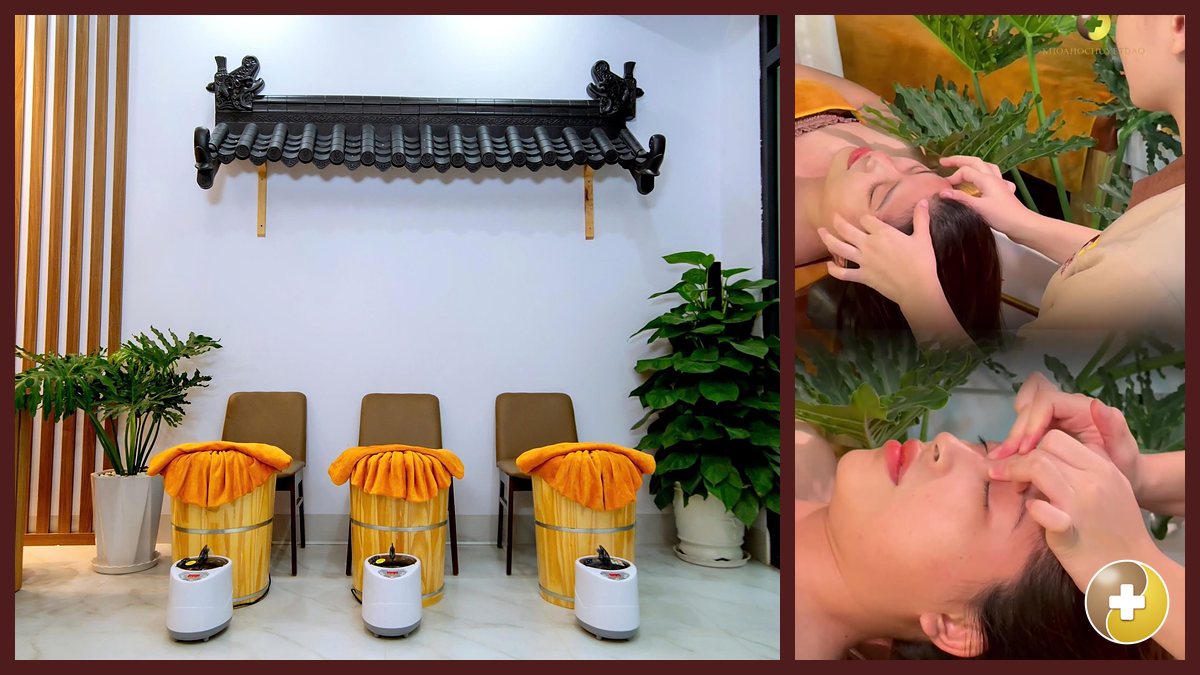
- Herbal steam: 120,000 VND (about US$4.60, CA$6, €4). An add-on for chills, only without fever.
Exchange rates are for reference; payment is in VND.
From Tân Sơn Nhất airport: the District 12 branch (225 Dương Thị Mười, Phường Tân Chánh Hiệp) lies to the north of the city and is usually around 30–45 minutes by car depending on traffic. Vinhomes Grand Park (Căn T16-21 khu Manhattan, Phường Long Bình, TP. Thủ Đức) is farther, with a longer drive, especially at rush hour. Please message ahead about luggage if you plan to come straight from the airport.
What you may feel: pressure at the nape and between the shoulder blades is usually tender but pleasant, the body warms, and as the upper back and chest loosen many people find their breath goes deeper. Some feel mild muscle soreness the next day. Everyone is different; Tong Gia supports and helps rebalance, with no promise that congestion will be gone after one visit.
Want Lương Y Tống Văn Huynh’s team to read your spine and posture in person?
A suggested plan for your trip and self-care
For a whole Tết week, see the 7-day wellness plan for a Tết visit; staying the whole winter, see wintering in Vietnam: a health routine.
| When | What to do |
|---|---|
| Before you fly | Sleep well for 2–3 nights; pack a light scarf, a thin jacket, a water bottle and saline nasal spray; ask family in Saigon to clean the air-con filter; message to book. |
| On the plane | Sip water, go easy on alcohol and coffee; turn the vent away from your face; wrap the scarf when sleeping; walk every 1–2 hours. |
| Day 1 | Warm shower, dry your hair; bedroom air-con around 26–28°C with the flap away from the bed; daylight to reset sleep. |
| Days 2–3 | Blocked nose but no fever: nose and sinus care 60 min, or Lung wellness care 90 min if there is a dry cough. |
| Days 4–10 | Dry off sweat before entering cold rooms; carry a light layer into malls and restaurants; fewer iced drinks. |
| 1–2 days before flying back | One more session for the nose or neck and shoulders; drink well, pack the scarf again. |
- Rinse the nose with saline morning and night.
- Rub Nghênh hương: index fingers either side of the nose wings for 1–2 minutes until warm.
- Belly breathing for 5–10 minutes a day.
- Keep the neck and chest warm, drink warm water; pear, lotus root and honey are suggested (no honey for babies under one). For congestion lasting weeks, read causes of a persistent stuffy nose and get checked.
Book from abroad before you fly
- District 12: 225 Dương Thị Mười, Phường Tân Chánh Hiệp, Quận 12. Daily 8:00–19:00.
- Vinhomes Grand Park: Căn T16-21 khu Manhattan, Phường Long Bình, TP. Thủ Đức (Unit T16-21, The Manhattan, Thu Duc City, formerly District 9). Daily 9:00–20:00.
Both branches have genuine guest reviews on Google Maps. From Toronto, Vancouver or Oslo, message WhatsApp or Zalo +84 888 264 559 (0888 264 559 in Vietnam), or book online. Send your landing date and time, what is bothering you (blocked nose, dry cough, fever or not) and which branch you prefer. Evening in Canada is early morning in Vietnam, so replies come during opening hours. Tết weeks fill up early. More for returning families on our overseas Vietnamese page.
Visit us
- Đông Y Huyệt Đạo Tống Gia Quận 12 (District 12)
225 Dương Thị Mười, Phường Tân Chánh Hiệp, Quận 12, HCMC · 8:00–19:00 daily · 0888 264 559 · Directions on Google Maps - Đông Y Huyệt Đạo Tống Gia Quận 9 (Vinhomes Grand Park, District 9)
Căn T16-21 khu Manhattan, Vinhomes Grand Park, Phường Long Bình, TP. Thủ Đức, HCMC · 9:00–20:00 daily · 0888 264 559 · Directions on Google Maps
Map of our two branches
Want Lương Y Tống Văn Huynh’s team to read your spine and posture in person?
What guests say on Google Maps
“I had a trial massage session and really enjoyed the experience. The massage was excellent… Everything was great, and I was very satisfied with the service.”
— Roman T., Google Maps review · Vinhomes Grand Park branch (District 9) · 10/2026 · See on Google Maps
“…they explained the close link between the organs inside and the signs the body shows outside; I understood it and saw there is a way to actively and sustainably look after my own health and my family's.” (translated from a Vietnamese review)
— Thục D., Google Maps review · Vinhomes Grand Park branch (District 9) · 2024 · See on Google Maps
Quoted from public reviews, shortened where marked (…). Experiences vary from person to person; reviews are not a substitute for seeing a doctor when something feels wrong.
Related guides for your trip
- Migraine sufferer: can I get a Vietnamese head spa in Ho Chi Minh City, and when is the right time?
- Can you get a massage after a heart stent? Who to ask first, how gentle it should be and when to call 115
- Massage after knee replacement: is it safe on a trip to Vietnam, which areas can be worked and what to avoid
FAQ
Why do I get a blocked nose in hot, humid Vietnam when I never do in a Canadian winter? In Toronto or Calgary your nose adapts to steady cold, dry air. In Saigon it has to warm, moisten and then cool air many times a day as you move from 33°C streets into 18°C rooms. The vessels in the nasal lining widen, it swells and blocks. A sweaty shirt in a cold draught adds chills and sneezing.
Is it a cold or an allergy if I sneeze every morning after flying in from Stockholm? Bursts of sneezing, a clear runny nose, itchy eyes and no fever lean towards a lining reacting to cold, dust or mould in an air-con unit that sat unused. A cold usually brings a sore throat, aching and a low fever and lasts about a week. High or lasting fever needs checking.
How long does a blocked nose from air-con last? If it is only dryness and temperature swings, it often settles within a few days once you raise the air-con to around 26–28°C, keep the vent off your face and drink enough. A viral cold lasts about a week. More than 10 days, worsening, or fever over 38.5°C means you should see a doctor.
Which acupressure points help a stuffy nose? Tong Gia's material uses Nghênh hương beside the nose wings, Ấn Đường between the brows, Phong Trì at the nape, Đại Chùy and Phế du on the upper back, and Liệt khuyết at the wrist. At home, rub Nghênh hương gently for 1–2 minutes until warm. Hợp cốc is avoided in pregnancy.
Can massage help a blocked nose, and which service should I book? Massage does not replace medical care, but releasing the neck, upper back and chest can make breathing feel easier. Tong Gia offers nose and sinus care, 60 min, 350,000 VND; Lung wellness care, 90 min, 900,000 VND; and herbal steam, 120,000 VND, if there is no fever. Book on +84 888 264 559.
Should I go straight from Tân Sơn Nhất airport to a massage? Only if you feel well enough and have no fever. The District 12 branch is usually 30–45 minutes by car depending on traffic; Vinhomes Grand Park is farther. Message ahead with your landing time and ask about luggage. Many people prefer to rest first and come on day 2 or 3.
Author: Lương Y Tống Văn Huynh – founder of Huyệt Đạo Tống Gia, a master of traditional Vietnamese wellness with over 13 years in Eastern wellness care, Y Tướng Học (face reading) and spinal nerve-reflex balancing massage.
Updated: 2026-11-15
Related guides
- Blocked nose and colds in hot, humid Saigon: why air-con hits your nose after winter, and how to care for it
- Wintering in Vietnam: looking after your body for one to three months in hot, humid, air-conditioned Saigon
This is a wellness service, not medical care.
Questions customers often ask
How long can a cold last after arriving in Vietnam before I should see a doctor?
If it is only the temperature change and dry air, symptoms usually settle within a few days; a viral cold often lasts about a week. See a doctor for a cough over two weeks, coughing blood, weight loss, night sweats, one-sided blockage with bleeding or loss of smell, or ear pain with discharge. For breathlessness, chest pain or blue lips, call 115.
Should I use a herbal steam room while I have a cold?
Only when you have no fever and feel well enough. The herbal steam session, 120,000 VND, is usually added after a care session for people who feel chilled and heavy. With fever, exhaustion, breathlessness, a severe headache or a stiff neck, skip the steam and see a doctor. Tong Gia technicians ask about your condition first.
My older parents travelled with me and keep catching colds. What should we watch?
Older parents and young children often have a weaker defence after a long flight. Make sure they sleep enough, sip water often, and never let the air conditioner blow straight onto their head or face at night; ask family at home to clean the filters before you arrive. Wheezing or blue lips means calling 115; a high fever needs a doctor.
Can Tết food and drinks make a cold worse?
They can. The Tống Gia curriculum says the Spleen produces phlegm and the Lungs store it: iced beer, iced drinks, fried food and sweet Tết snacks increase phlegm and make the nose and throat feel worse. In your first week back, cut down on cold, sweet and fatty food, drink warm water and rinse your nose with saline morning and night.
What is the difference between nose and sinus care and the lung wellness session?
Nose and sinus care, 60 minutes for 350,000 VND, works on the face, nose, forehead and neck with warm steam, suiting a blocked nose, heavy forehead and sneezing in the first week back. The lung wellness session, 90 minutes for 900,000 VND, is longer and covers the chest, upper back and neck along the Lung meridian, for a dry cough and shallow breathing.