
Back muscle release: which back muscles tighten, what a release session involves, and when to get checked first
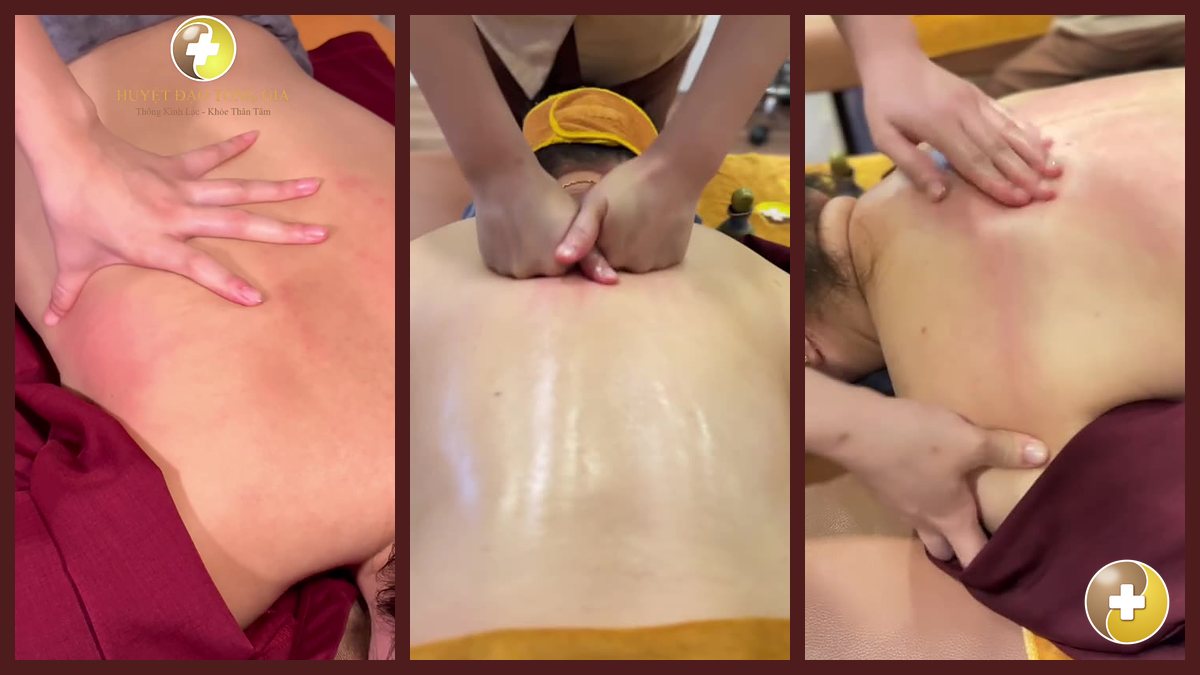
Quick answer: Back muscle release softens the tight bands running from between the shoulder blades down to the lower back, using pushing, circling, plucking and vibration exactly where the muscle is contracted, so bending and turning feel easier. Tong Gia Acupoint Wellness in District 12 and District 9, Ho Chi Minh City, reads the spine first; first visit 399,000₫.
Want Lương Y Tống Văn Huynh’s team to read your spine and posture in person?
What is back muscle release, and how is it different from a relaxing back massage?
Back muscle release means working deliberately on the bands of muscle that have locked up along the back so they soften, instead of spreading oil evenly over the whole back as in a relaxation massage. The practitioner has to find the exact tight spot, choose the right technique for that type of tissue and know when to stop. At Tong Gia Acupoint Wellness (Huyệt Đạo Tống Gia), this is done within a Vietnamese traditional method that starts by reading the spine by hand.
In Western anatomy, the back is built in layers. On the surface sit the middle and lower trapezius, covering the area between the shoulder blades, and the latissimus dorsi, the broad sheet wrapping the sides of the ribs down to the lower back. Underneath are the rhomboids, linking the spine to the inner edge of each shoulder blade. Deepest are the erector spinae, two long columns either side of the spine from neck to sacrum, and the quadratus lumborum deep at each side of the waist. A thick sheet of connective tissue, the thoracolumbar fascia, wraps the lower back.
When an area has to brace for hours (slouching, bending to lift, riding a motorbike, stress), the fibres cannot lengthen again. Small blood vessels inside the muscle are squeezed, less blood arrives, waste products linger and the muscle develops lumps that feel like cords or pebbles, sore when pressed and sometimes referring elsewhere. Over time the tighter side pulls the spine slightly off centre and the other side compensates, so the cycle repeats. A well-aimed release lets the fibres lengthen, improves circulation, stimulates skin receptors so pain is felt less for a while, and helps the autonomic nervous system shift into rest.
In Ho Chi Minh City, people asking for back muscle release are often office workers and developers sitting 8–10 hours a day, ride-hailing drivers, shift workers standing at machines, gym-goers, runners, badminton players and parents carrying small children. They describe the same thing: a back "stiff as a plank", bending feels blocked, and lying down does not loosen it.
Why back muscles tighten, level by level
Tong Gia divides the back into three levels to make tight areas easier to picture. Each level has its own typical habits.
| Back level | Muscles that tighten | Common habits and jobs | What people say |
|---|---|---|---|
| Upper back, between the shoulder blades (about D1–D6) | Middle trapezius, rhomboids, upper erector spinae | Laptop work with rounded shoulders, phones, carrying children, driving | Burning ache between the blades, shallow breathing, like wearing a heavy backpack |
| Mid back, below the shoulder blades (about D7–D12) | Erector spinae, latissimus dorsi | Long slouched sitting, stress, irregular meals, poor pull-up form | Rigid bands along the spine, urge to arch back, sometimes with bloating |
| Lower back, the waist (L1–S1) | Quadratus lumborum, lower erector spinae, glutes | Long rides, lifting, bending on shift, standing all day | Ache across the waist, pushing up with the hands to stand, stiff mornings |
Other causes are easy to miss: ongoing stress, which makes muscles brace without our noticing; air conditioning blowing on the back; low activity, so weak core and glute muscles leave the back to carry the load; overtraining without stretching; and very soft mattresses or long naps in a hammock. For more about back care in the city, see back massage in Saigon: Q&A.
Signs worth noting before back muscle release
- Pain that changes with position and eases with gentle movement: likely muscular, a good fit for release work.
- Cord-like bands or lumps that ache outward when pressed: exactly the kind of tightness release targets.
- Pain travelling into the buttock or leg with numbness: a nerve root may be irritated; this needs clarifying before the lower back is worked.
- Upper back pain on deep breaths or coughing: may be the muscles between the ribs, may be the lungs; with fever or breathlessness, get checked.
- One-sided flank pain with burning urination or fever: may involve the kidneys.
- A fresh strain from 1–3 days ago, sharp pain, hard to move: rest, use a compress, and wait for the acute stage to pass.
- History: pregnancy, high blood pressure, diabetes, osteoporosis, bleeding disorders, blood thinners. The Tong Gia curriculum requires these to be asked before any hands-on work.
When to see a doctor
Please see a doctor or go to a medical facility before any back muscle release if you have:
- Numbness in the saddle area (buttocks, groin, inner thighs), difficulty passing urine, or loss of bladder or bowel control: go to emergency now.
- Leg weakness, a foot that is hard to lift, frequent tripping, numbness spreading into both legs.
- Back pain after a fall or accident; sudden pain in older people or anyone with osteoporosis.
- Upper or mid back pain with chest tightness, breathlessness or cold sweats: call 115 immediately, no massage.
- Fever or chills; flank pain with burning urination or blood in the urine.
- Unexplained weight loss, ongoing fatigue, pale skin, or a history of tumours: get checked alongside any wellness care.
- Night pain, steadily worsening pain, or pain lasting more than 4–6 weeks.
- A known disc herniation, bone spurs or marked scoliosis: ask your medical team what level of pressure is acceptable.
This is a wellness service, not medical care. For guests who already have medical advice, Tong Gia only offers supportive care within those limits.
The Y Tướng Học view: every body type has its own kind of back
According to the Tong Gia curriculum, three organ systems in traditional Eastern terms are tied to the back muscles: the Liver governs the sinews (strong, the tendons are supple; weak, muscles cramp and stiffen; it is also linked with emotion, and long-held anger slows the flow of qi and blood), the Spleen governs the flesh and limbs (weak, the muscles go slack), and the Kidney governs the bones and marrow. The Bladder channel runs along both sides of the spine and carries the "back shu" points of the organs, such as the Lung, Liver, Spleen and Kidney shu points.
Y Tướng Học (face reading for wellness) rests on the idea that "what shows outside reflects the organs inside". Lương Y (master of traditional Vietnamese wellness) Tống Văn Huynh uses a person's build and face to anticipate the state of their back and choose the release technique. From the curriculum:
| Build or face shape | Typical back pattern | Suitable release approach |
|---|---|---|
| Firm muscle that feels hard as wood | Chronic deep contraction, especially trapezius and the long bands along the Bladder channel; risk of fibrous bands if not released in time | Pushing and circling, plucking along the fibres |
| Square, fleshy face (Điền 田) | Thick back muscle, large tight patches around D11–D12 | Pushing and circling over broad areas |
| Wide cheekbones (Thân 申) | Key points around D7 and D9, pulling the long back bands | Pushing, plucking along the bands |
| Long, square face (Đồng 同) | Upper back around D3 tightens and affects breathing | Upper back release with warmth |
| Bony, angular face (Vương 王) | Fibrous strands stuck in the joint gaps, vertebrae prone to tilt | Plucking and deep pushing to separate |
| Long, thin face (Mục 目) | Thin muscles beside the spine, deep hollows | Tonifying only: gentle vibration and light pressure |
| Round face (Viên 圓) | Cold skin at the waist, slack muscle, dull ache | Warming, vibration |
| Broad jaw (Phong 風) | Uneven tension when changing position, pain that moves | Movement-based work to catch the key point |
| Asymmetric face (Dụng 用) | Tilted axis, one side tight, the other weak | Two-sided balancing work |
The technician also looks at posture, shoulder and hip height and skin temperature under the hand. This is wellness knowledge for choosing a method, not a medical conclusion, and never a way to judge anyone.
Spine segments and nerve-reflex zones involved
In Tong Gia's spinal nerve-reflex balancing curriculum, the back D1–D12 serves circulation, breathing and digestion; the lumbar spine L1–L5 serves digestion, kidneys, urinary and reproductive organs and the legs; the sacrum and coccyx S1–S5 serve elimination and the lower pelvis. Nerve roots leave through the gaps on each side, so release works on the cushioning muscle around those gaps, never pressing straight on the bony spines.
| Segment / area | Nerves, function | Common feeling | Related organ (Eastern view) | Points often used |
|---|---|---|---|---|
| D1–D3 | Upper circulation and breathing | Ache between the blades, shallow breath | Lung, Heart | Lung shu (around D3) |
| D7–D9 | Upper digestion, rib area | Rigid bands, tight flanks under stress | Liver, Gallbladder, Spleen | Liver, Gallbladder and Spleen shu |
| D11–D12 | Digestion | Large tight patches, with bloating | Spleen and Stomach | Spleen and Stomach shu |
| L1–L3 | Kidneys, urinary, lower digestion | Cold, tired waist | Kidney | Kidney shu, Mệnh môn, Chí thất |
| L4–L5, S1 | Legs, sciatic roots | Low ache on bending, into the buttock | Kidney – Liver, Bladder channel | Glutes; Ủy trung behind the knee |
In the curriculum, the musculoskeletal group is worked through C5–C7, L1–L5 and S1–S5 together, and the internal organ and metabolic group through D1–D12 and L1–L3. So a back release at Tong Gia usually reads from the base of the neck to the sacrum, not only where the guest points. The table shows links for choosing areas, not conclusions about illness.
The Tong Gia method: back muscle release with spinal nerve-reflex balancing
This Vietnamese traditional method was developed by Lương Y Tống Văn Huynh, founder of Tong Gia, from over 13 years in Eastern wellness, Y Tướng Học and spinal nerve-reflex balancing. The curriculum sets out three "no"s: no chemicals or herbs taken or injected, no needles, no rough force. A back release session follows this order:
- Observe and ask: which level, how long, which side, any leg symptoms, job, training, medical checks, history; face shape, posture, shoulder and hip height.
- Read the spine by hand for the four objective signs: skin temperature, the cushioning muscle layer, spinal shape and sensation. Pressing checks skin warmth; stroking along muscles and the spinal groove finds tight spots; rolling feels each vertebra's shape (raised, raised-tilted, tilted, hollow-tilted, hollow). Left is compared with right, above with below, narrowing to the key point.
- Release by tissue type: pushing and circling for thick, rigid, immobile muscle; plucking across fibrous, taut strands; vibration for soft, thick or exhausted tissue; fine gliding and probing in hollows and grooves. Only "hot", contracted zones are worked; cool, inhibited zones are not pressed directly. Pressure rises through five levels, from one finger to full body weight. Stiff, stuck segments may be supported with compression methods, and a wave method sends an even rhythm from neck to tailbone.
- Acupressure on the right area: Lung, Liver, Spleen or Kidney shu points and Mệnh môn depending on the level, plus Ủy trung behind the knee, following the saying "for back pain, seek Ủy trung". The session stops at a point once the skin there turns from dry to slightly moist; hot areas are cooled and cool areas warmed.
- Self-care guidance: sitting posture, back stretches, how to rub the Kidney shu area at home.
A typical session: a developer in his early thirties who lifts weights four evenings a week described his mid back as "stiff as a plank"; after two hours of coding he had to arch backwards, and tying his shoes in the morning felt blocked. No leg numbness, no chest pain. The technician noted a Thân-shaped face and a lower right shoulder. Reading the spine showed both erector bands around D7–D9 hard as cords, the right side warmer, while the area around L2 was cool and slightly slack. The technician used pushing, circling and then plucking along the right D7–D9 band, then the left, followed by light vibration and warmth at L2, and finished on Ủy trung on both legs. He said the plucking was sore but "satisfying", his back grew warm and he dozed for a while; standing up, he reached his toes more easily than at the start. He was advised to stretch his back for ten minutes after each workout and stand up every 45 minutes while coding.
Suitable services (see the price list):
- Back and waist care, 60 minutes: 550,000₫ (about US$21), first visit 399,000₫ (about US$15); 90 minutes: 750,000₫ (about US$29). Ninety minutes suits stiffness across all three levels.
- Extra 30-minute area: 199,000₫ (about US$8), to add the back to another booking.
- Warming cupping, 30 minutes: 85,000₫ (about US$3), an add-on for a cold back or heavy air-conditioning exposure.
What guests feel: tight spots are sore but pleasant, the curriculum calls it a "sensation wave" that lets the body adjust itself; the back warms and many guests get drowsy. Afterwards bending, turning and arching feel easier, the back feels lighter and sleep is deeper; some feel mild muscle tiredness the next day, like after a light workout. Long-standing tightness usually needs a few sessions 5–7 days apart plus posture changes. Tong Gia supports balance and does not promise the pain will go. Related reading: a back massage session, step by step and massage after running in Thu Duc.
Want Lương Y Tống Văn Huynh’s team to read your spine and posture in person?
Back muscle self-care at home
- Stand up every 30–45 minutes, reach both arms overhead, roll your shoulders and lean to each side.
- Sit back in the chair with a small cushion behind the waist, the screen at eye level and shoulders relaxed.
- Ten minutes of stretching a day: cat–cow, knees to chest, lying spinal twist, child's pose. Stop if pain or leg numbness increases.
- Warm compress for 15 minutes in the evening when the back is stiff from cold or fatigue (not on a fresh, swollen strain). Rub the Kidney shu area as the curriculum suggests: warm your palms, place them on both sides of the lower back and rub up and down 50–100 times.
- Train with recovery: warm up first, stretch the back afterwards; lift with bent knees, the load close, and no twisting. More on acupressure basics: acupressure massage in Saigon.
Booking a back muscle release
Two branches in Ho Chi Minh City, open daily, with genuine guest reviews on Google Maps:
- District 12: 225 Dương Thị Mười, Phường Tân Chánh Hiệp (Tan Chanh Hiep Ward). 8:00–19:00 daily.
- Vinhomes Grand Park, District 9: Căn T16-21 khu Manhattan, Phường Long Bình, TP. Thủ Đức (Unit T16-21, Manhattan zone, Long Binh Ward, Thu Duc City). 9:00–20:00 daily.
Book online or call, Zalo or WhatsApp +84 888 264 559. Tell us which level of the back is stiff, for how long, whether it travels into the leg, whether you train, and whether you have had a medical check, so we can suggest 60 or 90 minutes.
Visit us
- Đông Y Huyệt Đạo Tống Gia Quận 12 (District 12)
225 Dương Thị Mười, Phường Tân Chánh Hiệp, Quận 12, HCMC · 8:00–19:00 daily · 0888 264 559 · Directions on Google Maps - Đông Y Huyệt Đạo Tống Gia Quận 9 (Vinhomes Grand Park, District 9)
Căn T16-21 khu Manhattan, Vinhomes Grand Park, Phường Long Bình, TP. Thủ Đức, HCMC · 9:00–20:00 daily · 0888 264 559 · Directions on Google Maps
Want Lương Y Tống Văn Huynh’s team to read your spine and posture in person?
FAQ
What is back muscle release, and is it the same as a back massage? Back muscle release finds the specific bands that have locked up along the back and softens them with pushing, circling, plucking and vibration, rather than covering the whole back evenly. At Tong Gia the spine is read by hand first to locate tight and weak areas before any technique is chosen.
Does back muscle release hurt? Tight spots feel sore, but in a pleasant way. In the Tong Gia curriculum pressure rises through five levels, only contracted zones are worked, and each point stops once the skin turns from dry to slightly moist. Thin people with little muscle get light vibration and gentle pressure.
Should I get a release for back pain after the gym? If it is stiffness and ache without sharp pain or leg numbness, a release one or two days later usually helps the muscles lengthen. A fresh strain with a sharp, swollen spot needs rest and a compress first; pain into the leg or leg weakness needs a medical check first.
How often should I book a back release if I sit all day? People with a lot of stiffness often start with one session a week for a few weeks, then every 2–4 weeks, combined with movement breaks and stretching at home. Your technician will suggest a schedule after reading your spine.
Can older parents have a strong back release? Strong pressure is not advised. Older people often have thin muscle and may have osteoporosis, so light pressure, vibration and warmth are used. Sudden pain or pain after a fall needs a medical check first. Mention age and health conditions when booking.
How much is back muscle release at Tong Gia? Back and waist care is 550,000₫ for 60 minutes (about US$21), 399,000₫ on a first visit, and 750,000₫ for 90 minutes. Warming cupping can be added for 85,000₫. Branches in District 12 and District 9 (Vinhomes Grand Park); call +84 888 264 559.
Author: Lương Y Tống Văn Huynh – founder of Huyệt Đạo Tống Gia, a master of traditional Vietnamese wellness with over 13 years in Eastern wellness care, Y Tướng Học (face reading) and spinal nerve-reflex balancing massage.
Updated: 2026-11-16
Related guides
- Hip and side cramps: six common causes, telling them from deeper pain, and how Tong Gia can help
- Pain in the middle of the back: four types to tell apart, warning signs, and how Tong Gia cares for it in Ho Chi Minh City
- Back pain and kidney failure: the signs that actually matter, the tests to ask for, and safe back care in Ho Chi Minh City
- Where is kidney back pain felt? Location, type of pain, warning signs, and how to tell it apart from a sore back muscle
- Swayback lower back pain: how an over-arched lower back causes aching, when to get checked, and how Tong Gia cares for it in Ho Chi Minh City
- Lower back pain with tired, weak knees: common causes, when to get checked, and how Tong Gia cares for the back and legs in Ho Chi Minh City
This is a wellness service, not medical care.