
Pain along the spine: why the back line aches, which signs need a medical check, and how Tong Gia cares for it in Ho Chi Minh City
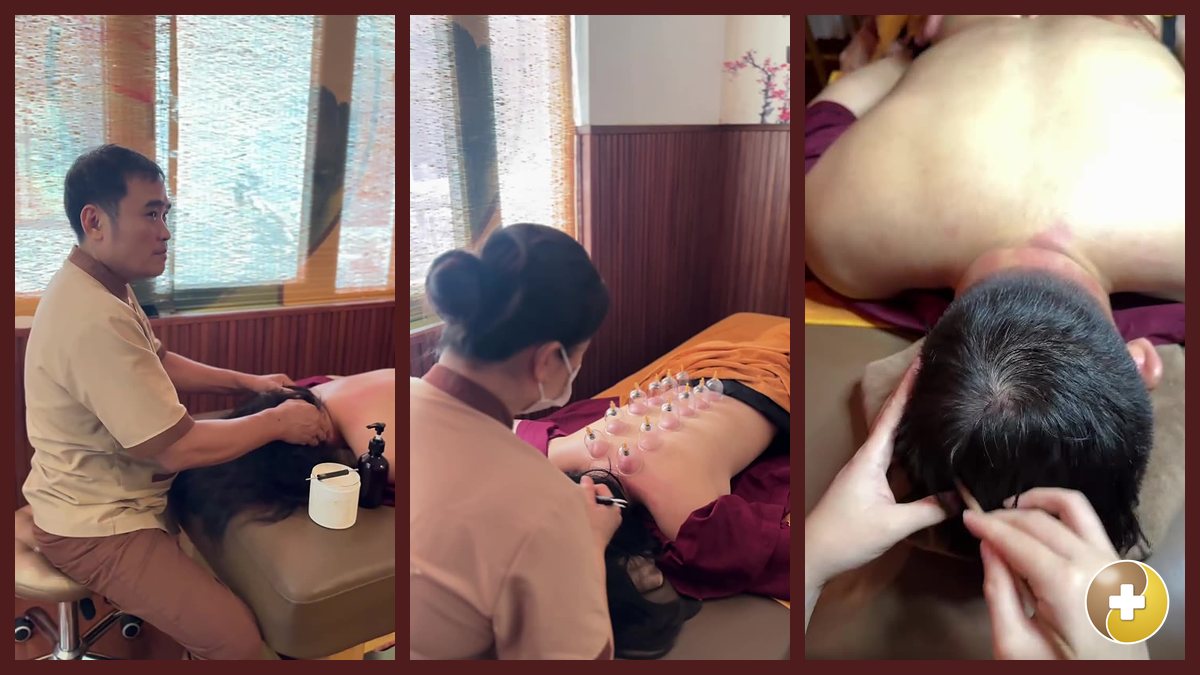
Quick answer: Pain along the spine is usually the muscles either side of it, strained by slouching, long bending or lifting badly; less often a disc, a vertebra or an organ. Fever, weight loss or leg weakness means get a medical check first. Tong Gia Acupoint Wellness in District 12 and District 9 releases these muscles by hand.
Want Lương Y Tống Văn Huynh’s team to read your spine and posture in person?
What is "spine pain" and who gets it?
Vietnamese people say đau sống lưng – literally "pain along the back line" – for pain, aching or stiffness that runs down the line of the spine. For some it sits right on the bony bumps you can feel under the skin; for others it is the two ropes of muscle running parallel on both sides of the spine; for others it is a whole strip from the base of the neck down to the lower back. In Western medicine this is a symptom, not a disease name. Where it hurts, how it hurts, what makes it worse and what comes with it tell you the likely cause.
An adult spine has 33 vertebrae: 7 cervical (C1–C7), 12 thoracic (D1–D12 in Vietnamese notation), 5 lumbar (L1–L5), then the sacrum and tailbone. Seen from the side, it has four natural curves: the neck curves slightly forward, the upper back slightly backward, the lower back forward again and the sacrum backward. These curves let the spine absorb load like a spring. Along both sides runs the erector spinae muscle group, plus many small muscles linking one vertebra to the next, with discs in between. When posture distorts these curves – a rounded upper back, an over-arched lower back, one shoulder lower, one hip pushed out – the muscles along the spine work overtime to compensate. That is where most spine pain comes from.
In Ho Chi Minh City we see this pain most in office workers and students glued to laptops, factory workers bent over a line all shift in District 12 and Thu Duc, ride-hailing drivers and couriers, hairdressers and nail technicians who twist to one side, new mothers carrying a baby on one hip, and older adults whose back muscles are thinning while the upper back slowly rounds forward. Expats often add long flights and hotel beds to the mix.
Common causes: posture, work, habits, environment
Spine pain falls into five common groups (from a Western medicine point of view). Use the table as a guide to decide between self-care and a medical check – it is not a medical verdict.
| Group | What it feels like | Typical person | What to do |
|---|---|---|---|
| 1. Postural muscle strain | Aching, heavy, burning strip either side of the spine; worse by afternoon, better lying down or with massage | Slouched sitters, people bending for hours | Change posture, stretch, release the muscles |
| 2. Acute strain or sprain | Sudden sharp pain after lifting, twisting or a hard sneeze; hard to bend or straighten | Lifting with the back, sport without warm-up | Relative rest 1–2 days, gentle movement; get checked if not easing |
| 3. Disc, wear-and-tear, bone spurs | Deep pain in one segment, may spread to buttock, leg or arm; tingling | Over 40, heavy work, very long sitting | Get checked; supportive care as advised |
| 4. Vertebra or spinal inflammation | Pain right on the bone, tender to tapping; long morning stiffness easing with movement | Older adults with osteoporosis; young men with months of stiffness | Get a medical check, imaging as advised |
| 5. Pain referred from organs | Deep dull pain that does not change with position; fever, burning urine, belly or chest pain | Any age | Get checked soon; heart or lung signs – call 115 |
Group 1 is by far the most common. When the upper back rounds and the head drifts forward of the body, the thoracic back muscles must hold the weight of head and shoulders like a rope holding a fishing rod. When the lower back sags or over-arches, the lumbar muscles are either squeezed or overstretched. Muscle that works too long gets less blood, develops tight knots that refer pain, and slowly becomes a hard "cable" along the spine. Habits that feed it: slumping on a sofa, perching on the edge of a chair, hours of phone scrolling, standing on one leg, a backpack on one shoulder, lifting from the floor with a bent back, and air-conditioning blowing straight onto the back at night.
Accompanying signs to watch
- Pain that changes with position – worse after sitting, better after walking, tender on the muscle strip: points to muscle, the easiest group to care for.
- Pain right on the bone, sharp when you tap a vertebra: think bone first and get a medical check before any massage.
- Tingling, numbness or weakness running into the buttock, leg or arm: a nerve root may be irritated.
- Morning stiffness lasting more than half an hour, for months, in a younger adult: see a musculoskeletal specialist.
- A changing shape: upper back rounding, one shoulder or hip clearly higher, uneven waist creases.
- Whole-body clues: tired knees, waking at night to urinate, a cold lower back; or frequent cramps and tight tendons; or weak limbs and soft muscles. Eastern medicine reads these as Kidney, Liver and Spleen signals.
When to see a doctor
Most spine pain is muscular, but some situations need a doctor first, not a massage:
- Chest tightness or pressure spreading to the back, breathlessness, cold sweats – call 115 immediately.
- Sudden, tearing pain along the back in someone with high blood pressure – call 115.
- Pain after a fall or accident, or sudden sharp pain over one vertebra in an older person or someone with osteoporosis.
- Weakness in both legs, numbness around the groin or anus, trouble passing urine or loss of control – go to emergency.
- Pain with fever, burning or bloody urine, colicky flank pain.
- Unexplained weight loss, night sweats, pain at night that no position relieves, or a history of cancer – please get a medical check alongside any wellness care.
- Pain lasting more than 4–6 weeks despite rest, or a curve or hump that is getting worse quickly, especially in a growing teenager.
Our standard advice: if pain is severe, sudden, or comes with fever, numbness, weakness, chest pain or breathing difficulty, please see a doctor first. This is a wellness service, not medical care. Tong Gia does not reshape the spine; for scoliosis, a hump or a disc problem, follow your doctor's plan. We only support the muscles once warning signs are ruled out.
The Eastern face-reading view: which organs, what signs
Eastern medicine reads the spine through three organs. The Kidney governs bone and marrow; when it weakens, the lower back and knees tire. The Liver governs the sinews; when it weakens, muscles and tendons stiffen and cramp. The Spleen governs muscle and the limbs; when it weakens, muscles go soft and the back muscles are too thin to hold the axis. Tong Gia's course book adds a point on the Lung: shallow breathing with a hunched back means the diaphragm barely moves, the lungs never fully open, and you tire, run short of breath and feel tense. A slouch is not only a back problem – it shortens your breath.
The Bladder meridian runs down both sides of the spine, paired with the Kidney meridian, and the Governor Vessel runs down the middle. Along the Bladder line, 1.5 cun from the midline, sit the "back-shu" points named after the organs – which is why Eastern medicine regards the back as a board that reflects the organs inside.
Vietnamese face reading (Y Tướng Học) says: "the sign is outside, the organ is inside." Its roots go back over 2,000 years; Master Tống Văn Huynh, a master of traditional Vietnamese wellness, systematised it for organ-based care. According to the Tong Gia course book, some face types call for a careful look at the spine: the bony "Vương" face with high cheekbones (vertebrae that tend to tilt, fibrous muscle stuck to the joints); the asymmetric "Dụng" face (a tilted axis, one side tight and one side slack); the long narrow "Mục" face (thin back muscles, vertebrae that sink – work gently); and a head tilted from birth or a crooked nasal bridge, which the school links with misalignment of the spinal axis and pelvis. The practitioner also looks at posture: rounded or flat upper back, raised or dropped shoulders, level hips. This is a school of observation for choosing where to work, never a medical verdict or a judgement.
Vertebrae and nerve reflex zones
| Segment | Governs (per the course book) | Typical spine complaint | Related organ (Eastern view) |
|---|---|---|---|
| C1–C7 (neck) | Head, face, neck, arms | Stiff neck pulling into the upper back, hands tingling after bending | Liver, Kidney |
| D1–D12 (thoracic) | Circulation, breathing, digestion | Rounded upper back, burning mid-spine, shallow breathing, bloating | Lung, Heart (upper); Liver, Spleen-Stomach (Spleen-shu below T11, Stomach-shu below T12) |
| L1–L5 (lumbar) | Digestion, kidneys, urinary, reproductive, legs | Lower back aching when standing, pain into buttock and leg, cold back | Kidney (Kidney-shu and Mingmen at L2) |
| S1–S5 and tailbone | Elimination, pelvic floor | Pain at the bottom of the spine when sitting or riding a motorbike | Kidney |
The course book groups neck pain, disc problems, bone spurs and sciatica as "muscle–bone–joint" and works C5–C7, L1–L5 and S1–S5 together – always as support, never replacing medical care. By hand, the practitioner reads four objective factors: skin temperature (warm means an "excited" zone, cool an "inhibited" one), the muscle layer (knotted, hard, slack, fibrous), the shape of each vertebra (raised, raised-tilted, tilted, sunken-tilted, sunken) and pain or tingling at the point.
The Tong Gia method: spinal nerve reflex balancing massage
This Vietnamese Eastern method was developed by Master Tống Văn Huynh, founder of Tong Gia Acupoint Wellness, from the Head-and-Spine school and over 13 years of practice in Eastern wellness, face reading and spinal reflex balancing. The school keeps three "No"s: no ingested or injected chemicals or herbs, no needles, no brute force. A session for spine pain:
- Observe and ask: which segment, which of the five groups, tingling or not, already medically checked or not; face type, standing and sitting posture, shoulders, hips. Warning signs mean we stop and refer you.
- Read the spine by hand: palm contact for skin temperature, strokes along the spinal groove, probing, rolling each vertebra from neck to tailbone; compare left–right and above–below.
- Release the muscles in "excited" zones only, with pressure building through five levels; pushing and rotating for thick, hard muscle, plucking across fibrous bands, vibration for soft or exhausted muscle; work on both sides together when one side is tight and the other slack.
- Press the right points: open the Bladder line on both sides; for a tired lower back, Kidney-shu, Mingmen, Zhishi and Weizhong behind the knee ("for back pain, seek Weizhong"). Stop when the skin over the key point turns from dry to slightly moist.
- Home care: sitting, lifting, stretches, warming the lower back.
A typical session: an accountant in his mid-thirties who aches from mid-back to lower back by late afternoon and has to arch backwards to feel better; his scans were clear. His upper back is rounded, right shoulder lower, weight on the right leg. The right-side muscle strip is warm and knotted, the left softer and cool. The practitioner releases the warm right side first, works the left gently, opens the Bladder line from neck to lower back and presses Kidney-shu and Weizhong. He describes it as "sore but satisfying", stands taller and warmer afterwards, and goes home with tips: raise the screen, a small cushion behind the lower back, stand up every hour.
Suitable services (see the price list): Back and waist care, 60 min: 550,000 VND (about US$21), first visit 399,000 VND (about US$15); 90 min: 750,000 VND (about US$29). Full-body care, 120 min: 950,000 VND (about US$37) for pain running the whole length of the spine. Cupping to release cold, 30 min: 85,000 VND (about US$3) after air-con or rain.
What you feel: tight points along the spine feel sore yet pleasant – the course book calls it "creating a sensation wave". Many guests stand straighter and feel warm and light right away, and sleep deeply that night; a few feel mild muscle tiredness the next day. We support balance; we do not promise the pain will vanish or the shape of the spine will change. Read more in our back massage Q&A, a guest's back massage experience in Saigon, and our cupping Q&A.
Want Lương Y Tống Văn Huynh’s team to read your spine and posture in person?
Self-care at home and prevention
- Sit well: hips to the back of the chair, a small cushion behind the lower back, screen at eye level, feet flat.
- Stand up every 45–60 minutes: walk a few steps, hands on hips, gently arch back five times, then bend forward five times.
- Lift with your legs: squat, keep the load close, back straight, stand up with your thighs; never lift and twist together.
- Warm the Kidney-shu area: rub your palms until warm, place them on both sides of the lower back and rub up and down 50–100 times.
- Keep the back warm and sleep before 11 pm: no air-con blowing on your back, a medium-firm mattress. Face reading fans can read our Eastern face reading Q&A.
Book a session
Tong Gia Acupoint Wellness has two branches in Ho Chi Minh City, open every day, with genuine guest reviews on Google Maps:
- District 12: 225 Dương Thị Mười, Tân Chánh Hiệp Ward (District 12). Open 8:00–19:00 daily.
- Vinhomes Grand Park, District 9: Unit T16-21, Manhattan zone, Long Bình Ward, Thủ Đức City. Open 9:00–20:00 daily.
Book online or call / Zalo / WhatsApp +84 888 264 559. Tell us which part of the spine hurts, whether you have tingling, and whether you have had a medical check, so we can suggest the right session.
Visit us
- Đông Y Huyệt Đạo Tống Gia Quận 12 (District 12)
225 Dương Thị Mười, Phường Tân Chánh Hiệp, Quận 12, HCMC · 8:00–19:00 daily · 0888 264 559 · Directions on Google Maps - Đông Y Huyệt Đạo Tống Gia Quận 9 (Vinhomes Grand Park, District 9)
Căn T16-21 khu Manhattan, Vinhomes Grand Park, Phường Long Bình, TP. Thủ Đức, HCMC · 9:00–20:00 daily · 0888 264 559 · Directions on Google Maps
Want Lương Y Tống Văn Huynh’s team to read your spine and posture in person?
FAQ
What causes pain along the spine? Most often the muscles either side of the spine are strained by slouching, long bending, standing on one leg or lifting badly. Less often it is a disc, wear-and-tear, a vertebra, spinal inflammation or pain from the kidneys, heart or lungs. Fever, weight loss, leg weakness or bladder changes need a medical check.
Is pain in the middle of the spine dangerous? If it is worse after sitting, better after walking and tender on the muscle, it is usually muscular. Pain right on the bone, pain at night, after a fall, or in someone with osteoporosis should be checked first. Chest pain or breathlessness means call 115.
Why does my spine hurt after sitting all day? A rounded upper back and sagging lower back make the spinal muscles hold your head and trunk for hours. Stand every 45–60 minutes, use a lumbar cushion and raise your screen. Spinal reflex balancing massage releases the strip that has hardened.
Can massage fix a hunched back or scoliosis? No. Massage does not change the shape of the spine. Scoliosis or a progressing hump needs a medical assessment. Tong Gia can support the tight and slack muscles on each side so the back feels more comfortable.
Does massage help spine pain? For muscular pain, releasing the spinal muscles and pressing the right points helps them soften; many guests stand straighter and feel lighter after one session. It does not replace a medical check when warning signs are present.
How often should I come? Many guests come weekly for a few weeks while they fix their posture, then every 2–4 weeks. Your practitioner suggests a rhythm after reading your spine; there is no fixed package you must buy.
Author: Lương Y Tống Văn Huynh – founder of Huyệt Đạo Tống Gia, a master of traditional Vietnamese wellness with over 13 years in Eastern wellness care, Y Tướng Học (face reading) and spinal nerve-reflex balancing massage.
Updated: 2026-11-17
Related guides
- Hip and side cramps: six common causes, telling them from deeper pain, and how Tong Gia can help
- Pain in the middle of the back: four types to tell apart, warning signs, and how Tong Gia cares for it in Ho Chi Minh City
- Back pain and kidney failure: the signs that actually matter, the tests to ask for, and safe back care in Ho Chi Minh City
- Where is kidney back pain felt? Location, type of pain, warning signs, and how to tell it apart from a sore back muscle
- Swayback lower back pain: how an over-arched lower back causes aching, when to get checked, and how Tong Gia cares for it in Ho Chi Minh City
- Lower back pain with tired, weak knees: common causes, when to get checked, and how Tong Gia cares for the back and legs in Ho Chi Minh City
This is a wellness service, not medical care.