
Pain below the knee: six common causes, the warning signs, and how Tong Gia can help
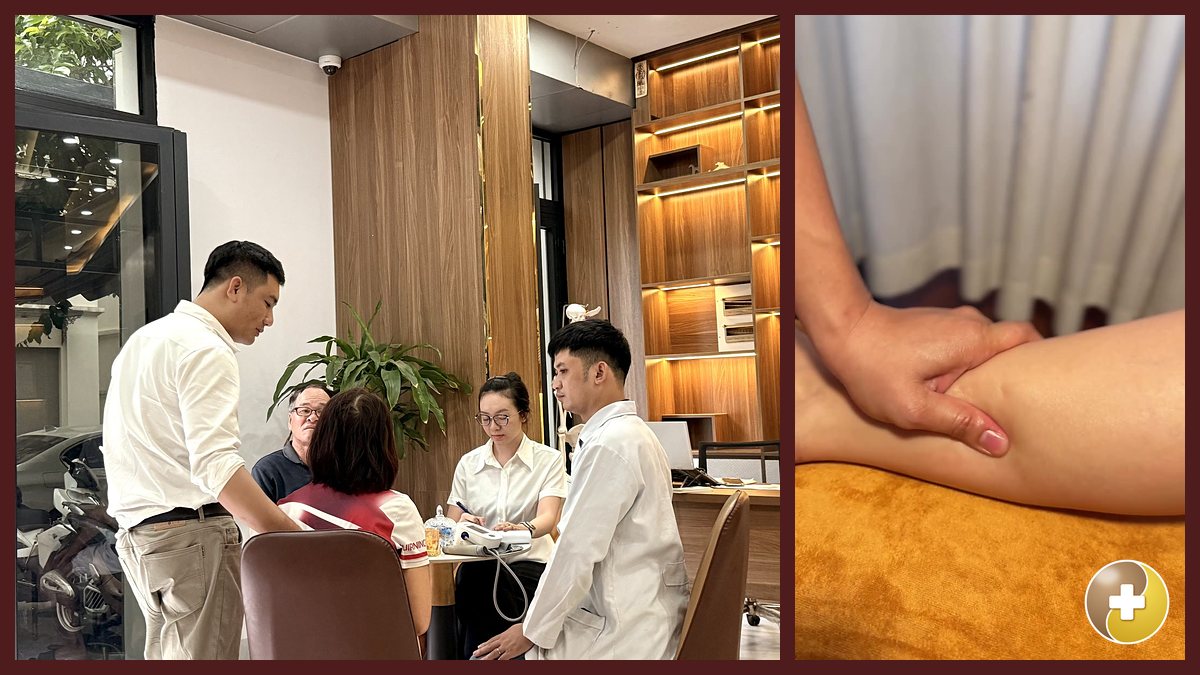
Quick answer: Pain just below the knee usually comes from an overloaded patellar tendon, irritation where the tendon attaches to the shinbone in growing teens, a bursa inflamed by kneeling, the inner "pes anserine" area, a meniscus strain or pain referred from the lower back. Hot swelling or being unable to walk needs a medical check. Tong Gia Acupoint Wellness (Huyệt Đạo Tống Gia) in District 12 and Vinhomes Grand Park, Ho Chi Minh City, cares for the muscles and tendons around it by hand.
Want Lương Y Tống Văn Huynh’s team to read your spine and posture in person?
What does pain below the knee mean?
"Pain below the knee" is an ache or sharp twinge just under the kneecap, on the bony bump at the top of the shin, or slightly to the inner side a few finger-widths below the joint line. Some people feel it walking down stairs, some when kneeling to clean the floor, some only after a run, a football match or a jump session, and some simply when they stand up after a long meeting.
In Western medical terms, the area under the knee is a crossroads. The patellar tendon runs from the lower edge of the kneecap to the tibial tuberosity, the bump on the front of the shin; it is the last link in the "pull cord" of the quadriceps, so every jump, uphill step and kick loads it. Small fluid sacs called bursae cushion the tendon in front and behind. On the inner side, just below the joint, three tendons from the thigh attach together in a spot nicknamed the pes anserine ("goose foot"). Inside the joint sit the menisci and a fat pad under the kneecap. Overload, friction or irritation of any of these can show up as pain below the knee.
So there is no single answer to "what is pain below the knee". It is a symptom, not the name of a condition. A 13-year-old basketball player with a tender bump below the knee is a very different story from a woman in her fifties with inner shin pain on the stairs, or from someone whose pain travels down from the lower back.
In Ho Chi Minh City, Tong Gia sees this pattern in teenagers who play a lot of sport; office workers who run, play pickleball or badminton at weekends without warming up; people whose jobs involve kneeling, such as tilers, painters and cleaners; women over 45 and people carrying extra weight; and older residents of high-rise apartments who take the stairs. This page walks through common causes, warning signs, the Eastern view and how Tong Gia's hands-on method can help.
Common causes: habits, work, posture and environment
These groups follow Western medicine and are here to help you describe your pain, not to label it yourself; only a medical facility can confirm a cause with an exam, ultrasound or imaging.
- Patellar tendon overload. Common with running, jumping, football, volleyball, heavy squats and hills. The pain sits right under the kneecap, worst when you start moving, go downstairs or rise from a squat. Long sitting stiffens the front thigh, then a big weekend session overloads the tendon.
- Growth-plate irritation in teens. Between roughly 10 and 15, the spot where the tendon attaches to the shin is still soft. Active children can develop a sore, slightly swollen bump there. It is usually linked to growth, but a medical professional should still confirm it and advise on activity.
- Bursitis from kneeling. Kneeling to clean, tile or pray presses the small sac in front of the tendon, which can swell like a soft water balloon below the knee.
- Pes anserine pain on the inner side. Tender a few finger-widths below the inner joint line; common in middle-aged women, people with extra weight, knee wear or slightly knock-kneed legs, and often mistaken for pain inside the joint.
- Meniscus, fat pad and joint wear. Twisting on a planted foot, or standing up suddenly after a long squat, can strain the meniscus; the fat pad can be pinched when the knee is locked straight. In older adults, wear in the joint can spread pain downward.
- Referred pain and environment. Lumbar nerve roots around L3–L4 supply the front thigh and the inner lower leg, so irritation there can be felt below the knee. Tight shin muscles after long runs, flat feet, worn shoes and cold air-conditioning on the legs all add load.
| Where it hurts | Often linked to | Typical situation |
|---|---|---|
| Right under the kneecap | Patellar tendon, fat pad | Running, jumping, squats, stairs down |
| Tender bump on the upper shin | Tendon attachment on the tibia | Teenagers in sport |
| Soft swelling in front | Bursa below the kneecap | Kneeling at work or prayer |
| Inner side, below the joint line | Pes anserine, knee wear | Middle-aged women, stairs up |
| Along the front of the shin | Shin muscles, bone lining | Long runs, mileage raised too fast |
| With numbness from the back | Lumbar roots L3–L4 | Long sitting, lifting, back pain |
For other running-related questions, see our massage after running Q&A.
Other signs to watch
- Swelling below the knee, or the whole knee bigger than the other side.
- Warm, red skin, sometimes with fever or chills.
- A tender bump on the shin in a growing child.
- Pain that spikes when you straighten the leg against force: kicking, jumping, a high step.
- Locking, giving way or buckling on stairs.
- Tingling on the inner lower leg, together with lower-back ache.
- One calf swollen, tight and warm.
Tip: for one or two weeks, note the exact spot (put one finger on it), what triggers it, morning or evening, any swelling and any new training. It helps a medical check and it is exactly what a Tong Gia practitioner asks first.
When to see a doctor
Please see a doctor first, and hold off on massage around the knee, if any of these apply:
- The area below the knee is very swollen, hot and red, especially with fever.
- Pain after a fall or blow, a "pop", a visible change in shape, or you cannot lift the straight leg.
- You cannot stand or walk on it.
- A child has lasting pain, a limp or night pain.
- One calf swollen, painful, warm and red: get checked at once, as this can be a blood clot; with chest pain, breathlessness or cold sweats, call 115 (Vietnam's emergency number) straight away.
- Night pain that rest does not ease, with unexplained weight loss or lasting tiredness.
- Pain with numbness, leg weakness or bladder changes.
- Pain lasting more than two weeks despite rest.
If a doctor is already following you for tendon problems, bursitis or knee wear, keep to that advice and tell the practitioner; a hot, swollen area is never worked on directly. This is a wellness service, not medical care.
The Y Tướng Học view: Liver, Kidney and Spleen
Y Tướng Học (face reading for wellness), taught at Tong Gia, rests on one idea: what is inside shows outside. According to the Tong Gia curriculum, the area below the knee, where tendon, bone and muscle work together, relates mainly to three organ systems:
- Liver governs the sinews. It nourishes tendons and ligaments. When it is strong, tendons are supple and joints move freely; when weak, muscles stiffen, cramp and lose flexibility. Liver blood deficiency shows as brittle nails, dry eyes and cramps.
- Kidney governs the bones. The curriculum lists aching lower back, weak tired knees and legs that tire quickly when standing as Kidney signs, cold with Kidney yang deficiency, warm palms and soles with Kidney yin deficiency.
- Spleen governs the muscles and limbs. When it is weak, limbs feel heavy and muscles soft, so the thigh cannot share the load and the tendon takes it all.
Outside signs you can check: thin, ridged nails and dry eyes (Liver); thin, soft ear rims (Kidney); flabby, cold or rock-hard thigh muscles (Spleen); knock knees, bow legs, flat feet or standing on one leg. These are cues to tailor the care, never judgements. More on our face reading for wellness page.
Spine segments and nerve-reflex areas involved
The curriculum maps 33 vertebrae: neck C1–C7 to head and arms, thoracic D1–D12 to circulation, breathing and digestion, lumbar L1–L5 to kidneys, pelvis and legs, and the sacrum S1–S5 to the lower pelvis. The muscle, bone and joint group works C5–C7, L1–L5 and S1–S5 together. For the area below the knee the focus is L2–L4, where the femoral nerve that drives the quadriceps begins.
| Segment | Nerve / function | Typical signs | Organ system |
|---|---|---|---|
| L1–L2 | Kidney area, lower back, hip flexors | Cold tired back, legs tire when standing | Kidney |
| L2–L4 | Femoral nerve: quadriceps, patellar tendon, inner knee and shin | Pain under the kneecap or inner shin | Liver, Kidney |
| L4–L5 | Front shin muscles | Tight shins when running | Liver |
| L5–S1 | Sciatic nerve: back thigh, calf | Tight back of knee | Liver, Kidney |
| D11–D12 | Digestion, energy for muscles | Soft muscles, heavy legs | Spleen |
The curriculum also uses "paired adjustment" (working a spinal key point together with a matching point on the limb) and a "screw press" technique meant for the knee and hip, so a session runs from the lower back to the ankle.
How Tong Gia works: spinal nerve-reflex balancing massage
This is a Vietnamese Eastern wellness method built by Lương Y Tống Văn Huynh, a master of traditional Vietnamese wellness with over 13 years in Eastern wellness care, Y Tướng Học and spinal nerve-reflex balancing. A session for pain below the knee follows clear steps:
- Observe and ask: the exact spot, triggers, swelling, new training, kneeling, any medical check; then nails, ears, thigh muscles and leg alignment.
- Read the spine by hand: skin temperature, muscle padding, vertebra shape and your sensations, comparing left and right.
- Find the key zone: usually around L2–L4 and the hip on the painful side, working only on overactive areas; a swollen spot is never pressed.
- Muscle release: lower back, buttocks, hip flexors, front and back thigh, back of the knee, shins and calves, in an even "wave" rhythm built from one finger according to your feedback.
- Acupressure: Kidney back point and Ming Men on the lower back, Wei Zhong behind the knee, Zu San Li and Yin Ling Quan on the lower leg, Tai Xi at the inner ankle, San Yin Jiao (not during pregnancy).
- Stop at the right moment: when the skin at the key point turns from dry to slightly moist.
- Home advice: stretches for the thighs, stair technique and how to build training back up.
Suitable services (same prices at both branches, full list on our prices page):
- Tired, heavy legs care, 60 min: 500,000 VND (about 19 USD).
- Lower back care, 60 min: 550,000 VND (about 21 USD); first visit 399,000 VND (about 15 USD).
- Herbal compress add-on: 130,000 VND (about 5 USD), never on a hot swollen area.
See also our sports recovery massage and foot massage pages.
A typical session
This is a composite of many sessions, not one guest's story. A man in his mid-thirties living near Vinhomes Grand Park had been increasing his morning runs quickly and developed pain right under his right kneecap, worse on stairs down and when rising from a squat; no swelling, and a medical check had advised less running and more stretching. The practitioner noticed he stood more on his right leg, his right front thigh was hard as wood and his nails had fine ridges. Reading the spine, L3–L4 on the right felt warmer, with uneven muscle on either side. The session released the lower back and hips, then the front and back thigh, knee crease and shin, with acupressure on Wei Zhong, Zu San Li, Yin Ling Quan and Tai Xi; the sore tendon itself was only stroked gently. At the end his squat felt less "pulled"; he went home with a nightly thigh stretch and a plan to rebuild his mileage slowly.
What guests feel
The tender spots are usually the front thigh, hip and lower back rather than the knee. As they soften, the tendon is pulled less and the legs feel warm and light; some guests feel mild thigh soreness for a day, like after a workout. Everyone is different, and Tong Gia does not promise the pain will be gone after one visit.
Want Lương Y Tống Văn Huynh’s team to read your spine and posture in person?
Home care and prevention
- Reduce load early: pause hill runs, jumps, deep squats and kneeling; walk on flat ground or cycle lightly with a high saddle.
- Stretch the thighs every evening: 20–30 seconds per side, never into sharp pain.
- Build up slowly: warm up 5–10 minutes and avoid big weekly jumps in distance or weight.
- Protect the knee when kneeling: use a soft pad, change position often, or sit on a low stool instead.
- Stay warm and keep weight steady: avoid cold air blowing on your legs, soak your feet in warm water for 15–20 minutes at night (people with diabetes should check the temperature carefully), and losing a few kilos lightens the knee. Visiting with older parents? See booking a massage for parents in Vietnam and our traditional Vietnamese massage Q&A.
Book a session
- District 12: 225 Dương Thị Mười, Phường Tân Chánh Hiệp (Tan Chanh Hiep Ward, District 12). Open 8:00–19:00 daily.
- Vinhomes Grand Park, District 9: Căn T16-21 khu Manhattan, Phường Long Bình, TP. Thủ Đức (Unit T16-21, Manhattan zone, Long Binh Ward, Thu Duc City). Open 9:00–20:00 daily.
Book online or call, Zalo or WhatsApp +84 888 264 559. Tell us which knee, the exact spot, since when, any swelling and whether you have had a check. Real guest reviews are on each branch's Google Maps page. Living in or visiting Ho Chi Minh City? Come and try a Vietnamese Eastern wellness method built by Lương Y Tống Văn Huynh.
Visit us
- Đông Y Huyệt Đạo Tống Gia Quận 12 (District 12)
225 Dương Thị Mười, Phường Tân Chánh Hiệp, Quận 12, HCMC · 8:00–19:00 daily · 0888 264 559 · Directions on Google Maps - Đông Y Huyệt Đạo Tống Gia Quận 9 (Vinhomes Grand Park, District 9)
Căn T16-21 khu Manhattan, Vinhomes Grand Park, Phường Long Bình, TP. Thủ Đức, HCMC · 9:00–20:00 daily · 0888 264 559 · Directions on Google Maps
Want Lương Y Tống Văn Huynh’s team to read your spine and posture in person?
FAQ
What causes pain below the knee? Most often an overloaded patellar tendon from running or jumping, irritation where the tendon attaches to the shin in growing teens, a bursa inflamed by kneeling, inner-side pes anserine pain, a meniscus strain, joint wear or pain referred from the lower back. Hot swelling, being unable to walk or pain beyond two weeks needs a medical check.
Why does my knee hurt when I straighten my leg? Often an irritated patellar tendon, a pinched fat pad under the kneecap, or tight hamstrings pulling on the knee. If the knee locks or you cannot lift the straight leg, get it checked soon.
Is knee pain in teenagers serious? Active children aged about 10 to 15 often get a sore bump below the knee linked to growth. It is usually not dangerous, but have it checked for activity advice, and go promptly if there is a limp or night pain.
What should I do after knee pain from sport? Rest that sport for a few days, apply a cool pack for 10–15 minutes if it is fresh, stretch gently, then return with a proper warm-up and gradual load. A pop, fast swelling or pain after a collision needs a check first.
Can I cycle with pain below the knee? If there is no hot swelling, easy cycling with the saddle high enough that the knee is nearly straight at the bottom usually loads the tendon less than running. Avoid hills and heavy gears; stop if pain rises.
Does massage help pain below the knee? When tight thighs, hips or calves are pulling on the tendon, muscle release and acupressure help them soften, and many guests find stairs easier afterwards. Tong Gia never works on a hot swollen area and does not promise the pain will go; injuries need a medical check first.
Author: Lương Y Tống Văn Huynh – founder of Huyệt Đạo Tống Gia, a master of traditional Vietnamese wellness with over 13 years in Eastern wellness care, Y Tướng Học (face reading) and spinal nerve-reflex balancing massage.
Updated: 2026-11-16
Related guides
- Cramp while swimming: six steps in the water, common causes, and how Tong Gia can help
- Calf pain: seven common causes, warning signs, and how Tong Gia can help
- Calf pain after running: seven common causes, warning signs, and how Tong Gia can help
- Knee pain from standing all day: why standing jobs strain the knees and how to look after them
- Knee pain in older adults: common causes, when to get checked and safe wellness care
- Tired legs from varicose veins: why legs feel heavy, when to get checked, and how Tong Gia cares for them safely
This is a wellness service, not medical care.