
Eye strain and a stiff neck from microscope work in electronics factories: causes and what helps
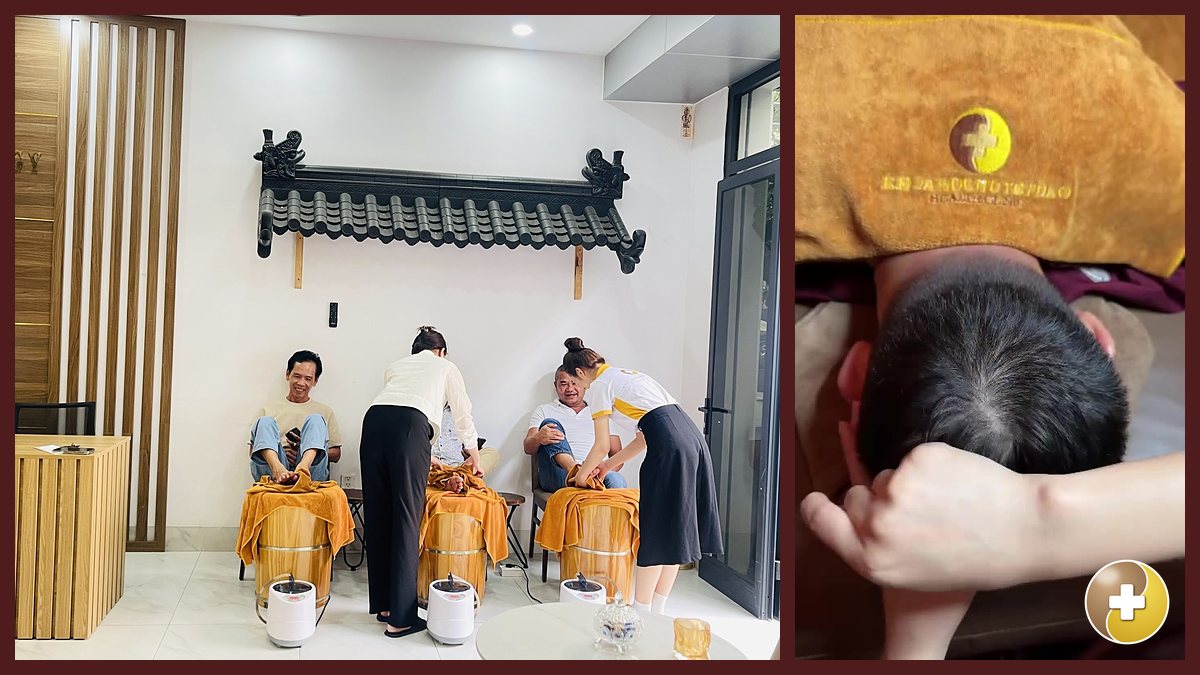
Quick answer: Eye strain and a stiff neck from microscope work come from hours of close focus with less blinking, while the head stays bent forward so the suboccipital and upper trapezius muscles tighten. The 20-20-20 rule and neck stretches help. Tong Gia Acupoint Wellness in Ho Chi Minh City offers head and neck-shoulder care.
Want Lương Y Tống Văn Huynh’s team to read your spine and posture in person?
Why microscope work tires the eyes and stiffens the neck, and why it is common in Hsinchu and Taichung
November is when the northeast monsoon starts to blow hard across Hsinchu, the city locals call "the windy city". Taichung is drier and sunnier, but mornings and evenings turn cool. In the semiconductor, component and circuit-board plants of the Hsinchu Science Park, the Central Taiwan Science Park in Taichung and the industrial zones around them, many Vietnamese women work in visual inspection: sitting at a stereo microscope, checking solder joints, component legs and scratches on boards and chips, picking parts with tweezers and logging defects. A shift lasts 8 to 12 hours, sometimes with weeks of overtime, eyes pressed to two eyepieces and head bent forward at almost the same angle. By the end of the shift the eyes sting, a bus number across the street looks blurred for a moment, and the back of the neck feels like a wooden board.
The same pattern shows up in engineers, lab staff, quality inspectors, jewellers and dental technicians who fly into Ho Chi Minh City after long weeks at a microscope. In Western terms, eye strain is a group of symptoms that appear after long, close, focused work: tired, burning, dry or watery eyes, short-lived blurring, heavy lids and an ache around the eye sockets, forehead and temples. Three things happen at once at a microscope:
- Constant focusing and convergence: the ciliary muscle inside the eye contracts to see fine detail, and both eyes must line up to fuse one image through two eyepieces. Even with well-set optics, many people unconsciously "lock" their focus as if looking at something very close, so the eye muscles tire hour by hour.
- Less blinking: concentration cuts the blink rate sharply, the tear film evaporates faster, and air-conditioned or filtered factory air speeds this up, so eyes feel gritty and red by the end of the shift.
- A fixed, bent neck: an adult head weighs roughly 4 to 5 kg. When it tips forward, the muscles at the back of the neck hold it for hours. Muscles under static load lose good blood flow, become tight and develop tender knots. The small suboccipital muscles just under the skull are packed with position sensors that work together with eye movements to keep the head steady, so tense eyes mean a tense neck, and a stiff neck makes the head heavy and the eyes more tired.
This article is different from headache and eye strain on night shifts, which looks at inspection lamps and daytime sleep, and from fatigue from cleanroom suits, which looks at whole-body tiredness. Here the focus is close-up eyes and a neck held in one position. The anchor article of this series is spine care after a long-haul flight.
Common causes: fixed close focus, a bent neck, long shifts and the windy season
- One viewing distance all shift: the eyes never refocus into the distance, so when you finally look up it takes seconds, sometimes minutes, for things to sharpen.
- Optics not set to your body: eyepieces too low force the neck to bend; the distance between eyepieces does not match your pupils; the dioptre for each eye is not adjusted, so one eye works harder.
- Chair and bench: a low stool with no back support, nowhere to rest the elbows, shoulders lifted to hold tweezers and turn the focus knob.
- Uneven light: a bright ring light, darker surroundings, and constant switching between eyepieces and a defect-logging screen.
- Dry air: air conditioning, cleanroom fans, and the dry monsoon wind outside in Hsinchu.
- Long shifts and hourly targets: twelve hours with output counted every hour, so people hesitate to stand up.
- Old glasses or early presbyopia: after 40 the eyes work harder to compensate.
- More close work after the shift: video calls home and scrolling in bed until late.
- A short, packed trip home: the flight from Taoyuan to Tân Sơn Nhất is about 3 to 4 hours and Vietnam is one hour behind Taiwan, so jet lag is mild. For visitors on long-haul flights from Europe, North America or Australia, add hours of sitting with the head bent over a screen. Then come heavy luggage, family visits, long car rides and Saigon's hot, bright, humid weather.
Poor sleep, rushed meals, drinking little water during the shift and stress also keep the neck and shoulders braced. Dry eye linked to thyroid problems, diabetes or glaucoma needs a proper medical check, not just a massage.
Related signs worth noticing
- Burning, gritty, red eyes at the end of the shift; watering in the wind.
- Blurred distance vision for a while after looking up from the eyepieces.
- Aching around the eye sockets, forehead or temples; a twitching eyelid.
- A heavy feeling at the back of the head or a band-like headache; see tension headache that feels like a tight band.
- A stiff neck that is hard to turn, clicking when you rotate it, heavy shoulders.
- Tired shoulders and brief tingling in the fingertips after long tweezer work; if numbness is strong, read hand numbness from assembly line work in Taiwan.
- Trouble sleeping, irritability, feeling drained after work.
According to the Tong Gia curriculum, the face directly reflects the state of the internal organs and the central nervous system, so the practitioner looks at the eyes, lids, complexion, neck posture and shoulder level before touching.
When to see a doctor
Eye strain and a stiff neck from close work usually ease with rest, posture changes and stretching. Please see a doctor at a medical facility right away, and do not use massage instead, if you notice:
- Sudden loss or blurring of vision, or a curtain-like shadow over part of what you see.
- Flashes of light or a sudden shower of dark floaters.
- Severe eye pain with a red eye, halos around lights, headache or nausea.
- Double vision or a drooping eyelid.
- A chemical splash (solvent, cleaner, solder paste): rinse with clean running water for about 15 minutes, then get checked; do not rub if a fragment flies into the eye.
- A red, painful, sticky eye or strong light sensitivity lasting more than 1 to 2 days.
- A sudden, explosive headache, or headache with fever and a neck too stiff to bend the chin to the chest.
- Numbness or weakness on one side, a drooping face or slurred speech: call 119 in Taiwan or 115 in Vietnam immediately.
- Chest pain, shortness of breath or cold sweats: call 115 (119 in Taiwan) right away; no massage.
- After a flight, one calf swollen, painful and warm, or sudden breathlessness and chest pain: this can be a blood clot, call 115 immediately.
- Neck pain after a fall or knock, neck pain spreading down the arm with weakness, or eye strain that lasts for weeks despite rest.
- Pregnancy, glaucoma, diabetes, high blood pressure, recent eye surgery or specific instructions from a health professional: ask first before any head and face massage.
If you have results from a check-up, bring a photo so the practitioner knows which areas to keep light. Tong Gia does not read X-rays or MRI scans, does not give medical conclusions and does not draw up medical plans. This is a wellness service, not medical care.
The Y Tướng Học view: the Liver opens into the eyes, the Spleen governs the lids, the Kidney nourishes the back of the head
Y Tướng Học (face reading for wellness) has roots going back more than 2,000 years and rests on the idea "what is inside shows outside". Lương Y (traditional healer) Tống Văn Huynh systematised it so practitioners can read appearance and complexion before they begin. For tired eyes and a stiff neck from microscope work, four organ systems are compared: Liver, Spleen, Kidney and Heart.
Liver (Can): in the Tong Gia curriculum the Liver opens into the eyes, stores blood and governs the sinews. Liver blood deficiency shows as dry eyes and blurred vision; Liver fire as red eyes; Liver wind as a twitching eyelid. An old Eastern saying holds that "looking for too long consumes the blood", which fits twelve hours at an eyepiece. When the sinews are not well nourished, the neck muscles stiffen and cramp. Outward signs: dry, tired eyes, irritability, tight shoulders, thin ridged nails.
Spleen (Tỳ): governs the muscles, and the eyelids belong to it. The curriculum describes puffy lids with dark circles (the "rat eye" pattern) as a sign that fluid metabolism of the Spleen and Kidney is weakened, with heaviness, poor focus and aching muscles. Rushed meals and sitting all day add to it.
Kidney (Thận): governs bone and marrow; the brain is the "sea of marrow". A flat or dented occipital bone is read as Kidney essence deficiency, often with deep muscle spasm at the base of the skull affecting the upper cervical vertebrae C1 to C3.
Cheekbones and eye shape: very high, bony cheekbones with little flesh point to rising Liver fire, with dry or burning eyes and tight trapezius muscles. A "dragon eye" person who overthinks may develop Liver yin deficiency with dry, burning eyes at night; a "phoenix eye" person who worries tends towards light, dream-filled sleep. These are wellness observations, not fortune-telling and not a judgement about illness.
Vertebrae and nerve-reflex areas involved
In the Tong Gia approach to spinal nerve-reflex balancing, the cervical vertebrae C1 to C7 relate to the head, face, neck and arms. Chronic headache, long-term poor sleep and dizziness are worked through C1 to C7, D1 to D3 and the sacral area; neck and shoulder aches through C5 to C7, L1 to L5 and S1 to S5.
| Vertebrae | Nerves / function (anatomy) | Typical signs at the microscope | Organ (Eastern view) | Appearance (Y Tướng Học) |
|---|---|---|---|---|
| Occiput – C1 – C2 | Suboccipital muscles with many position sensors linked to eye movement; greater occipital nerve from C2 | Heavy back of the head, eyes tire faster when the neck is tight | Kidney, Liver | Flat occipital bone; Giáp-shaped face with a warm upper neck |
| C2 – C3 | Lesser and third occipital nerves; upper neck shares pain pathways with the face and forehead | Ache around the eye sockets, tight temples, pain behind the ears | Liver – Gallbladder | High bony cheekbones, dry red eyes |
| C3 – C5 | Upper trapezius, levator scapulae, splenius capitis holding a bent head; cervical plexus | Stiff neck, heavy shoulders, band-like head pressure | Liver governs sinews | Knitted brows, lined forehead, wooden shoulders |
| C5 – C7 | Nerve roots to the shoulders, arms and hands | Tired shoulders from tweezers and focus knobs, brief fingertip tingling | Liver (sinews), Spleen (muscle) | Uneven shoulders, forward head |
| D1 – D3 | Neck-to-back junction; sympathetic fibres to the eyes and face begin in the upper thoracic cord; breathing | Stinging eyes under stress, shallow breathing, hard to relax after work | Heart, Lung | Pale complexion, frequent sighing |
| D9 – D11 (level of Liver, Gallbladder, Spleen shu points) | Intercostal nerves, upper abdomen and flanks | Irritability, bitter taste, poor appetite, heavy lids after long shift runs | Liver – Gallbladder, Spleen | Puffy lids, dark circles, brittle nails |
The table lists related areas for the practitioner to check by hand; it is not a conclusion about cause. For more on the neck after sitting on a plane, see stiff neck after a long flight.
How Tong Gia helps rebalance the head, eyes and neck
Every session follows the spinal nerve-reflex balancing method developed by Lương Y Tống Văn Huynh, founder of Tong Gia, with over 13 years in Eastern wellness, Y Tướng Học and spinal nerve-reflex balancing. It is a Vietnamese traditional method done entirely by hand.
Steps in one session
- Questions and observation: what you inspect, hours per shift, glasses or contact lenses, dry or watery eyes, where it aches, any persistent blurring or severe eye pain, pregnancy. Then the eyes, lids, brows, cheekbones, back of the head, neck posture and shoulder level are observed.
- Reading the spine by hand: four elements are felt, namely skin temperature, the muscle cushion, the shape of each vertebra and sensation, comparing left with right and top with bottom, narrowing from the survey area to the key point. For microscope workers the focus is the hairline at the back of the neck down to D3, plus D9 to D11.
- Muscle release: suboccipitals, upper trapezius, levator scapulae, muscles around the shoulder blades, then the temples, forehead and the bone around the eye sockets, never pressing on the eyeball. Pressure builds from light to firm in five levels, mostly one finger on the face, always checking how you feel.
- Acupressure in the right areas: Bách hội (GV20) at the crown to clear the head and calm the mind; Liver, Gallbladder and Spleen shu points on the back; on the legs, Khúc Tuyền (LR8) for dry eyes and weak sinews, Thái Xung (LR3) for tension, Hành Gian (LR2) for red eyes. Pressure stops when the skin at the key point turns from dry to slightly moist.
- Self-care coaching: simple eye and neck moves for the bench, how to set the chair and eyepieces, and slow breathing after work.
When the practitioner works along the hairline at the back of the head, the suboccipital area often feels sore, and some people feel it spread behind the eyes. As the muscles let go, the head feels lighter and the eyes warmer; many people drift off to sleep. Afterwards, some find the neck turns more easily and distance vision feels clearer; others feel mild soreness for a day first. Everyone responds differently, and Tong Gia does not promise that tiredness disappears after one session.
Suitable services and prices
- Head care, 60 min: 750,000 VND (about USD 29). For a heavy back of the head, tight temples, tired eyes and poor sleep.
- Neck-shoulder care, 60 min: 550,000 VND (about USD 21), first visit 399,000 VND (about USD 15); 90 min: 750,000 VND (about USD 29). For a stiff neck and heavy shoulders.
- Hair wash with neck-shoulder massage, 60 min: 250,000 VND (about USD 10). A gentle Vietnamese head spa, good the day after landing; see herbal hair wash after a long-haul flight and Vietnamese head spa.
Conversions use a reference rate of 1 USD ≈ 26,000 VND; payment is in VND. Full list: prices.
From Tân Sơn Nhất airport to a branch
The District 12 branch (225 Dương Thị Mười, Phường Tân Chánh Hiệp, District 12) is north of the airport and usually not a long drive, depending on traffic. The Vinhomes Grand Park branch (Căn T16-21 khu Manhattan, Phường Long Bình, TP. Thủ Đức – Manhattan zone, Thu Duc City) is farther and takes longer, especially in evening rush hour. To stop on your way from the airport, read massage near Tan Son Nhat airport.
Want Lương Y Tống Văn Huynh’s team to read your spine and posture in person?
A suggested plan for your trip, and eye and neck self-care
| When | What eyes and neck need | What to do |
|---|---|---|
| Last week before flying | Less overload | Ask your supervisor to adjust the chair and eyepieces; take regular eye breaks; note when and where it aches |
| Flight day | No extra bending | Limit phone time, close your eyes, roll the shoulders and tuck the chin a few times; sip water |
| Arrival day | Relax | Warm shower, a warm towel over closed eyes for 5 to 10 minutes, early sleep on Vietnam time |
| Day 2–3 | Release head and neck | A 60-minute head care or 60 to 90-minute neck-shoulder session |
| Family visit days | Rest the eyes | Sunglasses in strong sun, look out of the car window instead of down at a phone; a hair wash if the head feels heavy |
| Mid-trip | Get checked if needed | If blurring lasts or a warning sign appears, have your eyes examined; consider updating your glasses |
| 2–3 days before flying back | Prepare for long shifts | A light session and a review of the exercises; see preparing your body before a long flight |
- The 20-20-20 rule: general advice for close work: about every 20 minutes, look at something roughly 6 metres (20 feet) away for about 20 seconds.
- Deliberate blinking: each time you leave the eyepieces, blink slowly and fully ten times.
- Warm palms: rub your hands warm and rest them over closed eyes for 30 seconds without pressing the eyeballs.
- Chin tucks: draw the chin straight back, hold 5 seconds, 8 to 10 times an hour, then tilt the head gently to each side for 15 seconds.
- Set up the station: raise the chair or lower the eyepieces so the neck bends only slightly, use back support, rest the elbows, match the eyepiece width and dioptre to your eyes.
- Slow breathing and sleep: following the Tong Gia curriculum, breathe in through the nose for about 4 seconds and out slowly for about 6 seconds, for 5 to 10 minutes; put the phone away early at night.
Book from Hsinchu or Taichung before you fly
You can book while still in Taiwan or anywhere abroad. Call, Zalo or WhatsApp +84 888 264 559 (0888 264 559 inside Vietnam) with three details: your landing date and time at Tân Sơn Nhất, where it aches (eyes, back of the head, neck, shoulders) and which branch you prefer. You can also book online; how to message from abroad is explained in booking a massage in Saigon from abroad.
- District 12 branch: 225 Dương Thị Mười, Phường Tân Chánh Hiệp, Ho Chi Minh City. Open 8:00–19:00 daily.
- District 9 branch: Căn T16-21 khu Manhattan, Vinhomes Grand Park, Phường Long Bình, TP. Thủ Đức (Thu Duc City). Open 9:00–20:00 daily.
Dates around Tết fill up early. Genuine customer reviews are on each branch's Google Maps page. Family members in Ho Chi Minh City can book for you, too. More on this area: neck and shoulder massage.
Visit us
- Đông Y Huyệt Đạo Tống Gia Quận 12 (District 12)
225 Dương Thị Mười, Phường Tân Chánh Hiệp, Quận 12, HCMC · 8:00–19:00 daily · 0888 264 559 · Directions on Google Maps - Đông Y Huyệt Đạo Tống Gia Quận 9 (Vinhomes Grand Park, District 9)
Căn T16-21 khu Manhattan, Vinhomes Grand Park, Phường Long Bình, TP. Thủ Đức, HCMC · 9:00–20:00 daily · 0888 264 559 · Directions on Google Maps
Map of our two branches
Want Lương Y Tống Văn Huynh’s team to read your spine and posture in person?
What guests say on Google Maps
“A clean centre with comfortable furniture – very good for relaxing and taking care of yourself.” (translated from a Vietnamese review)
— Danh V., Google Maps review · District 12 branch · 2025 · See on Google Maps
“A very good place. Very caring. I felt so light when I left.” (translated from a Vietnamese review)
— Hồng P., Google Maps review · District 12 branch · 2023 · See on Google Maps
Quoted from public reviews, shortened where marked (…). Experiences vary from person to person; reviews are not a substitute for seeing a doctor when something feels wrong.
Related guides for your trip
- Headaches when typhoon weather hits Taiwan: low pressure, damp, the neck and what helps in Ho Chi Minh City
- Crane operators abroad: neck and back pain from looking down all shift, and care on a visit to Vietnam
- Fatigue from cleanroom suits on long shifts: heat, heavy shoulders and back, dry skin in chip plants
FAQ
Is eye strain and a stiff neck from microscope work serious? Usually it comes from hours of close focus with less blinking, which dries and tires the eyes, and a head held bent forward, which tightens the suboccipital and trapezius muscles. Eye breaks, deliberate blinking, chin tucks and a better-set chair and eyepieces often help. Sudden vision loss, severe eye pain, flashes or double vision mean you should see a doctor right away.
Why is my distance vision blurry for a while after an inspection shift? During long microscope work the focusing muscle inside the eye stays contracted. When you look up, it needs time to relax, so things look blurred for seconds to minutes. If it clears quickly after rest, it is usually eye strain. If blurring lasts, gets worse or comes with eye pain, have your eyes examined.
How do I use the 20-20-20 rule at a microscope? It is general advice for close work: about every 20 minutes, look away from the eyepieces at a point roughly 6 metres away for about 20 seconds, then blink slowly a few times. In a factory, a window or a notice board at the end of the room works well.
Can massage help tired eyes and a stiff neck? Massage can relax tight suboccipital, trapezius and temple muscles, and many people feel a lighter head, warmer eyes and deeper sleep. At Tong Gia the practitioner observes your face, reads the neck and upper back by hand, then releases muscles and applies acupressure. It is wellness care and does not replace an eye check when warning signs appear.
Which Tong Gia service suits someone flying in from Taichung? For a heavy head, tired eyes and poor sleep, head care 60 minutes, 750,000 VND (about USD 29). For a stiff neck and heavy shoulders, neck-shoulder care 60 minutes, 550,000 VND (first visit 399,000 VND) or 90 minutes, 750,000 VND. For gentle relaxation, a hair wash with neck-shoulder massage, 250,000 VND.
Can I book from Hsinchu before my trip? Yes. Message +84 888 264 559 on Zalo or WhatsApp with your landing time at Tân Sơn Nhất, where it aches and your preferred branch: District 12 (8:00–19:00) or Vinhomes Grand Park, Thu Duc City (9:00–20:00). Family in Ho Chi Minh City can also book for you.
Author: Lương Y Tống Văn Huynh – founder of Huyệt Đạo Tống Gia, a master of traditional Vietnamese wellness with over 13 years in Eastern wellness care, Y Tướng Học (face reading) and spinal nerve-reflex balancing massage.
Updated: 2026-11-18
Related guides
- Eye strain and a stiff neck from microscope work in electronics factories: causes and what helps
- Herbal hair wash after a long-haul flight: is it a good idea, what time of day, and who should wait
- Headache and eye strain from night shift work: why the back of the head and temples ache and what helps
This is a wellness service, not medical care.