
A 3-day wellness trip in Ho Chi Minh City: a Thu Duc – Vinhomes Grand Park plan after a long-haul flight
Quick answer: A 3-day wellness trip around Thu Duc and Vinhomes Grand Park suits travellers just off a long-haul flight: day 1 rest, morning light and a gentle head spa with neck massage; day 2 neck or back care; day 3 Spleen–Stomach care. Tong Gia Acupoint Wellness, District 9, Ho Chi Minh City, is open 9:00–20:00 daily.
Want Lương Y Tống Văn Huynh’s team to read your spine and posture in person?
What a wellness trip to Saigon means, and what post-flight fatigue really is
A wellness trip is a journey where the goal is not to tick off as many sights as possible, but to rest properly, sleep deeply again, eat at regular times and look after your body. For Viet Kieu flying home for Tết 2027 from the US, Australia or Europe, and for international visitors landing at Tân Sơn Nhất airport, the trip itself is long: often a connection, sometimes close to a full day from your front door to a relative's apartment in Ho Chi Minh City. Your body arrives first; your sleep rhythm and your muscles arrive a few days later.
In Western physiology, the tiredness after a long-haul trip has two separate parts. The first is travel fatigue: sitting almost still for many hours in a narrow seat, dry cabin air, broken sleep, irregular meals and too little water. The hip flexors shorten, the long back muscles brace to hold you upright, and blood in the leg veins returns to the heart more slowly, so you feel achy, heavy-legged and heavy-headed. This part usually eases within one or two days of sensible rest. The second is jet lag when you cross many time zones: the body clock in the hypothalamus keeps running on departure time, so you are sleepy at noon, wide awake at 3 a.m., and hungry at odd hours. The more time zones you cross, the more days the body needs to adjust.
Then there is the climate. You leave a cold, dry winter and step out into Saigon's humid heat, sweat a lot, then walk into air-conditioned rooms again and again. Scalps get itchy, necks get stiff, and digestion protests when Tết food arrives.
Around Thu Duc City and Vinhomes Grand Park, Tong Gia Acupoint Wellness (Huyệt Đạo Tống Gia) sees this kind of tiredness every year-end in:
- Viet Kieu home for Tết, staying with children or relatives in Vinhomes Grand Park, Long Binh, Long Thanh My or Phuoc Long, who want a few quiet days before the round of family visits.
- Family members doing the airport run, waiting for late arrivals and preparing the house, who end up with sore backs and stiff necks themselves.
- Saigon Hi-Tech Park staff hosting relatives from Taiwan, Korea or Europe over the holiday.
- Wellness travellers who want to experience a Vietnamese traditional wellness method during a short stay.
Why build the plan around Thu Duc and Vinhomes Grand Park? Because the Tong Gia District 9 branch sits inside the Manhattan zone of Vinhomes Grand Park and is open 9:00–20:00 every day, so if you are staying nearby you do not have to cross the city in traffic. For the full picture of the spine after a long flight, start with our main guide, spine care after a long-haul flight; this article focuses on the day-by-day plan.
Common reasons your body feels drained after flying into Ho Chi Minh City
- Long sitting with few position changes: a rounded back, hips folded for hours, lumbar discs under steady load. Standing up, your back feels locked for the first few steps.
- Slow blood return from the legs: still calf muscles do not pump blood upward, and with little water the ankles swell and shoes feel tight. See swollen legs after a long flight.
- Sleeping slumped in the seat or looking down at a screen: the head drops forward, neck and shoulder muscles brace, and you wake with a stiff neck. Read stiff neck after a long flight.
- A shifted sleep–wake cycle: arriving at midday when your body thinks it is midnight, then a long nap that ruins the night. Our guide to jet lag and sleep after flying to Vietnam explains the body clock.
- Dry, lower-pressure cabin air: dry eyes, nose and lips; gas in the gut expands, so the belly bloats easily.
- Climate change overnight: from cold and dry to hot and humid, heavy sweating, cold air blowing straight onto the neck and waist. Scalp itch is common, see itchy scalp in Vietnam's humid climate.
- Tết eating: bánh chưng, braised pork, fried dishes, parties, beer and late suppers. See bloating after Tết feasting.
- A packed first day: family visits straight from the airport, long rides in traffic, late-night catching up.
Knowing these reasons helps you plan: day one is for rest and resetting sleep, day two for the stiff and compressed areas along the spine, day three for digestion, legs and sleep before the busy Tết schedule begins.
Signs worth noting in the first three days
Most of the following are normal reactions to a long trip and a new climate, and they usually fade day by day. Note which ones improve and which do not:
- General tiredness, heavy arms and legs, sleepiness after meals.
- Sleepiness at the wrong time: drooping eyes at 3 p.m., wide awake at 3 a.m.
- Stiff neck, tired shoulders, a heavy head, a neck that catches when turning.
- Low back stiffness on standing up; a cool back after a night under air conditioning.
- Heavy legs and mild, equal swelling at both ankles that settles after a night with the legs raised.
- Bloating, burping, constipation or loose stools with the change of food.
- Dry eyes, nose and lips; dry skin that turns oily in the heat.
- An itchy scalp and hair that gets greasy faster than usual.
- Irritability and poor focus from short sleep.
The key question is not whether you have these signs, but whether they are getting better. Travel fatigue usually settles in one to three days of good rest. If things get worse, or if any sign below appears, get checked first.
When to see a doctor
Please see a doctor at a medical facility first, and skip massage or acupressure, if you notice any of these after your flight:
- Swelling in one leg only, pain or tightness in the calf, skin that is warm or red: this may be a deep vein clot and needs a check-up straight away. Do not have the leg massaged.
- Sudden shortness of breath, chest pain or coughing up blood in the days after flying: call 115 immediately.
- Chest tightness, breathlessness or cold sweats, pain spreading to the neck, jaw or left arm: call 115 immediately.
- A drooping mouth, slurred speech, numbness or weakness on one side, sudden blurred vision: call 115 immediately.
- A sudden, severe headache unlike any before, or headache with fever, stiff neck and vomiting.
- Fever, chills, repeated diarrhoea or vomiting after eating somewhere new.
- Dizziness, fainting or an unusually fast heartbeat.
- Fatigue lasting more than one to two weeks, unexplained weight loss or pale skin: get checked alongside any wellness care.
- Existing conditions such as heart disease, blood pressure or blood sugar problems, pregnancy, recent surgery or blood thinners: ask your doctor before booking and tell the practitioner.
This is a wellness service, not medical care. If you are already following medical advice, Tong Gia only offers supportive hands-on care alongside it.
The Y Tướng Học view: which organ systems feel the trip, and how it shows
Y Tướng Học (face reading for wellness) has a core saying: "the signs show outside, the organs lie inside." Its roots go back more than 2,000 years, and Lương Y (master of traditional Vietnamese wellness) Tống Văn Huynh has organised it into a practical way to plan care for each person. It is observation for wellness, not fortune-telling and not a statement that something is wrong with you. According to the Tong Gia curriculum, five organ systems tend to "speak up" after a long journey:
- Spleen–Stomach: governs the muscles and limbs and the transformation of food; it likes dryness and dislikes damp. Hours of sitting, irregular meals, then humid heat and festive food all load it: heavy limbs, sluggishness, sleepiness after eating, bloating. Outward signs: pale lips, a puffy tongue with tooth marks; people with a square "Điền" (田) face often have a broad tight band at D11–D12.
- Kidney: the body's "root", governing the bones and opening into the ears; the lower back is its home. Long folded sitting, air conditioning and short sleep bring a cool lower back, weak knees and night urination. Signs: thin, dull ears; a round "Viên" (圓) face often comes with a cool, soft lower back; a "Giáp" (甲) face tends to run warm at C1–C2 and hollow and cool in the low back.
- Liver: governs the sinews, opens into the eyes and is linked to emotions. Short sleep, braced sitting and screens leave tight tendons, a stiff neck, dry tired eyes and a short temper. Signs: knitted brows, a crease between them, shoulders hard as wood; a "Thân" (申) face often holds tension at D7–D9.
- Heart: governs circulation, opens into the tongue and relates to sleep and spirit. A shifted clock means trouble falling asleep, light sleep, mild palpitations. Signs: a pale or flushed complexion, tired eyes.
- Lung: governs qi and the skin and opens into the nose. Dry cabin air and air conditioning bring dry skin, a blocked nose, shallow breathing and frequent sighing. Signs: dry skin, a dry red nose; a "Đồng" (同) face often shows tightness around D3.
The curriculum also says: "Pain shows up in one place, but its source is often somewhere else." A stiff neck after a flight may come from the whole spine being compressed, or from poor sleep unsettling the Liver and Heart. That is why at Tong Gia the practitioner reads the face to understand the organs, then reads the spine by hand to find the zone. During your three days, a quick look in the mirror each morning helps: are your lips pinker, your eyes less sunken, your evening complexion less dull than the morning? To learn more, see our Eastern face reading Q&A.
Spine segments and nerve-reflex zones involved
In the Tong Gia curriculum on spinal nerve-reflex balancing, the spine has 33 vertebrae: 7 cervical (C1–C7) serving the head, face, neck and arms; 12 thoracic (D1–D12) linked to circulation, breathing and digestion; 5 lumbar (L1–L5) linked to digestion, kidneys, urinary and reproductive function and the legs; and the sacrum and coccyx (S1–S5) linked to elimination and the pelvis. Nerve roots leave the canal through the gaps between vertebrae, exactly where the practitioner's fingers search.
| Segment | Nerves and function (Western anatomy) | After-trip feeling | Organ system | Outward sign (Y Tướng Học) |
|---|---|---|---|---|
| C1–C2, base of the skull | Upper cervical roots; small muscles holding the head | Heavy head, ache at the back of the head after sleeping slumped | Liver, Heart, Kidney | "Giáp" face; flat back of the skull; knitted brows |
| C3–C7 | Cervical and brachial plexus; neck, shoulders, arms, hands | Stiff neck, tired shoulders, mild tingling after hauling luggage | Liver (sinews) | Uneven shoulders, rock-hard shoulder muscles |
| D1–D4 (D3: Lung point) | Upper thoracic nerves; heart and lung area, muscles between the shoulder blades | Shallow breathing, ache between the shoulder blades, dry nose | Lung, Heart | "Đồng" face; dry skin; pale complexion |
| D7–D9 | Mid-thoracic nerves; liver, gallbladder, stomach area | Tight ribs, burping, discomfort with irregular meals | Liver–Spleen–Stomach | "Thân" face; dry tired eyes |
| D11–D12 (Spleen and Stomach points) | Lower thoracic nerves; upper digestion | Bloating, heaviness, sleepiness after Tết meals | Spleen–Stomach | "Điền" face; pale lips; puffy tongue |
| L1–L3 (Shenshu, Mingmen at L2) | Upper lumbar roots; kidneys, urinary tract, hip flexors | Band of ache at the waist, cool back after air conditioning | Kidney | Thin, dull ears; "Viên" face |
| L4–S1 | Roots forming the sciatic nerve; buttocks and legs | Heavy legs, mild ankle swelling, numb buttocks after sitting | Kidney–Liver; Bladder meridian | "Do" or "Viên" face: thick or soft waist and hips |
| S1–S5, coccyx | Elimination, pelvis | Constipation with new food, heavy base of the spine | Kidney–Bladder | Slumped sitting posture |
The table shows "related" zones for planning care, not a way to name a condition. The final word always belongs to the hands: skin temperature, muscle padding, vertebra shape and your own response.
The Tong Gia method and a 3-day plan at Vinhomes Grand Park
The method was built by Lương Y Tống Văn Huynh, founder of Tong Gia, over more than 13 years in Vietnamese traditional wellness, face reading and spinal nerve-reflex balancing. It is a wellness massage that helps rebalance each spinal zone and the related organ function, supporting the body as it settles after travel. Every session follows five steps:
- Observation and questions: where you flew from, how long, when you landed, how you slept, any ankle swelling, existing conditions; face, lips, ears and posture.
- Reading the spine by hand from C1 to S1: skin temperature, muscle padding, vertebra shape and your response, comparing left and right.
- Muscle release of the neck, trapezius, long back muscles, quadratus lumborum and glutes, with pressure building through five levels and focused only on the warm, tight "active" zones.
- Acupressure chosen for you: the back of the neck for a heavy head, the Spleen and Stomach points for bloating, Shenshu and Mingmen for a cool lower back. Warm skin is cooled, cool skin is warmed; work stops when the skin at the key point turns from dry to slightly moist.
- Home-care advice: sleep timing, morning light, how to sit in the car, simple self-massage.
Here is a suggested 3-day plan for travellers staying around Thu Duc and Vinhomes Grand Park. All sessions are at the District 9 branch (open 9:00–20:00 daily); book early enough to finish before closing.
| Day | Suggested time | Goal for the body | Session at Tong Gia District 9 | Price |
|---|---|---|---|---|
| Day 1 (arrival day or the day after) | Late afternoon, about 17:00–18:30 | Ease the neck after seat-sleeping, wash off the sweat, stay awake until local bedtime | Vietnamese head spa with neck and shoulder massage, 60 minutes: gentle pressure | 250,000 VND (about US$10) |
| Day 2 (main day) | Late morning or early afternoon, after one night's sleep | Read the whole spine and release the compressed areas: neck, between the shoulder blades, lower back | Neck–shoulder or back–waist care, 90 minutes (60 minutes: 550,000 VND / about US$21; first visit 399,000 VND / about US$15) | 750,000 VND (about US$29) |
| Day 3 (before the Tết rush) | Afternoon, about two hours after a light lunch | Support digestion after festive meals: belly, D11–D12, heavy limbs | Spleen–Stomach wellness care, 75 minutes | 750,000 VND (about US$29) |
The three sessions total about 1,750,000 VND (about US$67), or 1,399,000 VND (about US$54) if you take the 60-minute first-visit option on day two. See the full price list for other services. If you visit relatives near Go Vap or District 12 on day three, you can do that session at the District 12 branch instead (open 8:00–19:00). Read more about the area on our Vinhomes Grand Park and District 9 – Thu Duc pages.
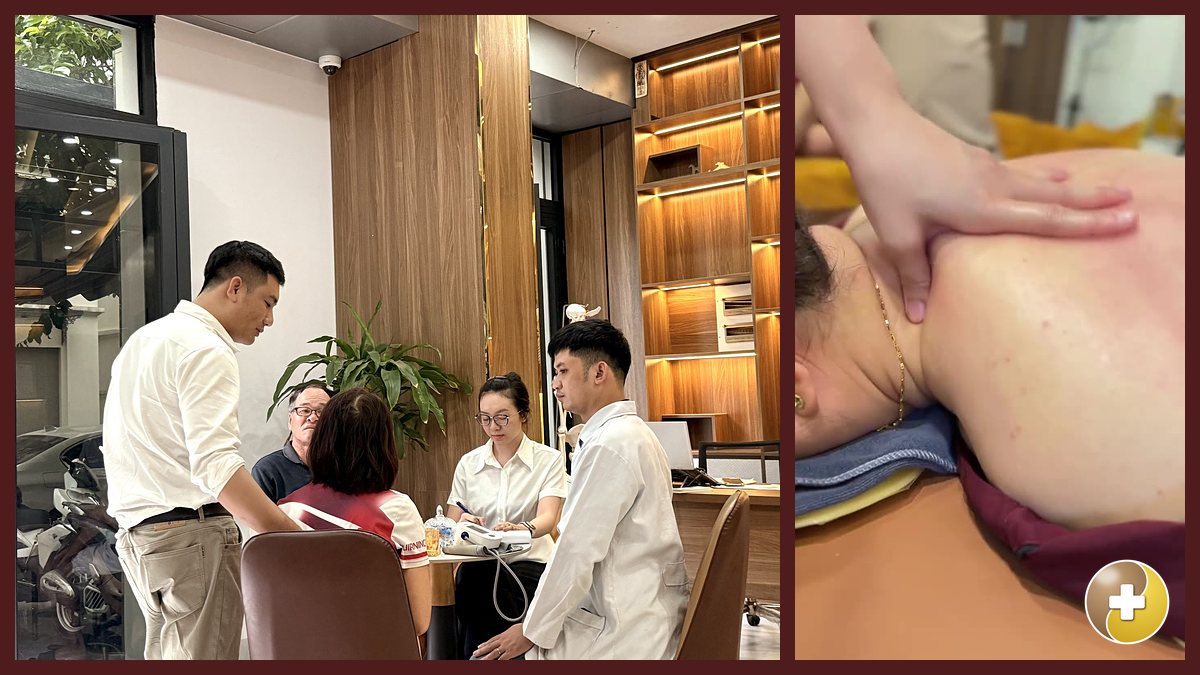
A typical day-two session: the guest has just flown in from overseas, slept one night but woke at 3 a.m. The practitioner notes pale lips, slightly sunken eyes, the right shoulder higher than the left and the head carried forward. On the spine, C1–C2 feel warm and tight, the muscles around D3 are thick, while L2 feels cool and slightly hollow. The neck and shoulder blades are released first, pressure building to the whole hand, then the lower back is warmed, with acupressure at the base of the skull and at Shenshu and Mingmen, finishing on the shoulders and arms. The guest leaves with advice to get morning light, keep naps under 30 minutes and press Shenmen at the wrist before bed.
How it feels: sore-but-pleasant pressure on the tight points, which the curriculum calls "creating a wave of sensation" so the body can adjust itself; many guests feel warmth spreading through the back and doze off near the end. Guests often share that their neck turns more easily afterwards, their head feels lighter and they fall asleep more easily that night; some feel mild muscle soreness the next day, like after light exercise. Every body responds differently. Tong Gia supports and helps rebalance; it does not promise that tiredness or jet lag will disappear after one session. Other travellers' questions are answered in our Viet Kieu wellness visit Q&A, and if your main problem is the body clock, see jet lag massage.
Want Lương Y Tống Văn Huynh’s team to read your spine and posture in person?
Self-care at home during the three days, and prevention next time
| Day | Morning | Midday–afternoon | Evening |
|---|---|---|---|
| Day 1 | 15–20 minutes of morning sunlight to tell your body clock it is morning; sip water, light breakfast | Nap no longer than 20–30 minutes; slow walk in the neighbourhood park when it cools | Warm shower, dry your hair fully before bed; legs up for 15 minutes; press Shenmen (wrist crease, little-finger side) 1–2 minutes each side; sleep at local bedtime |
| Day 2 | 20–30 minute walk, neck and shoulder circles, ankle pumps | Regular meals, fewer fried dishes; keep air conditioning off your neck and waist | Warm your palms, place them on both sides of the lower back and rub up and down 50–100 times until warm |
| Day 3 | Press Zusanli (below the knee, outside the shin) 1–2 minutes each side | Freshly cooked food, chew well, less alcohol, add vegetables and soup to festive meals | Gentle clockwise belly rub an hour after dinner; early night before family visits |
- On the plane: stand and walk every one to two hours when allowed; flex your ankles and roll your shoulders in the seat; wear loose clothes.
- Drink steadily, go easy on alcohol and coffee in flight, and bring a light jacket and scarf for the cold cabin.
- Use a neck pillow so your head does not drop to one side.
- Keep day one light: save long-distance visits for days two and three.
- Care early: the curriculum says "do not wait for pain before caring for yourself". Book ahead rather than waiting for tiredness to pile up.
Booking
Tong Gia has two branches in Ho Chi Minh City, open daily, with real guest reviews on Google Maps:
- District 9 – Vinhomes Grand Park: Căn T16-21 khu Manhattan, Phường Long Bình, TP. Thủ Đức (unit T16-21, Manhattan zone, Long Binh Ward, Thu Duc City). Open 9:00–20:00 daily.
- District 12: 225 Dương Thị Mười, Phường Tân Chánh Hiệp (Tan Chanh Hiep Ward, District 12). Open 8:00–19:00 daily.
Call, Zalo or WhatsApp +84 888 264 559, or book online. You can reserve all three sessions before you fly. Tell us your arrival date, where you are flying from, who is coming with you and any existing conditions, so we can time the sessions around your sleep in the first days. If you are visiting Ho Chi Minh City, this is a good chance to experience a Vietnamese traditional wellness method first-hand.
Visit us
- Đông Y Huyệt Đạo Tống Gia Quận 9 (Vinhomes Grand Park, District 9)
Căn T16-21 khu Manhattan, Vinhomes Grand Park, Phường Long Bình, TP. Thủ Đức, HCMC · 9:00–20:00 daily · 0888 264 559 · Directions on Google Maps
Want Lương Y Tống Văn Huynh’s team to read your spine and posture in person?
What guests say on Google Maps
“I came down from Nghệ An for work and tried the service here for the first time – it was good. Airy space, relaxing music, the massage was great.” (translated from a Vietnamese review)
— Hà N., Google Maps review · Vinhomes Grand Park branch (District 9) · 2025 · See on Google Maps
“It was amazing experience. I felt so good after session”
— Ivan K., Google Maps review · Vinhomes Grand Park branch (District 9) · 10/2026 · See on Google Maps
“A quiet space with a pleasant herbal scent – truly relaxing for both mind and body.” (translated from a Vietnamese review)
— Việt C., Google Maps review · Vinhomes Grand Park branch (District 9) · 2025 · See on Google Maps
Quoted from public reviews, shortened where marked (…). Experiences vary from person to person; reviews are not a substitute for seeing a doctor when something feels wrong.
Related guides for your trip
FAQ
What does a 3-day wellness trip in Saigon around Thu Duc look like? Day 1: rest, morning light and a 60-minute head spa with neck massage (250,000 VND, about US$10). Day 2: 90-minute neck–shoulder or back care (750,000 VND, about US$29). Day 3: 75-minute Spleen–Stomach care (750,000 VND). All three are at the District 9 branch in Vinhomes Grand Park, open 9:00–20:00.
Is there a wellness retreat option in Ho Chi Minh City for a short stay? Tong Gia is not a residential retreat, but you can build a short wellness stay around its District 9 branch: one session a day for three days, with simple home routines for sleep, walking and eating in between. Many visitors staying in Thu Duc combine it with family time.
Should I get a massage right after a long flight? Yes, but keep day one gentle, such as a head spa with light neck massage. Avoid strong pressure when you are exhausted. If one leg is swollen, your calf hurts, or you feel short of breath or chest pain after flying, see a doctor first and skip massage.
What are the opening hours near Vinhomes Grand Park? The District 9 branch at unit T16-21, Manhattan zone, Vinhomes Grand Park, is open 9:00–20:00 every day, including weekends. Book early enough to finish before 20:00. Call or WhatsApp +84 888 264 559 or book online.
How much does the 3-day plan cost? At current prices the three suggested sessions total about 1,750,000 VND (about US$67): 250,000 + 750,000 + 750,000 VND. Choosing the 60-minute first-visit option on day two brings it to 1,399,000 VND (about US$54).
Can massage help with jet lag? Massage cannot replace resetting your clock with morning light, meal times and a fixed bedtime. A gentle session in the late afternoon helps the body relax, and many guests find it easier to fall asleep. It supports adjustment; it does not promise to remove jet lag.
Author: Lương Y Tống Văn Huynh – founder of Huyệt Đạo Tống Gia, a master of traditional Vietnamese wellness with over 13 years in Eastern wellness care, Y Tướng Học (face reading) and spinal nerve-reflex balancing massage.
Updated: 2026-11-15
Related guides
- How often should you get acupressure? Rhythm by goal, the rest gap between sessions and when to space them out
- Is acupressure safe? Where the real risks come from, who should be careful and what Tong Gia asks before every session in Ho Chi Minh City
- Is gua sha (cạo gió) good for you? What the marks mean, how to do it properly and who should skip it in Ho Chi Minh City
- A 3-day wellness trip in Ho Chi Minh City: a Thu Duc – Vinhomes Grand Park plan after a long-haul flight
- How often should you get cupping? Waiting for marks to fade, a maintenance rhythm, rainy season and when to space it out
- What does cupping do? How it feels, what the round marks are, static vs moving cupping
This is a wellness service, not medical care.