
Back pain from factory work in Korea: lifting, bending, machine shifts and caring for your back on home leave
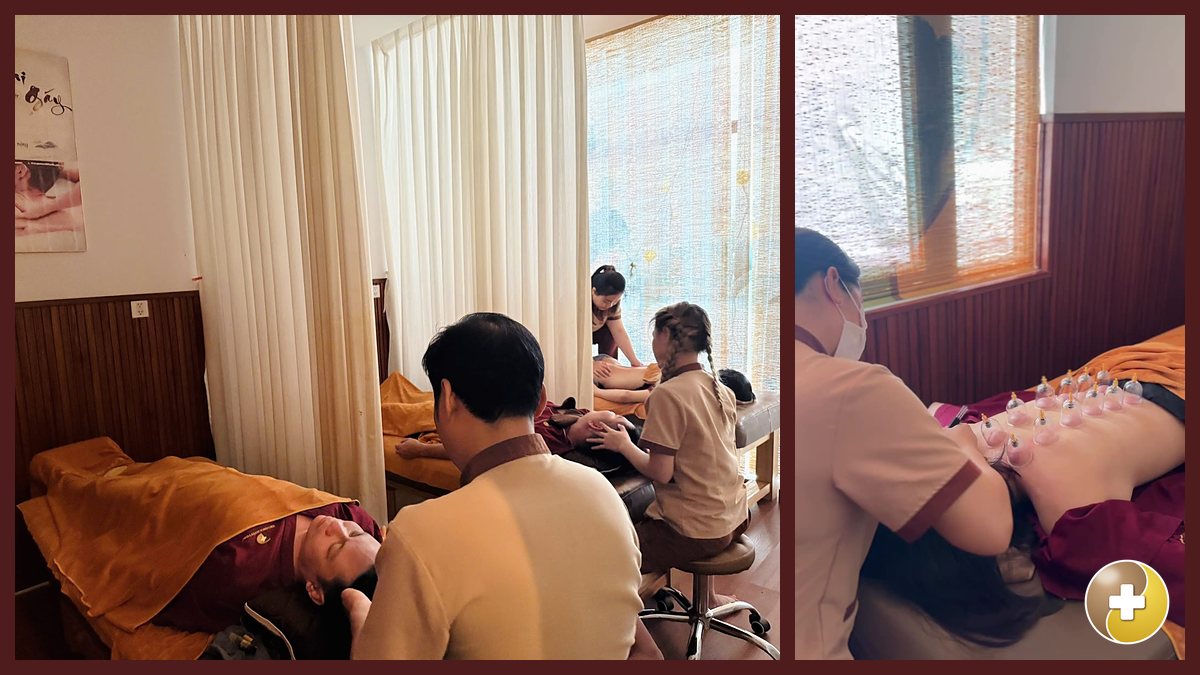
Quick answer: Back pain from factory work in Korea is usually mechanical: lifting, bending, long machine shifts and cold winters keep the lower back tight. Lifting with your legs and staying warm help. On home leave, Tong Gia Acupoint Wellness in Ho Chi Minh City reads the spine by hand, relaxes the muscles and applies acupressure.
Want Lương Y Tống Văn Huynh’s team to read your spine and posture in person?
Why factory work in Korea is so hard on your back
In Ansan, Hwaseong, Siheung, Gimpo and the industrial parks scattered across Gyeonggi, winter shifts often start before sunrise. From December to February, Seoul and Gyeonggi regularly drop below freezing, sometimes to minus ten or colder, with a dry, biting wind. Busan and Gimhae are a little milder, but the sea wind is raw. Inside the plant, the concrete floor pulls the cold up through your feet and the loading doors open and close all day. Many Vietnamese workers on the EPS (E-9 visa) program stand at injection molding presses, stamping machines, assembly lines or packing stations for 10–12 hours, with overtime weeks and night shifts. Students pick up part-time work in warehouses, restaurants and small workshops. Vietnamese wives carry toddlers, help on farms or in family shops, and every winter sit bent over for hours making kimchi with their in-laws. Then one morning you bend to tie your shoes and the lower back seizes; you need the wall to stand up.
From a Western medical point of view, most of this is mechanical back pain: muscles, tendons, ligaments, the small spinal joints and the discs are loaded again and again, or once too heavily. It does not usually mean an internal organ problem. The areas that complain most are:
- The low back (L4–L5, L5–S1): the most loaded segment when you lift. Every time you bend from the waist to pick up a box, force goes into the discs and the erector spinae muscles beside the spine. Bending and twisting together, such as lifting from a conveyor and turning to a pallet, is the classic way to strain a back muscle or sprain a ligament.
- The sides of the waist: the quadratus lumborum links the last rib to the pelvis. Standing with your weight on one leg or carrying a bucket or box in one hand keeps one side working nonstop, so the pain sits on one side.
- The mid back and shoulder blades: pulling carts, pushing pallets and reaching up to high shelves tire the lats, trapezius and rhomboids.
This page is about the back strain that comes from lifting, bending and long standing. For a wider view of how the neck, upper back and lower back connect, read our pillar guide on spine care after a long-haul flight.
Common causes: lifting, bending, machine shifts and the cold
- Lifting with a bent back: straight legs, rounded spine, box held far from the body. The farther the load is from you, the more force hits the lower back. Add a twist as you put it down and the muscle is overstretched.
- Hundreds of repetitions per shift: a light movement repeated for 10–12 hours never lets the muscle rest; tiny fibers get irritated, so you ache at the end of the shift and feel stiff in the morning.
- Standing on hard floors: no chair at the machine, weight shifted onto one hip, belly pushed forward as you tire. The lower back sways and the back muscles stay contracted.
- Working low: sorting at low tables, greenhouse and field work, kimchi making, floor cleaning keep the spine rounded for hours.
- Cold: cold muscles are less elastic. Heavy lifting at the start of a winter morning shift, before the body is warm, is when many strains happen. Going in and out of cold storage with a sweaty back makes it worse.
- Short sleep, night shifts, rushed meals: the body never fully recovers between shifts, so fatigue piles up week after week.
- Stress and homesickness: tension makes the shoulders and back brace without you noticing and lowers your pain threshold.
The flight from Incheon or Gimhae to Tan Son Nhat takes only about 5 hours, but a cramped economy seat after months of lifting is enough to stiffen the back further. Then come the gift-filled suitcases, long car rides to the countryside and meals sitting on the floor. More on lifting strain in back pain after lifting something heavy.
Related signs to notice
- Morning stiffness, hard to bend at the sink, easier after a few steps: tight lumbar muscles after a shift.
- Pain on one side of the waist that grows when you stand on one leg or twist: one-sided quadratus lumborum strain.
- Pain spreading into the buttock or the back of the thigh: the low lumbar and sacral nerve roots that form the sciatic nerve. Pain that goes below the knee with numbness needs a medical check.
- Tired knees, heavy calves, night cramps: long standing on hard floors.
- A cold lower back, sensitivity to wind, more aching in cold weather, waking at night to urinate: linked in Eastern wellness with weak Kidney yang, explained below.
- Poor, shallow sleep and waking up tired: pain makes it hard to find a position, and poor sleep slows muscle recovery.
Tong Gia's training material notes that pain shows up in one place while its source is often elsewhere: a sore lower back may start at the hip, in a habit of standing on one leg, or in feet that stand on concrete all day. That is why the whole spine is read, not only the sore spot.
Where is kidney pain felt? How it differs from lifting strain
Many workers worry: "Is this my kidneys?" The kidneys are a pair of bean-shaped organs behind the abdominal lining, on both sides of the spine, roughly from the T12 to the L3 vertebra; the right one sits a little lower because the liver is above it. In plain terms, they are in the flank, just under the lowest ribs and above your belt line, not down near the tailbone. Back pain is far more often muscle, bone or joint pain than kidney pain.
| Feature | Muscle strain from lifting or standing | Pain possibly linked to the kidney (get it checked) |
|---|---|---|
| Location | Low back on both sides of the spine, at or below the belt line, sometimes into the buttock | Flank, the angle between the last rib and the spine, usually one side, may wrap to the belly or groin |
| With movement | Worse when bending, lifting, twisting; better lying down or with warmth | Changes little with position; colicky pain can make you restless in any position |
| To the touch | Tender muscle, a cord-like tight band | Deep pain; a light tap on the flank hurts |
| Other signs | Morning stiffness, end-of-shift ache | Fever, chills, burning urination, blood in urine, cloudy urine, nausea, swelling of the face or legs |
In Eastern wellness, "Kidney deficiency" describes a functional pattern (tired lower back and knees, cold back, ringing ears, night urination). It is not the same thing as kidney disease in Western terms.
When to see a doctor
Most factory back pain eases with rest, sleep, warmth and stretching. Please see a doctor or go to a medical facility, and do not rely on massage, if you have any of the following:
- Pain right after a fall, a heavy object hitting you, a machine accident, or a "snap" while lifting followed by being unable to stand straight.
- Pain shooting below the knee, numbness in the calf or foot, leg weakness, or a foot that drags.
- Numbness in the buttocks, groin or around the anus, trouble passing urine, or loss of bladder or bowel control: go to emergency now.
- One-sided flank pain with fever, chills, burning urination, blood in the urine or cloudy urine.
- Back pain with fever, unexplained weight loss, lasting fatigue, or pain that gets worse at night even at rest.
- Back or chest pain with tightness in the chest, shortness of breath, sweating, or pain spreading to the jaw or left arm: call 119 in Korea or 115 in Vietnam, no massage.
- A swollen, painful, warm calf on one side after a flight or days of little movement: this can be a deep vein clot. Get checked now and do not have the leg massaged.
- Pain lasting more than 4–6 weeks despite rest, or pain that keeps getting worse; pregnancy, recent surgery or osteoporosis: ask your doctor before any massage.
If you are hurt at work in Korea, tell your supervisor and get checked early so there is a record. Tong Gia does not read X-rays or MRI scans and does not make medical plans. If you have results from a medical facility, simply tell the practitioner which areas to keep gentle or avoid. This is a wellness service, not medical care.
How to say "my back hurts" in Korean
The key phrase is 허리가 아파요 (heo-ri-ga a-pa-yo): "my lower back hurts". 허리 (heo-ri) means the waist and lower back; the upper back is 등 (deung). These short, polite sentences work at a hospital, a pharmacy counter or with your factory supervisor. The romanization gives an approximate pronunciation; speak slowly and point to the spot.
| Korean | Pronunciation | Meaning |
|---|---|---|
| 허리가 아파요. | heo-ri-ga a-pa-yo | My lower back hurts. |
| 등이 아파요. | deung-i a-pa-yo | My upper back hurts. |
| 여기가 아파요. | yeo-gi-ga a-pa-yo | It hurts here (while pointing). |
| 무거운 걸 들다가 허리를 다쳤어요. | mu-geo-un geol deul-da-ga heo-ri-reul da-chyeo-sseo-yo | I hurt my back while lifting something heavy. |
| 3일 전부터 아파요. | sa-mil jeon-bu-teo a-pa-yo | It has hurt since three days ago. |
| 많이 아파요. / 조금 아파요. | ma-ni a-pa-yo / jo-geum a-pa-yo | It hurts a lot. / It hurts a little. |
| 다리가 저려요. | da-ri-ga jeo-ryeo-yo | My leg feels numb. |
| 소변 볼 때 아파요. | so-byeon bol ttae a-pa-yo | It hurts when I urinate. |
| 열이 나요. | yeo-ri na-yo | I have a fever. |
| 통역이 필요해요. | tong-yeo-gi pi-ryo-hae-yo | I need an interpreter. |
| 구급차 불러 주세요. | gu-geup-cha bul-leo ju-se-yo | Please call an ambulance. |
Tip: save these on your phone together with when the pain started and what you were doing, so staff can read it. The emergency number for an ambulance in Korea is 119.
The Y Tướng Học view: the lower back and the Kidney, tendons and the Liver
Y Tướng Học (face reading for wellness) rests on the idea that what is inside shows outside. Lương Y (traditional healer) Tống Văn Huynh, founder of Tong Gia, systematized it so practitioners can read the face before placing their hands on the spine. For people who have lifted for years, three organ systems are usually considered.
Kidney and the lower back. In Tong Gia's material, the Kidney governs the bones, opens into the ears, shows in the hair, relates to the lower back and knees and corresponds to winter. Thick, rosy ears, glossy hair and a stable back are good signs; tired knees, a cold back, ringing ears, hair loss and forgetfulness suggest the Kidney needs support and the lower back needs warmth. Weak Kidney yang shows as feeling cold, cold hands and feet, a cold aching back and night urination, which many workers in cold Gyeonggi plants recognize.
Liver and tendons. The Liver governs tendons and ligaments. Long shifts, short sleep and stress tighten the long back muscles, the neck and shoulders, and bring dry red eyes, irritability and cramps. A Thân-shaped face (wide cheekbones, narrow forehead and chin) points to the D7 and D9 area.
Spleen and muscle. The Spleen and Stomach nourish muscle. Rushed, salty, spicy meals and late eating after night shifts tire digestion, so muscles fatigue faster. An Điền (square) face often comes with thick back muscles that can stiffen around D11–D12.
Faces that call for a careful look at the low back: the Do shape (narrow forehead, broad jaw) with very thick lumbar and hip muscles; the Viên (round) shape with a cold, soft lower back and dull aching; the Giáp shape (wide forehead, pointed chin) with a hollow, cold low back. The bridge of the nose is seen as a miniature of the spine; a crooked bridge often goes with an uneven spinal axis and uneven load at L4–L5–S1. These are wellness observations, never fortune telling or labels.
Want Lương Y Tống Văn Huynh’s team to read your spine and posture in person?
Vertebrae and nerve-reflex areas involved
In spinal nerve-reflex balancing, the lumbar spine L1–L5 relates to digestion, the kidneys, urinary and reproductive function and the legs, and the sacrum S1–S5 to elimination and the pelvis. For muscle, bone and joint complaints, Tong Gia's material combines C5–C7, L1–L5 and S1–S5.
| Vertebrae | Nerves / function (Western anatomy) | Common signs in factory workers | Organ (Eastern view) | Facial sign (Y Tướng Học) |
|---|---|---|---|---|
| C5–C7 | Roots of the brachial plexus to shoulder, arm, hand | Heavy shoulders, tired arms after carrying and pulling carts | Liver (tendons) | Tight shoulders, dry red eyes, frowning brows |
| D7–D9 | Mid intercostal nerves, upper abdominal wall | Tight long back muscles when pushing and pulling | Liver | Wide cheekbones (Thân face) |
| D10–D12 | Nerves to the lower abdominal wall | Heavy mid back, bloating after rushed meals | Spleen–Stomach | Pale lips; Điền face with thick back muscles |
| L1–L3 | Roots to the groin and front thigh; psoas attaches here; kidneys lie at T12–L3 | Stiff when standing up, cold aching back in winter | Kidney | Thin dull ears, dry hair; Viên face |
| L4–L5 | Roots that help form the sciatic nerve; heavily loaded discs when lifting | Low back pain across the belt line after lifting | Kidney–Bladder | Thick lumbar and hip muscles (Do face), crooked nose bridge |
| S1–S5 | Roots to buttock, back of thigh, calf; pelvic and bladder nerves | Buttock ache, tired hamstrings and knees after long standing | Kidney–Bladder | Hollow cold low back (Giáp face) |
The table shows related areas the practitioner reads by hand; it is not a statement of cause. For a general look at lower back causes, see what causes lower back pain.
How Tong Gia helps rebalance your back on home leave
Tong Gia Acupoint Wellness (Huyệt Đạo Tống Gia) follows the spinal nerve-reflex balancing method built by Lương Y Tống Văn Huynh, a Vietnamese traditional wellness practitioner with over 13 years of experience. The aim is to help each spinal area and the related organ function come back into balance, by hand.
- Questions and observation: what you do at the plant, how heavy, standing or bending, how many years, where it hurts, whether it spreads to the leg, any fall or injury, any results from Korea. Then complexion, ears, nose bridge, posture and shoulder and hip levels are observed.
- Reading the spine by hand: skin temperature, muscle layer, vertebral shape and sensation, left against right, top to bottom, narrowing to the key points. Long-term lifters often have one side of the low back thicker and harder.
- Muscle release: the erector spinae, the quadratus lumborum at both sides of the waist, glutes and hamstrings, plus shoulders and mid back if you push and pull. Pressure rises in five levels and you are asked how it feels.
- Acupressure on the right points: Thận du (BL23), Mệnh môn (GV4) and Chí thất (BL52) at the lower back, Can du and Tỳ du at the mid back, Ủy trung (BL40) behind the knee. Each point is worked until the skin turns from dry to slightly moist, then stopped.
- Self-care coaching: lifting technique, switching legs at the machine, a 5-minute stretch before and after shifts, warming the low back before bed, to take back to Korea.
You may feel tender points along the low back, buttocks and behind the knees; as the muscle lets go, the tenderness softens and the back warms. Afterward many people bend and stand more easily and sleep deeply that night; some feel a little sore for a day first. Everyone responds differently, and Tong Gia does not promise the pain will be gone after one session.
- Neck-shoulder / lower back care, 60 min: 550,000 VND (about 21 USD), first visit 399,000 VND (about 15 USD); 90 min: 750,000 VND (about 29 USD). Focus on the low back, waist, buttocks and mid back.
- Kidney wellness session, 75 min: 750,000 VND (about 29 USD). For a cold, dull-aching back, tired knees and night urination after cold winters.
- Cold-releasing cupping, 30 min: 85,000 VND (about 3 USD). An add-on for a cold, heavy back.
USD figures use a reference rate of 1 USD ≈ 26,000 VND; payment is in VND. Full list: prices.
From Tan Son Nhat airport: the District 12 branch (225 Dương Thị Mười, Phường Tân Chánh Hiệp) lies north of the airport, usually 30–45 minutes by car depending on traffic. The Vinhomes Grand Park branch (Căn T16-21 khu Manhattan, Phường Long Bình, TP. Thủ Đức) is farther and takes longer, especially at evening rush hour. Flights from Korea often land in the evening, so most people book for the next day. If you want to stop on the way from the airport, see massage near Tan Son Nhat airport.
A suggested plan for home leave, and self-care
| When | What your back needs | What to do |
|---|---|---|
| Last week in Korea | No extra load | Ask a roommate to help carry, pack suitcases you can lift, sleep well before the flight |
| The 5-hour flight | Change position | A rolled jacket behind the low back, walk the aisle every hour, sip water |
| Landing day | Relax and sleep | Let family lift the bags, warm shower, light walk; Vietnam is 2 hours behind Korea |
| Days 2–3 | Release months of lifting | A 90 min back session or the 75 min Kidney session; warm the low back at night |
| Family visits and Tet | Avoid long floor sitting | Use chairs with a backrest, take breaks on long drives, do not carry offerings alone |
| 2–3 days before flying back | Prepare for the new season | A gentle session, practice the stretches; see preparing your body before the flight |
- Lift with your legs: stand close, feet shoulder-width, bend hips and knees, hug the box to your belly, stand up with your legs and turn with your feet, never the waist.
- Warm up before the shift: 3–5 minutes of hip circles, side bends and marching in place, especially on winter mornings.
- Switch legs at the machine: rest one foot on a low step or rail and alternate every few minutes; wear cushioned shoes.
- Warm the low back: rub your palms warm, place them on both sides of the low back and rub up and down 50–100 times before bed; a 15–20 minute warm foot soak helps sleep.
- Keep the waist covered: thermal layers, change out of sweaty shirts after the shift, and sleep before 11 pm when you can.
More gentle moves: back pain exercises at home.
Book from Korea before you fly home
Message us on WhatsApp or Zalo at +84 888 264 559 (0888 264 559 inside Vietnam) from Ansan, Seoul or Busan with three details: your landing date and time at Tan Son Nhat, where it hurts (low back, one side of the waist, into the buttock, or shoulders too), and which branch you prefer. You can also book online; tips are in booking a massage in Saigon from abroad.
- District 12 branch: 225 Dương Thị Mười, Phường Tân Chánh Hiệp (Tan Chanh Hiep Ward, District 12). Daily 8:00–19:00.
- Vinhomes Grand Park branch: Căn T16-21 khu Manhattan, Vinhomes Grand Park, Phường Long Bình, TP. Thủ Đức (Unit T16-21, The Manhattan, Thu Duc City). Daily 9:00–20:00.
Slots before Tet fill quickly, so write early. Genuine guest reviews are on each branch's Google Maps listing. If your back pain came from a long-haul flight instead, read back pain after a long flight from the US to Vietnam.
Visit us
- Đông Y Huyệt Đạo Tống Gia Quận 12 (District 12)
225 Dương Thị Mười, Phường Tân Chánh Hiệp, Quận 12, HCMC · 8:00–19:00 daily · 0888 264 559 · Directions on Google Maps - Đông Y Huyệt Đạo Tống Gia Quận 9 (Vinhomes Grand Park, District 9)
Căn T16-21 khu Manhattan, Vinhomes Grand Park, Phường Long Bình, TP. Thủ Đức, HCMC · 9:00–20:00 daily · 0888 264 559 · Directions on Google Maps
Map of our two branches
Want Lương Y Tống Văn Huynh’s team to read your spine and posture in person?
What guests say on Google Maps
“I came in with very bad back pain – turning my motorbike around was so hard it brought me to tears. After one session my back had settled again.” (translated from a Vietnamese review)
— Trang T., Google Maps review · District 12 branch · 2024 · See on Google Maps
“I had been achy and tired for a long time. After the session I felt very comfortable.” (translated from a Vietnamese review)
— Nghĩa H., Google Maps review · District 12 branch · 2025 · See on Google Maps
Quoted from public reviews, shortened where marked (…). Experiences vary from person to person; reviews are not a substitute for seeing a doctor when something feels wrong.
Related guides for your trip
- Back and wrist pain from greenhouse farm work in Korea: lower back, knees, wrists and care on home leave
- Fatigue from cleanroom suits on long shifts: heat, heavy shoulders and back, dry skin in chip plants
- Vietnamese brides farming in rural Korea: back and knee pain, and how to care for your body on a visit home
FAQ
Is back pain from factory work in Korea serious? Usually it is mechanical strain from lifting, bending, long machine shifts and cold winters, and it eases with rest, warmth, better lifting and stretching. Get checked right away if it follows a fall, spreads below the knee with numbness or weakness, or comes with fever, trouble urinating or blood in the urine.
Where is kidney pain felt compared with a strained back? The kidneys sit on both sides of the spine around T12 to L3, in the flank just under the lowest ribs. Kidney-related pain is usually one-sided, deep, changes little with movement and often comes with fever or urinary symptoms; that needs a medical check. Low back pain that worsens when you bend or lift is more often muscular.
How do I say my back hurts in Korean at a hospital in Ansan or Busan? Say 허리가 아파요 (heo-ri-ga a-pa-yo) for the lower back or 등이 아파요 (deung-i a-pa-yo) for the upper back. Add 여기가 아파요 (yeo-gi-ga a-pa-yo) while pointing, and 통역이 필요해요 (tong-yeo-gi pi-ryo-hae-yo) if you need an interpreter. The ambulance number in Korea is 119.
I lift boxes all day in a Gyeonggi plant. What can I do for my back? Warm up 3–5 minutes before the shift, lift with your legs and keep the box close, turn with your feet, switch legs when standing, keep the waist warm and sleep enough. If the pain lasts several weeks, keeps growing or comes with leg numbness, see a doctor and report work injuries to your supervisor.
Should I get a back massage right after flying home from Korea? Flights from Korea often land in the evening, so most people sleep first and book for the next day or two. Before the session, Tong Gia asks about your work, where it hurts and whether you have numbness or a recent fall; if anything looks unusual, you will be advised to get checked first.
Does massage help back pain from heavy lifting, and what does it cost at Tong Gia? Massage helps tight lumbar muscles relax, supports circulation and often makes sleep easier; it is wellness care, not a substitute for a medical check. Lower back care is 550,000 VND for 60 minutes (399,000 VND first visit) or 750,000 VND for 90 minutes; the Kidney session is 750,000 VND; payment in VND.
Author: Lương Y Tống Văn Huynh – founder of Huyệt Đạo Tống Gia, a master of traditional Vietnamese wellness with over 13 years in Eastern wellness care, Y Tướng Học (face reading) and spinal nerve-reflex balancing massage.
Updated: 2026-11-15
Related guides
- Preparing your body before the long flight home after Tet: a 3–5 day plan for Viet Kieu returning to Australia
- Back pain from factory work in Korea: lifting, bending, machine shifts and caring for your back on home leave
- Back pain after a long flight from the US to Vietnam: upper back, lower back and what helps
- Standing all day at a market stall or nail salon: caring for the lower back and heavy legs on your trip home
- Self-acupressure at home when your family is far away: lower back, numb feet, poor sleep, and when to stop
This is a wellness service, not medical care.