
Massage chair at home vs hands-on massage: an honest comparison for long-haul visitors in Saigon
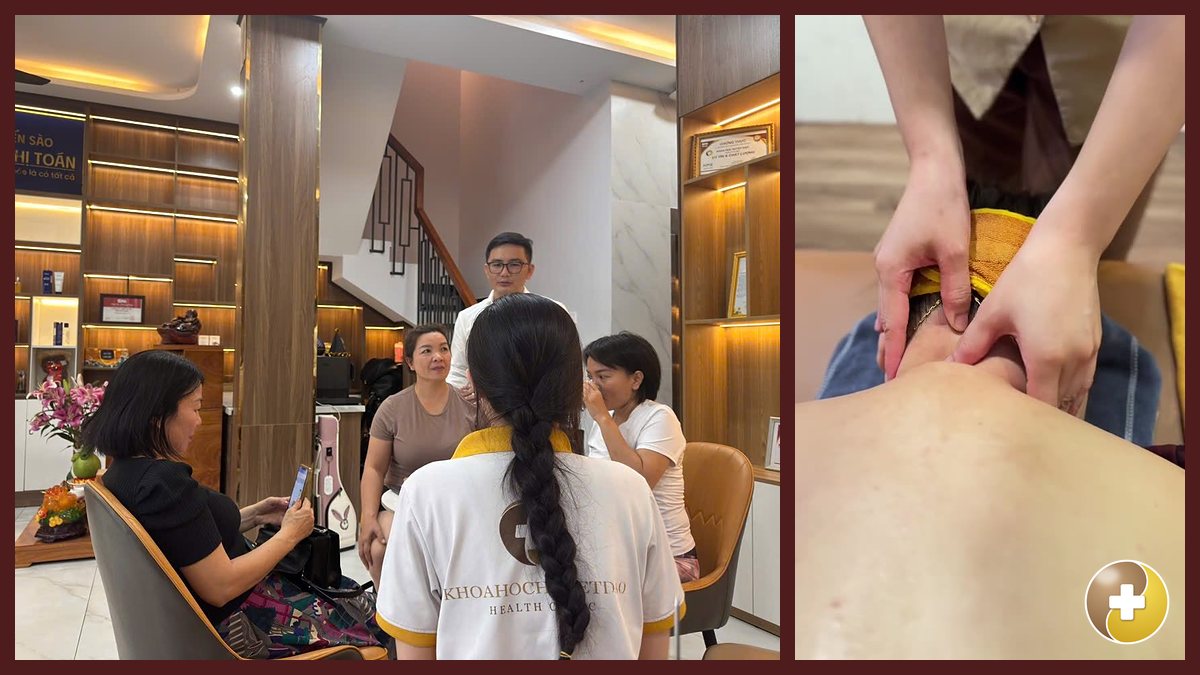
Quick answer: A massage chair at home helps you relax daily but does not fully replace hands-on massage: the chair runs a program, while hands read muscles, ask how it feels and adjust pressure. In Ho Chi Minh City, a session at Tong Gia Acupoint Wellness (District 12, Vinhomes Grand Park) shows which areas are tight so you use your chair more wisely.
Want Lương Y Tống Văn Huynh’s team to read your spine and posture in person?
Can a massage chair at home replace hands-on massage?
Many families in San Jose, Houston, Sydney, Melbourne, Seoul, Tokyo, Osaka, Taipei or Taichung keep a massage chair in the living room. After a shift at the factory, the nail salon or the restaurant, or a day at the computer, fifteen or twenty minutes in the chair has become a habit. In November, Seoul, Tokyo and the northern US are already cold, Taiwan feels its first monsoon chill, and Australia moves into summer. Then comes the trip back to Vietnam for Tet or to see parents. The chair stays behind, and you fly about three and a half hours from Taipei, around five from Seoul, six from Tokyo, eight or nine from Sydney, or close to twenty hours with a connection from the US. International travellers on long-haul trips to Ho Chi Minh City ask the same thing: does my massage chair at home do the same job as a hands-on massage, and is it worth booking one while I am here?
The short answer: chairs and hands do not replace each other; each does one job well. This guide does not criticise any product and does not say chairs are harmful. A massage chair is a convenient relaxation tool. It is always at home, starts at the press of a button, needs no appointment and the whole family can share it. What it does is run a pre-set program: rollers travel up and down the back, airbags squeeze the arms and calves, and there are vibration and heat modes. Some models scan shoulder height to position the rollers. But a program is still a program: the rollers pass over every area at the same set rhythm.
Human hands work differently. According to the Tong Gia training manual, before working the hands must read four things: skin temperature, the muscle layer, the shape of each vertebra and how the guest feels. The practitioner asks where it feels sore, whether anything tingles or spreads, whether the pressure is right, and then changes pressure and direction, stays longer on tight spots and goes lightly over tired, weak areas. A chair cannot ask "is this sore in a good way or too much?" A practitioner asks it all the time.
From a Western anatomy point of view, both chair and hands apply mechanical pressure to soft tissue: skin, fascia, muscle and tendon. Steady pressure stimulates mechanoreceptors, and signals travel along nerves to the spinal cord and brain; the autonomic nervous system shifts toward rest mode (parasympathetic), breathing slows, muscles let go and local circulation improves. That is why the chair feels good. The difference lies in who chooses the area and the pressure, and whether there is feedback both ways.
Comparison table: massage chair and human hands
The table describes common use. Every chair model has its own features, so read it as a map, not a ranking.
| Feature | Massage chair at home | Hands-on massage at Tong Gia |
|---|---|---|
| How areas are chosen | By the built-in program or the mode you press: full body, back, shoulders, legs | Face and posture observation, then reading the spine with the fingertips from the neck to the lower back |
| Pressure | A few fixed levels, the same level for a whole stretch of the back | Five levels, from one finger to full body weight, changed area by area and as you ask |
| Feedback | You press "softer" when it feels too strong | The practitioner asks, watches your face and feels the muscle tense, then adjusts at once |
| Cold, weak areas | Rollers pass over them like any other area | Not worked directly; warmed and worked gently around the edges |
| When it stops | When the program timer ends | When the skin over the tight point turns from dry to slightly moist |
| Convenience | At home, every day, no travel | Needs booking and a ride to the District 12 or Vinhomes Grand Park branch |
| Afterwards | Relaxed, easier sleep | You learn which areas tend to tighten and a few self-care moves, including how to set your chair |
The chair wins on routine and convenience; hands win on reading the body and asking back. Many people use both: the chair every evening at home, and one or two hands-on sessions on each trip to Vietnam to see how their body is changing. If you want to know what Vietnamese massage feels like in general, see what Vietnamese massage feels like and why people choose it.
Why regular chair users still feel stiff on a trip to Vietnam
People who use a chair daily are often surprised to feel stiffer a few days after landing. Several causes usually stack up:
- Long flights with hips flexed for hours: up to twenty hours from the US including connections; sleeping upright with the neck tilted loads the neck and lower back. The pillar guide spine care after a long-haul flight explains what happens to the spine.
- Losing the evening routine: at home the chair helps muscles let go regularly; without it, tension builds up faster than you expect.
- A sudden climate change: from cold Seoul, Tokyo or Chicago to Saigon above 30°C, moving in and out of air conditioning tightens the neck and lower back.
- A short trip with a full schedule: memorials, weddings, family visits and paperwork in one or two weeks, long rides in traffic.
- Unfamiliar beds and pillows: a higher or lower pillow than at home, waking up stiff on one side.
- Tet feasting: sweets, fried food, late meals and cold beer leave you bloated and heavy.
- Muscles used to strong settings: some people turn the chair up because "it only works when it is strong"; over time some muscle bands become thicker and harder without you noticing.
Signs that a hands-on session is worth it
- The chair feels good, but an hour or two later the neck is tight again.
- You keep needing a stronger setting to feel anything, while medium used to be enough.
- One shoulder sits higher, and turning your head one way catches.
- An ache between the shoulder blades, shallow breathing, constant stretching at work.
- A cold lower back and an ache across the waist that only eases with the heat mode on.
- A spot where the rollers cause a sharp, stabbing feeling so you shift away.
- Heavy calves, night cramps, tired arms and legs.
- Broken sleep, waking on home time, a heavy head in the morning.
If you only feel generally tired, the chair or a light relaxing session is enough. If two or three of these signs gather in one area, a hands-on session with spine reading helps you find the exact spot. Write down any sharp spot from the rollers and mention it; do not push through it.
Who should avoid strong chair settings and ask before any massage
The chair is not at fault; rollers moving evenly along the spine simply do not suit everyone. These groups should ask their own healthcare provider before using strong modes, read the cautions in the chair manual, and mention it when booking a massage:
- Osteoporosis: vertebrae are more fragile, so strong roller pressure straight onto the spine is not suitable. See massage with osteoporosis: is it safe.
- Blood thinners: skin and muscle bruise more easily under strong pressure. See massage while on blood thinners.
- Pregnancy: under the Tong Gia training manual, the abdomen is not worked and the Hegu (LI4) and Sanyinjiao (SP6) points are avoided. Hip squeeze, strong vibration and lower-back heat modes need checking first. See massage during pregnancy on a trip home for Tet.
- Heart stents or pacemakers: avoid strong pressure on the chest and the device area; ask your doctor first. See massage after a heart stent.
- Varicose veins: strong calf airbag modes need checking; see massage with varicose veins.
- Recent surgery, joint replacement or a fall: wait until the area is stable and follow your surgeon's advice.
When to see a doctor before using the chair or having a massage
- Chest pain or pressure, shortness of breath, cold sweat, pain spreading to the neck, jaw or left arm: in Vietnam call 115 straight away.
- Facial drooping, slurred speech, numbness or weakness on one side, sudden blurred vision or an unusually severe headache: call 115.
- Swelling in one leg, a painful, tight, warm or red calf after a long flight: this can signal deep vein thrombosis. See a doctor at once, and do not massage the leg or use calf airbags; with breathlessness or chest pain, call 115.
- Back pain with numbness down a leg, leg weakness, or trouble controlling bladder or bowels.
- Pain that worsens at night, fever, unexplained weight loss or pale skin: get checked alongside any wellness care.
- A spot where the rollers cause lasting sharp pain, swelling or unexplained bruising.
- Blisters, open wounds or a spreading rash on the area to be worked.
This is a wellness service, not medical care. Tong Gia does not read X-rays, MRI scans or lab results and does not draw up care plans in place of a hospital. If your healthcare provider at home has told you to avoid an area, say so when booking so the practitioner avoids it, and keep following the advice you already have.
Face reading (Y Tướng Học): what a chair cannot see
A chair does not look at your face. A Tong Gia session starts by looking. Y Tướng Học, Vietnamese face and body reading, has roots more than 2,000 years old. Lương Y Tống Văn Huynh, a traditional wellness practitioner and founder of Tong Gia, has worked in Eastern wellness care for over 13 years and built this into his method. Its core line is "the signs are outside, the organs are inside": the state of the inner organ systems shows in the shape and complexion outside. According to the training manual, this is reference knowledge for finding imbalanced areas before working, not a substitute for a medical check and never used to judge a guest. For people used to strong chair settings, heavy work or long sitting, then a long-haul flight, common patterns are:
- Liver (Can): governs tendons and sinews, opens into the eyes, shows in the nails. Stress and short sleep tighten tendons and muscles, with neck tension and cramps. Signs: tired dry eyes, a frown between the brows, pale nails, bunched shoulder muscles; the 申-shaped face often tightens at T7–T9.
- Spleen–Stomach (Tỳ Vị): governs flesh and the limbs. Irregular shift meals and Tet sweets leave you heavy, with tired limbs and soft muscles. Signs: pale lips, a puffy tongue with tooth marks; the square 田-shaped face has a thick back muscle layer that tightens in large bands at T11–T12.
- Kidney (Thận): governs bones and marrow; it shows in the lower back. People with osteoporosis and a cold lower back belong to the "gentle hands" group. Signs: thin, dull ears, dry hair, a cold lower back.
- Lung (Phế): governs breath and skin, opens into the nose. Dry cabin air, winter heating in Seoul or Tokyo, then air-con in Saigon dry the skin and block the nose. Signs: dry skin, a dry red nose; the 同-shaped face often tightens around T3.
- Heart (Tâm): linked to circulation and sleep. Jet lag brings palpitations and poor sleep. Signs: a pale or flushed complexion, dull eyes.
The manual separates thick, tight muscle in large bands from thin muscle over sunken vertebrae, or a cold back with soft muscle. One chair program for both types is natural for a machine; with hands, each type is worked differently.
Want Lương Y Tống Văn Huynh’s team to read your spine and posture in person?
Vertebrae and related nerve reflex areas
The Tong Gia spinal reflex method counts 33 vertebrae: 7 cervical (C1–C7) for the head, face, neck and arms; 12 thoracic (T1–T12, written D1–D12 in Vietnamese) linked to circulation, breathing and digestion; 5 lumbar (L1–L5) linked to digestion, kidneys, urinary and reproductive organs and the legs; and the sacrum and coccyx. Nerve roots leave on both sides between the vertebrae, which is where the fingertips search. Chair rollers follow a fixed track on both sides of the spine; fingers go vertebra by vertebra, comparing above and below, left and right.
| Vertebrae | Nerves and function (anatomy) | Common signs | Organ system | Face and body signs |
|---|---|---|---|---|
| C1–C2, base of the skull | Upper cervical roots; small muscles holding the head | Heavy head, stiff neck after sleeping upright on the plane; rollers rarely reach the hairline | Heart, Liver, Kidney | 甲-shaped face; dull eyes; frown |
| C3–C7 | Cervical and brachial plexus; neck, shoulder, arm, hand | One-sided stiff neck, tired arms after a shift, mild tingling in the fingertips | Liver (tendons) | Uneven shoulders, bunched shoulder muscles |
| T1–T4 (T3: Lung shu point) | Upper thoracic nerves; heart, lungs, muscles between the shoulder blades | Ache between the shoulder blades, shallow breathing, dry nose | Lung, Heart | 同-shaped face; dry skin, dry red nose |
| T7–T9 | Mid thoracic nerves; liver, gallbladder, stomach area | Tight ribs, burping after banquets, irritability on busy days | Liver – Spleen–Stomach | 申-shaped face; crease between the brows |
| T11–T12 | Lower thoracic nerves; upper digestive area | Tet bloating, heaviness, thick tight back muscle | Spleen–Stomach | 田-shaped face; pale lips; puffy tongue |
| L1–L3 (Kidney shu, Mingmen at L2) | Upper lumbar roots; kidneys, urinary tract, hip flexors | Cold lower back, ache across the waist; only comfortable with the heat mode | Kidney | Thin, dull ears; round face |
| L4–S1 | Roots forming the sciatic nerve; buttocks, thighs, calves | Stiff lower back, tired buttocks, heavy calves, night cramps | Kidney – Liver | 由 and round faces: thick or soft muscle at the lower back and hips |
The table shows links used to choose where to work, not to name any illness. It also shows what a hands-on session tells you that a chair cannot: which areas are over-active (warm, tight, more tender) and which are under-active (cool, sunken, soft).
How Tong Gia helps rebalance: one session, services, prices and getting there
Tong Gia uses a massage method for balancing the spinal nerve reflex system. It grew from the Head and Spine work of Lương y Nguyễn Tham Tán and Master Công Kim Thắng and was developed into Tong Gia's own Vietnamese Eastern method by Lương Y Tống Văn Huynh. A session has five steps aimed at helping rebalance each spinal area and the related organ function:
- Questions and observation: your flight, sore areas, health conditions, which chair mode you use at home and for how long, any spot where the rollers feel sharp; complexion, lips, ears, posture and shoulder level.
- Reading the spine by hand: the soft pads of the fingertips press, glide, push and roll from the neck to the lower back to read skin temperature, the muscle layer, vertebral shape and your sensations, comparing left and right.
- Muscle release: only the over-active areas are worked, never the under-active ones directly; pressure builds in five levels and stays at "sore but pleasant", with check-ins as it goes.
- Acupressure on the right zones: the back of the neck for a stiff neck, around T3 for an ache between the shoulder blades, the Kidney shu and Mingmen area for a cold lower back; warm skin is cooled, cool skin is warmed, and work stops when the skin turns from dry to moist.
- Self-care, including your chair: which areas tend to tighten, which need a lighter touch, what chair pressure suits you and where to use the heat mode.
The method follows "three no's": no needles, nothing to swallow or inject, no rough force. People used to strong chairs sometimes think hands must be very strong to work; in practice pressure is chosen per area, and some spots need only one finger. See is strong massage better? choosing the right pressure.
Prices are in VND; USD figures are approximate at 1 USD ≈ 26,000 VND (reference rate, payment in VND):
| Service | Length | Price (VND) | ≈ USD | Suits |
|---|---|---|---|---|
| Neck-shoulder / back-waist care | 60 min | 550,000 (first visit 399,000) | ≈ 21 (first visit ≈ 15) | Stiff neck, ache between the shoulder blades, cold lower back; finding out which areas are tight |
| Đông y (Eastern) massage | 60 min | 450,000 | ≈ 17 | Mild full-body tiredness; a first hands-on session after years of using only a chair |
| Full-body care | 120 min | 950,000 | ≈ 37 | Several tired areas after a long flight and a year of hard work |
Other services are on the price list. Anyone with one swollen leg or calf pain after a flight is advised to get checked first, and Tong Gia does not work on the leg in that case.
Getting there from Tan Son Nhat airport: the District 12 branch (225 Dương Thị Mười, Phường Tân Chánh Hiệp) lies north of the airport and is usually the shorter ride, handy if you stay around District 12, Gò Vấp or Tân Bình or want to stop by after landing. The Vinhomes Grand Park branch (Căn T16-21 khu Manhattan, Phường Long Bình, TP. Thủ Đức, in the east of the city) is a longer ride, handy if you stay in Thu Duc or District 9. Travel time depends a lot on the hour, and rush hour is often slow, so allow plenty of time.
What a session is usually like for someone who uses a strong chair every evening: the practitioner asks about your chair mode, notices one shoulder sitting higher and slightly pale lips, then finds thick, tight muscle on both sides of T11–T12, one side of the neck at C3–C5 warmer than the other, and the lower back at L2 slightly sunken and cool. The thick back muscle is released with the whole palm, the neck with the fingers, while the lower back is only warmed and worked gently around the edges. At the end you hear: lower the chair pressure on the lower back, use the heat mode there, and stretch the neck gently instead of letting the rollers press hard.
How it may feel: tight points feel sore but pleasant, which the manual calls "creating a sensation wave" so the body can adjust itself; the back often warms up. Chair users usually find a session "slower", with fewer repeated strokes, longer pauses in the right places and frequent questions. Afterwards the neck may turn more easily, shoulders feel looser and sleep comes more easily; some people feel slightly sore the next day, as after light exercise. Everyone is different. Tong Gia supports and helps rebalance; it does not promise that all tiredness will be gone after one session.
Back home: using your massage chair more wisely
This is the part many people find most useful. One hands-on session does not replace your chair; it helps you use it with a purpose. Take a few notes home:
- Tight, over-active areas: the chair can work them at a medium level for a moderate time.
- Cool, sunken or soft areas: lower the chair pressure, use gentle heat, or warm them with your own palms.
- Your right pressure: "sore but pleasant" is the measure; there is no need to keep turning it up.
- Length: fifteen to twenty minutes is usually enough to relax; sitting much longer on strong settings does not soften muscles further.
- When to skip the chair: right after a big meal, with a fever, or with an unusual swollen, painful spot.
| When | What to do | Massage (optional) |
|---|---|---|
| Before flying | Note your usual chair mode, any sharp spots and health conditions; message to book | Medium chair setting; skip strong modes right before a long flight |
| Landing day | Drink water, eat light, walk slowly, sleep on Saigon time | Rest, or a gentle hair wash with neck-shoulder massage |
| Days 2–3 | Adjust your pillow, avoid direct air-con, morning sun | Main session: neck-shoulder / back-waist care 60 min to read the spine |
| Mid-trip | Eat slowly between banquets, fewer cold drinks, morning neck stretches | Đông y massage 60 min if your whole body feels tired |
| Before flying home | Sleep well, pack early, note which areas need a light touch | A light session for a more comfortable flight |
| Back home | Set chair pressure and time as advised; warm cool areas with your palms | Chair every evening at medium; compare on your next trip |
For the days before your flight back, see preparing your body before a long-haul flight. Without a chair in Vietnam, daily self-care helps: tilt your head to each side for 20–30 seconds and roll your shoulders back 10 times each morning, rub your palms warm and stroke the lower back 50–100 times before bed, keep air-con off your neck and waist, and walk slowly for 15–20 minutes after meals.
Booking from abroad: what to send and which branch to choose
Message Zalo or WhatsApp at +84 888 264 559 (0888 264 559 inside Vietnam), or use the online booking page. Include your landing date and time at Tan Son Nhat (Vietnam time), sore areas, health conditions such as osteoporosis, blood thinners, pregnancy or a stent, your usual chair mode, the branch you prefer and your preferred time in Vietnam time. Taipei is 1 hour ahead of Vietnam, Seoul and Tokyo 2 hours, Sydney 4 hours at this time of year, and California 15 hours behind. More detail is in book a massage in Saigon from abroad. Tong Gia has two branches in Ho Chi Minh City, open every day, with genuine guest reviews on Google Maps:
- District 12 branch: 225 Dương Thị Mười, Phường Tân Chánh Hiệp (Tan Chanh Hiep ward). Open 8:00–19:00 daily.
- Vinhomes Grand Park branch, District 9: Căn T16-21 khu Manhattan, Phường Long Bình, TP. Thủ Đức (Manhattan zone, Long Binh ward, Thu Duc City). Open 9:00–20:00 daily.
This is a Vietnamese Eastern wellness method built by Lương Y Tống Văn Huynh. Your chair gives you relaxing evenings at home; one hands-on session in Saigon helps you understand your body, so every evening in the chair afterwards has a purpose.
Visit us
- Đông Y Huyệt Đạo Tống Gia Quận 12 (District 12)
225 Dương Thị Mười, Phường Tân Chánh Hiệp, Quận 12, HCMC · 8:00–19:00 daily · 0888 264 559 · Directions on Google Maps - Đông Y Huyệt Đạo Tống Gia Quận 9 (Vinhomes Grand Park, District 9)
Căn T16-21 khu Manhattan, Vinhomes Grand Park, Phường Long Bình, TP. Thủ Đức, HCMC · 9:00–20:00 daily · 0888 264 559 · Directions on Google Maps
Map of our two branches
Want Lương Y Tống Văn Huynh’s team to read your spine and posture in person?
What guests say on Google Maps
“A very comfortable space – you feel relaxed as soon as you step in. The staff really look after guests, always smiling and ready to help…” (translated from a Vietnamese review)
— Ngân L., Google Maps review · Vinhomes Grand Park branch (District 9) · 2025 · See on Google Maps
“Good service, and the young receptionist gets 10 points.” (translated from a Vietnamese review)
— Huy B., Google Maps review · Vinhomes Grand Park branch (District 9) · 2025 · See on Google Maps
Quoted from public reviews, shortened where marked (…). Experiences vary from person to person; reviews are not a substitute for seeing a doctor when something feels wrong.
Related guides for your trip
- Acid reflux: can I have a massage lying face down? Positions, timing and warning signs in Saigon
- Glaziers abroad carrying large glass panels: shoulder and forearm pain, and how to care for them in Vietnam
- Herbal steam with asthma: is it safe, when to skip it, what to choose instead and when to call 115
FAQ
Can a massage chair at home replace hands-on massage? Not fully. A chair is a convenient way to relax every day, but it runs a pre-set program. Human hands read skin temperature, muscle and vertebrae, ask how it feels and change pressure area by area. Many people use the chair at home and book a hands-on session at Tong Gia when they visit Ho Chi Minh City.
I use my massage chair in Houston every night but my neck is still stiff. Is that normal? Often the causes are still there: long sitting, heavy work, short sleep, and the chair works every area evenly instead of staying on the tight spot. If you also have numbness down the arm, arm weakness or a severe headache, see a doctor. Otherwise a 60-minute neck-shoulder session (550,000 VND, first visit 399,000) with spine reading helps find the area.
Should I use strong massage chair settings if I have osteoporosis? Not on your own. Vertebrae are more fragile, so strong roller pressure straight onto the spine is not suitable. Ask your healthcare provider, read the chair manual cautions and keep pressure light. When booking at Tong Gia, mention it so the practitioner works gently and avoids pressing deep on bone.
Is a massage chair OK during pregnancy on a trip to Vietnam? Ask the person monitoring your pregnancy first, especially about hip squeeze, strong vibration and lower-back heat. Under the Tong Gia manual, the abdomen is not worked during pregnancy and the Hegu and Sanyinjiao points are avoided. When booking, mention how many weeks along you are.
I am used to a chair in Seoul or Taipei. Will hands-on massage in Saigon hurt more? Not necessarily. At Tong Gia pressure builds in five levels and stays at sore but pleasant, with no rough force. Tight points may feel more intense than the chair, but the practitioner keeps asking how it feels, and you can ask for lighter pressure at any time.
How do I book from Sydney or Melbourne and what does it cost? Message Zalo or WhatsApp +84 888 264 559 with your landing time at Tan Son Nhat, sore areas, health conditions and preferred branch. Đông y massage 60 min is 450,000 VND (about 17 USD); neck-shoulder / back-waist care 60 min is 550,000 VND, first visit 399,000. Conversions are approximate; payment is in VND.
Author: Lương Y Tống Văn Huynh – founder of Huyệt Đạo Tống Gia, a master of traditional Vietnamese wellness with over 13 years in Eastern wellness care, Y Tướng Học (face reading) and spinal nerve-reflex balancing massage.
Updated: 2026-11-18
Related guides
- Can you get a massage with sensitive skin or an essential oil allergy? What to say and how to test safely
- Can you get a massage while on blood thinners? How light it should be, what to avoid and when to get checked
- Massage chair at home vs hands-on massage: an honest comparison for long-haul visitors in Saigon
- Women getting a massage alone in Vietnam: choosing a safe, private place and a session at Tong Gia
- Used to the Russian banya: what Vietnamese massage offers in Saigon, and who should skip the heat
- Can children and teens get a massage in Vietnam? Safety rules for families bringing teenagers home
This is a wellness service, not medical care.