
Stiff neck and headaches from studying late for exams: why low desks and laptops strain the neck
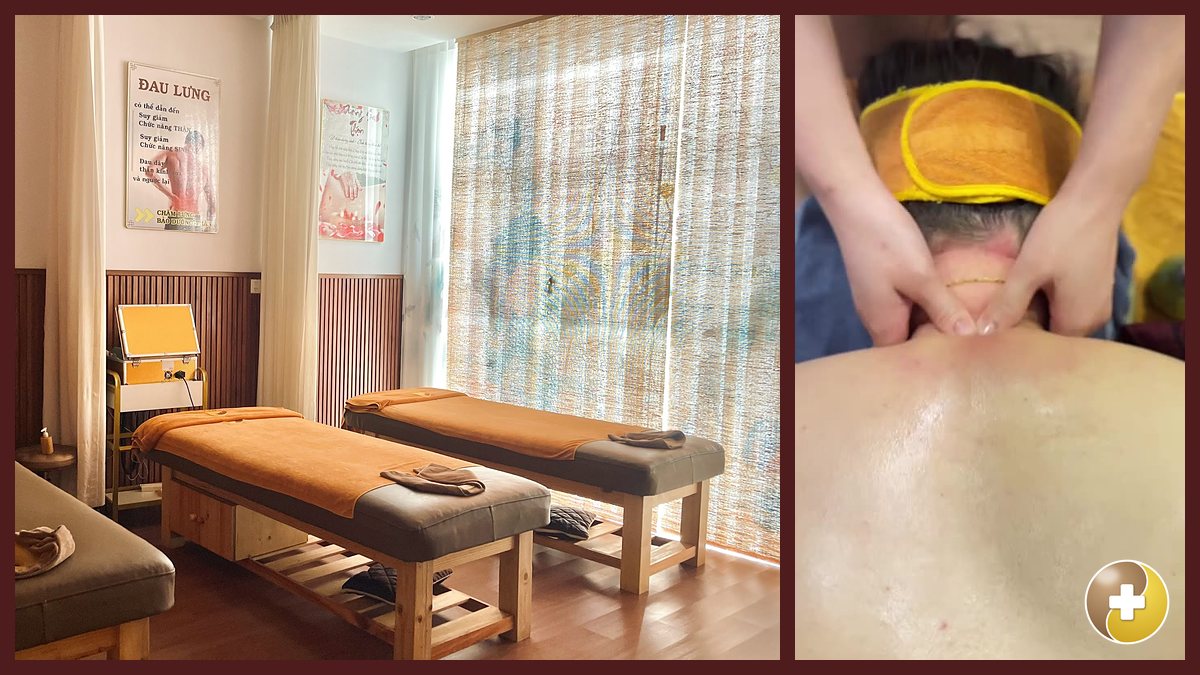
Quick answer: A stiff neck and headaches during late-night exam study usually come from hours bent over a laptop at a low desk, neck muscles holding the head forward, short sleep and a lot of coffee. Take a 5-minute break every 30–45 minutes, tuck your chin, look far away, and sleep before 1 a.m. In Ho Chi Minh City, Tong Gia Acupoint Wellness releases the neck and shoulders and applies head acupressure.
Want Lương Y Tống Văn Huynh’s team to read your spine and posture in person?
Why late-night exam study brings a stiff neck and headaches
It is midnight in a one-room studio in Sinchon, Seoul, or near a university in Busan. The desk is a low folding table on a heated floor, the laptop sits at knee height, and next to it is the third iced coffee of the day and a stack of TOPIK II practice papers. In Tokyo, Osaka or Fukuoka, a language-school student finishes a convenience-store shift at 10 p.m., goes back to a tiny 1K apartment with room for one low table, and opens the JLPT N2 workbook until 2 a.m. In final-exam week, many students camp in the library or a 24-hour study café. Then one morning the neck will not turn, the back of the neck feels pulled tight, and an ache climbs from the base of the skull to the crown and out to the temples. Reading for a while brings a dull pain behind the eyes.
In Western terms this is usually three things stacked together. First, a tension-type headache: the suboccipital muscles, upper trapezius, levator scapulae, temple and forehead muscles stay contracted for hours, giving that tight-band feeling around the head. Second, a headache that starts in the neck: with the head bent and pushed forward for hours, the neck muscles carry far more load than usual. The greater and lesser occipital nerves, which come from the C2–C3 roots, pass through these muscles to the scalp, and tight muscle can irritate them, sending pain from the back of the head up to the crown or behind the eyes. Pain signals from the upper neck and the face meet in the same area of the brainstem, so the source is in the neck while the ache is felt around the eyes and forehead. Third, a posture-related stiff neck: a muscle held at one length too long tires, shortens and loses circulation, so you wake with a neck that feels "locked".
On top of all this sits short sleep and exam stress. Lack of sleep lowers pain tolerance, so the same muscle tension hurts more. Stress lifts the shoulders, clenches the jaw and furrows the brow without you noticing. This pattern is common in:
- Language-school students preparing for TOPIK, JLPT or EJU while working part-time in the evening.
- University and graduate students writing reports and theses on a laptop from afternoon to almost dawn.
- Students who work late shifts at convenience stores, restaurants or warehouses and study afterwards.
- Anyone studying on a phone or tablet on the subway, head bent the whole ride.
- Students used to sitting on the floor, leaning against the bed with books on their lap.
This guide is for Vietnamese and international students in Korea and Japan during exam season, and for families in Ho Chi Minh City waiting for them to come home for Tết. If your problem is night-shift eye strain, read headache and eye strain on night shifts; for the whole spine after the flight home, see our main guide on spine care after a long-haul flight.
Common causes: low desks, laptops, coffee and part-time work
- Low desks and floor sitting: small rooms in Korea and Japan often mean a low folding table and a floor cushion. The back rounds, the head drops and the eyes look almost straight down. An adult head weighs roughly 4.5–5.5 kg, and the further it tips, the harder the neck muscles work.
- A laptop screen set too low: the screen is attached to the keyboard, so it always sits well below eye level. The chin juts forward, the upper neck folds back and the lower neck bends down, keeping the suboccipital muscles short all evening.
- Late nights and irregular sleep: asleep at 3 a.m., up at 8 a.m. for class, catching up until noon at the weekend. The body clock drifts, sleep stays shallow, and muscles never fully recover.
- Coffee and energy drinks: several cups to stay awake, some close to bedtime, then a caffeine-withdrawal headache on the day you skip it. Instant noodles, rushed meals and skipped breakfasts add to it.
- Working before studying: hours at a till, carrying trays or stacking shelves tire the shoulders before you even sit down to study.
- Cold, dry winters: December finals and the December JLPT fall in the cold season. A bare neck in cold wind tightens, heated rooms dry you out, and sleeping on an ondol floor or near a heater can leave the neck stiff and the throat dry.
- The phone in bed: lying on one side with a high pillow, scrolling for an hour after studying.
- Exam pressure and homesickness: fear of failing, visa renewals, tuition worries. Stress shows up as raised shoulders, a tight jaw and shallow breathing.
- Old glasses: an outdated prescription makes the eyes work harder on small print, and the brow and forehead tense with them.
The tight-band type of headache is explained further in tension headache that feels like a tight band.
Related signs to watch for
- Ache at the base of the skull and both sides of the neck, tender at the hairline, sometimes spreading to the crown: suboccipitals and the C1–C3 area.
- Pain turning the head one way, a "locked" neck in the morning: sternocleidomastoid and levator scapulae.
- A tight-hat feeling and pressure at the temples, a tired jaw: temple and jaw muscles, often with night-time clenching.
- Dry, tired eyes and brief blurring after long screen time.
- Heavy shoulders, an ache between the shoulder blades, brief tingling in the fingers after long typing: C5–C7 and the upper back.
- Trouble falling asleep despite exhaustion, vivid dreams, poor memory for what you just studied.
- Poor appetite, bloating and a racing heart after too much coffee.
In the Tong Gia curriculum, pain shows in one place while its source often sits in another: a temple ache may begin in the neck, a stiff neck may begin with sleep, and stress makes all of it worse.
When to see a doctor
Most tension headaches and posture-related stiff necks ease with rest, sleep and a better desk set-up. With any of the following, please see a doctor at a medical facility and do not rely on massage. The ambulance number is 119 in Korea and Japan, and 115 in Vietnam.
- A sudden, severe "thunderclap" headache that peaks within a minute: call an ambulance.
- Headache with high fever, a neck too stiff to bring your chin to your chest, a rash or sensitivity to light: go to emergency care now, as meningitis must be ruled out, especially in shared dormitories.
- Headache with blurred or double vision, repeated vomiting, confusion or a seizure.
- A drooping face, slurred speech, weakness or numbness on one side, unsteady walking.
- Neck pain or stiffness after a fall, a knock to the head, a cycling or skiing accident.
- Lasting numbness or weakness in an arm, dropping things, or electric pain running down the arm.
- Chest pain, breathlessness, cold sweats, pain spreading to the left arm or jaw, or a very fast heartbeat after energy drinks: call 119 or 115 now.
- Headaches that worsen week by week, wake you at night, or flare with coughing or straining.
- After the flight home, one calf swollen, warm and painful, or sudden breathlessness: this can be a clot; get checked and do not have your legs massaged.
Long-lasting fatigue, pale skin, unexplained weight loss, or low mood for weeks deserve a check-up alongside any wellness care; universities in Korea and Japan have health centres and student counselling. In Korea, neck pain usually goes to orthopaedics (정형외과) and headaches to neurology (신경과); in Japan, 整形外科 for the neck and 脳神経外科 or 神経内科 for headaches. Tong Gia does not read X-rays, CT or MRI scans and does not make medical plans; bring any results so staff know which areas to keep gentle. This is a wellness service, not medical care.
The Y Tướng Học view: worry weighs on the Spleen, late nights drain the Liver
Y Tướng Học (face reading for wellness) rests on one line: the signs show outside, the organs lie inside. Lương Y (traditional practitioner) Tống Văn Huynh organised this knowledge so staff read the face before they touch the neck. For students with a stiff neck and headaches, three areas are checked: Spleen and Heart, Liver and Gallbladder, and Kidney.
Spleen and Heart: "worry harms the Spleen". The Tong Gia curriculum states that overthinking harms the Spleen, bringing poor appetite and bloating. The Spleen makes blood and the Heart governs it, so heavy worry strains both: poor appetite, poor sleep, palpitations and forgetfulness. That is exam week in a sentence. The Spleen also governs the muscles and limbs; when it is weak, muscles tire quickly and the neck cannot hold the head for long. It shows at the mouth and lips, so staff look at whether the lips are pale or rosy.
Liver and Gallbladder: late nights, eyes and tendons. The Liver opens into the eyes and stores blood; at rest, blood returns to the Liver to be replenished. Studying until 2 or 3 a.m. night after night means, in this framework, that blood does not return in time, so the eyes dry out and tendons and muscles tighten. The Liver governs the tendons, and a rigid neck is one of the clearest places this shows. Liver fire easily stirs Heart fire: restlessness, irritability, poor sleep. The Gallbladder channel, paired with the Liver, is described as easing pain in the head and neck-shoulder area; out of balance it shows as headaches on the sides of the head and shoulder ache.
Kidney: the brain as the "sea of marrow". The curriculum notes that when Kidney essence is lacking, the "sea of marrow" runs low: nervous exhaustion, headaches, dizziness, very light sleep and early memory decline, often with deep tightness at the base of the skull affecting C1–C3.
Faces and complexion often seen (observation for wellness, not fortune-telling): a "Giáp" face (broad forehead, narrow pointed chin), described as quick and imaginative but prone to worry, with "excess above, weakness below": headaches and poor sleep above, tired knees below, and a warm, reactive C1–C2 area; a young forehead already full of tangled lines and a furrowed brow, which the curriculum links to tight forehead, scalp and shoulder-lifting muscles; a narrow point between the brows with vertical lines, linked to deep stress and frequent sighing; a flat back of the skull; dull skin, dark circles, pale dry lips.
Vertebrae and nerve-reflex areas involved
In the Tong Gia curriculum on spinal nerve-reflex balancing, the cervical vertebrae C1–C7 govern the head, face, neck and arms. Nerve roots leave the spine between the vertebrae, which is where the practitioner's fingertips read.
| Vertebrae | Nerves / function (anatomy) | Typical signs during exam season | Organ (Eastern view) | Face sign (Y Tướng Học) |
|---|---|---|---|---|
| C1–C2 | Suboccipital muscles; greater occipital nerve from C2 to the scalp | Ache at the base of the skull spreading to the crown or behind the eyes | Kidney, Liver | "Giáp" face, warm C1–C2; flat back of skull |
| C2–C3 | Lesser and third occipital nerves; upper-neck pain converges with the face | Pain behind the ears, tight temples, ache around the eyes | Liver–Gallbladder | Furrowed brow, vertical lines between brows |
| C3–C4 | Cervical plexus; sternocleidomastoid, upper trapezius, levator scapulae | Painful turning, a "locked" neck in the morning | Liver governs tendons | Tangled forehead lines at a young age |
| C5–C7 | Nerve roots to the shoulders, arms and hands | Heavy shoulders, finger tingling after typing | Liver, Spleen | Head pushed forward, uneven shoulders |
| D1–D3 | Sympathetic fibres to the head and face; breathing, heart rate | Shallow breathing, palpitations with coffee, trouble relaxing | Heart, Lung | Narrow area between brows, sighing |
| D9–D11 | Intercostal nerves, upper abdomen | Poor appetite, bloating in exam week | Liver–Spleen | Pale dry lips, dull complexion |
| Sacral area | Sacral nerves; lower end of the spinal axis | Low-back ache, numb buttocks after floor sitting | Kidney | Cool, hollow low back |
The table lists areas to examine, not causes. The curriculum groups chronic headache and long-term poor sleep with C1–C7, D1–D3 and the sacral area, and neck pain with C5–C7, L1–L5 and S1–S5, so the whole spine is read, not only the neck. See also neck and shoulder massage.
How Tong Gia helps rebalance the neck, head and sleep
Every session follows the spinal nerve-reflex balancing massage developed by Lương Y Tống Văn Huynh, founder of Tong Gia Acupoint Wellness (Huyệt Đạo Tống Gia), with over 13 years in Vietnamese traditional wellness, Y Tướng Học and spinal nerve-reflex balancing. It is a Vietnamese hands-on method; the aim is to help rebalance the neck and upper back and support Spleen and Liver function in Eastern terms. You are welcome to try it when you are in Ho Chi Minh City.
- Questions and observation: where you study, which exams, hours of sleep, low desk or chair, laptop time, part-time work, coffee, where it aches, any arm tingling or dizziness; then head posture, shoulder height, complexion, eyes, lips, forehead and the back of the skull.
- Reading the spine by hand: from C1 down to the sacrum, staff read four signs from the Tong Gia curriculum: skin temperature, the muscle layer, vertebral shape (raised, raised-shifted, shifted, sunken-shifted, sunken) and sensation. Overactive zones (warmer skin, tight muscle, more pain) get the focus; underactive zones are not worked directly.
- Muscle release: suboccipitals, upper trapezius, levator scapulae, a very light touch on the sternocleidomastoid, temples, forehead and the upper back between the shoulder blades, with five pressure levels from light to firm.
- Acupressure: Bách hội at the crown, described in the curriculum as clearing the head and calming the mind; Can du and Tỳ du on the back; Nội quan on the wrist for tension and Thần môn for sleep; Thái Xung on the foot for stress, poor sleep and headache. Work stops once the skin at the key point turns from dry to slightly moist.
- Self-care: a 5-minute study-break routine and a desk set-up for the next semester.
A typical session: a student back home a few days after exams, still falling asleep at 2 a.m. Staff notice the chin pushed forward, the right shoulder higher, dark circles. On the spine, the C1–C2 skin is warmer and the right suboccipital band is hard; the upper back is tender. Most of the hour goes to the neck, shoulders and upper back, with gentle fingertip work on the head. You will usually feel tender spots at the hairline, temples and the inner edge of the shoulder blades. As the muscles let go, the neck turns more easily, the head feels lighter and many people drift off. Some sleep early and deeply that night; some feel mild soreness for a day first. We do not promise the pain will be gone after one session.
Suitable services:
- Neck and shoulder care, 60 minutes: 550,000 VND (about 21 USD), first visit 399,000 VND (about 15 USD).
- Hair wash with neck and shoulder massage, 60 minutes: 250,000 VND (about 10 USD), a relaxing Vietnamese head spa for the days after exams.
- Head care, 60 minutes: 750,000 VND (about 29 USD), when headache, temple tension and poor sleep come first.
Reference rate 1 USD ≈ 26,000 VND; payment is in VND. Full list on the price page; the hair wash is described on Vietnamese head spa.
From Tân Sơn Nhất airport: the District 12 branch (225 Dương Thị Mười, Phường Tân Chánh Hiệp) lies north of the airport and is usually a short drive, depending on traffic. The Vinhomes Grand Park branch (Căn T16-21 khu Manhattan, Phường Long Bình, TP. Thủ Đức) is farther and takes longer, especially in the evening rush. See massage near Tân Sơn Nhất airport.
Want Lương Y Tống Văn Huynh’s team to read your spine and posture in person?
A 5-minute study-break routine and a better desk
Set a timer for every 30–45 minutes of study and do this:
- Stand and tuck your chin (1 minute): draw the chin straight back into a "double chin", hold 5 seconds, 8–10 times.
- Roll and tilt (1 minute): roll the shoulders back 10 times; tilt one ear towards the shoulder and hold 15 seconds each side without pulling.
- Look far (1 minute): find a point several metres away for 20 seconds, blink slowly ten times, then cup warm palms over closed eyes for 30 seconds.
- Circle the hairline and temples (1 minute) with your fingertips; press Nội quan on each wrist when you feel tense.
- Slow breathing (1 minute): the Tong Gia curriculum suggests a 4–6 rhythm, in through the nose for about 4 seconds and out for about 6. Sip warm water before you sit back down.
Desk set-up: use a desk and a chair with a backrest if you can; on a low table, sit on a firm cushion so hips are above knees and lean against a wall. Raise the laptop on books or a stand so the top of the screen is at eye level, and add a separate keyboard and mouse, which are inexpensive at 100-yen shops or Daiso. Prop books on a stand and hold your phone up at eye level.
Sleep and food: set a "books closed" time and aim to sleep before 1 a.m., waking at the same hour each day; 6–7 hours helps memory more than three all-nighters. Keep coffee before 3 p.m. and to 2–3 cups, eat breakfast, and wear a scarf over the neck outdoors in winter. Before bed, put the phone away, press Thần môn on each wrist for 1–2 minutes as the curriculum suggests, and soak your feet in warm water for 10–15 minutes. If unfamiliar beds also stiffen your neck, read stiff neck from unfamiliar beds on trips home.
A suggested plan for the trip home after exams
Direct flights from Incheon to Tân Sơn Nhất take about 5–6 hours; from Narita, Haneda, Kansai or Fukuoka about 6 hours. Vietnam is 2 hours behind Korea and Japan, so jet lag is mild; the real issue is weeks of late nights and a bent neck. Korean winter break usually runs from late December to the end of February; many Japanese universities hold finals in late January or early February before spring break.
| When | What the neck and head need | What to do |
|---|---|---|
| Exam week | No build-up of stiffness | 5-minute break every 30–45 minutes; sleep before 1 a.m.; message us to book for your arrival |
| Night before the flight | Recovery after exams | One long sleep; pack the day before instead of staying up |
| Flight day | No extra neck bending | U-shaped pillow, limit phone time, walk the aisle, sip water |
| Arrival day | Rest and adjust to the heat | Home-cooked meal, morning sun next day, bed before 11 p.m. |
| Days 2–3 | Release the neck and shoulders | Neck and shoulder care, 60 minutes (first visit 399,000 VND) |
| Tết family visits | Gentle relaxation, regular sleep | Hair wash with neck and shoulder massage; fewer late-night films and games |
| If headaches continue | Release the head and skull base | Head care, 60 minutes, a few days after the neck session |
| 2–3 days before going back | Prepare for the new semester | Buy a laptop stand and keyboard; read a 7-day wellness plan for a Tết visit |
If the flight itself leaves your neck stiff, see stiff neck after a long flight.
Book from Korea or Japan before you fly
Message us from Seoul, Busan, Tokyo or Osaka, even right after your last exam. Call, Zalo or WhatsApp +84 888 264 559 (0888 264 559 in Vietnam) with your landing date and time, where it aches (back of the head, temples, neck, shoulders or between the shoulder blades) and which branch you prefer. Mention how many hours you sleep and study so staff can suggest the right session. Parents in Ho Chi Minh City can book for you. You can also book online or read how to book a massage in Saigon from abroad.
- District 12 branch: 225 Dương Thị Mười, Phường Tân Chánh Hiệp (Tan Chanh Hiep Ward), Ho Chi Minh City. Open 8:00–19:00 daily (10:00–21:00 Korea and Japan time).
- Vinhomes Grand Park branch: Căn T16-21 khu Manhattan, Vinhomes Grand Park, Phường Long Bình, TP. Thủ Đức (Thu Duc City). Open 9:00–20:00 daily (11:00–22:00 Korea and Japan time).
Slots fill up before Tết, so message early. Real customer reviews are on Google Maps on each branch page.
Visit us
- Đông Y Huyệt Đạo Tống Gia Quận 12 (District 12)
225 Dương Thị Mười, Phường Tân Chánh Hiệp, Quận 12, HCMC · 8:00–19:00 daily · 0888 264 559 · Directions on Google Maps - Đông Y Huyệt Đạo Tống Gia Quận 9 (Vinhomes Grand Park, District 9)
Căn T16-21 khu Manhattan, Vinhomes Grand Park, Phường Long Bình, TP. Thủ Đức, HCMC · 9:00–20:00 daily · 0888 264 559 · Directions on Google Maps
Map of our two branches
Want Lương Y Tống Văn Huynh’s team to read your spine and posture in person?
What guests say on Google Maps
“I often get neck and shoulder aches, and a friend recommended this place. Anyone who often has aches can come and give it a try.” (translated from a Vietnamese review)
— Trang H., Google Maps review · Vinhomes Grand Park branch (District 9) · 02/2026 · See on Google Maps
“Lovely, attentive staff, a relaxing comfortable space, and the herbal hair wash was great.” (translated from a Vietnamese review)
— Thanh T., Google Maps review · Vinhomes Grand Park branch (District 9) · 2025 · See on Google Maps
Quoted from public reviews, shortened where marked (…). Experiences vary from person to person; reviews are not a substitute for seeing a doctor when something feels wrong.
Related guides for your trip
- Frequent-Flying Parcel Couriers With Heavy Suitcases: Sore Shoulders, Aching Back and Poor Sleep
- Fatigue from cleanroom suits on long shifts: heat, heavy shoulders and back, dry skin in chip plants
- Acupressure points for sleep on rotating shifts: which points to press, how to press safely, and sleep habits
FAQ
Is a stiff neck and headache from studying late for exams serious? Usually it is tension headache and posture-related stiffness from hours bent over a laptop or books at a low desk, plus short sleep and exam stress, and it eases with breaks, a better desk and enough sleep. A sudden severe headache, high fever with a neck too stiff to bend, blurred vision, repeated vomiting or one-sided weakness needs emergency care: 119 in Korea or Japan, 115 in Vietnam.
I study late in Seoul and wake up with a neck I can't turn. What is it? Most often the sternocleidomastoid, levator scapulae and suboccipital muscles have tightened after hours of looking down, then a high pillow or scrolling in bed. Use gentle warmth, slow shoulder rolls and chin tucks, and do not crack the neck. If pain runs down the arm, the arm feels weak, or stiffness comes with fever, get checked.
What helps a headache at the back of the head while studying for JLPT or TOPIK? Every 30–45 minutes, take 5 minutes: stand, tuck the chin, roll the shoulders, look far away, rub the hairline and breathe slowly in a 4–6 rhythm. Raise the laptop to eye level, drink water, keep coffee before 3 p.m. and sleep before 1 a.m. Headaches that worsen week by week or wake you need a check-up.
Can too much coffee during exams cause headaches? It can. Coffee late in the day makes sleep shallow, short sleep makes headaches worse, and skipping coffee after heavy use brings a withdrawal headache. Keep to 2–3 cups before 3 p.m. and cut down gradually after exams. A very fast heartbeat or chest pain after energy drinks needs emergency help.
Does massage help a stiff neck and headaches from studying? Wellness massage relaxes the suboccipital, trapezius and shoulder-lifting muscles and the upper back, and many people find the neck turns more easily and sleep comes sooner. At Tong Gia Acupoint Wellness, staff read the spine by hand before releasing muscles and applying acupressure. It does not replace a medical check when warning signs appear, and results also depend on changing how you sit.
Coming home to Vietnam after exams: neck and shoulder care or a hair wash? For a stiff neck and heavy shoulders, choose neck and shoulder care, 60 minutes (550,000 VND, about 21 USD; first visit 399,000 VND), ideally on day 2 or 3. For gentle relaxation during family visits, the hair wash with neck and shoulder massage, 60 minutes (250,000 VND, about 10 USD). Message +84 888 264 559 with your landing time and preferred branch.
Author: Lương Y Tống Văn Huynh – founder of Huyệt Đạo Tống Gia, a master of traditional Vietnamese wellness with over 13 years in Eastern wellness care, Y Tướng Học (face reading) and spinal nerve-reflex balancing massage.
Updated: 2026-11-16
Related guides
- Elbow and shoulder pain from golf and pickleball: why it builds after 55 and how to care for it in Vietnam
- Stiff neck and headaches from studying late for exams: why low desks and laptops strain the neck
- Working US hours remotely from Vietnam: neck and shoulder pain, night calls and day sleep on a long visit home
- Stiff neck from unfamiliar beds on trips home: why it happens, how to fix the pillow and when to get checked
- Neck and shoulder pain from factory shifts in Japan: causes, Japanese phrases and care on your trip home
This is a wellness service, not medical care.